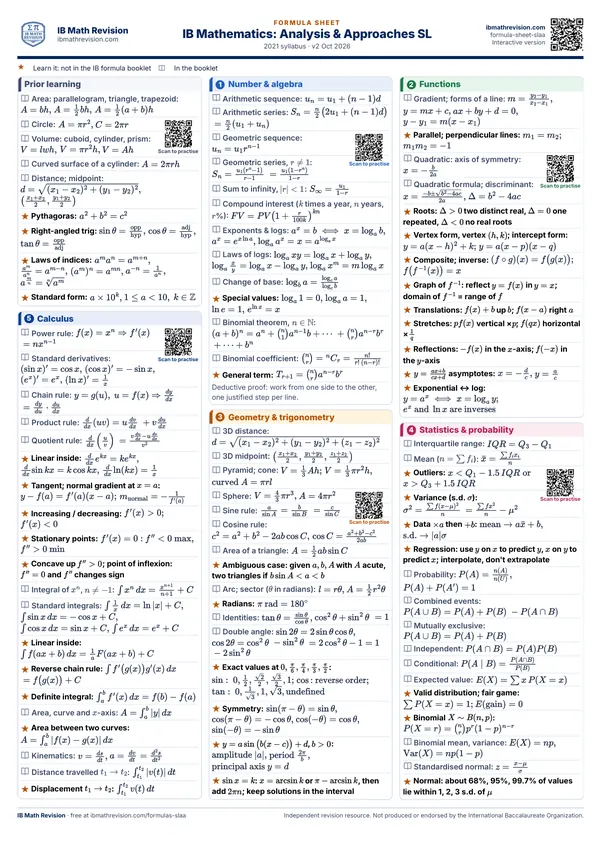
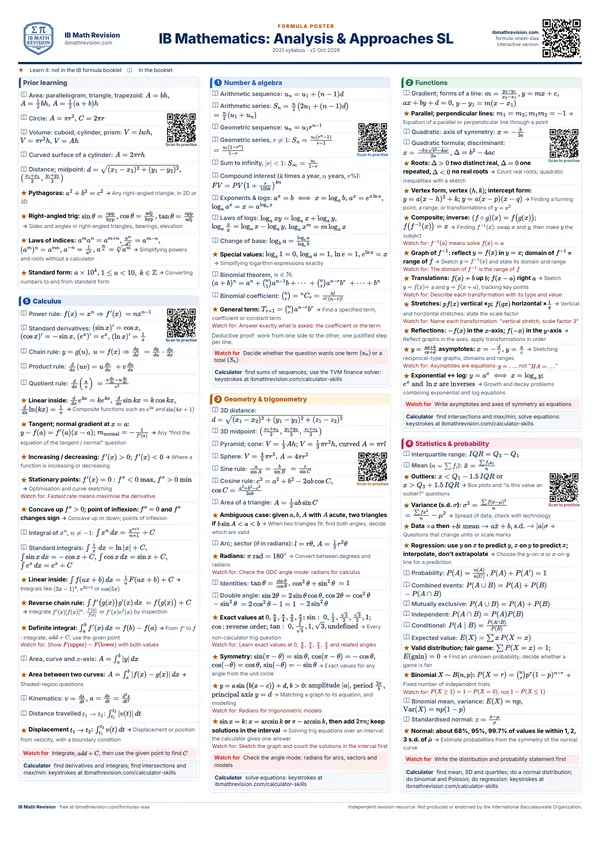
Every formula you need for Analysis & Approaches SL on one A4 page. Formulas marked ★ are not in the IB AA SL formula booklet, so learn those; the rest are printed in the booklet, and knowing them saves exam time.
Tick what you know: 0 of 88 (saved on this device). Tap a formula to copy its LaTeX.
No formulas match. Clear the search or pick another topic.
IB Math Revisionibmathrevision.com
IB Mathematics: Analysis & Approaches SLOne-page formula sheet · booklet formulas + ★ the ones you must learn
★ Learn it: not in the IB formula booklet. In the booklet (its notation may differ slightly).
Prior learning
Area: parallelogram, triangle, trapezoid:\(A=bh,\)\(A=\tfrac12bh,\)\(A=\tfrac12(a+b)h\)Use: Areas of composite shapes
Circle:\(A=\pi r^2,\)\(C=2\pi r\)Use: Circles, sectors, cylinders and compound shapes
Volume: cuboid, cylinder, prism:\(V=lwh,\)\(V=\pi r^2h,\)\(V=Ah\)Use: Volume and surface area of prisms and composite solids
Curved surface of a cylinder:\(A=2\pi rh\)Use: Surface area of composite solids, with units
Distance; midpoint:\(d=\sqrt{(x_1-x_2)^2+(y_1-y_2)^2},\)\(\left(\tfrac{x_1+x_2}{2},\tfrac{y_1+y_2}{2}\right)\)Use: Distance between two points; midpoint of a segment
★Pythagoras:\(a^2+b^2=c^2\)Use: Any right-angled triangle, in 2D or 3D
★Right-angled trig:\(\sin\theta=\tfrac{\text{opp}}{\text{hyp}},\)\(\cos\theta=\tfrac{\text{adj}}{\text{hyp}},\)\(\tan\theta=\tfrac{\text{opp}}{\text{adj}}\)Use: Sides and angles in right-angled triangles, bearings, elevation
★Laws of indices:\(a^ma^n=a^{m+n},\)\(\tfrac{a^m}{a^n}=a^{m-n},\)\((a^m)^n=a^{mn},\)\(a^{-n}=\tfrac1{a^n},\)\(a^{\frac mn}=\sqrt[n]{a^m}\)Use: Simplifying powers and roots without a calculator
★Standard form:\(a\times10^k,\)\(1\le a<10,\ k\in\mathbb Z\)Use: Converting numbers to and from standard form
1 Number & algebra
Arithmetic sequence:\(u_n=u_1+(n-1)d\)Use: Find a term, the first term or the number of termsWatch for: Term or sum? Decide whether you need one term \((u_{n})\) or a total \((S_{n})\)
Arithmetic series:\(S_n=\tfrac n2\big(2u_1+(n-1)d\big)\)\({}=\tfrac n2(u_1+u_n)\)Use: Find sums and unknown termsWatch for: Label \(u_{1}\), \(u_{2}\), \(u_{3}\) first: \(n = 5\) is not the 6th term
Geometric sequence:\(u_n=u_1r^{n-1}\)Use: Find a term, the ratio, or which term first passes a value
Geometric series, \(r\ne1\):\(S_n=\frac{u_1(r^n-1)}{r-1}\)\({}=\frac{u_1(1-r^n)}{1-r}\)Use: Solving for an unknown number of terms in context
Sum to infinity, \(|r|<1\):\(S_\infty=\frac{u_1}{1-r}\)Use: Only when the series converges: check \(|r| < 1\)
Exponents & logs:\(a^x=b\iff x=\log_ab,\)\(a^x=e^{x\ln a},\)\(\log_aa^x=x=a^{\log_ax}\)Use: Convert between \(a^{x} = b\) and \(x = \log_{a} b\)
Laws of logs:\(\log_axy=\log_ax+\log_ay,\)\(\log_a\tfrac xy=\log_ax-\log_ay,\)\(\log_ax^m=m\log_ax\)Use: Solve log equations, rejecting invalid solutionsWatch for: Rewrite logs with the laws before you transform a graph
Change of base:\(\log_ba=\frac{\log_ca}{\log_cb}\)Use: Equations such as \(\log_{2} x + \log_{2}(x - 2) = 3\)
Binomial theorem, \(n\in\mathbb N\):\((a+b)^n=a^n+\tbinom n1a^{n-1}b+\cdots\)\({}+\tbinom nra^{n-r}b^r\)\({}+\cdots+b^n\)Use: Expand \((a + b)^{n}\), writing out the first few termsWatch for: \((2x)^{6}\) is not \(2x^{6}\): brackets round every term
Binomial coefficient:\(\binom nr={}^nC_r=\frac{n!}{r!\,(n-r)!}\)Use: Calculate \({}^{n}\!C_{r}\) with and without technology
★General term:\(T_{r+1}=\binom nra^{n-r}b^r\)Use: Find a specified term, coefficient or constant termWatch for: Answer exactly what is asked: the coefficient or the term
Deductive proof: work from one side to the other, one justified step per line.
Watch for: Decide whether the question wants one term \((u_{n})\) or a total \((S_{n})\)
Gradient; forms of a line:\(m=\frac{y_2-y_1}{x_2-x_1},\)\(y=mx+c,\)\(ax+by+d=0,\)\(y-y_1=m(x-x_1)\)Use: Equation of a line in gradient-intercept, general or point-gradient form
★Parallel; perpendicular lines:\(m_1=m_2;\)\(m_1m_2=-1\)Use: Equation of a parallel or perpendicular line through a point
Quadratic: axis of symmetry:\(x=-\frac{b}{2a}\)Use: Sketching parabolas: vertex and axis of symmetryWatch for: Lines are equations: write \(x = \ldots\), not a number
Quadratic formula; discriminant:\(x=\frac{-b\pm\sqrt{b^2-4ac}}{2a},\)\(\Delta=b^2-4ac\)Use: Solve quadratics; count real roots with the discriminant
★Roots: \(\Delta>0\) two distinct real, \(\Delta=0\) one repeated, \(\Delta<0\) no real rootsUse: Count real roots; quadratic inequalities with a sketch
★Vertex form, vertex \((h,k)\); intercept form:\(y=a(x-h)^2+k;\)\(y=a(x-p)(x-q)\)Use: Finding a turning point, a range, or transformations of \(y = x^{2}\)
★Composite; inverse:\((f\circ g)(x)=f\big(g(x)\big);\)\(f\big(f^{-1}(x)\big)=x\)Use: Finding \(f^{-1}(x)\): swap \(x\) and \(y\), then make \(y\) the subjectWatch for: \(f^{-1}(a)\) means solve \(f(x) = a\)
★Graph of \(f^{-1}\): reflect \(y=f(x)\) in \(y=x\); domain of \(f^{-1}\) = range of \(f\)Use: Sketch \(y = f^{-1}(x)\) and state its domain and rangeWatch for: The domain of \(f^{-1}\) is the range of \(f\)
★Translations: \(f(x)+b\) up \(b\); \(f(x-a)\) right \(a\)Use: Sketch \(y = f(x) +\) a and \(y = f(x + a)\), tracking key pointsWatch for: Describe each transformation with its type and value
★Stretches: \(pf(x)\) vertical ×\(p\); \(f(qx)\) horizontal ×\(\tfrac1q\)Use: Vertical and horizontal stretches: state the scale factorWatch for: Name each transformation: "vertical stretch, scale factor 3"
★Reflections: \(-f(x)\) in the \(x\)-axis; \(f(-x)\) in the \(y\)-axisUse: Reflect graphs in the axes; apply transformations in order
★\(y=\frac{ax+b}{cx+d}\) asymptotes:\(x=-\frac dc,\)\(y=\frac ac\)Use: Sketching reciprocal-type graphs; domains and rangesWatch for: Asymptotes are equations: \(y = \ldots\), not "\(HA = \ldots\)"
★Exponential ↔ log:\(y=a^x\iff x=\log_ay;\)\(e^x\text{ and }\ln x\text{ are inverses}\)Use: Growth and decay problems combining exponential and log equations
Watch for: Write asymptotes and axes of symmetry as equations
3D distance:\(d=\sqrt{(x_1-x_2)^2+(y_1-y_2)^2+(z_1-z_2)^2}\)Use: Distance between two points in three dimensions
3D midpoint:\(\left(\tfrac{x_1+x_2}2,\tfrac{y_1+y_2}2,\tfrac{z_1+z_2}2\right)\)Use: Midpoint of a line segment in three dimensions
Pyramid; cone:\(V=\tfrac13Ah;\)\(V=\tfrac13\pi r^2h,\)\(\text{curved }A=\pi rl\)Use: Volume and surface area of pyramids and cones
Sphere:\(V=\tfrac43\pi r^3,\)\(A=4\pi r^2\)Use: Volume and surface area of spheres and composite solids
Sine rule:\(\frac{a}{\sin A}=\frac{b}{\sin B}\)\({}=\frac{c}{\sin C}\)Use: A side and its opposite angle are knownWatch for: Degrees for triangle problems given in degrees
Cosine rule:\(c^2=a^2+b^2-2ab\cos C,\)\(\cos C=\frac{a^2+b^2-c^2}{2ab}\)Use: Two sides and the included angle, or three sides
Area of a triangle:\(A=\tfrac12ab\sin C\)Use: Two sides and the included angle
★Ambiguous case: given \(a,b,A\) with \(A\) acute, two triangles if \(b\sin A<a<b\)Use: When two triangles fit: find both angles, decide which are valid
Arc; sector (\(\theta\) in radians):\(l=r\theta,\)\(A=\tfrac12r^2\theta\)Use: Arc lengths, sector perimeters, unknown radii or anglesWatch for: Radians in the arc and sector formulas, never degrees
★Radians:\(\pi\text{ rad}=180^\circ\)Use: Convert between degrees and radiansWatch for: Check the GDC angle mode: radians for calculus
Identities:\(\tan\theta=\frac{\sin\theta}{\cos\theta},\)\(\cos^2\theta+\sin^2\theta\)\({}=1\)Use: Solve equations such as \(\sin 2x = \cos x\) using identities
Double angle:\(\sin2\theta=2\sin\theta\cos\theta,\)\(\cos2\theta=\cos^2\theta\)\({}-\sin^2\theta\)\({}=2\cos^2\theta-1=1\)\({}-2\sin^2\theta\)Use: Equations and exact values with \(\sin 2x\) and \(\cos 2x\)
★Exact values at \(0,\frac\pi6,\frac\pi4,\frac\pi3,\frac\pi2\):\(\sin:\ 0,\tfrac12,\tfrac{\sqrt2}2,\tfrac{\sqrt3}2,1;\)\(\cos\text{: reverse order};\)\(\tan:\ 0,\tfrac1{\sqrt3},1,\sqrt3,\text{undefined}\)Use: Every non-calculator trig questionWatch for: Learn exact values at 0, \(\frac{\pi}{6}\), \(\frac{\pi}{4}\), \(\frac{\pi}{3}\), \(\frac{\pi}{2}\) and related angles
★Symmetry:\(\sin(\pi-\theta)=\sin\theta,\)\(\cos(\pi-\theta)=-\cos\theta,\)\(\cos(-\theta)=\cos\theta,\)\(\sin(-\theta)=-\sin\theta\)Use: Exact values for any angle from the unit circle
★\(y=a\sin\big(b(x-c)\big)+d\), \(b>0\):\(\text{amplitude }|a|,\)\(\text{period }\tfrac{2\pi}b,\)\(\text{principal axis }y=d\)Use: Matching a graph to its equation, and modellingWatch for: Radians for trigonometric models
★\(\sin x=k\): \(x=\arcsin k\) or \(\pi-\arcsin k\), then add \(2\pi n\); keep solutions in the intervalUse: Solving trig equations over an interval: the calculator gives one answerWatch for: Sketch the graph and count the solutions in the interval first
Watch for: Check the angle mode: radians for arcs, sectors and models
Interquartile range:\(IQR=Q_3-Q_1\)Use: Box plots; comparing distributionsWatch for: Use the GDC for quartiles on Paper 2
Mean (\(n=\sum f_i\)):\(\bar x=\frac{\sum f_ix_i}{n}\)Use: Mean of a frequency table; grouped data with midpoints
★Outliers:\(x<Q_1-1.5\,IQR\)\(\text{or}\)\(x>Q_3+1.5\,IQR\)Use: Box plots and "is this value an outlier?" questions
★Variance (s.d. \(\sigma\)):\(\sigma^2=\frac{\sum f(x-\mu)^2}{n}\)\({}=\frac{\sum fx^2}{n}-\mu^2\)Use: Spread of data; check with technology
★Data \(\times a\) then \(+b\):\(\text{mean}\to a\bar x+b,\)\(\text{s.d.}\to|a|\sigma\)Use: Questions that change units or scale marks
★Regression: use \(y\) on \(x\) to predict \(y\), \(x\) on \(y\) to predict \(x\); interpolate, don't extrapolateUse: Choose the \(y\)-on-\(x\) or \(x\)-on-\(y\) line for a prediction
Probability:\(P(A)=\frac{n(A)}{n(U)},\)\(P(A)+P(A')=1\)Use: Probabilities from sample spaces and Venn diagrams
Combined events:\(P(A\cup B)=P(A)+P(B)\)\({}-P(A\cap B)\)Use: Overlapping events: sample-space and Venn diagramsWatch for: A union is not an intersection: read which is asked
Mutually exclusive:\(P(A\cup B)=P(A)+P(B)\)Use: Decide whether events are mutually exclusive
Independent:\(P(A\cap B)=P(A)P(B)\)Use: Test whether events are independentWatch for: Only multiply when independence is given or proved
Conditional:\(P(A\mid B)=\frac{P(A\cap B)}{P(B)}\)Use: "Given that" questions with tables, Venn and tree diagramsWatch for: Write the events in context in the conditional formula
Expected value:\(E(X)=\sum x\,P(X=x)\)Use: Expected values for a discrete random variable
★Valid distribution; fair game:\(\sum P(X=x)=1;\)\(E(\text{gain})=0\)Use: Find an unknown probability; decide whether a game is fair
★Binomial \(X\sim B(n,p)\):\(P(X=r)=\binom nrp^r(1-p)^{n-r}\)Use: Fixed number of independent trialsWatch for: \(P(X \ge 1) = 1 - P(X = 0)\), not \(1 - P(X \le 1)\)
Binomial mean, variance:\(E(X)=np,\)\(\mathrm{Var}(X)=np(1-p)\)Use: Mean np and variance \(np(1 - p)\) of \(B(n, p)\)
Standardised normal:\(z=\frac{x-\mu}{\sigma}\)Use: Find an unknown mean or standard deviationWatch for: Solve for \(\mu\) and \(\sigma\) on the GDC
★Normal: about 68%, 95%, 99.7% of values lie within 1, 2, 3 s.d. of \(\mu\)Use: Estimate probabilities from the symmetry of the normal curve
Watch for: Write the distribution and probability statement first
Power rule:\(f(x)=x^n\Rightarrow f'(x)\)\({}=nx^{n-1}\)Use: Differentiate \(x^{n}\) after rewriting in index form
Standard derivatives:\((\sin x)'=\cos x,\)\((\cos x)'=-\sin x,\)\((e^x)'=e^x,\)\((\ln x)'=\tfrac1x\)Use: Every calculus question with exponentials, logs or trig
Chain rule:\(y=g(u),\ u=f(x)\Rightarrow\frac{dy}{dx}\)\({}=\frac{dy}{du}\cdot\frac{du}{dx}\)Use: Composite functions: identify the inner and outer functions
Product rule:\(\frac{d}{dx}(uv)=u\frac{dv}{dx}\)\({}+v\frac{du}{dx}\)Use: Differentiate products such as \(x^{2}e^{x}\), simplifying fully
Quotient rule:\(\frac{d}{dx}\Big(\frac uv\Big)\)\({}=\frac{v\frac{du}{dx}-u\frac{dv}{dx}}{v^2}\)Use: Differentiate quotients such as \(\sin x / x\)Watch for: A quotient-rule numerator needs brackets
★Linear inside:\(\tfrac{d}{dx}e^{kx}=ke^{kx},\)\(\tfrac{d}{dx}\sin kx=k\cos kx,\)\(\tfrac{d}{dx}\ln(kx)=\tfrac1x\)Use: Composite functions such as \(e^{2x}\) and \(\sin(4x + 1)\)
★Tangent; normal gradient at \(x=a\):\(y-f(a)=f'(a)(x-a);\)\(m_\text{normal}=-\frac{1}{f'(a)}\)Use: Any "find the equation of the tangent / normal" question
★Increasing / decreasing:\(f'(x)>0;\)\(f'(x)<0\)Use: Where a function is increasing or decreasing
★Stationary points:\(f'(x)=0:\)\(f''<0\text{ max},\)\(f''>0\text{ min}\)Use: Optimisation and curve sketchingWatch for: Fastest rate means maximise the derivative
★Concave up \(f''>0\); point of inflexion: \(f''=0\) and \(f''\) changes signUse: Concave up or down; points of inflexion
Integral of \(x^n\), \(n\ne-1\):\(\int x^n\,dx=\frac{x^{n+1}}{n+1}+C\)Use: Indefinite integrals of power terms, with the constant
Standard integrals:\(\int\tfrac1x\,dx=\ln|x|+C,\)\(\int\sin x\,dx=-\cos x+C,\)\(\int\cos x\,dx=\sin x+C,\)\(\int e^x\,dx=e^x+C\)Use: Integrate \(\sin x\), \(\cos x\), \(\frac{1}{x}\) and \(e^{x}\) with power termsWatch for: Integrating \(e^{kx}\) needs the \(\frac{1}{k}\); recognise \(\int \frac{1}{x}\,\mathrm{d}x = \ln x\)
★Linear inside:\(\int f(ax+b)\,dx=\tfrac1aF(ax+b)+C\)Use: Integrals like \((3x - 1)^{4}\), \(e^{2x+1}\) or \(\cos(5x)\)
★Reverse chain rule:\(\int f'\big(g(x)\big)g'(x)\,dx\)\({}=f\big(g(x)\big)+C\)Use: Integrate \(f'(x)[f(x)]^{n}\), \(\frac{f'(x)}{f(x)}\) or \(f'(x)e^{f}(x)\) by inspection
★Definite integral:\(\int_a^bf'(x)\,dx=f(b)-f(a)\)Use: From \(f'\) to \(f\): integrate, \(add + C\), use the given pointWatch for: Show \(F(\text{upper}) - F(\text{lower})\) with both values
Area, curve and \(x\)-axis:\(A=\int_a^b|y|\,dx\)Use: Areas above and below the \(x\)-axis: split at the roots
★Area between two curves:\(A=\int_a^b|f(x)-g(x)|\,dx\)Use: Shaded-region questions
Kinematics:\(v=\frac{ds}{dt},\)\(a=\frac{dv}{dt}=\frac{d^2s}{dt^2}\)Use: Move between displacement, velocity and accelerationWatch for: Speed is \(|v|\); change of direction means \(v = 0\)
Distance travelled \(t_1\to t_2\):\(\int_{t_1}^{t_2}|v(t)|\,dt\)Use: Total distance travelled when the particle changes directionWatch for: Distance is \(\int |v|\,\mathrm{d}t\), not \(\int v\,\mathrm{d}t\)
★Displacement \(t_1\to t_2\):\(\int_{t_1}^{t_2}v(t)\,dt\)Use: Displacement or position from velocity, with a boundary condition
Watch for: Integrate, \(add + C\), then use the given point to find \(C\)
Free to print for your classes. If you share it, please keep our name on it and credit “IB Math Revision (ibmathrevision.com)” with a link to this page.
IB Mathematics: Analysis & Approaches SL: the A4 sheetIB Mathematics: Analysis & Approaches SL: the A3 poster
Official booklet: the IB Mathematics: analysis and approaches SL formula booklet (IB DP Mathematics page). You get a clean copy in the exam.
Is this the official IB Mathematics: analysis and approaches SL formula booklet?
No. It is our own one-page summary, written independently by IB Math Revision. In every AA SL exam paper you get a clean copy of the official AA SL formula booklet, so use this sheet to learn where each formula is and which ones (★) you must know by heart.
Which formulas do I have to learn?
The 39 rows marked ★ (of 88 on the sheet) are not given in the exam, so learn them. Know the given ones well too: finding them quickly saves time.
How do I print it or read it on my phone?
Download the PDF: 1 page of A4 (600 KB), made to print on one sheet of paper. On a phone, this page shows the same formulas in one column, and the PDF has a bookmark for each section.
What other formats are there?
As well as the A4 sheet there is an A3 poster (it adds when to use each formula to learn, mistakes to watch for, and a QR code per topic that leads to practice), a print-friendly black and white A4 version, and a one-page sheet of only the formulas you must memorise. On this page you can also search, filter by topic, tick off the formulas you know and copy any formula as LaTeX.
Is it free?
Yes. Every PDF and this page are free to download and print, with no sign-up.
Make a free account: no card needed5 more practice questions on every topic with instant feedback, full worked answers on free questions, 3 AI-marked answers a week, free, and your streak and progress on any device.
IB Math Revision is independent and is not affiliated with, endorsed by or connected to the International Baccalaureate Organization. This work/product/service has been developed independently from and is not endorsed by the International Baccalaureate Organization. International Baccalaureate, Baccalauréat International, Bachillerato Internacional and IB are registered trademarks owned by the International Baccalaureate Organization.