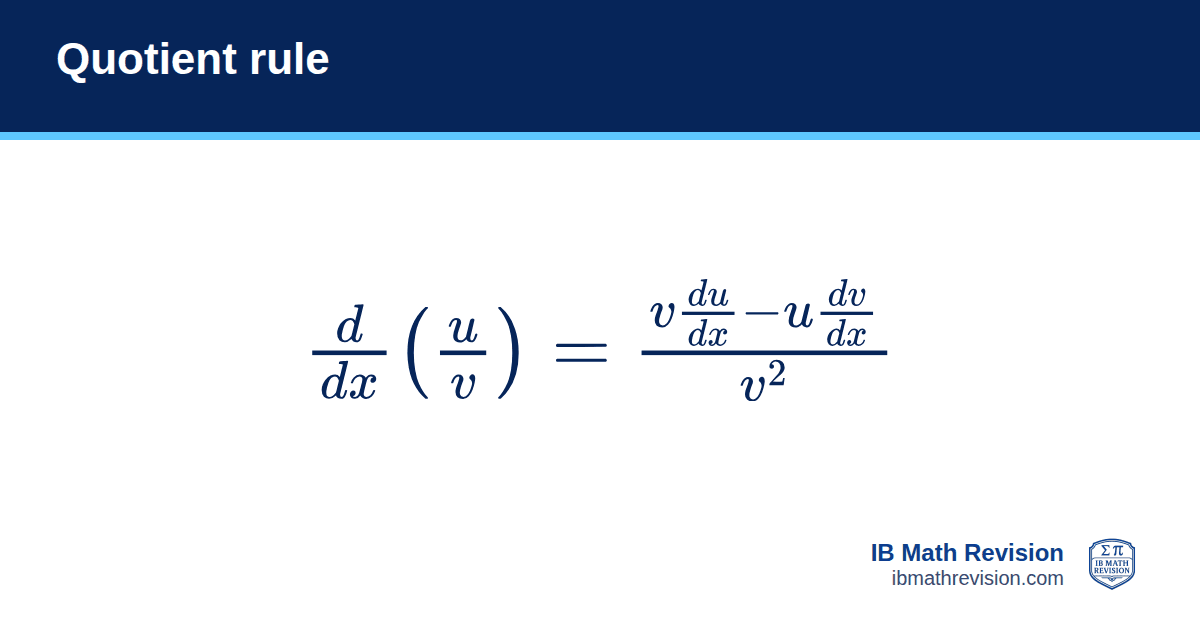
Quotient rule: d/dx (u/v) = (v u′ − u v′) / v²
The quotient rule is d/dx (u/v) = (v du/dx − u dv/dx) / v².
What each letter means
- \(u\) the top (numerator), a function of x
- \(v\) the bottom (denominator), a function of x
When to use it
To differentiate one function divided by another, such as (2x + 1)/(x − 3) or sin x / x.
Worked example
Differentiate \(y=\dfrac{2x+1}{x-3}\).
- \(u=2x+1,\ v=x-3\); \(u'=2,\ v'=1\)
- \(\dfrac{(x-3)(2)-(2x+1)(1)}{(x-3)^2}\)
Answer: \(\dfrac{dy}{dx}=\dfrac{-7}{(x-3)^2}\)
Common mistake
Swapping the order on top. It is v u′ − u v′; the other order flips the sign of the answer.
On your course
| Course | In the exam |
|---|---|
| AA SL | In the IB formula booklet |
| AA HL | In the IB formula booklet |
| AI HL | In the IB formula booklet |
From our own IB Maths formula sheets, in our words. The IB gives its booklet to schools, so we checked against our own copy: your teacher has the official one. Official: IB DP Mathematics page.
Practise and revise
- Practise AA SL rules of differentiation questions
- Practise AA HL advanced differentiation questions
- Revise Differentiation (AA SL)
- Revise Differentiation (AA HL)
- Print AA SL one-page formula sheet
Questions
What is the quotient rule formula?
The quotient rule is d/dx (u/v) = (v du/dx − u dv/dx) / v². u: the top (numerator), a function of x; v: the bottom (denominator), a function of x.
Is the quotient rule given in the exam?
AA SL: in the IB formula booklet. AA HL: in the IB formula booklet. AI HL: in the IB formula booklet. This comes from our own IB Maths formula sheets; your teacher has the official booklet.
Is there a way to remember the order?
Start with the bottom: 'v du minus u dv, all over v squared'.
Our own wording, examples and card, checked by IB Math Revision. Not produced or endorsed by the International Baccalaureate Organization.