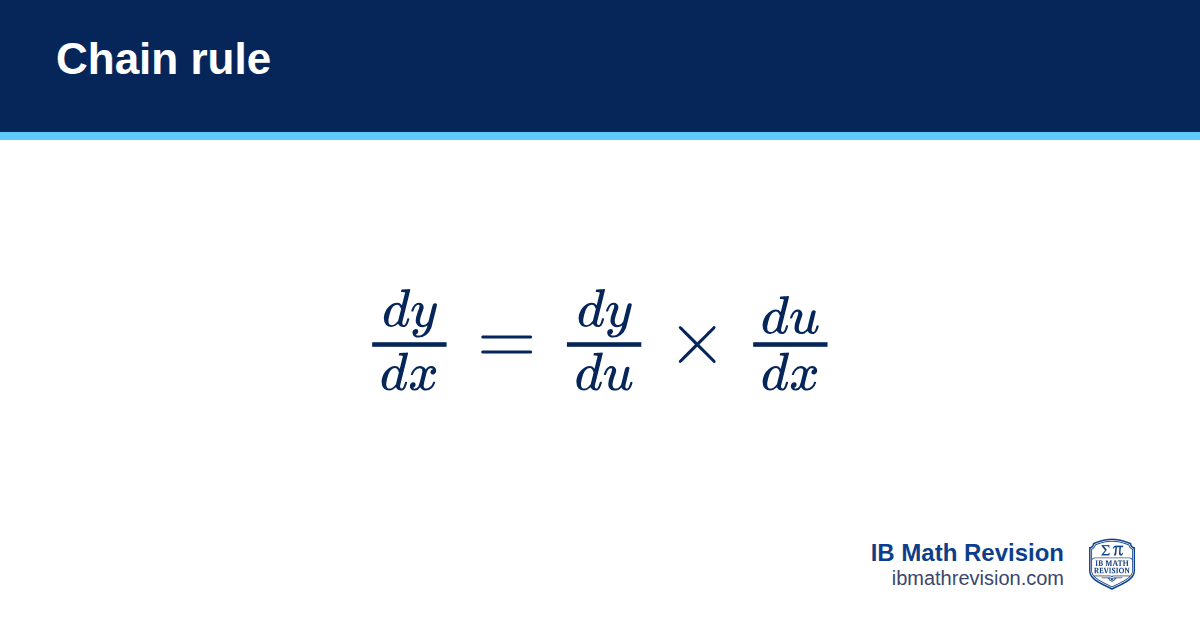
Chain rule: dy/dx = dy/du × du/dx
The chain rule is dy/dx = dy/du × du/dx.
What each letter means
- \(y\) a function of u
- \(u\) the inside function, a function of x
When to use it
To differentiate a function of a function: a bracket to a power, e to the power of an expression, sin or ln of an expression.
Worked example
Differentiate \(y=(3x^2+1)^5\).
- Let \(u=3x^2+1\), so \(y=u^5\)
- \(\dfrac{dy}{du}=5u^4\), \(\dfrac{du}{dx}=6x\)
Answer: \(\dfrac{dy}{dx}=30x(3x^2+1)^4\)
Common mistake
Forgetting to multiply by the derivative of the inside: d/dx (3x² + 1)⁵ is not just 5(3x² + 1)⁴.
On your course
| Course | In the exam |
|---|---|
| AA SL | In the IB formula booklet |
| AA HL | In the IB formula booklet |
| AI HL | In the IB formula booklet |
From our own IB Maths formula sheets, in our words. The IB gives its booklet to schools, so we checked against our own copy: your teacher has the official one. Official: IB DP Mathematics page.
Practise and revise
- Practise AA SL rules of differentiation questions
- Practise AA HL advanced differentiation questions
- Revise Differentiation (AA SL)
- Revise Differentiation (AA HL)
- Print AA SL one-page formula sheet
Questions
What is the chain rule formula?
The chain rule is dy/dx = dy/du × du/dx. y: a function of u; u: the inside function, a function of x.
Is the chain rule given in the exam?
AA SL: in the IB formula booklet. AA HL: in the IB formula booklet. AI HL: in the IB formula booklet. This comes from our own IB Maths formula sheets; your teacher has the official booklet.
How do I spot when to use the chain rule?
Look for one function inside another: a bracket raised to a power, eˢᵒᵐᵉᵗʰⁱⁿᵍ, sin(something) or ln(something), where the something is not just x.
Our own wording, examples and card, checked by IB Math Revision. Not produced or endorsed by the International Baccalaureate Organization.