IB Math Revisionibmathrevision.com
IB Mathematics: Analysis & Approaches HLOne-page formula sheet (SL + HL) · ★ = not in the booklet
★ Learn it: not in the IB formula booklet. In the booklet (its notation may differ slightly).
Prior learning
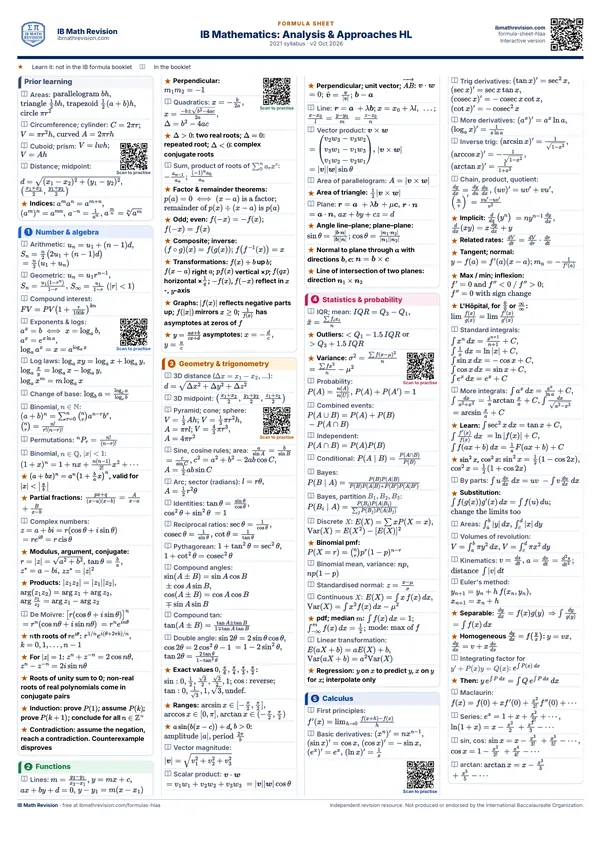
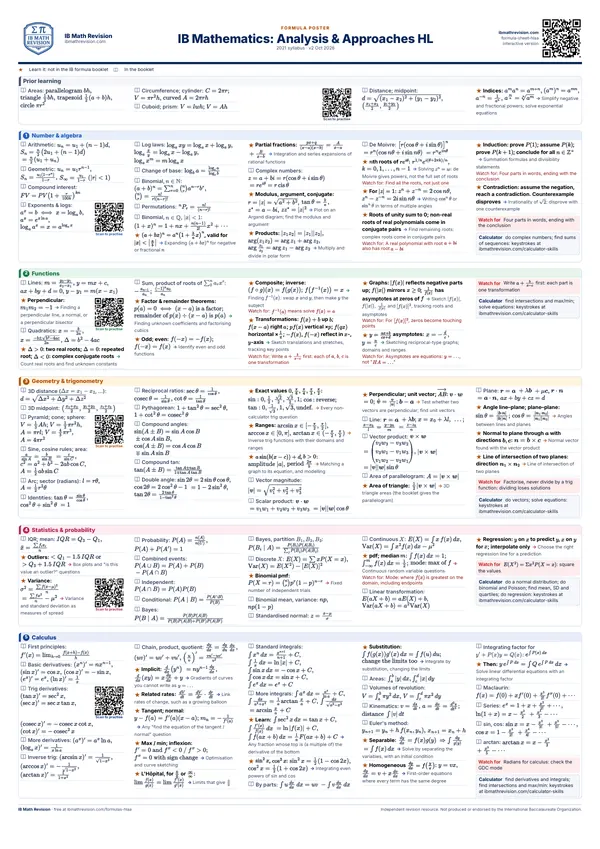
Areas: \(\text{parallelogram }bh,\) \(\text{triangle }\tfrac12bh,\) \(\text{trapezoid }\tfrac12(a+b)h,\) \(\text{circle }\pi r^2\)Use: Areas of composite shapes
Circumference; cylinder: \(C=2\pi r;\) \(V=\pi r^2h,\) \(\text{curved }A=2\pi rh\)Use: Circles, sectors, cylinders and compound shapes
Cuboid; prism: \(V=lwh;\) \(V=Ah\)Use: Volume and surface area of prisms and composite solids
★Indices: \(a^ma^n=a^{m+n},\) \((a^m)^n=a^{mn},\) \(a^{-n}=\tfrac1{a^n},\) \(a^{\frac mn}=\sqrt[n]{a^m}\)Use: Simplify negative and fractional powers; solve exponential equations
1 Number & algebra
Arithmetic: \(u_n=u_1+(n-1)d,\) \(S_n=\tfrac n2\big(2u_1+(n-1)d\big)\) \({}=\tfrac n2(u_1+u_n)\)Use: Find a term, the number of terms, or a sumWatch for: Decide whether you need one term \((u_{n})\) or a total \((S_{n})\)Explained: Arithmetic sequence · Sum of an arithmetic series
Geometric: \(u_n=u_1r^{n-1},\) \(S_n=\frac{u_1(1-r^n)}{1-r},\) \(S_\infty=\frac{u_1}{1-r}\ (|r|<1)\)Use: Sums, unknown ratios, and the sum to infinity when \(|r| < 1\)Explained: Geometric sequence · Sum of a geometric series · Sum to infinity of a geometric series
Compound interest: \(FV=PV\left(1+\tfrac{r}{100k}\right)^{kn}\)Use: Compound interest and depreciation; the finance solver
Exponents & logs: \(a^x=b\iff x=\log_ab,\) \(a^x=e^{x\ln a},\) \(\log_aa^x=x=a^{\log_ax}\)Use: Convert between \(a^{x} = b\) and \(x = \log_{a} b\)
Log laws: \(\log_axy=\log_ax+\log_ay,\) \(\log_a\tfrac xy=\log_ax-\log_ay,\) \(\log_ax^m=m\log_ax\)Use: Solve log equations, rejecting invalid solutionsWatch for: Logs of a sum do not split
Change of base: \(\log_ba=\frac{\log_ca}{\log_cb}\)Use: Equations such as \(\log_{2} x + \log_{2}(x - 2) = 3\)
Binomial, \(n\in\mathbb N\): \((a+b)^n=\sum_{r=0}^n\tbinom nra^{n-r}b^r,\) \(\tbinom nr=\frac{n!}{r!(n-r)!}\)Use: Expand \((a + b)^{n}\); use the general term for a coefficient
Permutations: \({}^nP_r=\frac{n!}{(n-r)!}\)Use: Arrangements with restrictions, such as items together
Binomial, \(n\in\mathbb Q\), \(|x|<1\): \((1+x)^n=1+nx+\frac{n(n-1)}{2!}x^2+\cdots\)Use: Expand \((1 + x)^{-1}\) or \((4 - x)^{\frac{1}{2}}\) as infinite series
★\((a+bx)^n=a^n\left(1+\tfrac bax\right)^n\), valid for \(|x|<\left|\tfrac ab\right|\)Use: Expanding \((a + bx)^{n}\) for negative or fractional \(n\)
★Partial fractions: \(\frac{px+q}{(x-a)(x-b)}=\frac{A}{x-a}\) \({}+\frac{B}{x-b}\)Use: Integration and series expansions of rational functions
Complex numbers: \(z=a+bi=r(\cos\theta+i\sin\theta)\) \({}=re^{i\theta}=r\,\mathrm{cis}\,\theta\)Use: Convert between Cartesian and polar forms
★Modulus, argument, conjugate: \(r=|z|=\sqrt{a^2+b^2},\) \(\tan\theta=\tfrac ba,\) \(z^*=a-bi,\) \(zz^*=|z|^2\)Use: Plot on an Argand diagram; find the modulus and argument
★Products: \(|z_1z_2|=|z_1||z_2|,\) \(\arg(z_1z_2)=\arg z_1+\arg z_2,\) \(\arg\tfrac{z_1}{z_2}=\arg z_1-\arg z_2\)Use: Multiply and divide in polar form
De Moivre: \(\big[r(\cos\theta+i\sin\theta)\big]^n\) \({}=r^n(\cos n\theta+i\sin n\theta)\) \({}=r^ne^{in\theta}\)Use: Powers such as \((1 + i)^{8}\) in exact form
★\(n\)th roots of \(re^{i\theta}\): \(r^{1/n}e^{i(\theta+2\pi k)/n},\) \(k=0,1,\dots,n-1\)Use: Solving \(z^{n} = w\): de Moivre gives powers, not the full set of rootsWatch for: Find all the roots, not just one
★For \(|z|=1\): \(z^n+z^{-n}=2\cos n\theta,\) \(z^n-z^{-n}=2i\sin n\theta\)Use: Writing \(\cos^{n}\theta\) or \(\sin^{n}\theta\) in terms of multiple angles
★Roots of unity sum to 0; non-real roots of real polynomials come in conjugate pairsUse: Find remaining roots: complex roots come in conjugate pairsWatch for: A real polynomial with root \(a + bi\) also has root \(a - bi\)
★Induction: prove \(P(1)\); assume \(P(k)\); prove \(P(k+1)\); conclude for all \(n\in\mathbb Z^+\)Use: Summation formulas and divisibility statementsWatch for: Four parts in words, ending with the conclusion
★Contradiction: assume the negation, reach a contradiction. Counterexample disprovesUse: Irrationality of \(\sqrt{2}\); disprove with one counterexample
Watch for: Four parts in words, ending with the conclusion
Practise Topic 1: free questions → Calculator: do complex numbers →
2 Functions
Lines: \(m=\frac{y_2-y_1}{x_2-x_1},\) \(y=mx+c,\) \(ax+by+d=0,\) \(y-y_1=m(x-x_1)\)Use: Equation of a line in gradient-intercept, general or point-gradient formExplained: Equation of a straight line · Gradient formula
★Perpendicular: \(m_1m_2=-1\)Use: Finding a perpendicular line, a normal, or a perpendicular bisector
Quadratics: \(x=-\frac b{2a},\) \(x=\frac{-b\pm\sqrt{b^2-4ac}}{2a},\) \(\Delta=b^2-4ac\)Use: Solve quadratics; use the discriminant to find unknown constants
★\(\Delta>0\): two real roots; \(\Delta=0\): repeated root; \(\Delta<0\): complex conjugate rootsUse: Count real roots and find unknown constants
Sum, product of roots of \(\sum_0^na_rx^r\): \(-\frac{a_{n-1}}{a_n};\) \(\frac{(-1)^na_0}{a_n}\)Use: Find unknown coefficients; form new equations
★Factor & remainder theorems: \(p(a)=0\iff(x-a)\text{ is a factor};\) \(\text{remainder of }p(x)\div(x-a)\text{ is }p(a)\)Use: Finding unknown coefficients and factorising cubics
★Odd; even: \(f(-x)=-f(x);\) \(f(-x)=f(x)\)Use: Identify even and odd functions
★Composite; inverse: \((f\circ g)(x)=f(g(x));\) \(f\big(f^{-1}(x)\big)=x\)Use: Finding \(f^{-1}(x)\): swap \(x\) and \(y\), then make \(y\) the subjectWatch for: \(f^{-1}(a)\) means solve \(f(x) = a\)
★Transformations: \(f(x)+b\) up \(b\); \(f(x-a)\) right \(a\); \(pf(x)\) vertical ×\(p\); \(f(qx)\) horizontal ×\(\tfrac1q\); \(-f(x)\), \(f(-x)\) reflect in \(x\)-, \(y\)-axisUse: Sketch translations and stretches, tracking key pointsWatch for: Write \(a + \frac{b}{x - c}\) first: each of \(a\), \(b\), \(c\) is one transformation
★Graphs: \(|f(x)|\) reflects negative parts up; \(f(|x|)\) mirrors \(x\ge0\); \(\frac1{f(x)}\) has asymptotes at zeros of \(f\)Use: Sketch \(|f(x)|\), \(f(|x|)\), \(\frac{1}{f(x)}\) and \([f(x)]^{2}\), tracking roots and asymptotesWatch for: For \([f(x)]^{2}\), zeros become touching points
★\(y=\frac{ax+b}{cx+d}\) asymptotes: \(x=-\frac dc,\) \(y=\frac ac\)Use: Sketching reciprocal-type graphs; domains and rangesWatch for: Asymptotes are equations: \(y = \ldots\), not "\(HA = \ldots\)"
Watch for: Write \(a + \frac{b}{x - c}\) first: each part is one transformation
Practise Topic 2: free questions → Calculator: find intersections and max/min →
3 Geometry & trigonometry
3D distance (\(\Delta x=x_1-x_2\), …): \(d=\sqrt{\Delta x^2+\Delta y^2+\Delta z^2}\)Use: Distance between two points in three dimensions
3D midpoint: \(\left(\tfrac{x_1+x_2}2,\tfrac{y_1+y_2}2,\tfrac{z_1+z_2}2\right)\)Use: Midpoint of a line segment in three dimensions
Sine, cosine rules; area: \(\frac{a}{\sin A}=\frac{b}{\sin B}\) \({}=\frac{c}{\sin C},\) \(c^2=a^2+b^2-2ab\cos C,\) \(A=\tfrac12ab\sin C\)Use: Sides, angles and areas of non-right-angled triangles
Arc; sector (radians): \(l=r\theta,\) \(A=\tfrac12r^2\theta\)Use: Arc lengths, sectors and segments (with \(\tfrac{1}{2}ab \sin C\))Watch for: Radians for arc and sector formulas
Identities: \(\tan\theta=\frac{\sin\theta}{\cos\theta},\) \(\cos^2\theta+\sin^2\theta\) \({}=1\)Use: Solve equations such as \(\sin 2x = \cos x\) using identities
Reciprocal ratios: \(\sec\theta=\frac1{\cos\theta},\) \(\cosec\theta=\frac1{\sin\theta},\) \(\cot\theta=\frac{1}{\tan\theta}\)Use: Sketch sec, cosec and cot
Pythagorean: \(1+\tan^2\theta=\sec^2\theta,\) \(1+\cot^2\theta=\cosec^2\theta\)Use: Equations mixing \(\tan^{2}\) and sec, or \(\cot^{2}\) and cosec
Compound angles: \(\sin(A\pm B)=\sin A\cos B\) \({}\pm\cos A\sin B,\) \(\cos(A\pm B)=\cos A\cos B\) \({}\mp\sin A\sin B\)Use: Simplify and prove results with compound angles
Compound tan: \(\tan(A\pm B)=\frac{\tan A\pm\tan B}{1\mp\tan A\tan B}\)Use: Simplify and prove results with \(\tan 2\theta\) and compound angles
Double angle: \(\sin2\theta=2\sin\theta\cos\theta,\) \(\cos2\theta=2\cos^2\theta-1\) \({}=1-2\sin^2\theta,\) \(\tan2\theta=\frac{2\tan\theta}{1-\tan^2\theta}\)Use: Equations and exact values with \(\sin 2x\) and \(\cos 2x\)
★Exact values \(0,\frac\pi6,\frac\pi4,\frac\pi3,\frac\pi2\): \(\sin:0,\tfrac12,\tfrac{\sqrt2}2,\tfrac{\sqrt3}2,1;\) \(\cos\text{: reverse};\) \(\tan:0,\tfrac1{\sqrt3},1,\sqrt3,\text{undef.}\)Use: Every non-calculator trig question
★Ranges: \(\arcsin x\in[-\tfrac\pi2,\tfrac\pi2],\) \(\arccos x\in[0,\pi],\) \(\arctan x\in(-\tfrac\pi2,\tfrac\pi2)\)Use: Inverse trig functions with their domains and ranges
★\(a\sin(b(x-c))+d\), \(b>0\): \(\text{amplitude }|a|,\) \(\text{period }\tfrac{2\pi}b\)Use: Matching a graph to its equation, and modelling
Scalar product: \(\boldsymbol v\cdot\boldsymbol w\) \({}=v_1w_1+v_2w_2+v_3w_3\) \({}=|\boldsymbol v||\boldsymbol w|\cos\theta\)Use: Angle between vectors; test for perpendicular
★Perpendicular; unit vector; \(\overrightarrow{AB}\): \(\boldsymbol v\cdot\boldsymbol w\) \({}=0;\) \(\hat{\boldsymbol v}=\frac{\boldsymbol v}{|\boldsymbol v|};\) \(\boldsymbol b-\boldsymbol a\)Use: Test whether two vectors are perpendicular; find unit vectors
Line: \(\boldsymbol r=\boldsymbol a\) \({}+\lambda\boldsymbol b;\) \(x=x_0+\lambda l,\ \dots;\) \(\frac{x-x_0}l=\frac{y-y_0}m\) \({}=\frac{z-z_0}n\)Use: Vector, parametric and Cartesian equations of a lineWatch for: Skew: not parallel AND no intersection. State both
Vector product: \(\boldsymbol v\times\boldsymbol w\) \({}=\begin{pmatrix}v_2w_3-v_3w_2\\v_3w_1-v_1w_3\\v_1w_2-v_2w_1\end{pmatrix},\) \(|\boldsymbol v\times\boldsymbol w|\) \({}=|\boldsymbol v||\boldsymbol w|\sin\theta\)Use: A vector perpendicular to both; areas
Area of parallelogram: \(A=|\boldsymbol v\times\boldsymbol w|\)Use: Areas of triangles and parallelograms
★Area of triangle: \(\tfrac12|\boldsymbol v\times\boldsymbol w|\)Use: 3D triangle areas (the booklet gives the parallelogram)
Plane: \(\boldsymbol r=\boldsymbol a\) \({}+\lambda\boldsymbol b\) \({}+\mu\boldsymbol c,\) \(\boldsymbol r\cdot\boldsymbol n\) \({}=\boldsymbol a\cdot\boldsymbol n,\) \(ax+by+cz=d\)Use: Equation of a plane in vector, parametric and Cartesian form
★Angle line–plane; plane–plane: \(\sin\theta=\frac{|\boldsymbol b\cdot\boldsymbol n|}{|\boldsymbol b||\boldsymbol n|};\) \(\cos\theta=\frac{|\boldsymbol n_1\cdot\boldsymbol n_2|}{|\boldsymbol n_1||\boldsymbol n_2|}\)Use: Angles between lines and planes
★Normal to plane through \(\boldsymbol a\) with directions \(\boldsymbol b,\boldsymbol c\): \(\boldsymbol n=\boldsymbol b\times\boldsymbol c\)Use: Normal vector found with the vector product
★Line of intersection of two planes: direction \(\boldsymbol n_1\times\boldsymbol n_2\)Use: Line of intersection of two planes
Watch for: Factorise, never divide by a trig function: dividing loses solutions
4 Statistics & probability
IQR; mean: \(IQR=Q_3-Q_1,\) \(\bar x=\frac{\sum f_ix_i}{n}\)Use: Mean from frequency tables; quartiles and the IQR
★Outliers: \(<Q_1-1.5\,IQR\) \(\text{or}\) \({}>Q_3+1.5\,IQR\)Use: Box plots and "is this value an outlier?" questions
★Variance: \(\sigma^2=\frac{\sum f(x-\mu)^2}{n}\) \({}=\frac{\sum fx^2}{n}-\mu^2\)Use: Variance and standard deviation as measures of spread
Probability: \(P(A)=\frac{n(A)}{n(U)},\) \(P(A)+P(A')=1\)Use: Probabilities from sample spaces and Venn diagrams
Combined events: \(P(A\cup B)=P(A)+P(B)\) \({}-P(A\cap B)\)Use: Overlapping events: sample-space and Venn diagramsWatch for: A union is not an intersection: read which is asked
Independent: \(P(A\cap B)=P(A)P(B)\)Use: Test whether events are independentWatch for: Only multiply when independence is given or proved
Conditional: \(P(A\mid B)=\frac{P(A\cap B)}{P(B)}\)Use: "Given that" questions with tables, Venn and tree diagramsWatch for: Write the events in context in the conditional formula
Bayes: \(P(B\mid A)=\frac{P(B)P(A\mid B)}{P(B)P(A\mid B)+P(B')P(A\mid B')}\)Use: Reverse a conditional probability, such as \(P(\text{disease}\ \mid\ \text{positive}\ \text{test})\)
Bayes, partition \(B_1,B_2,B_3\): \(P(B_i\mid A)=\frac{P(B_i)P(A\mid B_i)}{\sum_jP(B_j)P(A\mid B_j)}\)Use: Three mutually exclusive events, such as three machines
Discrete \(X\): \(E(X)=\sum xP(X=x),\) \(\mathrm{Var}(X)=E(X^2)-[E(X)]^2\)Use: Variance of a discrete random variableWatch for: \(E(X^{2}) = \Sigma x^{2}P(X = x)\): square the values, not the probabilities
Binomial mean, variance: \(np,\) \(np(1-p)\)Use: Mean np and variance \(np(1 - p)\) of \(B(n, p)\)
Standardised normal: \(z=\frac{x-\mu}\sigma\)Use: Find an unknown mean or standard deviationWatch for: Solve for \(\mu\) and \(\sigma\) on the GDC
Continuous \(X\): \(E(X)=\int x\,f(x)\,dx,\) \(\mathrm{Var}(X)=\int x^2f(x)\,dx-\mu^2\)Use: \(E(X)\), \(E(X^{2})\), \(\operatorname{Var}(X)\) by integration
★pdf; median \(m\): \(\int f(x)\,dx=1;\) \(\int_{-\infty}^mf(x)\,dx=\tfrac12;\) \(\text{mode: max of }f\)Use: Continuous random variable questionsWatch for: Mode: where \(f(x)\) is greatest on the domain, including endpoints
Linear transformation: \(E(aX+b)=aE(X)+b,\) \(\mathrm{Var}(aX+b)=a^2\mathrm{Var}(X)\)Use: Mean and variance of transformed variablesWatch for: \(\operatorname{Var}(aX + b) = a^{2}\operatorname{Var}(X)\)
★Regression: \(y\) on \(x\) to predict \(y\), \(x\) on \(y\) for \(x\); interpolate onlyUse: Choose the right regression line for a prediction
Watch for: \(E(X^{2}) = \Sigma x^{2}P(X = x)\): square the values
Practise Topic 4: free questions → Calculator: do a normal distribution →
5 Calculus
First principles: \(f'(x)=\lim_{h\to0}\frac{f(x+h)-f(x)}{h}\)Use: Differentiate \(x^{2}\) and \(x^{3}\) from first principles
Basic derivatives: \((x^n)'=nx^{n-1},\) \((\sin x)'=\cos x,\) \((\cos x)'=-\sin x,\) \((e^x)'=e^x,\) \((\ln x)'=\tfrac1x\)Use: Differentiate \(\sin x\), \(\cos x\), \(\tan x\), \(e^{x}\) and \(\ln x\)Explained: Derivative of sin x · Power rule
Trig derivatives: \((\tan x)'=\sec^2x,\) \((\sec x)'=\sec x\tan x,\) \((\cosec x)'=-\cosec x\cot x,\) \((\cot x)'=-\cosec^2x\)Use: Differentiate \(\sec x\), \(\operatorname{cosec} x\) and \(\cot x\)
More derivatives: \((a^x)'=a^x\ln a,\) \((\log_ax)'=\tfrac1{x\ln a}\)Use: Differentiate \(a^{x}\) and \(\log_{a} x\)
Inverse trig: \((\arcsin x)'=\tfrac1{\sqrt{1-x^2}},\) \((\arccos x)'=-\tfrac1{\sqrt{1-x^2}},\) \((\arctan x)'=\tfrac1{1+x^2}\)Use: Differentiate \(\arcsin x\), \(\arccos x\) and \(\arctan x\)
★Implicit: \(\tfrac{d}{dx}\big(y^n\big)\) \({}=ny^{n-1}\tfrac{dy}{dx},\) \(\tfrac{d}{dx}(xy)=x\tfrac{dy}{dx}+y\)Use: Gradients of curves you cannot write as \(y = \ldots\)
★Related rates: \(\frac{dV}{dt}=\frac{dV}{dr}\cdot\frac{dr}{dt}\)Use: Link rates of change, such as a growing balloon
★Tangent; normal: \(y-f(a)=f'(a)(x-a);\) \(m_\text{n}=-\tfrac1{f'(a)}\)Use: Any "find the equation of the tangent / normal" question
★Max / min; inflexion: \(f'=0\text{ and }f''<0\ /\ f''>0;\) \(f''=0\text{ with sign change}\)Use: Optimisation and curve sketching
★L'Hôpital, for \(\frac00\) or \(\frac\infty\infty\): \(\lim\frac{f(x)}{g(x)}=\lim\frac{f'(x)}{g'(x)}\)Use: Limits that give \(\frac{0}{0}\)
Standard integrals: \(\int x^n\,dx=\tfrac{x^{n+1}}{n+1}+C,\) \(\int\tfrac1x\,dx=\ln|x|+C,\) \(\int\sin x\,dx=-\cos x+C,\) \(\int\cos x\,dx=\sin x+C,\) \(\int e^x\,dx=e^x+C\)Use: Integrate \(\sin x\), \(\cos x\), \(\frac{1}{x}\) and \(e^{x}\) with power termsWatch for: Integrating \(e^{kx}\) needs the \(\frac{1}{k}\); recognise \(\int \frac{1}{x}\,\mathrm{d}x = \ln x\)
More integrals: \(\int a^x\,dx=\tfrac{a^x}{\ln a}+C,\) \(\int\tfrac{dx}{a^2+x^2}=\tfrac1a\arctan\tfrac xa+C,\) \(\int\tfrac{dx}{\sqrt{a^2-x^2}}\) \({}=\arcsin\tfrac xa+C\)Use: Integrate \(\frac{1}{a^{2} + x^{2}}\) and \(\frac{1}{\sqrt{a^{2} - x^{2}}}\)
★Learn: \(\int\sec^2x\,dx=\tan x+C,\) \(\int\tfrac{f'(x)}{f(x)}\,dx\) \({}=\ln|f(x)|+C,\) \(\int f(ax+b)\,dx=\tfrac1aF(ax+b)+C\)Use: Any fraction whose top is (a multiple of) the derivative of the bottom
★\(\sin^2x\), \(\cos^2x\): \(\sin^2x=\tfrac12(1-\cos2x),\) \(\cos^2x=\tfrac12(1+\cos2x)\)Use: Integrating even powers of sin and cos
By parts: \(\int u\frac{dv}{dx}\,dx=uv\) \({}-\int v\frac{du}{dx}\,dx\)Use: Integrate products such as \(x e^{x}\) and \(x \ln x\)
★Substitution: \(\int f(g(x))g'(x)\,dx=\int f(u)\,du;\) \(\text{change the limits too}\)Use: Integrate by substitution, changing the limits
Areas: \(\int_a^b|y|\,dx,\) \(\int_c^d|x|\,dy\)Use: Area between a curve and the \(y\)-axis: integrate with respect to \(y\)
Volumes of revolution: \(V=\int_a^b\pi y^2\,dx,\) \(V=\int_c^d\pi x^2\,dy\)Use: Rotate a region \(360^\circ\) about the \(x\)- or \(y\)-axisWatch for: About the \(y\)-axis: \(\pi\int x^{2}\,\mathrm{d}y\), with \(y\)-limits
Kinematics: \(v=\tfrac{ds}{dt},\) \(a=\tfrac{dv}{dt}=\tfrac{d^2s}{dt^2};\) \(\text{distance }\int|v|\,dt\)Use: Move between displacement, velocity and accelerationWatch for: Speed is \(|v|\); change of direction means \(v = 0\)
Euler's method: \(y_{n+1}=y_n+h\,f(x_n,y_n),\) \(x_{n+1}=x_n+h\)Use: Approximate solutions with a given step length
★Separable: \(\frac{dy}{dx}=f(x)g(y)\) \({}\Rightarrow\int\frac{dy}{g(y)}\) \({}=\int f(x)\,dx\)Use: Solve by separating the variables, with an initial condition
★Homogeneous \(\frac{dy}{dx}=f\big(\frac yx\big)\): \(y=vx,\) \(\frac{dy}{dx}=v+x\frac{dv}{dx}\)Use: First-order equations where every term has the same degree
Integrating factor for \(y'+P(x)y=Q(x)\): \(e^{\int P(x)\,dx}\)Use: Solve \(\frac{dy}{dx} + P(x)y = Q(x)\)Watch for: Add \(+ C\) at the integration step, then find \(C\)
★Then: \(y\,e^{\int P\,dx}=\int Q\,e^{\int P\,dx}\,dx\)Use: Solve linear differential equations with an integrating factor
Maclaurin: \(f(x)=f(0)+xf'(0)+\frac{x^2}{2!}f''(0)+\cdots\)Use: Series by repeated differentiation; approximate values
Series: \(e^x=1+x+\tfrac{x^2}{2!}+\cdots,\) \(\ln(1+x)=x-\tfrac{x^2}2\) \({}+\tfrac{x^3}3-\cdots\)Use: Series of \(e^{2x}\) or \(\ln(1 + x^{2})\) by substituting into known series
sin, cos: \(\sin x=x-\tfrac{x^3}{3!}\) \({}+\tfrac{x^5}{5!}-\cdots,\) \(\cos x=1-\tfrac{x^2}{2!}\) \({}+\tfrac{x^4}{4!}-\cdots\)Use: Series of \(x \sin x\) by multiplying known series
arctan: \(\arctan x=x-\tfrac{x^3}3\) \({}+\tfrac{x^5}5-\cdots\)Use: Series by differentiating or integrating known series
Watch for: Radians for calculus: check the GDC mode
Practise Topic 5: free questions → Calculator: find derivatives and integrals →