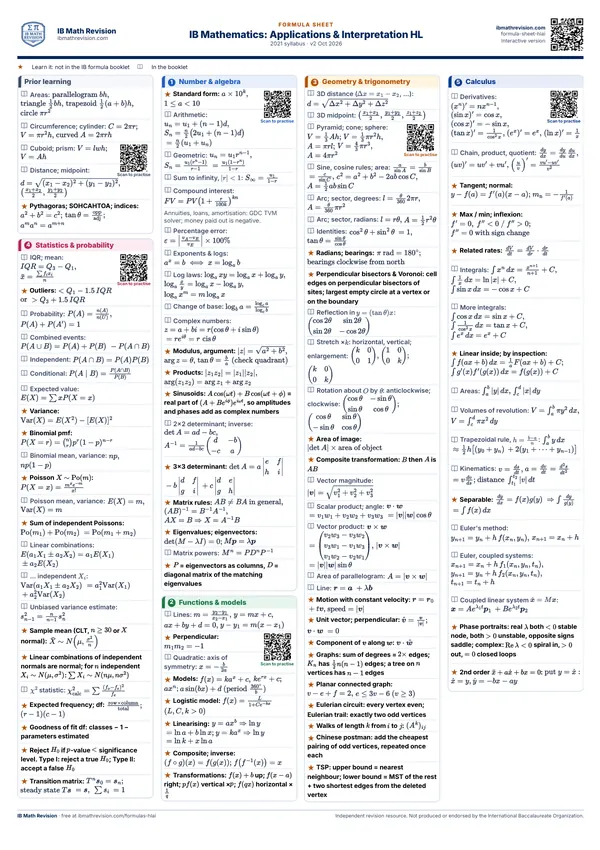
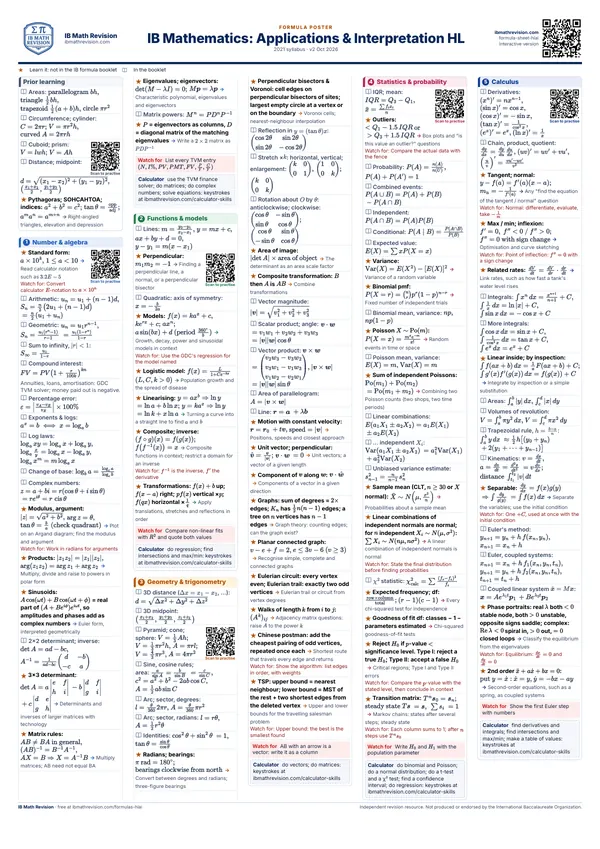
Every formula you need for Applications & Interpretation HL, SL and HL content together, on one A4 page. Formulas marked ★ are not in the IB AI HL formula booklet, so learn those; the rest are printed in it. The HL booklet includes the SL formulas, so you need only this sheet.
Tick what you know: 0 of 101 (saved on this device). Tap a formula to copy its LaTeX.
No formulas match. Clear the search or pick another topic.
IB Math Revisionibmathrevision.com
IB Mathematics: Applications & Interpretation HLOne-page formula sheet (SL + HL) · ★ = not in the booklet
★ Learn it: not in the IB formula booklet. In the booklet (its notation may differ slightly).
Prior learning
Areas:\(\text{parallelogram }bh,\)\(\text{triangle }\tfrac12bh,\)\(\text{trapezoid }\tfrac12(a+b)h,\)\(\text{circle }\pi r^2\)Use: Areas of fields and land shapes
Cuboid; prism:\(V=lwh;\)\(V=Ah\)Use: Volume and surface area of prisms and composite solids
Distance; midpoint:\(d=\sqrt{(x_1-x_2)^2+(y_1-y_2)^2},\)\(\left(\tfrac{x_1+x_2}{2},\tfrac{y_1+y_2}{2}\right)\)Use: Distance between two points; midpoint of a segment
★Pythagoras; SOHCAHTOA; indices:\(a^2+b^2=c^2;\)\(\tan\theta=\tfrac{\text{opp}}{\text{adj}};\)\(a^ma^n=a^{m+n}\)Use: Right-angled triangles, elevation and depression
1 Number & algebra
★Standard form:\(a\times10^k,\)\(1\le a<10\)Use: Read calculator notation such as \(3.2E-5\)Watch for: Convert calculator \(E\)-notation to \(a \times 10^{n}\)
Arithmetic:\(u_n=u_1+(n-1)d,\)\(S_n=\tfrac n2\big(2u_1+(n-1)d\big)\)\({}=\tfrac n2(u_1+u_n)\)Use: Terms and sums in contexts such as total savings or seatingWatch for: Decide first: one term, a total, or which termExplained: Arithmetic sequence · Sum of an arithmetic series
Geometric:\(u_n=u_1r^{n-1},\)\(S_n=\frac{u_1(r^n-1)}{r-1}\)\({}=\frac{u_1(1-r^n)}{1-r}\)Use: Terms, sums, and when a value is first exceededExplained: Geometric sequence · Sum of a geometric series
Sum to infinity, \(|r|<1\):\(S_\infty=\frac{u_1}{1-r}\)Use: Convergent series, such as a bouncing ball's total distance
Compound interest:\(FV=PV\left(1+\tfrac{r}{100k}\right)^{kn}\)Use: Future values, rates and time periods; the finance appWatch for: List every TVM entry; money in and out have opposite signs
Annuities, loans, amortisation: GDC TVM solver; money paid out is negative.
Percentage error:\(\varepsilon=\left|\frac{v_A-v_E}{v_E}\right|\times100\%\)Use: Percentage error for measured quantities and calculated results
Exponents & logs:\(a^x=b\iff x=\log_ab\)Use: Solve equations such as \(5^{x} = 40\)
Log laws:\(\log_axy=\log_ax+\log_ay,\)\(\log_a\tfrac xy=\log_ax-\log_ay,\)\(\log_ax^m=m\log_ax\)Use: Solve exponential and logarithmic equations
Change of base:\(\log_ba=\frac{\log_ca}{\log_cb}\)Use: Simplify expressions and solve log equations
Complex numbers:\(z=a+bi=r(\cos\theta+i\sin\theta)\)\({}=re^{i\theta}=r\,\cis\theta\)Use: Convert between Cartesian, polar and Euler forms
★Modulus, argument:\(|z|=\sqrt{a^2+b^2},\)\(\arg z=\theta,\)\(\tan\theta=\tfrac ba\ \text{(check quadrant)}\)Use: Plot on an Argand diagram; find the modulus and argumentWatch for: Work in radians for arguments
★Products:\(|z_1z_2|=|z_1||z_2|,\)\(\arg(z_1z_2)=\arg z_1+\arg z_2\)Use: Multiply, divide and raise to powers in polar form
★Sinusoids: \(A\cos(\omega t)+B\cos(\omega t+\phi)\) = real part of \((A+Be^{i\phi})e^{i\omega t}\), so amplitudes and phases add as complex numbersUse: Euler form, interpreted geometrically
2×2 determinant; inverse:\(\det A=ad-bc,\)\(A^{-1}=\frac1{ad-bc}\begin{pmatrix}d&-b\\-c&a\end{pmatrix}\)Use: Solve systems of equations in the form \(AX = B\)
★3×3 determinant:\(\det A=a\begin{vmatrix}e&f\\h&i\end{vmatrix}\)\({}-b\begin{vmatrix}d&f\\g&i\end{vmatrix}\)\({}+c\begin{vmatrix}d&e\\g&h\end{vmatrix}\)Use: Determinants and inverses of larger matrices with technology
★Matrix rules:\(AB\ne BA\text{ in general},\)\((AB)^{-1}=B^{-1}A^{-1},\)\(AX=B\Rightarrow X=A^{-1}B\)Use: Multiply matrices; AB need not equal BA
★Eigenvalues; eigenvectors:\(\det(M-\lambda I)=0;\)\(M\boldsymbol p=\lambda\boldsymbol p\)Use: Characteristic polynomial, eigenvalues and eigenvectors
Matrix powers:\(M^n=PD^nP^{-1}\)Use: High powers of a matrix from \(PDP^{-1}\)
★\(P\) = eigenvectors as columns, \(D\) = diagonal matrix of the matching eigenvaluesUse: Write a \(2 \times 2\) matrix as \(PDP^{-1}\)
Watch for: List every TVM entry \((N, I\%, PV, PMT, FV, \frac{P}{Y}, \frac{C}{Y})\)
★Perpendicular:\(m_1m_2=-1\)Use: Finding a perpendicular line, a normal, or a perpendicular bisector
Quadratic: axis of symmetry:\(x=-\frac b{2a}\)Use: Zeros, axis of symmetry and vertex in context
★Models:\(f(x)=ka^x+c,\)\(ke^{rx}+c;\)\(ax^n;\)\(a\sin(bx)+d\ (\text{period }\tfrac{360^\circ}b)\)Use: Growth, decay, power and sinusoidal models in contextWatch for: Use the GDC's regression for the model named
★Logistic model:\(f(x)=\frac{L}{1+Ce^{-kx}}\)\((L,C,k>0)\)Use: Population growth and the spread of disease
★Linearising:\(y=ax^b\Rightarrow\ln y\)\({}=\ln a+b\ln x;\)\(y=ka^x\Rightarrow\ln y\)\({}=\ln k+x\ln a\)Use: Turning a curve into a straight line to find \(a\) and \(b\)
★Composite; inverse:\((f\circ g)(x)=f(g(x));\)\(f\big(f^{-1}(x)\big)=x\)Use: Composite functions in context; restrict a domain for an inverseWatch for: \(f^{-1}\) is the inverse, \(f'\) the derivative
★Transformations: \(f(x)+b\) up; \(f(x-a)\) right; \(pf(x)\) vertical ×\(p\); \(f(qx)\) horizontal ×\(\tfrac1q\)Use: Apply translations, stretches and reflections in order
Watch for: Compare non-linear fits with \(R^{2}\) and quote both values
3D distance (\(\Delta x=x_1-x_2\), …):\(d=\sqrt{\Delta x^2+\Delta y^2+\Delta z^2}\)Use: Distance between two points in three dimensions
3D midpoint:\(\left(\tfrac{x_1+x_2}2,\tfrac{y_1+y_2}2,\tfrac{z_1+z_2}2\right)\)Use: Midpoint of a line segment in three dimensions
Pyramid; cone; sphere:\(V=\tfrac13Ah;\)\(V=\tfrac13\pi r^2h,\)\(A=\pi rl;\)\(V=\tfrac43\pi r^3,\)\(A=4\pi r^2\)Use: Volume and surface area of pyramids, cones and spheres
Sine, cosine rules; area:\(\frac{a}{\sin A}=\frac{b}{\sin B}\)\({}=\frac{c}{\sin C},\)\(c^2=a^2+b^2-2ab\cos C,\)\(A=\tfrac12ab\sin C\)Use: Non-right-angled triangles, bearings and areas in context
Arc; sector, degrees:\(l=\tfrac{\theta}{360}2\pi r,\)\(A=\tfrac{\theta}{360}\pi r^2\)Use: Arc lengths and sector areas with angles in degrees
Arc; sector, radians:\(l=r\theta,\)\(A=\tfrac12r^2\theta\)Use: Arc lengths and sector areas with angles in radians
Identities:\(\cos^2\theta+\sin^2\theta\)\({}=1,\)\(\tan\theta=\frac{\sin\theta}{\cos\theta}\)Use: Solve trig equations graphically in a given interval
★Radians; bearings:\(\pi\text{ rad}=180^\circ;\)\(\text{bearings clockwise from north}\)Use: Convert between degrees and radians; three-figure bearings
★Perpendicular bisectors & Voronoi: cell edges on perpendicular bisectors of sites; largest empty circle at a vertex or on the boundaryUse: Voronoi cells; nearest-neighbour interpolation
Reflection in \(y=(\tan\theta)x\):\(\begin{pmatrix}\cos2\theta&\sin2\theta\\\sin2\theta&-\cos2\theta\end{pmatrix}\)Use: Reflections, rotations and stretches as \(2 \times 2\) matrices
Stretch ×\(k\): horizontal, vertical; enlargement:\(\begin{pmatrix}k&0\\0&1\end{pmatrix},\)\(\begin{pmatrix}1&0\\0&k\end{pmatrix};\)\(\begin{pmatrix}k&0\\0&k\end{pmatrix}\)Use: Stretches and enlargements as matrices
Rotation about \(O\) by \(\theta\): anticlockwise; clockwise:\(\begin{pmatrix}\cos\theta&-\sin\theta\\\sin\theta&\cos\theta\end{pmatrix};\)\(\begin{pmatrix}\cos\theta&\sin\theta\\-\sin\theta&\cos\theta\end{pmatrix}\)Use: Rotations as matrices; combining transformations
★Area of image:\(|\det A|\times\text{area of object}\)Use: The determinant as an area scale factor
★Composite transformation: \(B\) then \(A\) is \(AB\)Use: Combine transformations
Vector magnitude:\(|\boldsymbol v|=\sqrt{v_1^2+v_2^2+v_3^2}\)Use: Magnitudes, unit vectors, a vector of a given length
Scalar product; angle:\(\boldsymbol v\cdot\boldsymbol w\)\({}=v_1w_1+v_2w_2+v_3w_3\)\({}=|\boldsymbol v||\boldsymbol w|\cos\theta\)Use: Angle between vectors; test for perpendicularWatch for: Displacement \(AB = b - a\), written as a column
Vector product:\(\boldsymbol v\times\boldsymbol w\)\({}=\begin{pmatrix}v_2w_3-v_3w_2\\v_3w_1-v_1w_3\\v_1w_2-v_2w_1\end{pmatrix},\)\(|\boldsymbol v\times\boldsymbol w|\)\({}=|\boldsymbol v||\boldsymbol w|\sin\theta\)Use: Areas of triangles and parallelograms
Area of parallelogram:\(A=|\boldsymbol v\times\boldsymbol w|\)Use: Areas of triangles and parallelograms
Line:\(\boldsymbol r=\boldsymbol a\)\({}+\lambda\boldsymbol b\)Use: Vector equation of a line through two points
★Motion with constant velocity:\(\boldsymbol r=\boldsymbol r_0\)\({}+t\boldsymbol v,\)\(\text{speed}=|\boldsymbol v|\)Use: Positions, speeds and closest approach
★Unit vector; perpendicular:\(\hat{\boldsymbol v}=\frac{\boldsymbol v}{|\boldsymbol v|};\)\(\boldsymbol v\cdot\boldsymbol w\)\({}=0\)Use: Unit vectors; a vector of a given length
★Component of \(\boldsymbol v\) along \(\boldsymbol w\):\(\boldsymbol v\cdot\hat{\boldsymbol w}\)Use: Components of a vector in a given direction
★Graphs: sum of degrees = \(2\times\) edges; \(K_n\) has \(\tfrac12n(n-1)\) edges; a tree on \(n\) vertices has \(n-1\) edgesUse: Graph theory: counting edges; can the graph exist?
★Planar connected graph:\(v-e+f=2,\)\(e\le3v-6\ (v\ge3)\)Use: Recognise simple, complete and connected graphs
★Eulerian circuit: every vertex even; Eulerian trail: exactly two odd verticesUse: Eulerian trail or circuit from vertex degrees
★Walks of length \(k\) from \(i\) to \(j\):\((A^k)_{ij}\)Use: Adjacency matrix questions: raise \(A\) to the power \(k\)
★Chinese postman: add the cheapest pairing of odd vertices, repeated once eachUse: Shortest route that travels every edge and returnsWatch for: Show the algorithm: list edges in order, with weights
★TSP: upper bound = nearest neighbour; lower bound = MST of the rest + two shortest edges from the deleted vertexUse: Upper and lower bounds for the travelling salesman problemWatch for: Upper bound: the best is the smallest found
Watch for: AB with an arrow is a vector: write it as a column
IQR; mean:\(IQR=Q_3-Q_1,\)\(\bar x=\frac{\sum f_ix_i}{n}\)Use: Mean, quartiles and IQR of raw and grouped data
★Outliers:\(<Q_1-1.5\,IQR\)\(\text{or}\)\({}>Q_3+1.5\,IQR\)Use: Box plots and "is this value an outlier?" questionsWatch for: Compare the actual data with the fence
Probability:\(P(A)=\frac{n(A)}{n(U)},\)\(P(A)+P(A')=1\)Use: Probabilities from sample spaces, tables and diagrams
Combined events:\(P(A\cup B)=P(A)+P(B)\)\({}-P(A\cap B)\)Use: Combined events with and without replacementWatch for: Along a branch multiply; between outcomes add
Independent:\(P(A\cap B)=P(A)P(B)\)Use: Decide whether two events are independent
Conditional:\(P(A\mid B)=\frac{P(A\cap B)}{P(B)}\)Use: Conditional probabilities from Venn diagrams, trees and tablesWatch for: For "given that", divide by the size of the given group
Expected value:\(E(X)=\sum xP(X=x)\)Use: Use \(E(X)\) to compare options in context
★Variance:\(\mathrm{Var}(X)=E(X^2)-[E(X)]^2\)Use: Variance of a random variable
★Binomial pmf:\(P(X=r)=\tbinom nrp^r(1-p)^{n-r}\)Use: Fixed number of independent trials
Binomial mean, variance:\(np,\)\(np(1-p)\)Use: Mean and variance of \(B(n, p)\) in context
★Poisson \(X\sim\mathrm{Po}(m)\):\(P(X=x)=\frac{m^xe^{-m}}{x!}\)Use: Random events in time or space
Poisson mean, variance:\(E(X)=m,\)\(\mathrm{Var}(X)=m\)Use: Check a Poisson model: mean \(=\) variance
★Sum of independent Poissons:\(\mathrm{Po}(m_1)+\mathrm{Po}(m_2)\)\({}=\mathrm{Po}(m_1+m_2)\)Use: Combining two Poisson counts (two shops, two time periods)
Linear combinations:\(E(a_1X_1\pm a_2X_2)=a_1E(X_1)\)\({}\pm a_2E(X_2)\)Use: Total weight of several items packed togetherWatch for: Variances add, for \(X + Y\) and \(X - Y\)
… independent \(X_i\):\(\mathrm{Var}(a_1X_1\pm a_2X_2)\)\({}=a_1^2\mathrm{Var}(X_1)\)\({}+a_2^2\mathrm{Var}(X_2)\)Use: Variance of linear combinations of independent variablesWatch for: \(\operatorname{Var}(aX) = a^{2}\operatorname{Var}(X)\)
Unbiased variance estimate:\(s^2_{n-1}=\frac{n}{n-1}s^2_n\)Use: Unbiased estimates of population mean and variance
★Sample mean (CLT, \(n\ge30\) or \(X\) normal):\(\bar X\sim N\!\left(\mu,\tfrac{\sigma^2}{n}\right)\)Use: Probabilities about a sample mean
★Linear combinations of independent normals are normal; for \(n\) independent \(X_i\sim N(\mu,\sigma^2)\): \(\sum X_i\sim N(n\mu,n\sigma^2)\)Use: A linear combination of independent normals is normalWatch for: State the final distribution before finding probabilities
\(\chi^2\) statistic:\(\chi^2_\text{calc}=\sum\frac{(f_o-f_e)^2}{f_e}\)Use: \(\chi^{2}\) test statistic, compared with the critical value
★Expected frequency; df:\(\frac{\text{row}\times\text{column}}{\text{total}};\)\((r-1)(c-1)\)Use: Every chi-squared test for independence
★Goodness of fit df: classes − 1 − parameters estimatedUse: Chi-squared goodness-of-fit tests
★Reject \(H_0\) if \(p\)-value \(<\) significance level. Type I: reject a true \(H_0\); Type II: accept a false \(H_0\)Use: Critical regions; Type I and Type II errorsWatch for: Compare the \(p\)-value with the stated level, then conclude in context
★Transition matrix:\(T^n\boldsymbol s_0=\boldsymbol s_n;\)\(\text{steady state }T\boldsymbol s\)\({}=\boldsymbol s,\ \sum s_i\)\({}=1\)Use: Markov chains: states after several steps; steady stateWatch for: Each column sums to 1; after \(n\) steps use \(T^{n}s_{0}\)
Watch for: Write \(H_{0}\) and \(H_{1}\) with the population parameter
Derivatives:\((x^n)'=nx^{n-1},\)\((\sin x)'=\cos x,\)\((\cos x)'=-\sin x,\)\((\tan x)'=\tfrac1{\cos^2x},\)\((e^x)'=e^x,\)\((\ln x)'=\tfrac1x\)Use: Differentiate \(e^{x}\), \(\ln x\), \(\sin x\), \(\cos x\) and \(\tan x\), in radiansExplained: Derivative of sin x · Power rule
Chain, product, quotient:\(\frac{dy}{dx}=\frac{dy}{du}\frac{du}{dx},\)\((uv)'=uv'+vu',\)\(\Big(\frac uv\Big)'=\frac{vu'-uv'}{v^2}\)Use: Products, quotients and composite functions
★Tangent; normal:\(y-f(a)=f'(a)(x-a);\)\(m_\text{n}=-\tfrac1{f'(a)}\)Use: Any "find the equation of the tangent / normal" questionWatch for: Normal: differentiate, evaluate, take \(-\frac{1}{m}\)
★Max / min; inflexion:\(f'=0,\ f''<0\ /\ f''>0;\)\(f''=0\text{ with sign change}\)Use: Optimisation and curve sketchingWatch for: Point of inflection: \(f'' = 0\) with a sign change
★Related rates:\(\frac{dV}{dt}=\frac{dV}{dr}\cdot\frac{dr}{dt}\)Use: Link rates, such as how fast a tank's water level rises
More integrals:\(\int\cos x\,dx=\sin x+C,\)\(\int\tfrac1{\cos^2x}\,dx=\tan x+C,\)\(\int e^x\,dx=e^x+C\)Use: Reversing the standard derivatives
★Linear inside; by inspection:\(\int f(ax+b)\,dx=\tfrac1aF(ax+b)+C;\)\(\int g'(x)f'(g(x))\,dx=f(g(x))+C\)Use: Integrate by inspection or a simple substitution
Areas:\(\int_a^b|y|\,dx,\)\(\int_c^d|x|\,dy\)Use: Area between a curve and the \(y\)-axis: integrate in \(y\)
Volumes of revolution:\(V=\int_a^b\pi y^2\,dx,\)\(V=\int_c^d\pi x^2\,dy\)Use: Rotate a region \(360^\circ\) about the \(x\)- or \(y\)-axisWatch for: About the \(y\)-axis: \(\pi\int x^{2}\,\mathrm{d}y\), with \(y\)-limits
Trapezoidal rule, \(h=\tfrac{b-a}n\):\(\int_a^by\,dx\)\({}\approx\tfrac12h\big[(y_0+y_n)\)\({}+2(y_1+\cdots+y_{n-1})\big]\)Use: Estimate an area from tabulated dataWatch for: \(h = \frac{b - a}{n}\), with \(n\) the number of strips
Kinematics:\(v=\tfrac{ds}{dt},\)\(a=\tfrac{dv}{dt}=\tfrac{d^2s}{dt^2}\)\({}=v\tfrac{dv}{ds};\)\(\text{distance }\int_{t_1}^{t_2}|v|\,dt\)Use: Displacement, velocity, acceleration; at rest or changing direction
★Separable:\(\frac{dy}{dx}=f(x)g(y)\)\({}\Rightarrow\int\frac{dy}{g(y)}\)\({}=\int f(x)\,dx\)Use: Separate the variables; use the initial conditionWatch for: One \(+ C\), used at once with the initial condition
Euler's method:\(y_{n+1}=y_n+h\,f(x_n,y_n),\)\(x_{n+1}=x_n+h\)Use: Approximate solutions with a given step lengthWatch for: Show the first step with numbers, then the GDC table
Euler, coupled systems:\(x_{n+1}=x_n+h\,f_1(x_n,y_n,t_n),\)\(y_{n+1}=y_n+h\,f_2(x_n,y_n,t_n),\)\(t_{n+1}=t_n+h\)Use: Euler's method on coupled equations
Coupled linear system \(\dot{\boldsymbol x}=M\boldsymbol x\):\(\boldsymbol x=Ae^{\lambda_1t}\boldsymbol p_1\)\({}+Be^{\lambda_2t}\boldsymbol p_2\)Use: Solve coupled systems with eigenvalues and eigenvectors
★Phase portraits: real \(\lambda\) both \(<0\) stable node, both \(>0\) unstable, opposite signs saddle; complex: \(\mathrm{Re}\,\lambda<0\) spiral in, \(>0\) out, \(=0\) closed loopsUse: Classify the equilibrium from the eigenvaluesWatch for: Equilibrium: \(\frac{dx}{dt} = 0\) and \(\frac{dy}{dt} = 0\)
★2nd order \(\ddot x+a\dot x+bx=0\):\(\text{put }y=\dot x:\)\(\dot x=y,\)\(\dot y=-bx-ay\)Use: Second-order equations, such as a spring, as coupled systems
Free to print for your classes. If you share it, please keep our name on it and credit “IB Math Revision (ibmathrevision.com)” with a link to this page.
IB Mathematics: Applications & Interpretation HL: the A4 sheetIB Mathematics: Applications & Interpretation HL: the A3 poster
Official booklet: the IB Mathematics: applications and interpretation HL formula booklet (IB DP Mathematics page). You get a clean copy in the exam.
Is this the official IB Mathematics: applications and interpretation HL formula booklet?
No. It is our own one-page summary, written independently by IB Math Revision. In every AI HL exam paper you get a clean copy of the official AI HL formula booklet, which includes the SL formulas, so use this sheet to learn where each formula is and which ones (★) you must know by heart.
Which formulas do I have to learn?
The 46 rows marked ★ (of 101 on the sheet) are not given in the exam, so learn them. Know the given ones well too: finding them quickly saves time.
How do I print it or read it on my phone?
Download the PDF: 1 page of A4 (789 KB), made to print on one sheet of paper. On a phone, this page shows the same formulas in one column, and the PDF has a bookmark for each section.
What other formats are there?
As well as the A4 sheet there is an A3 poster (it adds when to use each formula to learn, mistakes to watch for, and a QR code per topic that leads to practice), a print-friendly black and white A4 version, and a one-page sheet of only the formulas you must memorise. On this page you can also search, filter by topic, tick off the formulas you know and copy any formula as LaTeX.
Is it free?
Yes. Every PDF and this page are free to download and print, with no sign-up.
Make a free account: no card needed5 more practice questions on every topic with instant feedback, full worked answers on free questions, 3 AI-marked answers a week, free, and your streak and progress on any device.
IB Math Revision is independent and is not affiliated with, endorsed by or connected to the International Baccalaureate Organization. This work/product/service has been developed independently from and is not endorsed by the International Baccalaureate Organization. International Baccalaureate, Baccalauréat International, Bachillerato Internacional and IB are registered trademarks owned by the International Baccalaureate Organization.