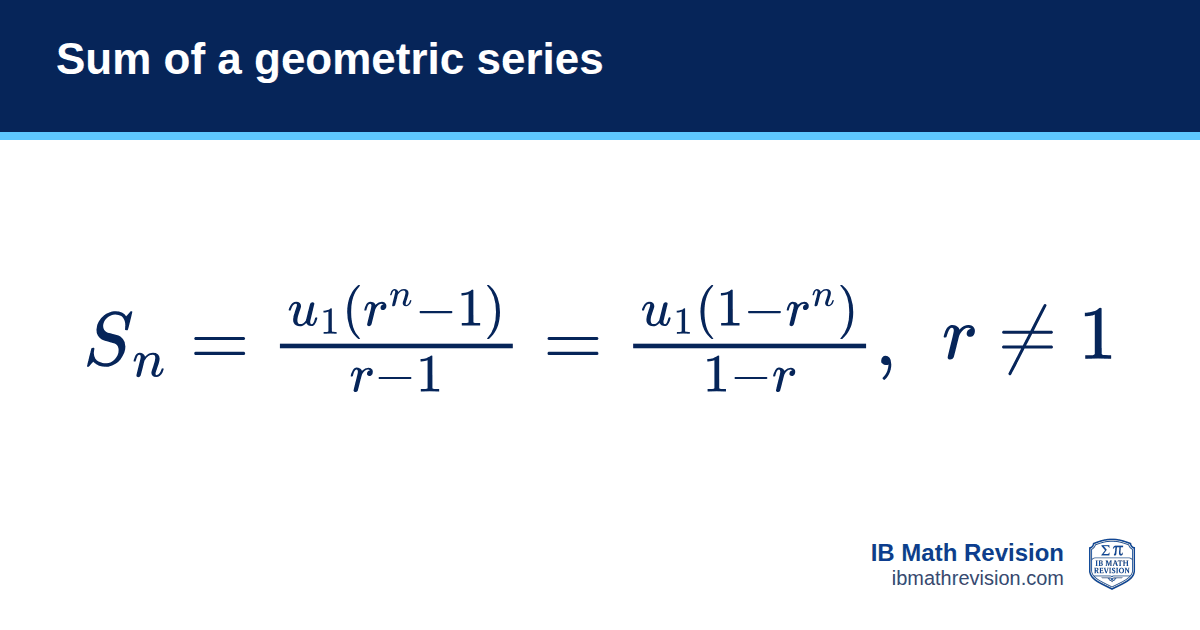
Geometric series sum formula: Sₙ = u₁(1 − rⁿ)/(1 − r)
The geometric series sum formula is Sₙ = u₁(rⁿ − 1)/(r − 1) = u₁(1 − rⁿ)/(1 − r), r ≠ 1.
What each letter means
- \(S_n\) the sum of the first n terms
- \(u_1\) the first term
- \(r\) the common ratio (each term ÷ the one before)
- \(n\) how many terms you add
When to use it
To add up the first n terms of a geometric sequence: savings with regular deposits, a bouncing ball, repeated percentage growth.
Worked example
Find the sum of the first 10 terms of \(3+6+12+\cdots\)
- \(u_1=3,\ r=2,\ n=10\)
- \(S_{10}=\dfrac{3(2^{10}-1)}{2-1}=3\times1023\)
Answer: \(S_{10}=3069\)
Common mistake
Using rⁿ⁻¹ in the sum. That power belongs to the nth term; the sum uses rⁿ.
On your course
| Course | In the exam |
|---|---|
| AA SL | In the IB formula booklet |
| AI SL | In the IB formula booklet |
| AA HL | In the IB formula booklet |
| AI HL | In the IB formula booklet |
From our own IB Maths formula sheets, in our words. The IB gives its booklet to schools, so we checked against our own copy: your teacher has the official one. Official: IB DP Mathematics page.
Practise and revise
- Practise AA SL sequences and series questions
- Practise AI SL sequences and series questions
- Revise Geometric sequences (AI SL)
- Revise Sequences and series (AA SL)
- Tool Sums of sequences on your GDC
- Print AA SL one-page formula sheet
Questions
What is the geometric series sum formula?
The geometric series sum formula is Sₙ = u₁(rⁿ − 1)/(r − 1) = u₁(1 − rⁿ)/(1 − r), r ≠ 1. Sₙ: the sum of the first n terms; u₁: the first term; r: the common ratio (each term ÷ the one before); n: how many terms you add.
Is the sum of a geometric series given in the exam?
AA SL: in the IB formula booklet. AI SL: in the IB formula booklet. AA HL: in the IB formula booklet. AI HL: in the IB formula booklet. This comes from our own IB Maths formula sheets; your teacher has the official booklet.
Which version should I use?
Both give the same answer. The (rⁿ − 1)/(r − 1) form avoids negatives when r > 1; the (1 − rⁿ)/(1 − r) form is neater when r < 1.
Our own wording, examples and card, checked by IB Math Revision. Not produced or endorsed by the International Baccalaureate Organization.