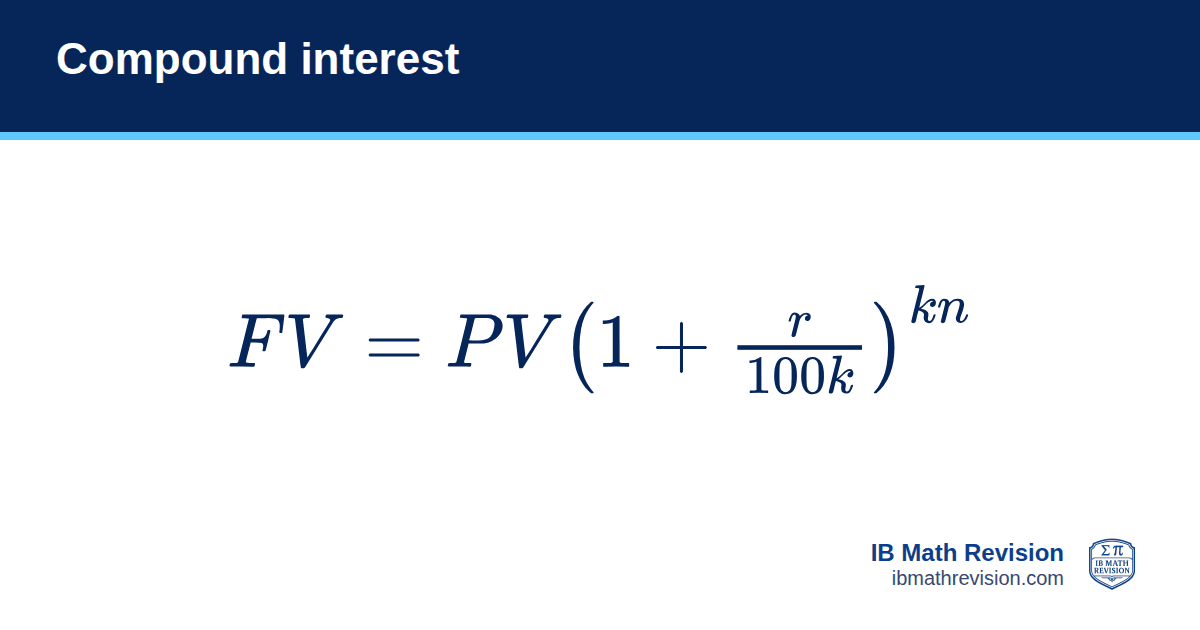
Compound interest formula: FV = PV(1 + r/100k)^kn
The compound interest formula is FV = PV × (1 + r/(100k))^(kn).
What each letter means
- \(PV\) present value: the amount invested or borrowed
- \(FV\) future value: the amount after n years
- \(r\) the interest rate, as a percentage per year
- \(k\) how many times a year the interest is added (12 for monthly)
- \(n\) the number of years
When to use it
When interest is added to the balance and then earns interest itself. The same formula with a negative rate models depreciation.
Worked example
$2500 is invested at 3.6% per year, compounded monthly. Find its value after 5 years, to the nearest cent.
- \(PV=2500,\ r=3.6,\ k=12,\ n=5\)
- \(FV=2500\left(1+\dfrac{3.6}{1200}\right)^{60}=2500(1.003)^{60}\)
Answer: \(FV=\$2992.24\)
Common mistake
Using the yearly rate for each month. With monthly compounding the rate per period is r/12 and there are 12n periods.
On your course
| Course | In the exam |
|---|---|
| AA SL | In the IB formula booklet |
| AI SL | In the IB formula booklet |
| AA HL | In the IB formula booklet |
| AI HL | In the IB formula booklet |
From our own IB Maths formula sheets, in our words. The IB gives its booklet to schools, so we checked against our own copy: your teacher has the official one. Official: IB DP Mathematics page.
Practise and revise
- Practise AI SL financial mathematics questions
- Practise AA SL financial maths questions
- Revise Financial maths (AI SL)
- Tool Finance (TVM) solver on your GDC
- Print AA SL one-page formula sheet
Questions
What is the compound interest formula?
The compound interest formula is FV = PV × (1 + r/(100k))^(kn). PV: present value: the amount invested or borrowed; FV: future value: the amount after n years; r: the interest rate, as a percentage per year; k: how many times a year the interest is added (12 for monthly); n: the number of years.
Is the compound interest given in the exam?
AA SL: in the IB formula booklet. AI SL: in the IB formula booklet. AA HL: in the IB formula booklet. AI HL: in the IB formula booklet. This comes from our own IB Maths formula sheets; your teacher has the official booklet.
What is the difference between simple and compound interest?
Simple interest is paid on the original amount only, so it is the same each year. Compound interest is also paid on earlier interest, so the balance grows faster each year.
Our own wording, examples and card, checked by IB Math Revision. Not produced or endorsed by the International Baccalaureate Organization.