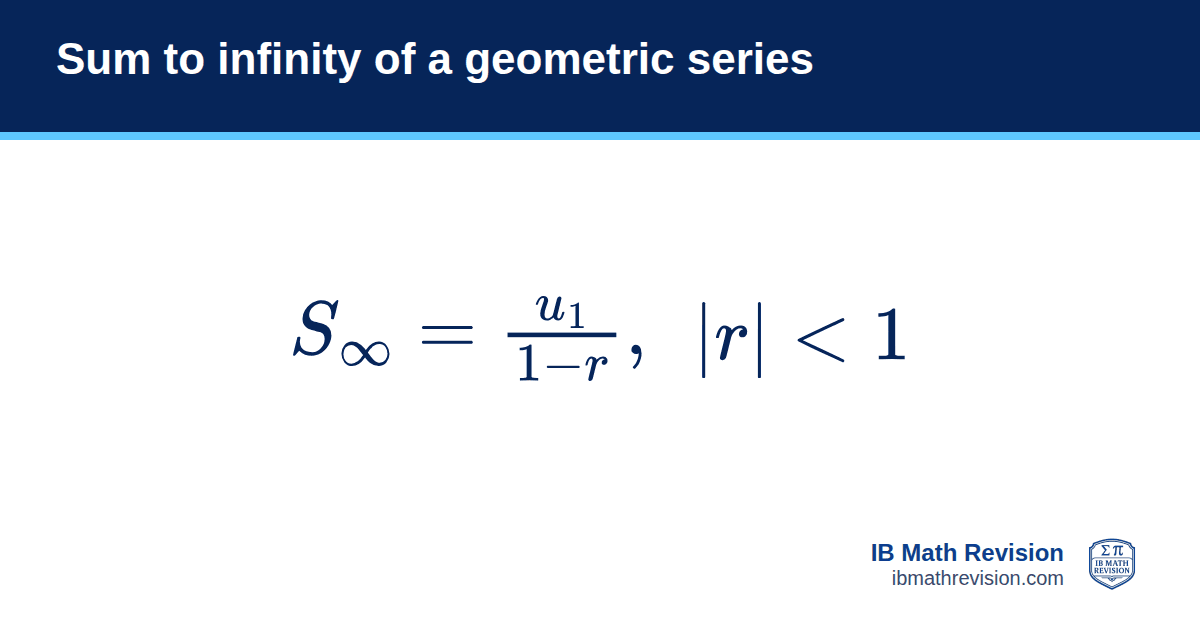
Geometric series sum to infinity: S∞ = u₁ / (1 − r)
The geometric series sum to infinity is S∞ = u₁ / (1 − r), for |r| < 1.
What each letter means
- \(S_\infty\) the sum to infinity: the value the sums get closer and closer to
- \(u_1\) the first term
- \(r\) the common ratio, which must be between −1 and 1
When to use it
When a geometric series goes on for ever and its terms shrink towards 0, for example a recurring decimal or the total distance travelled by a bouncing ball.
Worked example
Find the sum to infinity of \(24+18+13.5+\cdots\)
- \(r=\dfrac{18}{24}=0.75\), and \(|r|<1\)
- \(S_\infty=\dfrac{24}{1-0.75}=\dfrac{24}{0.25}\)
Answer: \(S_\infty=96\)
Common mistake
Using it when |r| ≥ 1. Then the terms do not shrink and the series has no sum to infinity.
On your course
| Course | In the exam |
|---|---|
| AA SL | In the IB formula booklet |
| AA HL | In the IB formula booklet |
| AI HL | In the IB formula booklet |
From our own IB Maths formula sheets, in our words. The IB gives its booklet to schools, so we checked against our own copy: your teacher has the official one. Official: IB DP Mathematics page.
Practise and revise
Questions
What is the geometric series sum to infinity formula?
The geometric series sum to infinity is S∞ = u₁ / (1 − r), for |r| < 1. S_∞: the sum to infinity: the value the sums get closer and closer to; u₁: the first term; r: the common ratio, which must be between −1 and 1.
Is the sum to infinity of a geometric series given in the exam?
AA SL: in the IB formula booklet. AA HL: in the IB formula booklet. AI HL: in the IB formula booklet. This comes from our own IB Maths formula sheets; your teacher has the official booklet.
When does a geometric series have a sum to infinity?
Only when −1 < r < 1. The terms then shrink towards 0 and the sums settle at u₁ / (1 − r).
Our own wording, examples and card, checked by IB Math Revision. Not produced or endorsed by the International Baccalaureate Organization.