IB Maths AA SL Formula Booklet — Analysis & Approaches SL
Quick answer: yes, you get a clean copy of the IB Maths AA SL formula booklet in every paper, including calculator-free Paper 1. SL and HL have separate booklets; the 2026 exams use the current editions (first assessment 2021). Your school can give you a copy to revise with: the IB publishes it only to schools on its Programme Resource Centre, and there is no public copy on ibo.org (we don't host it either; the course is on the IB DP Mathematics page). It does not have everything, so also learn the 39 results it leaves out.
All 51 formulas you need for IB Mathematics Analysis & Approaches SL, grouped by syllabus topic and written in the same notation as the IB formula booklet. Use it to revise which formulas are given in the exam, and which you still need to understand how to apply.
Got your PDF? Next, practise every formula. Free account, no card: +5 practice questions on every topic, with instant feedback.
Free SL AA questions by topic Join freeUpdated November 2026
What's in the IB Maths AA SL formula booklet?
There is a separate SL booklet and HL booklet for AA. This table is for the AA SL booklet. Topic by topic, this is what it prints and the main results it leaves out (★), which you must learn.
| Topic | Printed in the booklet | ★ Not printed: learn these |
|---|---|---|
| Prior learning | Area · Circle · Volume · Curved surface of a cylinder · Distance; midpoint | Pythagoras · Right-angled trig · Laws of indices · Standard form |
| Number & algebra | Arithmetic sequence · Arithmetic series · Geometric sequence · Geometric series, | Special values · General term |
| Functions | Gradient; forms of a line · Quadratic · Quadratic formula; discriminant | Parallel; perpendicular lines · Roots · Vertex form, vertex |
| Geometry & trigonometry | 3D distance · 3D midpoint · Pyramid; cone · Sphere · Sine rule · Cosine rule · and 4 more | Ambiguous case · Radians · Exact values at |
| Statistics & probability | Interquartile range · Mean ( | Outliers · Variance (s.d. |
| Calculus | Power rule · Standard derivatives · Chain rule · Product rule · Quotient rule · Integral of | Linear inside · Tangent; normal gradient at |
Every row is on our free one-page IB Maths AA SL formula sheet (PDF), with ★ on the ones to learn.
Prior learning
- Area of a parallelogram
- Area of a triangle
- Area of a trapezium
- Volume of a cuboid
Topic 1 — Number & Algebra
- Exponents & logs (change of base)
Using the booklet: a worked example
A geometric sequence has
- From the booklet,
- Also from the booklet,
- Solve
- Check:
Infinite geometric series and sum of n terms explained · Free SL AA sequences and series questions with mark schemes
Topic 2 — Functions
- Axis of symmetry of a quadratic
- Discriminant
Topic 3 — Geometry & Trigonometry
- Double-angle: sine
- Double-angle: cosine
- Tangent from sine & cosine
Topic 4 — Statistics & Probability
- Interquartile range
- Mean of a data set
- Probability of an event
- Complementary events
- Independent events
- Expected value (discrete)
- Mean & variance of a binomial
Topic 5 — Calculus
- Derivatives of standard functions
- Exponential & log derivatives
- Integral of xⁿ
- Standard integrals
- Area between a curve and the x-axis
Try it now
1 of 5
- Question 1 of 5
- Question 2 of 5
- Question 3 of 5
- Question 4 of 5
- Question 5 of 5
5 quick questions from across SL AA. No sign-in needed.
Not in the AA SL booklet: 39 results to learn
The IB Maths AA SL formula booklet does not print these, but questions expect you to know them. Learn them by heart; every formula above without a ★ is given in the exam.
Prior learning
- Laws of indices
- Standard form
Number & algebra
- Special values
- General term
Functions
- Parallel; perpendicular lines
- Roots:
- Vertex form, vertex
- Composite; inverse
- Graph of
- Translations:
- Stretches:
- Reflections:
- Exponential ↔ log
Geometry & trigonometry
- Ambiguous case: given
- Radians
- Exact values at
- Symmetry
Statistics & probability
- Outliers
- Data
- Regression: use
- Valid distribution; fair game
- Normal: about 68%, 95%, 99.7% of values lie within 1, 2, 3 s.d. of
Calculus
- Linear inside
- Tangent; normal gradient at
- Increasing / decreasing
- Stationary points
- Concave up
- Linear inside
- Reverse chain rule
- Definite integral
- Area between two curves
- Displacement
Each of these with a worked example · Tick them off on the interactive sheet · One-page PDF of just these
Using the IB Maths AA SL formula booklet: mistakes that cost marks
- Degrees in an arc or sector formula. The booklet's
- Variance in place of standard deviation.
- A sum to infinity that does not exist.
- Expanding without the general term. The booklet gives
Calculator tip: Paper 1 has no calculator, and the booklet does not print the exact values of sin, cos and tan at
IB Maths AA SL formula sheet PDF: download it your way
Our own one-page sheets (not the IB's booklet), free to print, no sign-up.
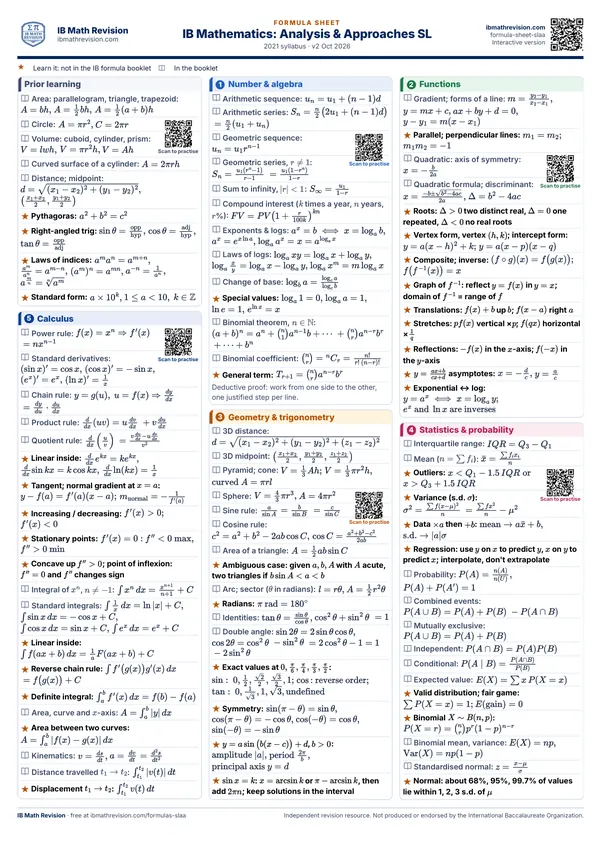
- A4 colour sheetOne page, colour-coded by topic, ★ on the ones to learn · PDF 600 KB
- A3 posterFor your wall: adds when to use each formula · PDF 695 KB
- Print-friendlyOne A4 page in black and white, saves ink · PDF 576 KB
- Formulas you must memoriseOne A4 page: only the ones not in the booklet · PDF 368 KB
Key formulas explained, with a worked example
Derivative of sin x nCr formula (combinations) Pythagoras' theorem SOH CAH TOA (right-angled trigonometry) Standard deviation Volume of a cone Volume of a sphere
Questions
Is this the IB's own formula booklet?
No. It is our own page, written in the same notation as the IB formula booklet so you get used to it. In the exam you are given a clean copy of the IB booklet.
Can I take this sheet into the exam?
No. Only the clean copy of the IB formula booklet that the exam provides is allowed. Use this page and the PDF to revise.
Which formulas do I have to learn by heart?
Some results you need are not printed in the booklet. They are listed on this page under "Not in the booklet", and the one-page formula sheet marks each of them with a star.
Do you get the formula booklet in every IB Maths AA SL paper?
Yes. A clean copy of the formula booklet is provided in every paper, including calculator-free Paper 1. You cannot bring your own copy or any notes.
How do I get quick at using the formula booklet?
Practise past-style questions with the booklet open beside you, so you know which topic each formula sits under and what each letter means. Then learn the results it leaves out (our formulas-to-memorise page lists them with worked examples).
Is there a separate formula booklet for SL and HL?
Yes. AA has an SL booklet and an HL booklet. SL students get the SL booklet.
Is the IB Maths AA SL data booklet the same as the formula booklet?
Yes. For maths the IB calls it the formula booklet; "data booklet" is the name of the IB Chemistry and Physics booklets, so many students use either name. Everything on this page is in the IB Maths AA SL formula booklet, apart from the results marked as not in the booklet.
Which formula booklet is used for the 2026 exams?
The current editions, for first assessment 2021. They are used for every exam on the current courses, up to the last ones in November 2028. The revised courses are first examined in May 2029.
Is the PDF free?
Yes. The PDFs (A4, A3 poster, black and white, and the formulas to memorise) and this page are free, with no sign-up.
What else is free here
- AA SL questions by topicUse these formulas on exam-style questions, each with a full mark scheme, so you learn when each one applies.
- AA SL revision notesEvery topic in plain English with a worked example, to fill the gaps the questions show up.
- Where AA SL students lose marksA summary of the IB's published subject reports, so you avoid the common slips.
- Free AA SL practice exams (PDF)A printable exam for each unit, with a separate mark scheme.
Make a free account: no card needed5 more practice questions on every topic with instant feedback, full worked answers on free questions, 3 AI-marked answers a week, free, and your streak and progress on any device.
Join freeAlready have an account? Sign in
Other courses: IB Math AI SL formula sheet · IB Math AI HL formula booklet · IB Math AA HL formula booklet · Print-ready one-page booklet · SL AA revision notes · SL AA questions by topic