IB Maths AI HL Formula Booklet — Applications & Interpretation HL
Quick answer: yes, you get a clean copy of the IB Maths AI HL formula booklet in all three papers. SL and HL have separate booklets, and the HL booklet includes the SL formulas; the 2026 exams use the current editions (first assessment 2021). Your school can give you a copy to revise with: the IB publishes it only to schools on its Programme Resource Centre, and there is no public copy on ibo.org (we don't host it either; the course is on the IB DP Mathematics page). It does not have everything, so also learn the 46 results it leaves out.
The 18 formulas that HL adds for IB Mathematics Applications & Interpretation HL, grouped by syllabus topic and written in the same notation as the IB formula booklet. You also need every formula in the IB Maths AI SL formula booklet: they are further down this page, and the free PDF has both on one page.
Got your PDF? Next, practise every formula. Free account, no card: +5 practice questions on every topic, with instant feedback.
Free HL AI questions by topic Join freeUpdated November 2026
What's in the IB Maths AI HL formula booklet?
There is a separate SL booklet and HL booklet for AI. This table is for the AI HL booklet, which includes the SL formulas as well as the HL ones. Topic by topic, this is what it prints and the main results it leaves out (★), which you must learn.
| Topic | Printed in the booklet | ★ Not printed: learn these |
|---|---|---|
| Prior learning | Areas · Circumference; cylinder · Cuboid; prism · Distance; midpoint | Pythagoras; SOHCAHTOA; indices |
| Number & algebra | Arithmetic · Geometric · Sum to infinity, | Standard form · Modulus, argument · Products · Sinusoids · 3×3 determinant · Matrix rules · and 2 more |
| Functions & models | Lines · Quadratic | Perpendicular · Models · Logistic model · Linearising · Composite; inverse · Transformations |
| Geometry & trigonometry | 3D distance ( | Radians; bearings · Perpendicular bisectors & Voronoi · Area of image · Composite transformation · Motion with constant velocity · Unit vector; perpendicular · and 7 more |
| Statistics & probability | IQR; mean · Probability · Combined events · Independent · Conditional · Expected value · and 6 more | Outliers · Variance · Binomial pmf · Poisson |
| Calculus | Derivatives · Chain, product, quotient · Integrals · More integrals · Areas · Volumes of revolution · and 5 more | Tangent; normal · Max / min; inflexion · Related rates · Linear inside; by inspection · Separable · Phase portraits · and 1 more |
Every row is on our free one-page IB Maths AI HL formula sheet (PDF), with ★ on the ones to learn.
Everything in SL AI, plus…
- Complex numbers — Cartesian ★ not in the booklet
- Modulus of a complex number ★ not in the booklet
Topic 3 (HL only) — Geometry & Trig extension
- Angle between two vectors
- Vector equation of a line
- Matrix multiplication (2×2)
- Determinant (2×2)
- Inverse of a 2×2 matrix
- Eigenvalue equation ★ not in the booklet
Using the booklet: a worked example
- From the booklet,
- Step 1:
- Step 2:
- The exact solution is
Euler's method explained · Free HL AI differential equations and Euler's method questions with mark schemes
Topic 4 (HL only) — Statistics extension
- Poisson distribution
- Mean & variance of Poisson
- Confidence interval for a mean (large n) ★ not in the booklet
- Chi-squared test statistic
- Transition matrix (Markov chain) ★ not in the booklet
Topic 5 (HL only) — Calculus extension
- Euler's method
- Separable differential equation ★ not in the booklet
- Trapezoidal rule (refresher)
The SL formulas (also in the HL booklet)
HL papers use every IB Maths AI SL formula as well as the HL ones above. IB Maths AI SL formula booklet page.
Prior learning
- Area of a parallelogram
- Area of a triangle
- Area of a trapezium
- Circumference of a circle
- Volume of a cuboid
- Volume of a prism
- Area of curved surface of cylinder
Topic 1 — Number & Algebra
- Exponents
- % error
Topic 2 — Functions
- Axis of symmetry of a quadratic
Topic 3 — Geometry & Trigonometry
- Surface area of a sphere
- Curved surface area of a cone
- Volume of a pyramid
Topic 4 — Statistics & Probability
- Interquartile range
- Mean of a data set
- Probability of an event
- Complementary events
- Mutually exclusive events
- Independent events
- Expected value (discrete)
Topic 5 — Calculus
- Integral of xⁿ
- Area between curve and x-axis
- Trapezoidal rule (approx. area)
Try it now
1 of 5
- Question 1 of 5
- Question 2 of 5
- Question 3 of 5
- Question 4 of 5
- Question 5 of 5
5 quick questions from across HL AI. No sign-in needed.
Not in the AI HL booklet: 46 results to learn
The IB Maths AI HL formula booklet does not print these (SL and HL results), but questions expect you to know them. Learn them by heart; every formula above without a ★ is given in the exam.
Prior learning
- Pythagoras; SOHCAHTOA; indices
Number & algebra
- Standard form
- Modulus, argument
- Products
- Sinusoids:
- 3×3 determinant
- Matrix rules
- Eigenvalues; eigenvectors
Functions & models
- Perpendicular
- Models
- Logistic model
- Linearising
- Composite; inverse
- Transformations:
Geometry & trigonometry
- Radians; bearings
- Perpendicular bisectors & Voronoi: cell edges on perpendicular bisectors of sites; largest empty circle at a vertex or on the boundary
- Area of image
- Composite transformation:
- Motion with constant velocity
- Unit vector; perpendicular
- Component of
- Graphs: sum of degrees =
- Planar connected graph
- Eulerian circuit: every vertex even; Eulerian trail: exactly two odd vertices
- Walks of length
- Chinese postman: add the cheapest pairing of odd vertices, repeated once each
- TSP: upper bound = nearest neighbour; lower bound = MST of the rest + two shortest edges from the deleted vertex
Statistics & probability
- Outliers
- Variance
- Poisson
- Sum of independent Poissons
- Sample mean (CLT,
- Linear combinations of independent normals are normal; for
- Expected frequency; df
- Goodness of fit df: classes − 1 − parameters estimated
- Reject
- Transition matrix
Calculus
- Tangent; normal
- Max / min; inflexion
- Related rates
- Linear inside; by inspection
- Separable
- Phase portraits: real
- 2nd order
Each of these with a worked example · Tick them off on the interactive sheet · One-page PDF of just these
Using the IB Maths AI HL formula booklet: mistakes that cost marks
- Degrees or radians. The AI HL booklet prints the arc and sector formulas in both degrees and radians. Check which unit the question uses before you pick one.
- The biased variance. For an unbiased estimate of the population variance use
- Matrices in the wrong order. Transformation
- Rounding inside Euler's method. Keep each
Calculator tip: Every AI HL paper allows the GDC. Use Poisson and binomial cdf for probabilities, matrix powers
IB Maths AI HL formula sheet PDF: download it your way
Our own one-page sheets (not the IB's booklet), free to print, no sign-up.
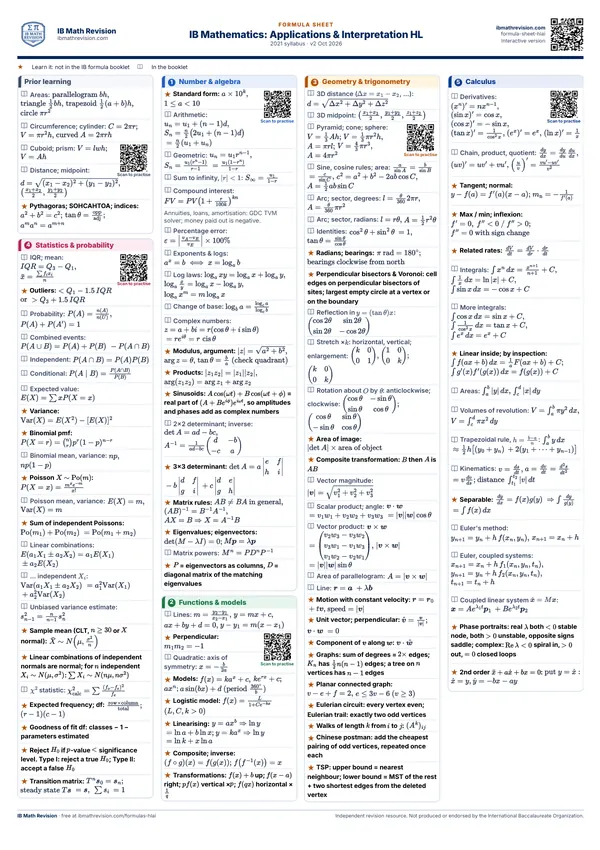
- A4 colour sheetOne page, colour-coded by topic, ★ on the ones to learn · PDF 789 KB
- A3 posterFor your wall: adds when to use each formula · PDF 853 KB
- Print-friendlyOne A4 page in black and white, saves ink · PDF 765 KB
- Formulas you must memoriseOne A4 page: only the ones not in the booklet · PDF 391 KB
Key formulas explained, with a worked example
Binomial distribution Chain rule Derivative of sin x Product rule Pythagoras' theorem Quotient rule Sum to infinity of a geometric series Trig identities
Questions
Is this the IB's own formula booklet?
No. It is our own page, written in the same notation as the IB formula booklet so you get used to it. In the exam you are given a clean copy of the IB booklet.
Can I take this sheet into the exam?
No. Only the clean copy of the IB formula booklet that the exam provides is allowed. Use this page and the PDF to revise.
Do HL students need the SL formulas too?
Yes. HL papers can use every SL formula as well as these HL ones. The free IB Maths AI HL PDF has both on one page.
Do you get the formula booklet in every IB Maths AI HL paper?
Yes. A clean copy of the formula booklet is provided in all three papers. You cannot bring your own copy or any notes.
How do I get quick at using the formula booklet?
Practise past-style questions with the booklet open beside you, so you know which topic each formula sits under and what each letter means. Then learn the results it leaves out (our formulas-to-memorise page lists them with worked examples).
Is there a separate formula booklet for SL and HL?
Yes. AI has an SL booklet and an HL booklet. The HL booklet includes the SL formulas as well as the HL ones, so HL students need only the HL booklet.
Is the IB Maths AI HL data booklet the same as the formula booklet?
Yes. For maths the IB calls it the formula booklet; "data booklet" is the name of the IB Chemistry and Physics booklets, so many students use either name. Everything on this page is in the IB Maths AI HL formula booklet, apart from the results marked as not in the booklet.
Which formula booklet is used for the 2026 exams?
The current editions, for first assessment 2021. They are used for every exam on the current courses, up to the last ones in November 2028. The revised courses are first examined in May 2029.
Is the PDF free?
Yes. The PDFs (A4, A3 poster, black and white, and the formulas to memorise) and this page are free, with no sign-up.
What else is free here
- AI HL questions by topicUse these formulas on exam-style questions, each with a full mark scheme, so you learn when each one applies.
- AI HL revision notesEvery topic in plain English with a worked example, to fill the gaps the questions show up.
- Where AI HL students lose marksA summary of the IB's published subject reports, so you avoid the common slips.
- Free AI HL practice exams (PDF)A printable exam for each unit, with a separate mark scheme.
Make a free account: no card needed5 more practice questions on every topic with instant feedback, full worked answers on free questions, 3 AI-marked answers a week, free, and your streak and progress on any device.
Join freeAlready have an account? Sign in
Other courses: IB Math AI SL formula sheet · IB Math AA SL formula booklet · IB Math AA HL formula booklet · Print-ready one-page booklet · HL AI revision notes · HL AI questions by topic