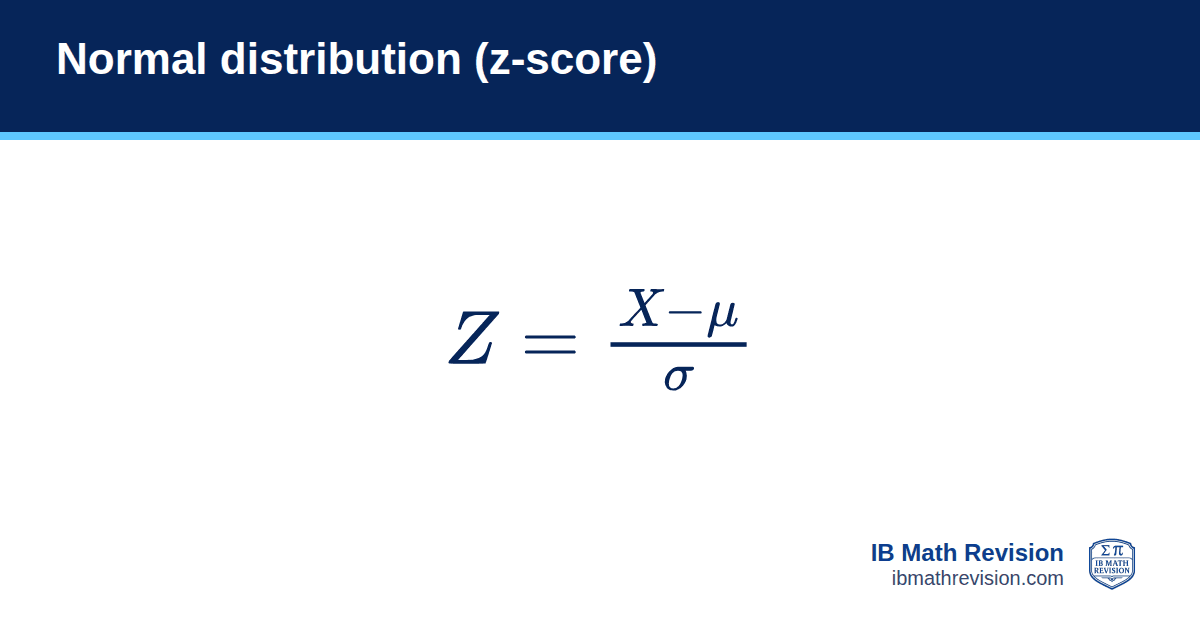
Normal distribution formula: z = (x − μ) / σ
The normal distribution formula is z = (x − μ) / σ, which turns X ~ N(μ, σ²) into Z ~ N(0, 1).
What each letter means
- \(X\) a normally distributed variable, X ~ N(μ, σ²)
- \(\mu\) the mean
- \(\sigma\) the standard deviation (the square root of the variance σ²)
- \(Z\) the standard normal variable, mean 0 and standard deviation 1
When to use it
To turn a normal probability into a standard one, and to find an unknown mean or standard deviation from a given probability.
Worked examples
1. \(X\sim N(50,\,4^2)\). Find \(P(X<56)\).
- \(z=\dfrac{56-50}{4}=1.5\)
- \(P(Z<1.5)\) from your GDC
Answer: \(P(X<56)=0.933\) (3 s.f.)
2. \(X\sim N(50,\,\sigma^2)\) and \(P(X<62)=0.9\). Find \(\sigma\).
- Inverse normal: \(P(Z
- \(\dfrac{62-50}{\sigma}=1.2816\ldots\)
Answer: \(\sigma=9.36\) (3 s.f.)
Common mistake
Dividing by the variance. X ~ N(50, 16) has σ = 4, not 16.
On your course
| Course | In the exam |
|---|---|
| AA SL | In the IB formula booklet |
| AA HL | In the IB formula booklet |
From our own IB Maths formula sheets, in our words. The IB gives its booklet to schools, so we checked against our own copy: your teacher has the official one. Official: IB DP Mathematics page.
Practise and revise
- Practise AA SL normal distribution questions
- Revise Normal distribution (AA SL)
- Revise Normal distribution (AI SL)
- Tool Normal distribution on your GDC
- Print AA SL one-page formula sheet
Questions
What is the normal distribution formula?
The normal distribution formula is z = (x − μ) / σ, which turns X ~ N(μ, σ²) into Z ~ N(0, 1). X: a normally distributed variable, X ~ N(μ, σ²); μ: the mean; σ: the standard deviation (the square root of the variance σ²); Z: the standard normal variable, mean 0 and standard deviation 1.
Is the normal distribution (z-score) given in the exam?
AA SL: in the IB formula booklet. AA HL: in the IB formula booklet. This comes from our own IB Maths formula sheets; your teacher has the official booklet.
What does a z-score mean?
It says how many standard deviations a value lies above (positive) or below (negative) the mean.
Our own wording, examples and card, checked by IB Math Revision. Not produced or endorsed by the International Baccalaureate Organization.