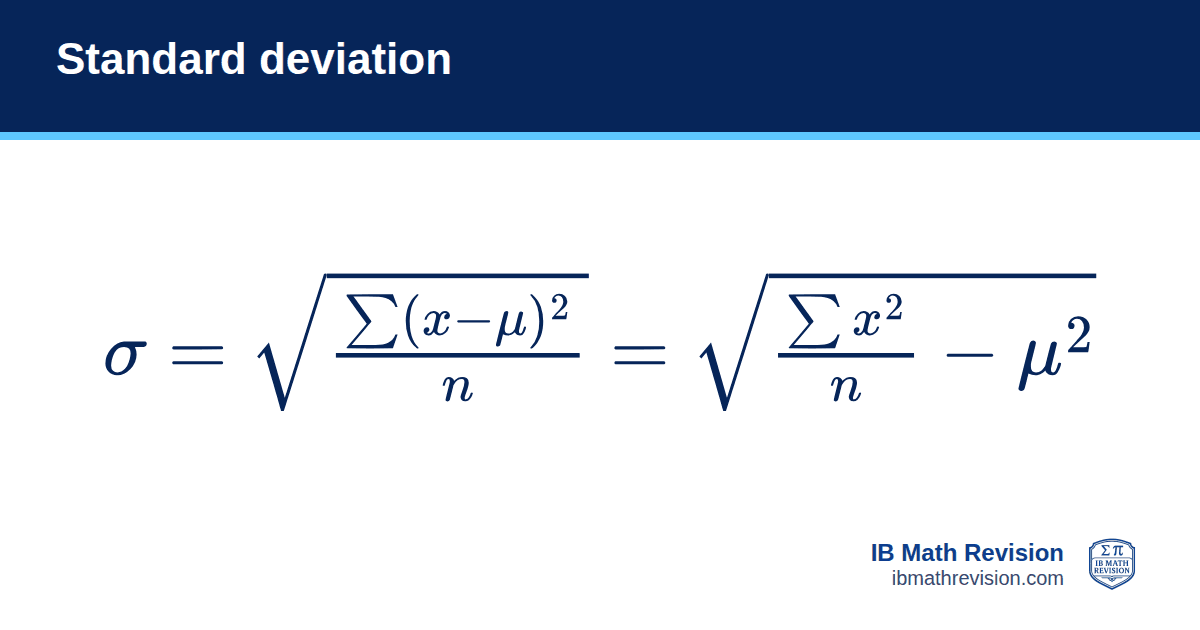
Standard deviation formula: σ = √(Σ(x − μ)² / n)
The standard deviation formula is σ = √(Σ(x − μ)² / n) = √(Σx²/n − μ²).
What each letter means
- \(\sigma\) the standard deviation
- \(x\) each data value
- \(\mu\) the mean
- \(n\) the number of values
When to use it
To measure how spread out data are around the mean. The second form is quicker when you are given Σx and Σx².
Worked example
Find the standard deviation of \(4,\ 7,\ 8,\ 10,\ 11\).
- \(\mu=\dfrac{40}{5}=8\)
- \(\sum(x-\mu)^2=16+1+0+4+9=30\), so \(\sigma=\sqrt{\tfrac{30}{5}}=\sqrt6\)
Answer: \(\sigma=2.45\) (3 s.f.)
Common mistake
Forgetting the square root (that gives the variance), or squaring the mean of x instead of subtracting μ².
On your course
| Course | In the exam |
|---|---|
| AA SL | Not in the booklet: learn it |
| AI SL | Not in the booklet: learn it |
| AA HL | Not in the booklet: learn it |
From our own IB Maths formula sheets, in our words. The IB gives its booklet to schools, so we checked against our own copy: your teacher has the official one. Official: IB DP Mathematics page.
Practise and revise
Questions
What is the standard deviation formula?
The standard deviation formula is σ = √(Σ(x − μ)² / n) = √(Σx²/n − μ²). σ: the standard deviation; x: each data value; μ: the mean; n: the number of values.
Is the standard deviation given in the exam?
AA SL: not in the booklet: learn it. AI SL: not in the booklet: learn it. AA HL: not in the booklet: learn it. This comes from our own IB Maths formula sheets; your teacher has the official booklet.
Should I divide by n or n − 1?
This page divides by n: the standard deviation of the data set itself (σx on a calculator). Dividing by n − 1 (sx) estimates a population's standard deviation from a sample; use it only when the question asks for that.
Our own wording, examples and card, checked by IB Math Revision. Not produced or endorsed by the International Baccalaureate Organization.