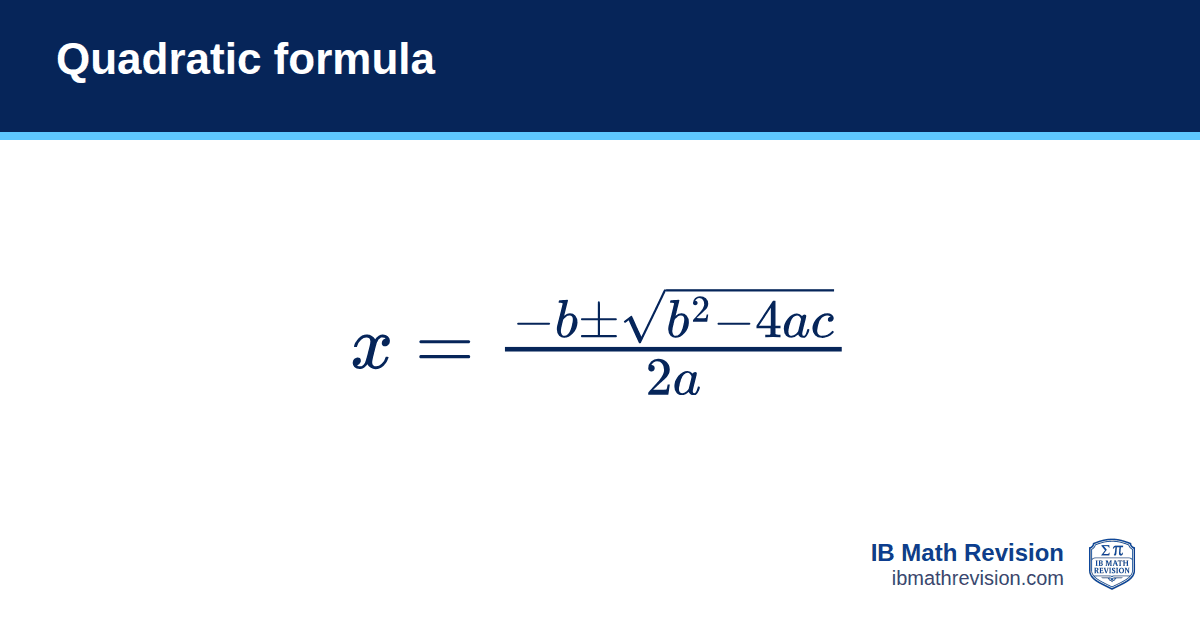
Quadratic formula: x = (−b ± √(b² − 4ac)) / 2a
The quadratic formula is x = (−b ± √(b² − 4ac)) / 2a.
What each letter means
- \(a,\ b,\ c\) the numbers in ax² + bx + c = 0 (a is not 0)
- \(x\) the solutions (roots) of the equation
- \(b^2-4ac\) the discriminant: it tells you how many real roots there are
When to use it
To solve any quadratic equation ax² + bx + c = 0, especially one that does not factorise. Rearrange so that one side is 0 before you read off a, b and c.
Worked example
Solve \(2x^2-3x-4=0\), giving your answers to 3 significant figures.
- \(a=2,\ b=-3,\ c=-4\)
- \(x=\dfrac{3\pm\sqrt{9+32}}{4}=\dfrac{3\pm\sqrt{41}}{4}\)
Answer: \(x=2.35\) or \(x=-0.851\)
Common mistake
Losing a minus sign. If b = −3, then −b = 3 and b² = 9, not −9. Put negative values in brackets when you substitute.
On your course
| Course | In the exam |
|---|---|
| AA SL | In the IB formula booklet |
| AA HL | In the IB formula booklet |
From our own IB Maths formula sheets, in our words. The IB gives its booklet to schools, so we checked against our own copy: your teacher has the official one. Official: IB DP Mathematics page.
Practise and revise
Questions
What is the quadratic formula?
The quadratic formula is x = (−b ± √(b² − 4ac)) / 2a. a, b, c: the numbers in ax² + bx + c = 0 (a is not 0); x: the solutions (roots) of the equation; b²-4ac: the discriminant: it tells you how many real roots there are.
Is the quadratic formula given in the exam?
AA SL: in the IB formula booklet. AA HL: in the IB formula booklet. This comes from our own IB Maths formula sheets; your teacher has the official booklet.
What does the discriminant tell you?
If b² − 4ac is positive there are two different real roots, if it is 0 there is one repeated root, and if it is negative there are no real roots.
Our own wording, examples and card, checked by IB Math Revision. Not produced or endorsed by the International Baccalaureate Organization.