IA ideas library
Voting, fair division and game theory IA ideas
How should a class choose a trip, split a bill or share out chores fairly? Mathematics has precise answers, and they often disagree. Voting methods can crown different winners from the same ballots, fair-division methods guarantee different kinds of fairness, and game theory predicts what rational people will do when their choices affect each other.
Almost none of this is in the IB syllabus, so explain each method clearly with a small example. The mathematics you bring from your course (probability, expected value, counting, sometimes calculus) does the analysis.
Voting, fairness & game theory ideas (8)
- Same ballots, different winners: comparing voting methods in a class voteAA SLAI SLAA HLAI HLAccessible
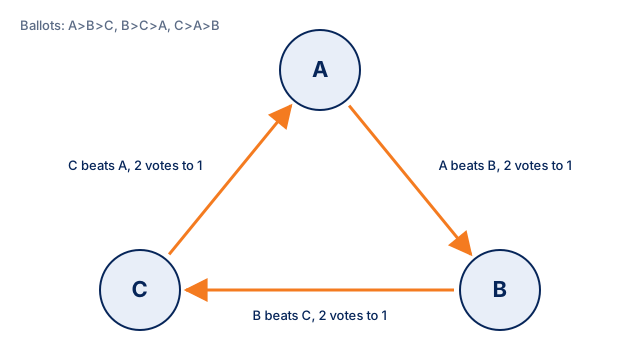
- How likely is a voting paradox? Rock–paper–scissors preferencesAA HLAI HLAmbitious
- Cutting a cake fairly when people value it differentlyAA SLAA HLSolid
- Left, right or centre? Game theory for penalty kicksAA SLAI SLAA HLAI HLSolid
- Who should pay what for a shared taxi? The Shapley valueAA SLAI SLAA HLSolid
- Turning votes into seats: D'Hondt, Sainte-Laguë and largest remainderAI SLAA SLAI HLSolid
- Secret Santa: how often does someone draw their own name?AA HLAA SLSolid
- How much should you bid in a sealed-bid auction?AA HLAA SLAmbitious
Also relevant (4)
- Is a penalty shoot-out fair to the team that shoots second?AA SLAA HLAI SLAI HLSolid
- When should you stop looking? The 37% rule for choosing the bestAA HLAA SLAI HLAmbitious
- Can you beat people at rock–paper–scissors?AI SLAI HLAA SLAA HLAccessible
- Does the best team win? Knockout cups versus leaguesAI SLAI HLAA SLAA HLSolid
Frequently asked questions
Is game theory mathematical enough for a Maths IA?
Yes, when you calculate: expected payoffs, mixed strategies found by solving equations, probabilities of outcomes, or proofs that a method is fair. A description of the prisoner's dilemma alone is not enough.
Can I use real election results?
Yes, from official sources, but most published results show only first choices, so methods that need full rankings must be simulated or tested on ballots you collect yourself. Say clearly which you did.
Free: the IA checklist an examiner uses
Every check for Criteria A–E in a 4-page PDF, the mistakes that cost the most marks and a self-assessment grid. We'll email it with a short IA tip every few days, timed to your deadline if you give it. Free — no account, no payment.
While you wait for the email: read a free annotated exemplar excerpt →
Related types of IA: Games & puzzles · Probability & chance
Other topics: Modelling · Calculus · Differential equations · Statistics · Probability · Geometry & Voronoi · Finance · Sport · Environment · Health & biology · Networks & graphs · Pure maths · Art & music · Games & puzzles · Optimisation · Simulation · Cryptography · Numerical methods · Fractals & chaos · Matrices & Markov · Trig & navigation · Kinematics · Surveys
By interest: Computer science · Physics and engineering · Psychology and social sciences · Geography and travel · Chemistry · Biology · Economics · Business management · Sports, exercise and health science · Environmental systems and societies · Music · Visual arts · Design technology · By course: AA SL · AA HL · AI SL · AI HL