IA ideas library
Numerical methods IA ideas: iteration, Newton–Raphson, integration and error
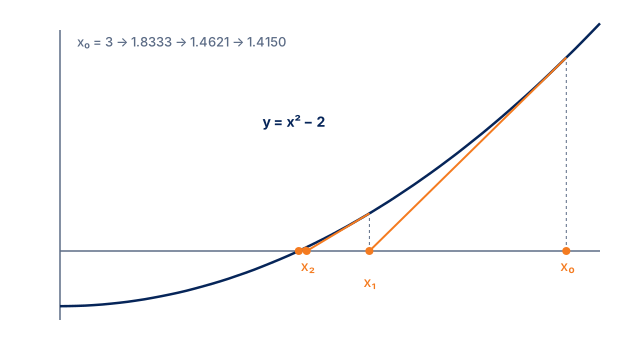
Calculators and computers don't solve equations the way you do in class: they iterate. A numerical methods IA asks how an approximation works, how fast it gets close to the answer, and how big the error is. That last question is where the mathematics lives.
The trapezoidal rule (SL) and Euler's method (HL) are in the IB courses; Newton–Raphson, Simpson's rule and fixed-point iteration are not, so explain them as new mathematics. These IAs need no data collection, which suits students who would rather calculate than measure.
Next step: shortlist ideas with the free IA topic explorer, which filters starting points by course, interest and how easy the data is to get. For feedback on your own draft, the IA package (€39 once) gives you 5 AI feedback credits and every annotated exemplar in full.
How numerical methods explorations reach the top bands
Personal engagement (C)
Choose the function or equation yourself and predict how each method will behave before you run it. Hunting for the cases that break a method is engagement an examiner can see.
Reflection (D)
Reflect on error: how it changes with step size or iterations, why a method converges slowly or not at all, and how you know your 'exact' comparison value is correct.
Use of mathematics (E)
SL: The trapezoidal rule or a simple iteration applied correctly, errors tabulated against step size and explained, with any method outside the syllabus explained step by step.
HL: Convergence analysed rather than observed: an error bound derived with calculus or a series, an order of convergence measured and justified, or Euler's method studied against an exact solution.
An HL version
Derive an error bound with a Maclaurin series or calculus, then show your numerical results follow it.
Numerical methods & error analysis ideas (8)
- Why does the ancient square-root method double the correct digits?AA SLAA HLSolid
- Trapezoidal rule or Simpson's rule? Areas under the normal curveAA SLAA HLAI SLSolid
- When does Newton–Raphson fail? Cycles, divergence and basins of attractionAA HLAA SLAmbitious
- How small must the step be? Euler's method against an exact solutionAA HLAI HLSolid
- Press cos again and again: when does fixed-point iteration converge?AA SLAA HLSolid
- How many terms do you need? Fast and slow series for πAA HLAmbitious
- What interest rate are you really paying? Solving for the rate by iterationAI SLAI HLAA SLSolid
- When the computer gets it wrong: rounding error and cancellationAA HLAA SLAI HLAmbitious
Also relevant (5)
- How big is my local lake? Estimating area with the trapezoidal ruleAI SLAI HLAA SLAA HLAccessible
- How does a calculator work out sin(x)?AA HLAA SLSolid
- Where should a shared mast go? Minimising total distance to villagesAA HLAI HLAA SLAmbitious
- From steady to chaotic: the logistic map's period doublingAA HLAI HLAmbitious
- How high did the lift go? Integrating a phone's accelerometerAA SLAA HLAI HLSolid
Frequently asked questions
Can a numerical methods IA reach the top of Criterion E?
Yes, if it goes beyond running the method: comparing methods, measuring and explaining the rate at which the error shrinks, and finding cases where a method fails and saying why.
Which numerical methods are in the IB syllabus?
The trapezoidal rule is in both SL courses and Euler's method is in both HL courses. Newton–Raphson, Simpson's rule and the bisection method are not; you may use them if you explain them.
Start your IA plan, free
Answer the planning questions: your question, the maths, the data and milestones back from your deadline. Then take it to your first teacher meeting.
Your plan is kept in this browser. A free account keeps it with your drafts on any device: Join free · Sign in
- Free IA self-check: guided questions give a rough band for each criterion. No upload.
- The A–E checklist as a PDF, free by email.
- Have a draft? AI feedback against A–E (Criterion A free), or a one-to-one review with Pete (€100).
Related types of IA: Calculus & optimisation · Differential equations & dynamics
Other topics: Modelling · Calculus · Differential equations · Statistics · Probability · Geometry & Voronoi · Finance · Sport · Environment · Health & biology · Networks & graphs · Pure maths · Art & music · Games & puzzles · Optimisation · Simulation · Cryptography · Fractals & chaos · Matrices & Markov · Trig & navigation · Kinematics · Voting & game theory · Surveys
By interest: Computer science · Physics and engineering · Psychology and social sciences · Geography and travel · Chemistry · Biology · Economics · Business management · Sports, exercise and health science · Environmental systems and societies · Music · Visual arts · Design technology · By course: AA SL · AA HL · AI SL · AI HL