IA ideas library
Optimisation IA ideas beyond the drinks can: constraints, trade-offs and linear programming
Every optimisation exploration asks the same thing: what is the best choice, and best by which measure? The ideas here go beyond a single variable and a derivative. Some have several constraints at once (linear programming), some trade one goal against another, and some need calculus with two variables or a numerical search because there is no neat formula.
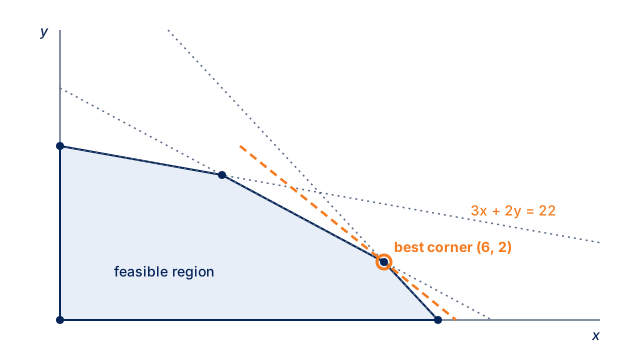
Linear programming is not in either IB course, so treat it as new mathematics: explain the feasible region, why the optimum sits at a vertex, and check it by hand on a small case before you trust software. Single-variable calculus optimisation lives on the calculus page; the ideas here suit students who want a decision with more moving parts.
Next step: shortlist ideas with the free IA topic explorer, which filters starting points by course, interest and how easy the data is to get. For feedback on your own draft, the IA package (€39 once) gives you 5 AI feedback credits and every annotated exemplar in full.
How optimisation explorations reach the top bands
Personal engagement (C)
Optimise a decision that is really yours or your school's (a timetable, a budget, a delivery), gather the real constraints yourself, and say which ones you chose to ignore and why.
Reflection (D)
Compare the mathematical optimum with what people actually do, and test how sensitive the optimum is: which constraint, if relaxed a little, would change the answer most?
Use of mathematics (E)
SL: An objective function and constraints set up from the context, solved correctly (graphically for two variables, or with differentiation), the optimum checked and interpreted, and any new method such as linear programming explained in your own words.
HL: Optimisation with two or more variables, a justified numerical search, a proof that the optimum lies at a vertex, or a sensitivity analysis with calculus, used because the problem needs it.
An HL version
Add a second variable or a non-linear constraint, use a numerical search where calculus alone is not enough, and analyse how the optimum moves as a parameter changes.
Optimisation & linear programming ideas (8)
- What is the cheapest way to hire coaches for a school trip?AA SLAI SLAA HLAI HLAccessible
- The cheapest healthy weekly shop: a linear programming diet problemAI SLAI HLAA SLSolid
- How many of each? Planning a charity bake sale with linear programmingAA SLAI SLAccessible
- Cutting shelves from planks with the least wasteAA SLAA HLAI SLAI HLSolid
- How few staff can a café roster? An integer programming rotaAI SLAI HLAA SLSolid
- Where should a shared mast go? Minimising total distance to villagesAA HLAI HLAA SLAmbitious
- What speed minimises the total cost of a long drive?AA SLAI SLAA HLAI HLSolid
- Square or hexagonal? Packing tins into a boxAA SLAA HLAI SLSolid
Also relevant (7)
- Why aren't drinks cans the optimal shape?AA SLAI SLAA HLAI HLAccessible
- Will the sofa fit round the corner? The longest object through a corridorAA SLAA HLAI SLAI HLSolid
- What price maximises profit at our school bake sale?AA SLAI SLAA HLAI HLSolid
- A fractal shortcut for the travelling salesman: ordering stops along a Hilbert curveAI HLAA HLAmbitious
- What is the best angle to sail upwind?AA HLAA SLAI HLAmbitious
- Designing an accessible ramp for a real entranceAA SLAI SLAccessible
- Crossing a river with a current: fastest or straightest?AA HLAI HLAA SLSolid
Frequently asked questions
Can I use linear programming in a Maths IA if it isn't on the syllabus?
Yes. Mathematics from outside the course is allowed if you explain it clearly and show that you understand it. Draw the feasible region for a two-variable version by hand, explain why the optimum is at a corner, then use a solver for larger versions.
How is this different from a calculus optimisation IA?
Calculus optimisation finds a turning point of one smooth function. These ideas add constraints, several variables or competing goals, so you have to choose the method, not just apply one. See the calculus ideas for single-variable problems.
Start your IA plan, free
Answer the planning questions: your question, the maths, the data and milestones back from your deadline. Then take it to your first teacher meeting.
Your plan is kept in this browser. A free account keeps it with your drafts on any device: Join free · Sign in
- Free IA self-check: guided questions give a rough band for each criterion. No upload.
- The A–E checklist as a PDF, free by email.
- Have a draft? AI feedback against A–E (Criterion A free), or a one-to-one review with Pete (€100).
Related types of IA: Calculus & optimisation · Networks, graphs & algorithms
Taking Business Management or Design Technology? Maths IA ideas for business management students · Maths IA ideas for design technology students
Other topics: Modelling · Calculus · Differential equations · Statistics · Probability · Geometry & Voronoi · Finance · Sport · Environment · Health & biology · Networks & graphs · Pure maths · Art & music · Games & puzzles · Simulation · Cryptography · Numerical methods · Fractals & chaos · Matrices & Markov · Trig & navigation · Kinematics · Voting & game theory · Surveys
By interest: Computer science · Physics and engineering · Psychology and social sciences · Geography and travel · Chemistry · Biology · Economics · Business management · Sports, exercise and health science · Environmental systems and societies · Music · Visual arts · Design technology · By course: AA SL · AA HL · AI SL · AI HL