IA ideas library
Kinematics IA ideas: motion, velocity and acceleration from your own data
Phones and free video-tracking software make it easy to collect motion data: the position of a ball every thirtieth of a second, the acceleration of a lift, the speed of a bike. Kinematics IAs turn that data into displacement, velocity and acceleration with calculus, and test a model of the motion against it.
Calculus kinematics is in AA SL and AI HL, and vectors add a second dimension at HL. Keep the focus mathematical: a physics law can motivate the model, but the IA is about deriving, fitting and testing it.
Next step: shortlist ideas with the free IA topic explorer, which filters starting points by course, interest and how easy the data is to get. For feedback on your own draft, the IA package (€39 once) gives you 5 AI feedback credits and every annotated exemplar in full.
How kinematics explorations reach the top bands
Personal engagement (C)
Film or record the motion yourself, choose what to vary, and say what you expected before you analysed it.
Reflection (D)
Compare your model with the data and explain each mismatch (air resistance, friction, tracking error); reflect on how noise affects numerical derivatives.
Use of mathematics (E)
SL: Displacement, velocity and acceleration related by differentiation and integration, fitted models compared with residuals, and the physics assumptions turned into stated mathematical assumptions.
HL: Vectors for motion in two dimensions, a differential equation for a resisted motion solved and compared with data, or numerical differentiation with an error analysis.
An HL version
Add air resistance or friction as a differential equation, solve it (analytically or with Euler's method) and compare with the simpler model.
Kinematics & physics-style modelling ideas (8)
- How high did the lift go? Integrating a phone's accelerometerAA SLAA HLAI HLSolid
- Estimating g from a video of a falling ballAA SLAI SLAccessible
- Why is a rolling marble slower than a sliding block?AA SLAI SLAA HLSolid
- Crossing a river with a current: fastest or straightest?AA HLAI HLAA SLSolid
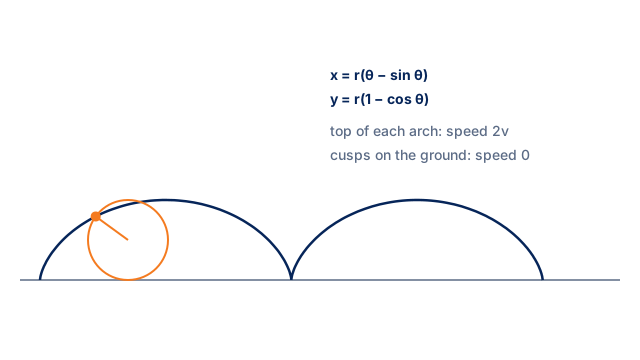
- The path of a bike valve: parametric equations of a cycloidAA HLAI HLAmbitious
- How fast does a sledge go? Acceleration, friction and slopeAA SLAI SLAA HLSolid
- How quickly does a swing die down? Exponential or linear decay?AA SLAA HLAI HLAI SLSolid
- Modelling a bus journey between two stops from a phone's sensorsAA SLAI SLAI HLSolid
Also relevant (8)
- How fast is a sprinter at each moment? Differentiating 100 m splitsAA SLAA HLAI SLAI HLSolid
- Linear or quadratic drag? Testing air resistance with falling coffee filtersAA HLAI HLSolid
- What is the best angle to shoot a free throw?AA SLAA HLAI SLAI HLSolid
- Why don't long jumpers take off at 45°?AA SLAA HLAI SLAI HLSolid
- How fast does a speaker get quieter? Decibels, logarithms and distanceAA SLAI SLAA HLAI HLAccessible
- What speed minimises the total cost of a long drive?AA SLAI SLAA HLAI HLSolid
- Why do buses come in bunches? A simulation of a bus routeAI HLAI SLAA HLAmbitious
- What is the best angle to sail upwind?AA HLAA SLAI HLAmbitious
Frequently asked questions
How is a kinematics Maths IA different from a Physics IA?
A Maths IA is assessed on the mathematics: setting up functions, differentiating and integrating them, fitting and comparing models and reflecting on them. Apparatus and procedure matter much less than in Physics. Check your school's rules before using the same experiment for both.
What software can I use for motion data?
Tracker (free video analysis) gives position against time from a video; phyphox turns a phone's sensors into data loggers. Both export CSV for a spreadsheet, Desmos or GeoGebra.
Start your IA plan, free
Answer the planning questions: your question, the maths, the data and milestones back from your deadline. Then take it to your first teacher meeting.
Your plan is kept in this browser. A free account keeps it with your drafts on any device: Join free · Sign in
- Free IA self-check: guided questions give a rough band for each criterion. No upload.
- The A–E checklist as a PDF, free by email.
- Have a draft? AI feedback against A–E (Criterion A free), or a one-to-one review with Pete (€100).
Related types of IA: Calculus & optimisation · Differential equations & dynamics · Sport
Other topics: Modelling · Calculus · Differential equations · Statistics · Probability · Geometry & Voronoi · Finance · Sport · Environment · Health & biology · Networks & graphs · Pure maths · Art & music · Games & puzzles · Optimisation · Simulation · Cryptography · Numerical methods · Fractals & chaos · Matrices & Markov · Trig & navigation · Voting & game theory · Surveys
By interest: Computer science · Physics and engineering · Psychology and social sciences · Geography and travel · Chemistry · Biology · Economics · Business management · Sports, exercise and health science · Environmental systems and societies · Music · Visual arts · Design technology · By course: AA SL · AA HL · AI SL · AI HL