Free download
The Maths IA checklist I use with my own students
I'm Pete Bromfield, a former Head of Maths with IB examining experience. I give my own students a one-page, student-friendly checklist for every criterion. This is that checklist, rewritten for everyone: 46 checks across Criteria A–E, the mistakes I see most, and a self-assessment grid to fill in before your draft goes to your teacher.
Get the checklist (PDF)
I'll email it to you. Then, for three weeks, the weekly Math Revision email carries one IA tip, in the order you need them: choosing a question, where the marks are, engagement and reflection. Give your school's deadline and each tip tells you where you should be. One-click unsubscribe.
The email form needs JavaScript.
Prefer not to give an email? Download the PDF directly.
A · Presentation (4)
- A title and a clear, precise aim in the introduction (one of the most important sentences you will write).
- An introduction, a body and a conclusion — and each part links to the next.
- Written for a classmate (a peer), not for your teacher: someone who knows the course but not your topic can follow it.
B · Mathematical communication (4)
- Every variable defined when it first appears, with units and domain (e.g., “let t be the time in minutes, t ≥ 0”).
- Key terms defined where they are first used — not in a glossary at the start.
- No calculator or computer notation: write x², not x^2; e^(0.5t) as a proper exponent; √ not sqrt; × not *; E for standard form never.
C · Personal engagement (3)
- Your own question — not a topic lifted from a list without changes.
- Predictions made before calculating, then tested (“I expected the exponential to fit better because…”).
- Questions you ask and answer along the way (“Would this still work for a deeper chain?”).
D · Reflection (3)
- After each major result: what does it mean in context, and is it reasonable?
- “What next?” — reflection that leads to the next step (“the residuals show a pattern, so I tried…”).
- Comparisons between methods or models, with reasons for choosing one.
E · Use of mathematics (6)
- Every technique is relevant to your aim — it helps answer the question.
- Mathematics at the level of your course (or similar), not only prior-knowledge mathematics.
- Reasoning shown: why each method is appropriate and what each step does.
…and 31 more checks in the PDF.
What's in it
- A–E checks in plain English, each one something you can tick off in your own draft.
- The mistakes that cost the most marks, with the fix for each.
- HL: what changes in Criterion E (and what doesn't).
- A self-assessment grid to estimate your band for each criterion — and see where the next marks are.
- A reminder of the academic integrity rules, including how to acknowledge AI tools.
The official level descriptors are in the IB subject guide — ask your teacher. This checklist is our own guidance and is not produced or endorsed by the IB.
Want feedback on your draft against the checklist?
Upload it to AI IA feedback for criterion-by-criterion comments, or book a One-to-one IA Review with Pete.
Fitting a model to data?
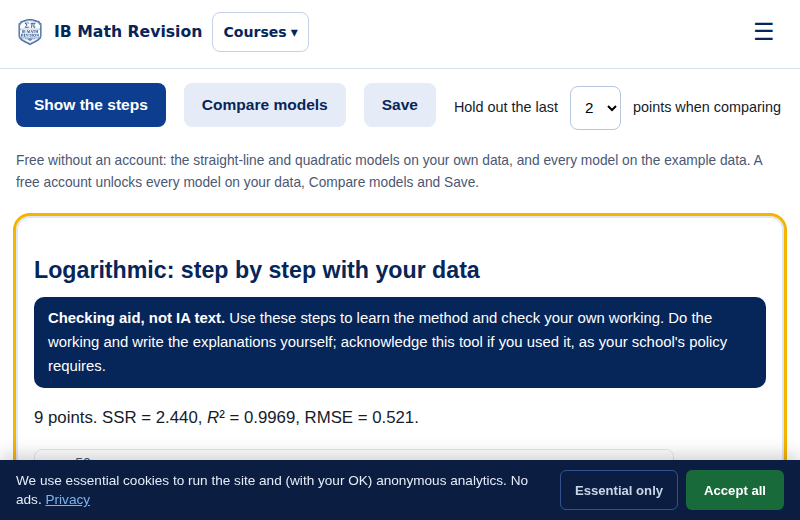
Paste your Desmos data, get the step-by-step method, send the model back. Model my data runs every common model on your numbers, with a criterion tip at each step — and the modelling guide shows each model worked in full.
Teachers and IB coordinators: you are welcome to link to this checklist from your school's IA page. Free IA resources for schools, with ready-to-paste links.