IB Maths Question of the Day and weekly starter questions
Our own IB Maths practice questions as images you can open, save or share: the daily puzzles from the Question of the Day and the weekly lesson starters, by course and week. Each image names the course and topic, and the question text is written out below it.
Question of the Day
The Question of the Day is a three-part multiple-choice puzzle, a new one each day, with hints if you get stuck. These are all the puzzles in the rotation, as images.
IB Maths AA SL
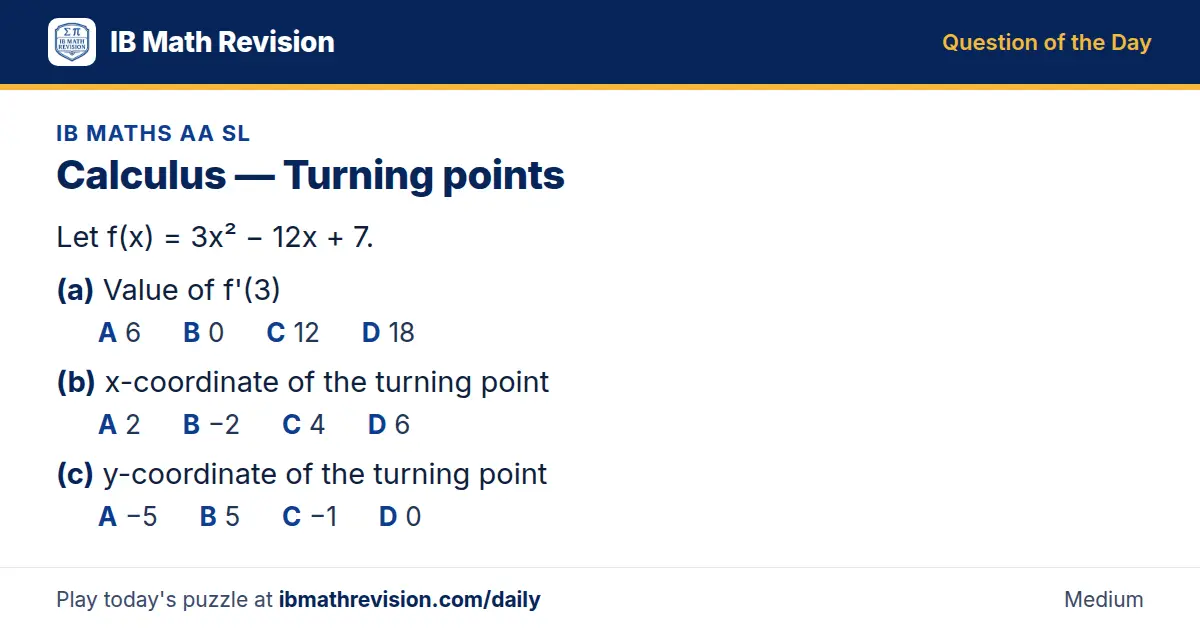
Calculus — Turning points
Let f(x) = 3x² − 12x + 7.
- Value of f'(3) Options: A) 6; B) 0; C) 12; D) 18
- x-coordinate of the turning point Options: A) 2; B) −2; C) 4; D) 6
- y-coordinate of the turning point Options: A) −5; B) 5; C) −1; D) 0
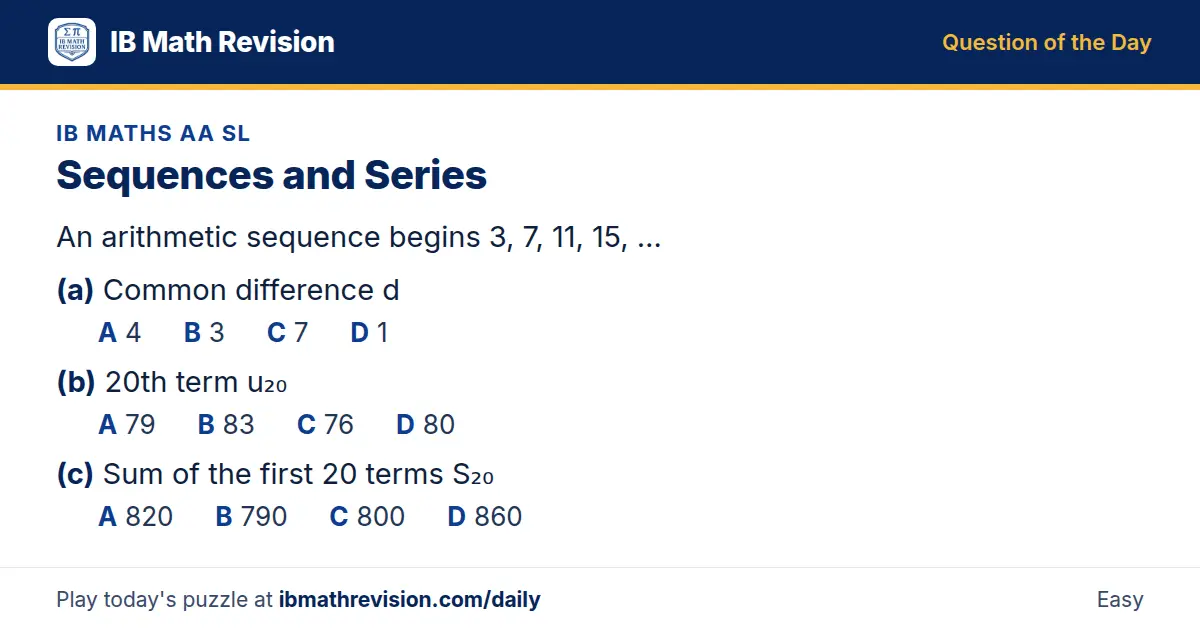
Sequences and Series
An arithmetic sequence begins 3, 7, 11, 15, …
- Common difference d Options: A) 4; B) 3; C) 7; D) 1
- 20th term u₂₀ Options: A) 79; B) 83; C) 76; D) 80
- Sum of the first 20 terms S₂₀ Options: A) 820; B) 790; C) 800; D) 860
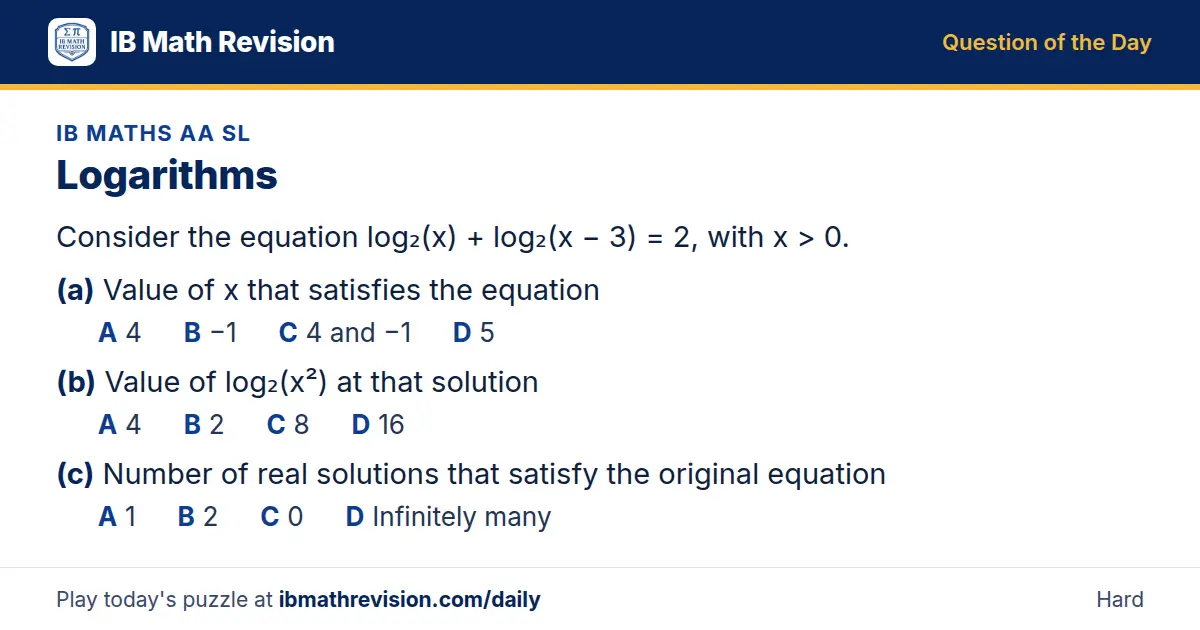
Logarithms
Consider the equation log₂(x) + log₂(x − 3) = 2, with x > 0.
- Value of x that satisfies the equation Options: A) 4; B) −1; C) 4 and −1; D) 5
- Value of log₂(x²) at that solution Options: A) 4; B) 2; C) 8; D) 16
- Number of real solutions that satisfy the original equation Options: A) 1; B) 2; C) 0; D) Infinitely many
IB Maths AI SL
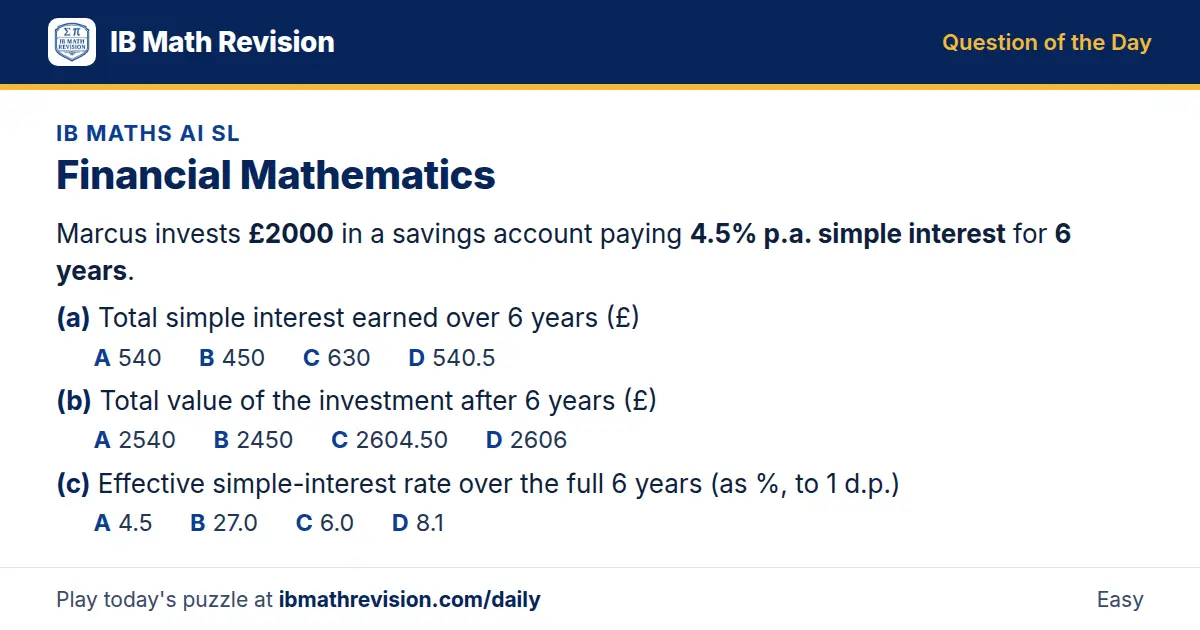
Financial Mathematics
Marcus invests £2000 in a savings account paying 4.5% p.a. simple interest for 6 years.
- Total simple interest earned over 6 years (£) Options: A) 540; B) 450; C) 630; D) 540.5
- Total value of the investment after 6 years (£) Options: A) 2540; B) 2450; C) 2604.50; D) 2606
- Effective simple-interest rate over the full 6 years (as %, to 1 d.p.) Options: A) 4.5; B) 27.0; C) 6.0; D) 8.1
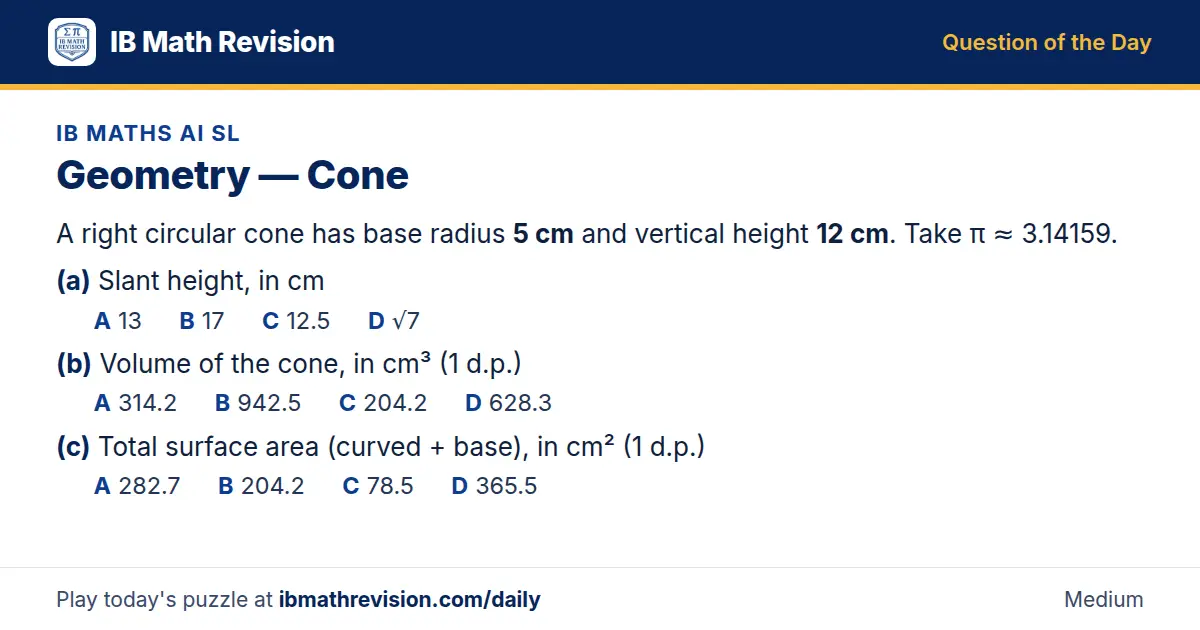
Geometry — Cone
A right circular cone has base radius 5 cm and vertical height 12 cm. Take π ≈ 3.14159.
- Slant height, in cm Options: A) 13; B) 17; C) 12.5; D) √7
- Volume of the cone, in cm³ (1 d.p.) Options: A) 314.2; B) 942.5; C) 204.2; D) 628.3
- Total surface area (curved + base), in cm² (1 d.p.) Options: A) 282.7; B) 204.2; C) 78.5; D) 365.5
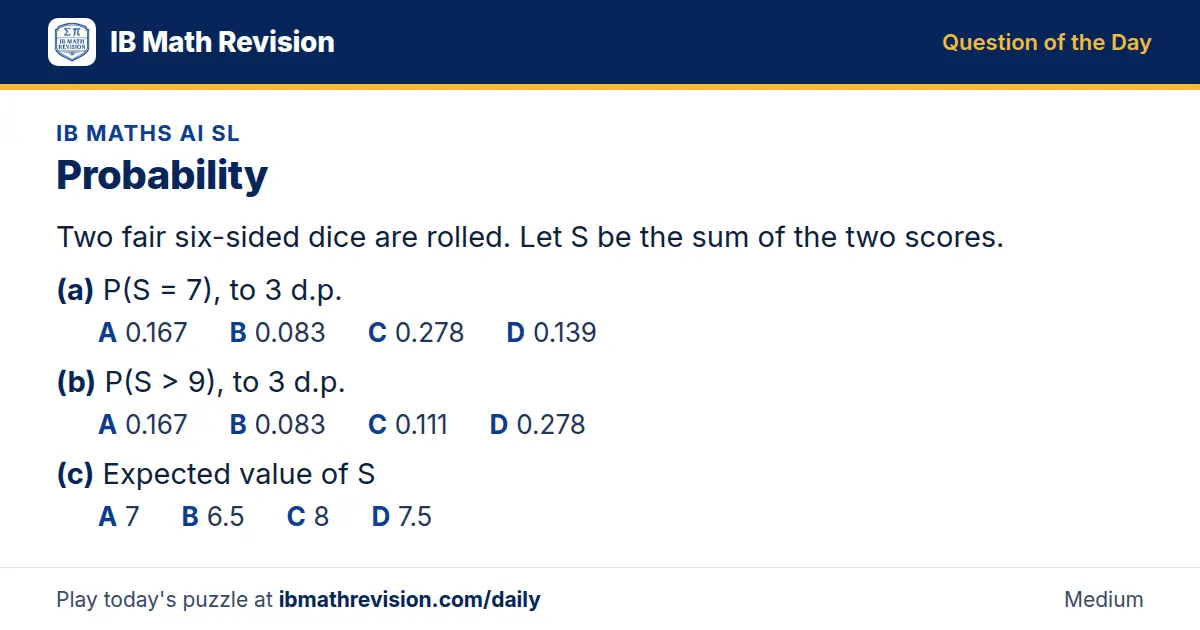
Probability
Two fair six-sided dice are rolled. Let S be the sum of the two scores.
- P(S = 7), to 3 d.p. Options: A) 0.167; B) 0.083; C) 0.278; D) 0.139
- P(S > 9), to 3 d.p. Options: A) 0.167; B) 0.083; C) 0.111; D) 0.278
- Expected value of S Options: A) 7; B) 6.5; C) 8; D) 7.5
IB Maths AA HL
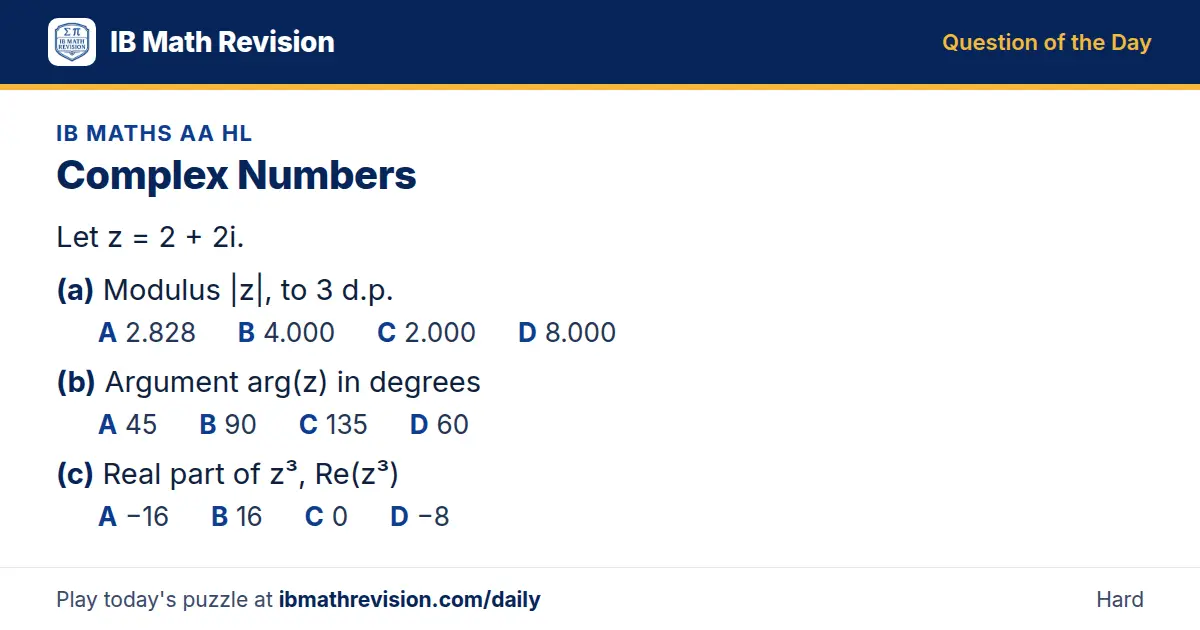
Complex Numbers
Let z = 2 + 2i.
- Modulus |z|, to 3 d.p. Options: A) 2.828; B) 4.000; C) 2.000; D) 8.000
- Argument arg(z) in degrees Options: A) 45; B) 90; C) 135; D) 60
- Real part of z³, Re(z³) Options: A) −16; B) 16; C) 0; D) −8
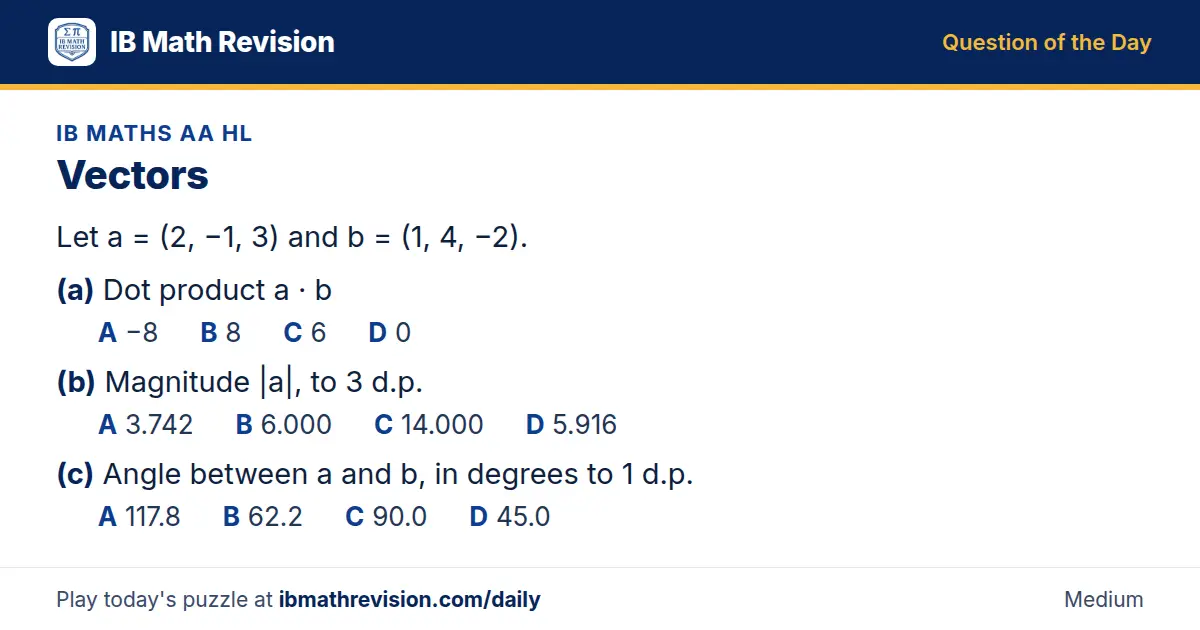
Vectors
Let a = (2, −1, 3) and b = (1, 4, −2).
- Dot product a · b Options: A) −8; B) 8; C) 6; D) 0
- Magnitude |a|, to 3 d.p. Options: A) 3.742; B) 6.000; C) 14.000; D) 5.916
- Angle between a and b, in degrees to 1 d.p. Options: A) 117.8; B) 62.2; C) 90.0; D) 45.0
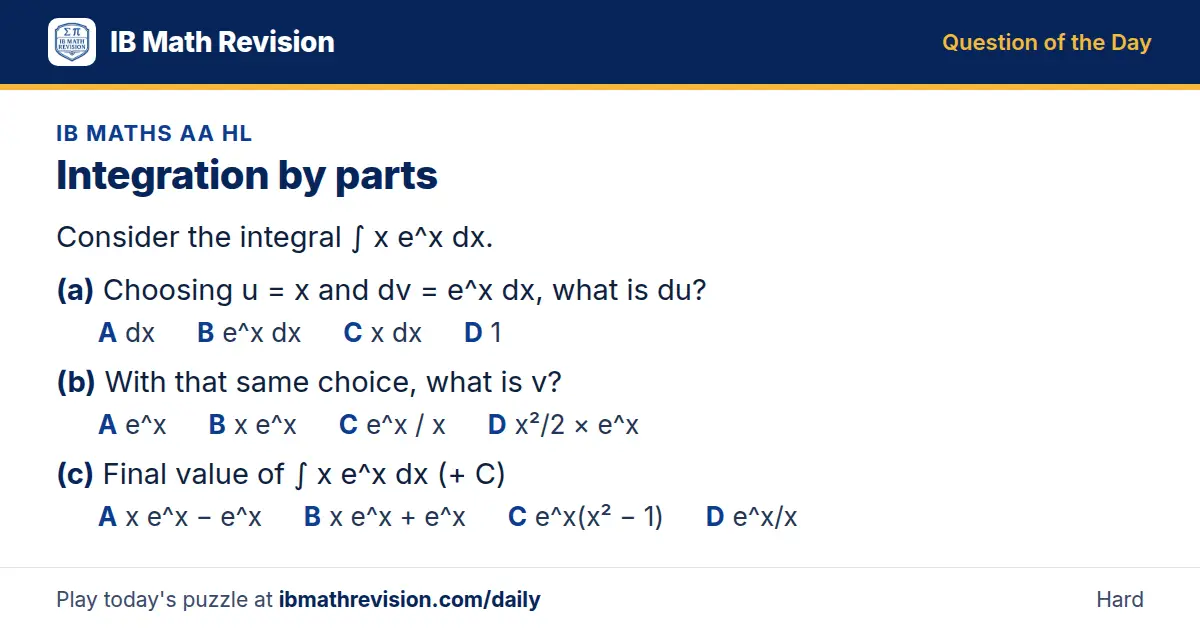
Integration by parts
Consider the integral ∫ x e^x dx.
- Choosing u = x and dv = e^x dx, what is du? Options: A) dx; B) e^x dx; C) x dx; D) 1
- With that same choice, what is v? Options: A) e^x; B) x e^x; C) e^x / x; D) x²/2 × e^x
- Final value of ∫ x e^x dx (+ C) Options: A) x e^x − e^x; B) x e^x + e^x; C) e^x(x² − 1); D) e^x/x
IB Maths AI HL
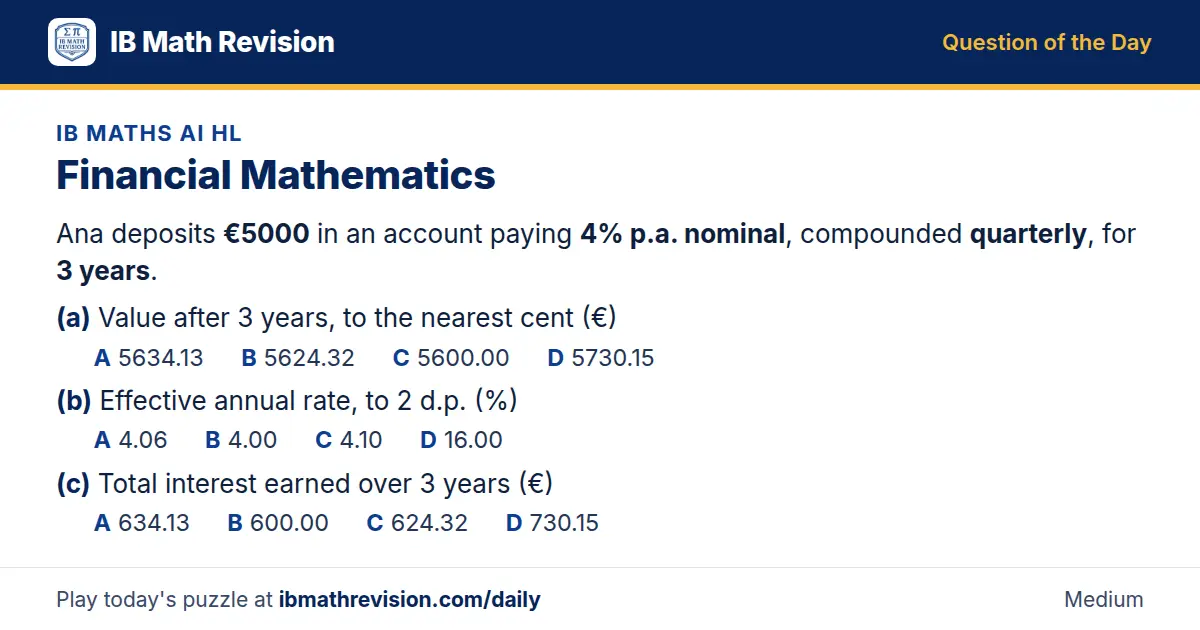
Financial Mathematics
Ana deposits euro;5000 in an account paying 4% p.a. nominal, compounded quarterly, for 3 years.
- Value after 3 years, to the nearest cent (euro;) Options: A) 5634.13; B) 5624.32; C) 5600.00; D) 5730.15
- Effective annual rate, to 2 d.p. (%) Options: A) 4.06; B) 4.00; C) 4.10; D) 16.00
- Total interest earned over 3 years (euro;) Options: A) 634.13; B) 600.00; C) 624.32; D) 730.15
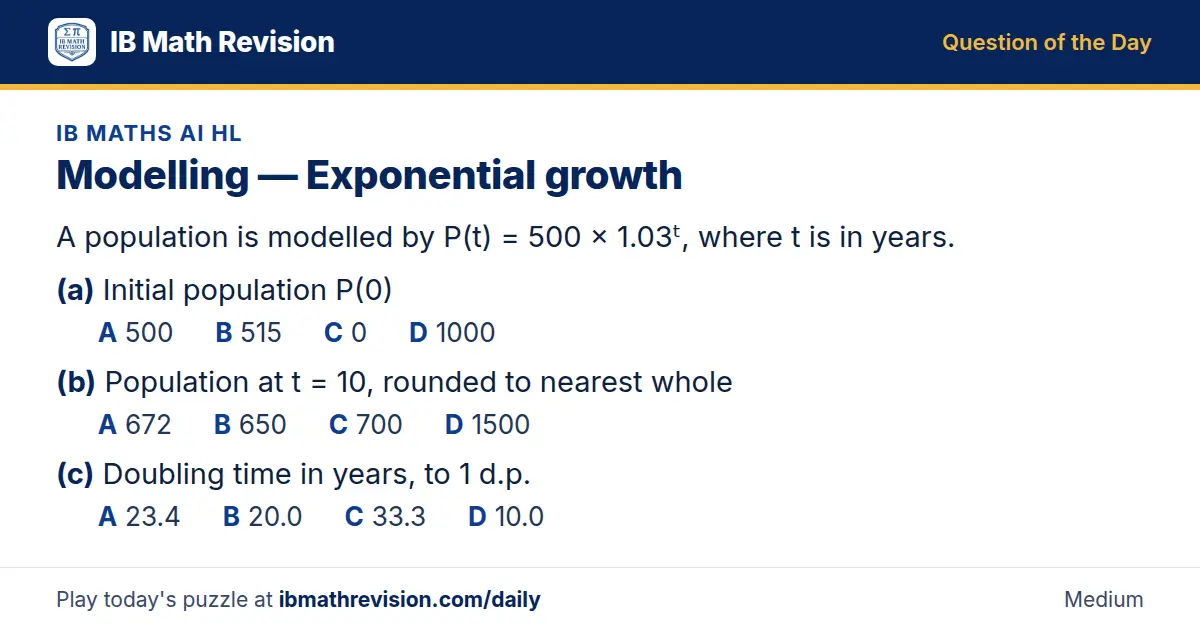
Modelling — Exponential growth
A population is modelled by P(t) = 500 × 1.03ᵗ, where t is in years.
- Initial population P(0) Options: A) 500; B) 515; C) 0; D) 1000
- Population at t = 10, rounded to nearest whole Options: A) 672; B) 650; C) 700; D) 1500
- Doubling time in years, to 1 d.p. Options: A) 23.4; B) 20.0; C) 33.3; D) 10.0
![IB Maths AI HL Question of the Day on Matrices, a 3-part multiple-choice question: Consider the matrix M = [ 2 1 ] [ 3 4 ] (a) Determinant of M (b) Trace of M (sum of the leading diagonal) (c) Larger eigenvalue of M (to 2 d.p.)](/images/questions/ib-maths-ai-hl-matrices-question-of-the-day-hlai-3.webp)
Matrices
Consider the matrix M = [ 2 1 ] [ 3 4 ]
- Determinant of M Options: A) 5; B) 11; C) −1; D) 7
- Trace of M (sum of the leading diagonal) Options: A) 6; B) 5; C) 7; D) 0
- Larger eigenvalue of M (to 2 d.p.) Options: A) 5.00; B) 6.00; C) 3.00; D) 4.79
Maths Challenge
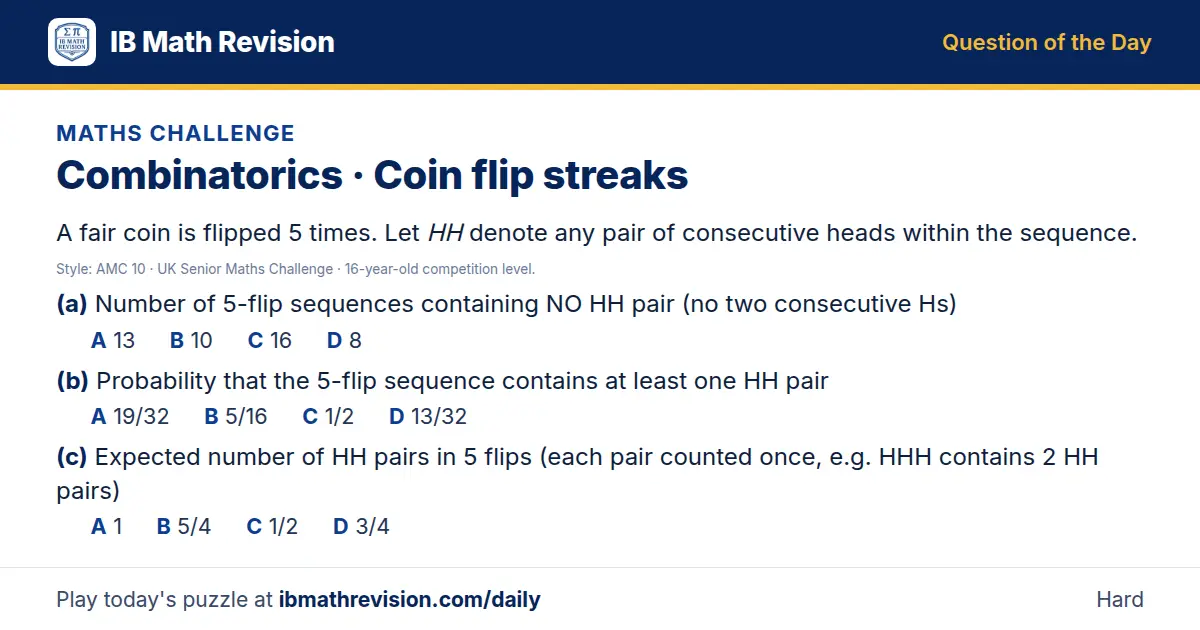
Combinatorics · Coin flip streaks
A fair coin is flipped 5 times. Let HH denote any pair of consecutive heads within the sequence. Style: AMC 10 · UK Senior Maths Challenge · 16-year-old competition level.
- Number of 5-flip sequences containing NO HH pair (no two consecutive Hs) Options: A) 13; B) 10; C) 16; D) 8
- Probability that the 5-flip sequence contains at least one HH pair Options: A) 19/32; B) 5/16; C) 1/2; D) 13/32
- Expected number of HH pairs in 5 flips (each pair counted once, e.g. HHH contains 2 HH pairs) Options: A) 1; B) 5/4; C) 1/2; D) 3/4
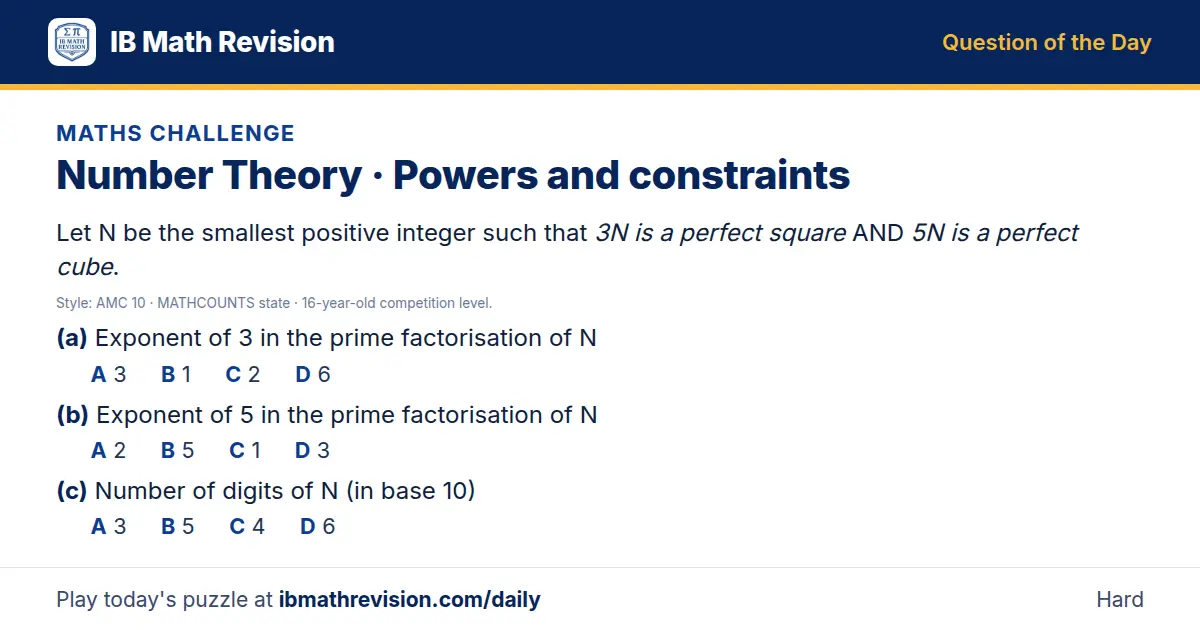
Number Theory · Powers and constraints
Let N be the smallest positive integer such that 3N is a perfect square AND 5N is a perfect cube. Style: AMC 10 · MATHCOUNTS state · 16-year-old competition level.
- Exponent of 3 in the prime factorisation of N Options: A) 3; B) 1; C) 2; D) 6
- Exponent of 5 in the prime factorisation of N Options: A) 2; B) 5; C) 1; D) 3
- Number of digits of N (in base 10) Options: A) 3; B) 5; C) 4; D) 6
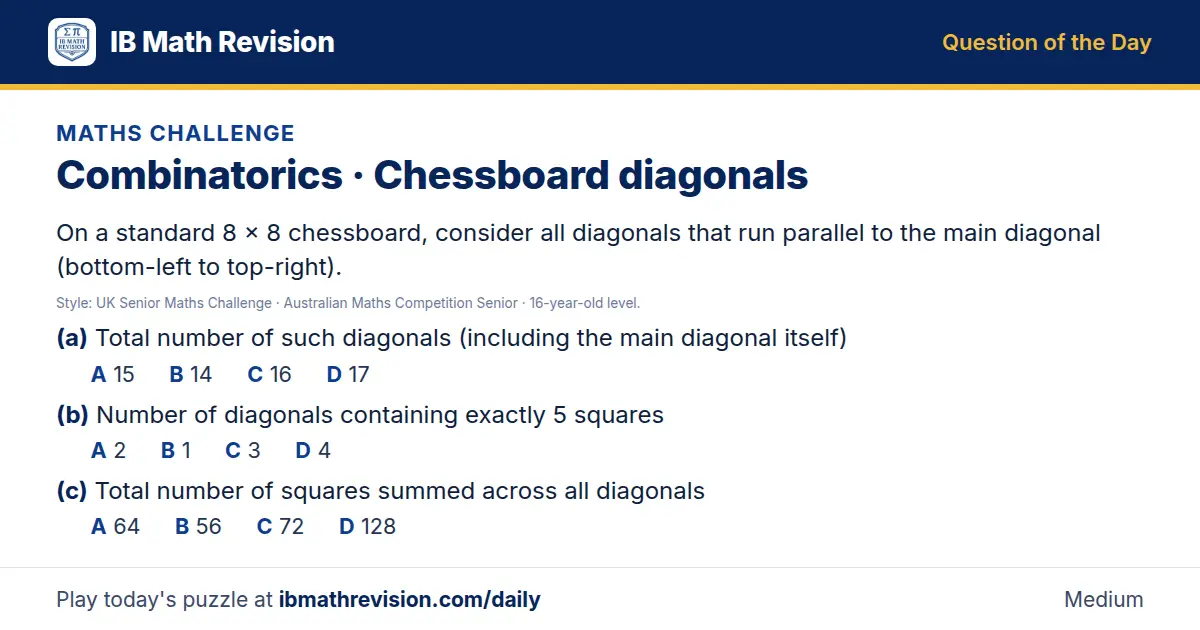
Combinatorics · Chessboard diagonals
On a standard 8 × 8 chessboard, consider all diagonals that run parallel to the main diagonal (bottom-left to top-right). Style: UK Senior Maths Challenge · Australian Maths Competition Senior · 16-year-old level.
- Total number of such diagonals (including the main diagonal itself) Options: A) 15; B) 14; C) 16; D) 17
- Number of diagonals containing exactly 5 squares Options: A) 2; B) 1; C) 3; D) 4
- Total number of squares summed across all diagonals Options: A) 64; B) 56; C) 72; D) 128
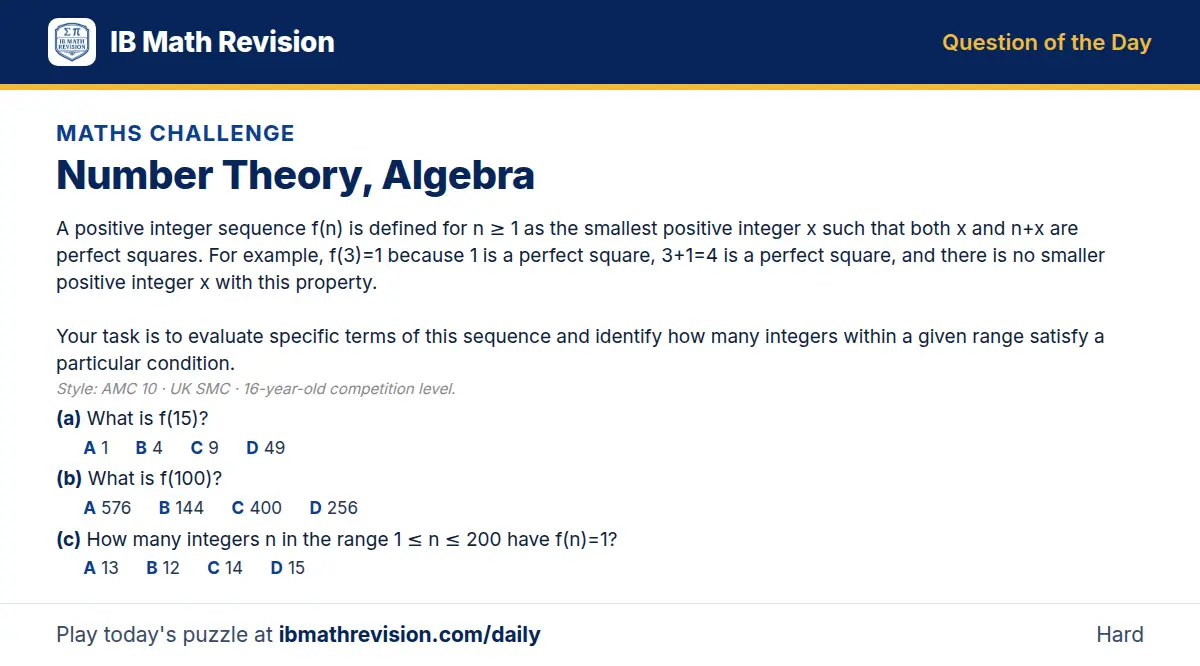
Number Theory, Algebra
A positive integer sequence f(n) is defined for n ge; 1 as the smallest positive integer x such that both x and n+x are perfect squares. For example, f(3)=1 because 1 is a perfect square, 3+1=4 is a perfect square, and there is no smaller positive integer x with this property. Your task is to evaluate specific terms of this sequence and identify how many integers within a given range satisfy a particular condition.Style: AMC 10 middot; UK SMC middot; 16-year-old competition level.
- What is f(15)? Options: A) 1; B) 4; C) 9; D) 49
- What is f(100)? Options: A) 576; B) 144; C) 400; D) 256
- How many integers n in the range 1 le; n le; 200 have f(n)=1? Options: A) 13; B) 12; C) 14; D) 15
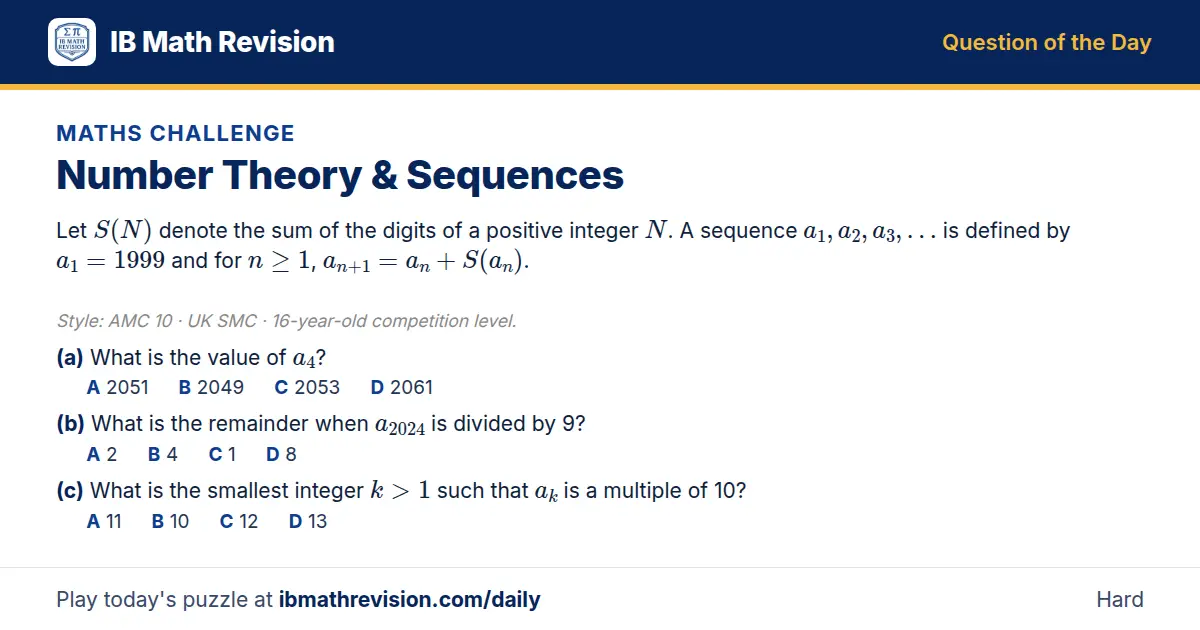
Number Theory & Sequences
Let S(N) denote the sum of the digits of a positive integer N. A sequence a_1, a_2, a_3, … is defined by a_1 = 1999 and for n ≥ 1, a_n+1 = a_n + S(a_n). Style: AMC 10 · UK SMC · 16-year-old competition level.
- What is the value of a_4? Options: A) 2051; B) 2049; C) 2053; D) 2061
- What is the remainder when a_2024 is divided by 9? Options: A) 2; B) 4; C) 1; D) 8
- What is the smallest integer k > 1 such that a_k is a multiple of 10? Options: A) 11; B) 10; C) 12; D) 13
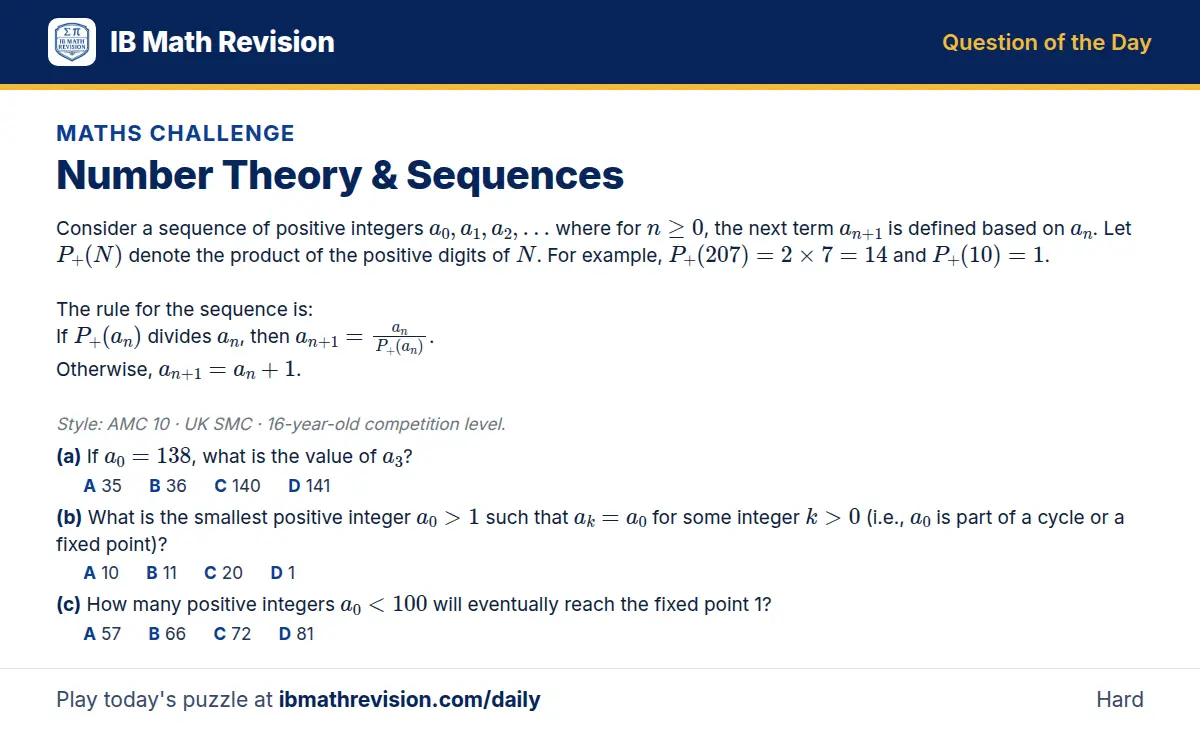
Number Theory & Sequences
Consider a sequence of positive integers a_0, a_1, a_2, … where for n ≥ 0, the next term a_n+1 is defined based on a_n. Let P_+(N) denote the product of the positive digits of N. For example, P_+(207) = 2 × 7 = 14 and P_+(10) = 1. The rule for the sequence is: If P_+(a_n) divides a_n, then a_n+1 = a_n/(P_+(a_n)). Otherwise, a_n+1 = a_n + 1. Style: AMC 10 · UK SMC · 16-year-old competition level.
- If a_0 = 138, what is the value of a_3? Options: A) 35; B) 36; C) 140; D) 141
- What is the smallest positive integer a_0 > 1 such that a_k = a_0 for some integer k > 0 (i.e., a_0 is part of a cycle or a fixed point)? Options: A) 10; B) 11; C) 20; D) 1
- How many positive integers a_0 < 100 will eventually reach the fixed point 1? Options: A) 57; B) 66; C) 72; D) 81
Weekly starter questions
Three or four short questions for each teaching week, to open a lesson or warm up for homework. Each page shows the questions as images with their text; answers and mark schemes are in the starter tasks for teachers.
IB Maths Analysis and Approaches SL
120 starter questions: Weeks 1–13 · Weeks 14–26 · Weeks 27–40.
IB Maths Applications and Interpretation SL
120 starter questions: Weeks 1–13 · Weeks 14–26 · Weeks 27–40.
IB Maths Analysis and Approaches HL
120 starter questions: Weeks 1–13 · Weeks 14–26 · Weeks 27–40.
IB Maths Applications and Interpretation HL
120 starter questions: Weeks 1–13 · Weeks 14–26 · Weeks 27–40.