IB Maths AA HL starter questions: weeks 14–26
39 short questions to open a lesson for IB Maths Analysis and Approaches HL, weeks 14–26 of the teaching year, three or four a week. Each question is shown as an image with its text underneath; answers and mark schemes stay with teachers.
Week 14
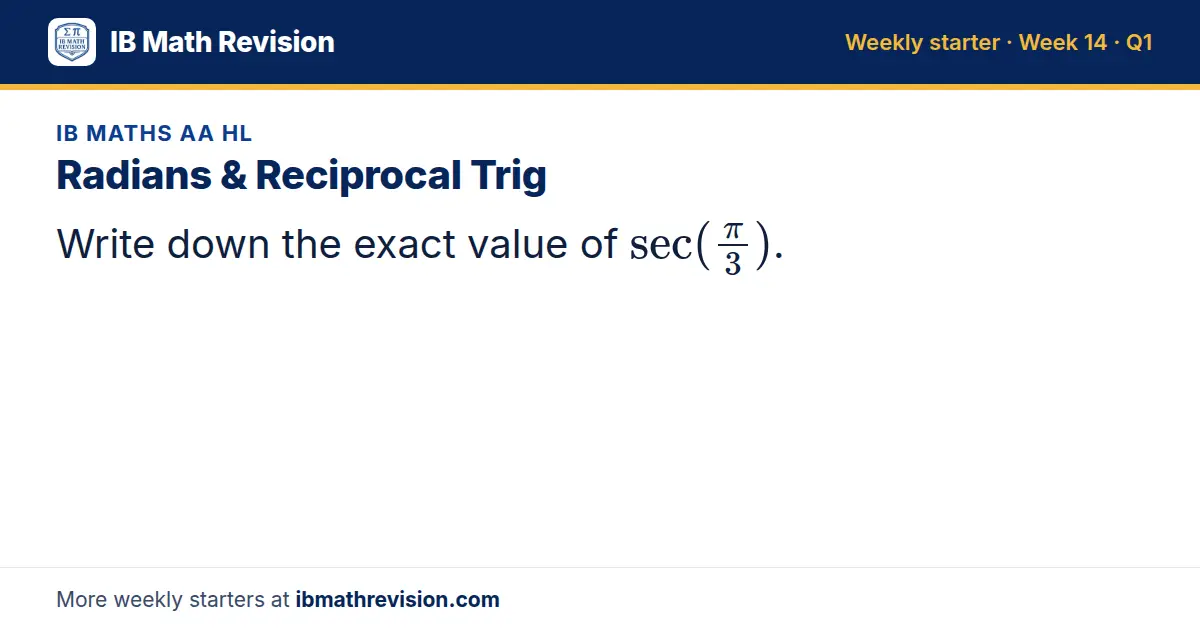
Question 1: Radians & Reciprocal Trig
Write down the exact value of sec((π)/3).
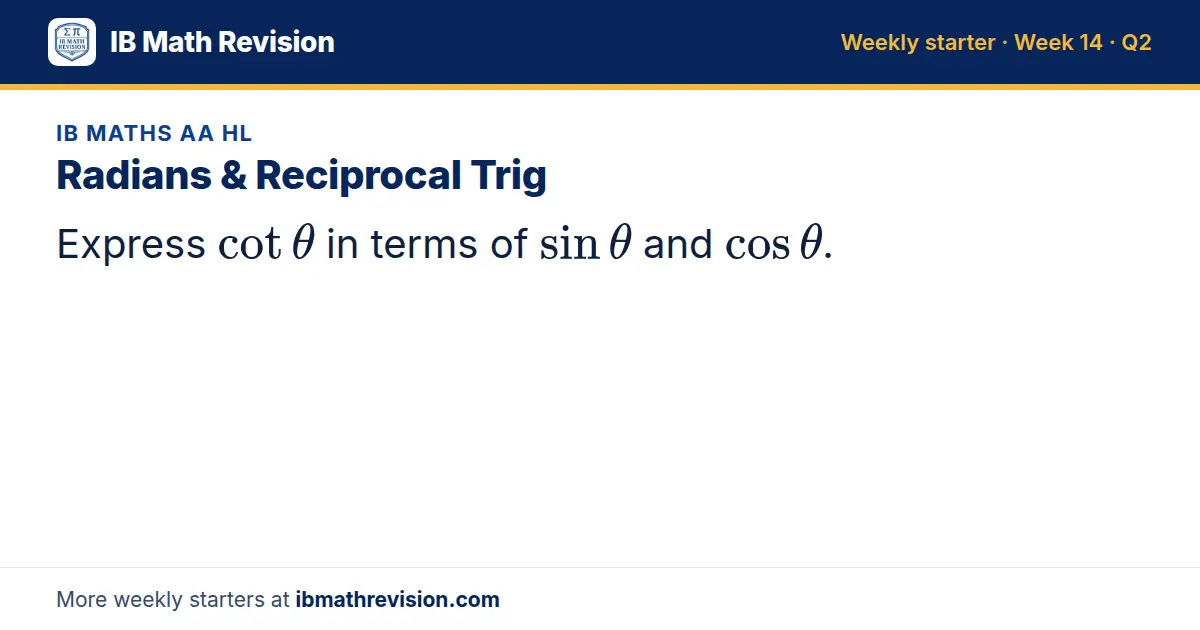
Question 2: Radians & Reciprocal Trig
Express cot θ in terms of sin θ and cos θ.
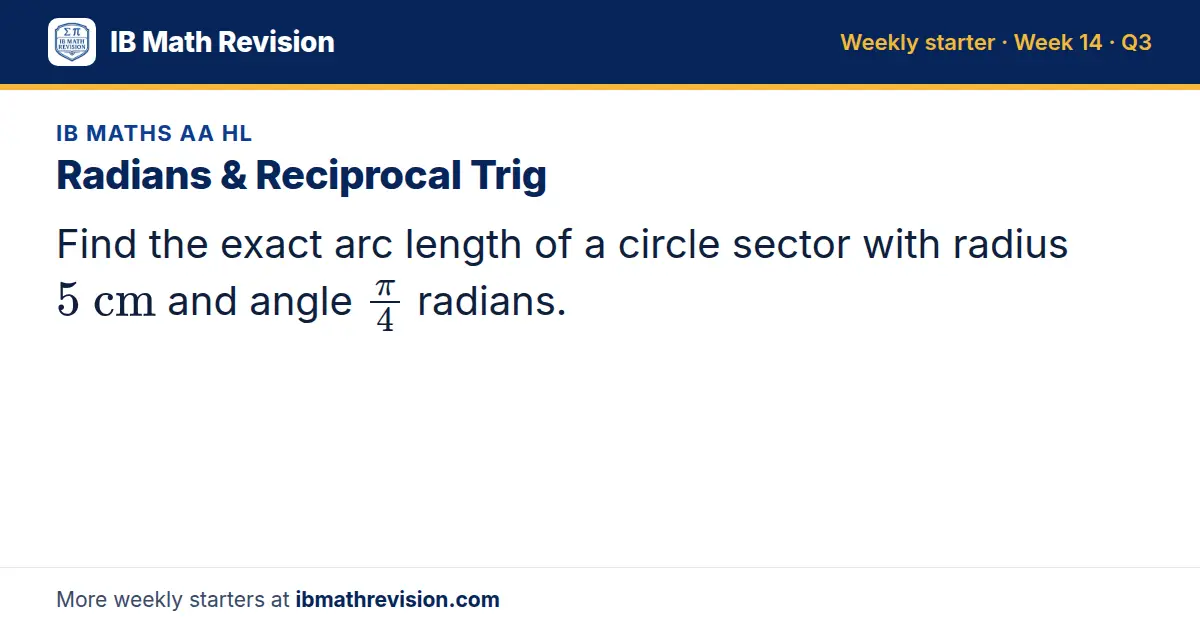
Question 3: Radians & Reciprocal Trig
Find the exact arc length of a circle sector with radius 5 cm and angle (π)/4 radians.
Week 15
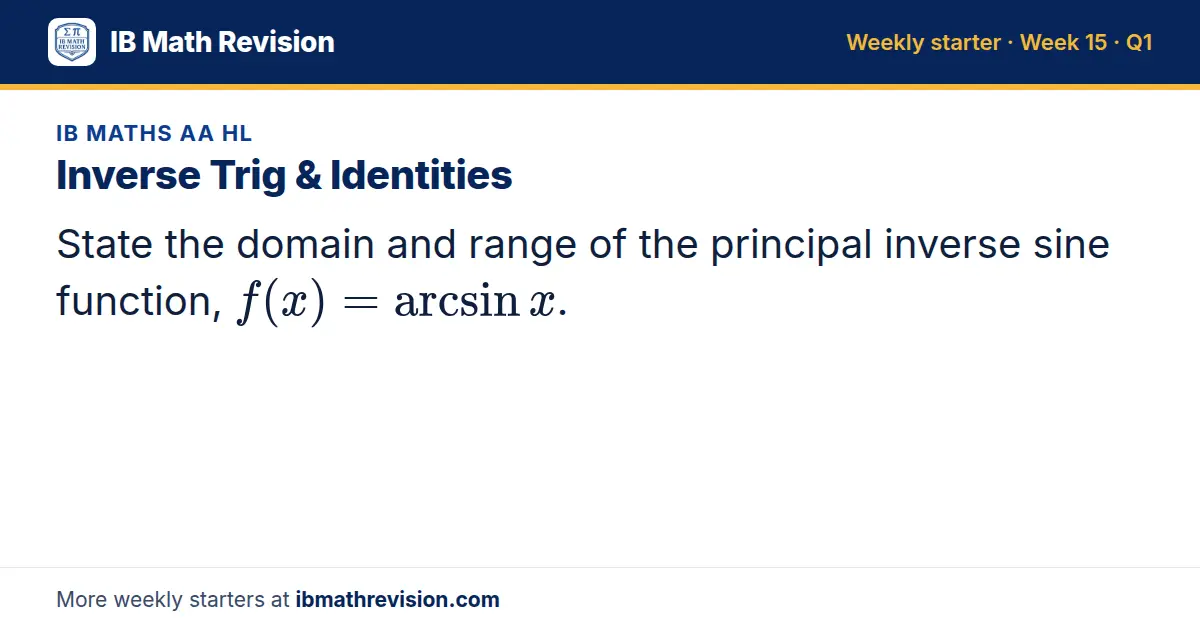
Question 1: Inverse Trig & Identities
State the domain and range of the principal inverse sine function, f(x) = arcsin x.
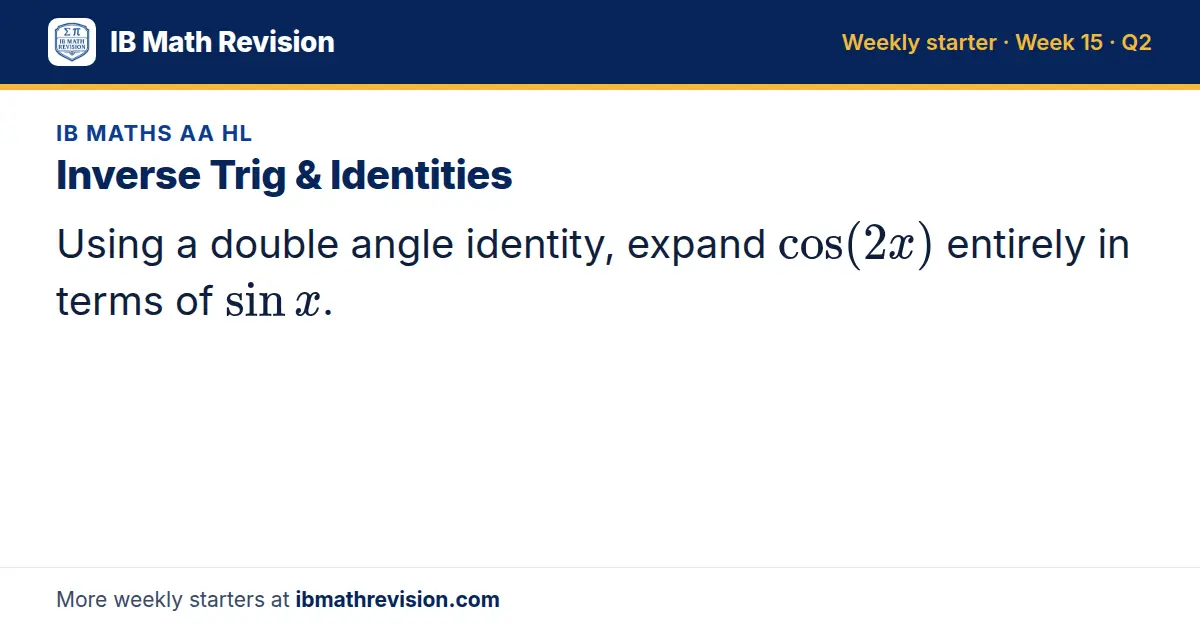
Question 2: Inverse Trig & Identities
Using a double angle identity, expand cos(2x) entirely in terms of sin x.
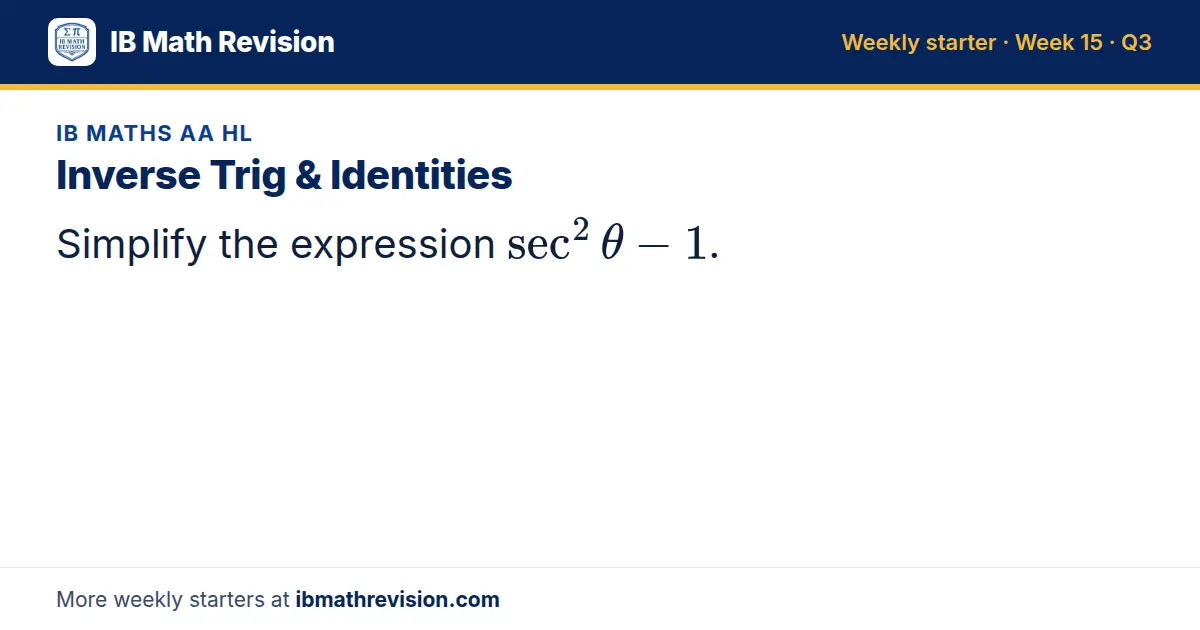
Question 3: Inverse Trig & Identities
Simplify the expression sec² θ - 1.
Week 16
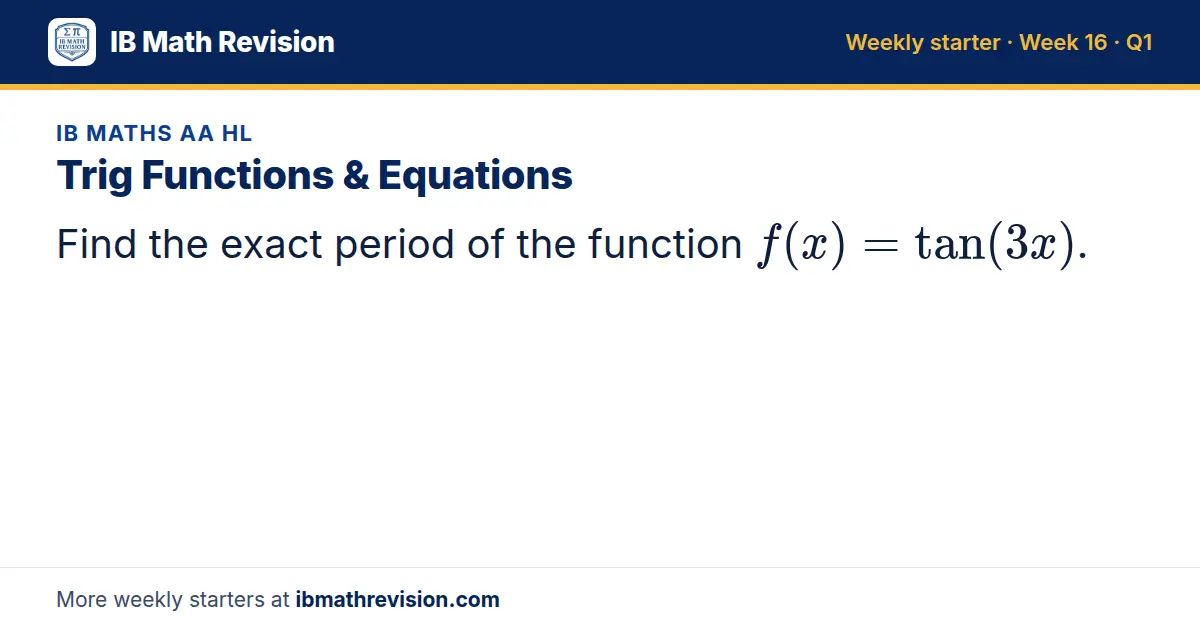
Question 1: Trig Functions & Equations
Find the exact period of the function f(x) = tan(3x).
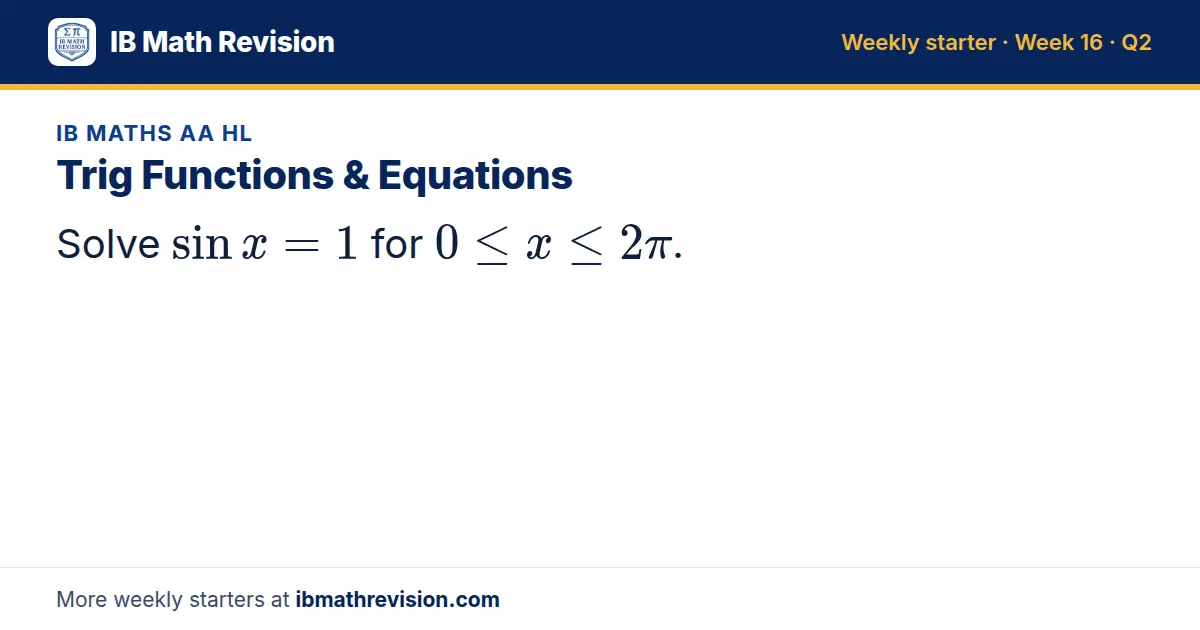
Question 2: Trig Functions & Equations
Solve sin x = 1 for 0 ≤ x ≤ 2π.
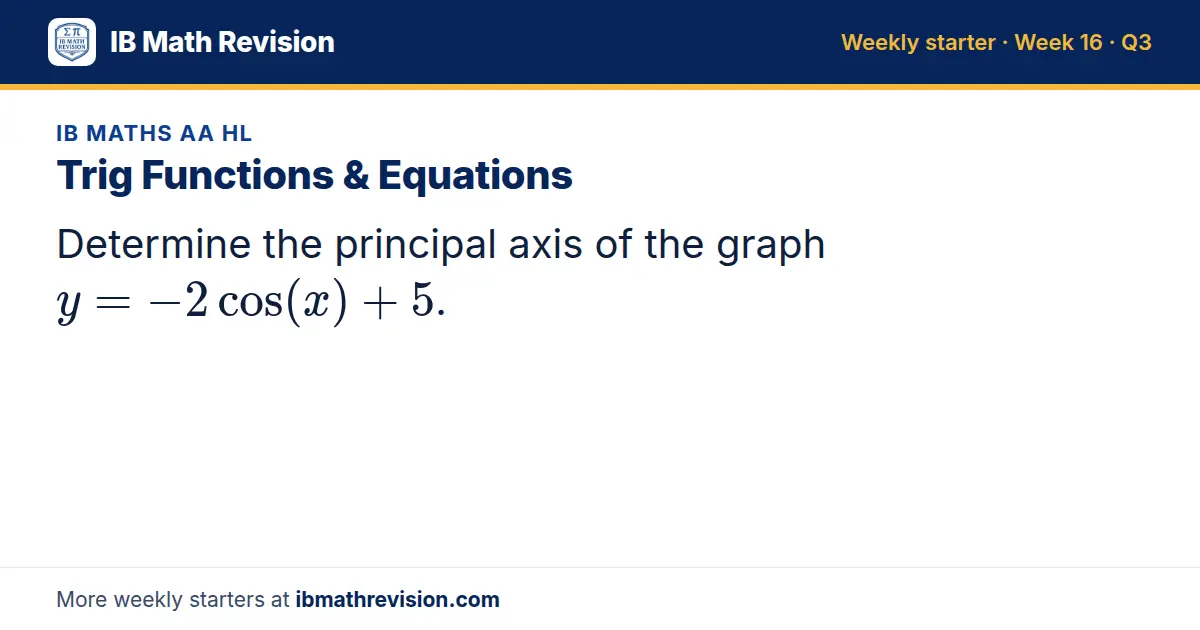
Question 3: Trig Functions & Equations
Determine the principal axis of the graph y = -2cos(x) + 5.
Week 17
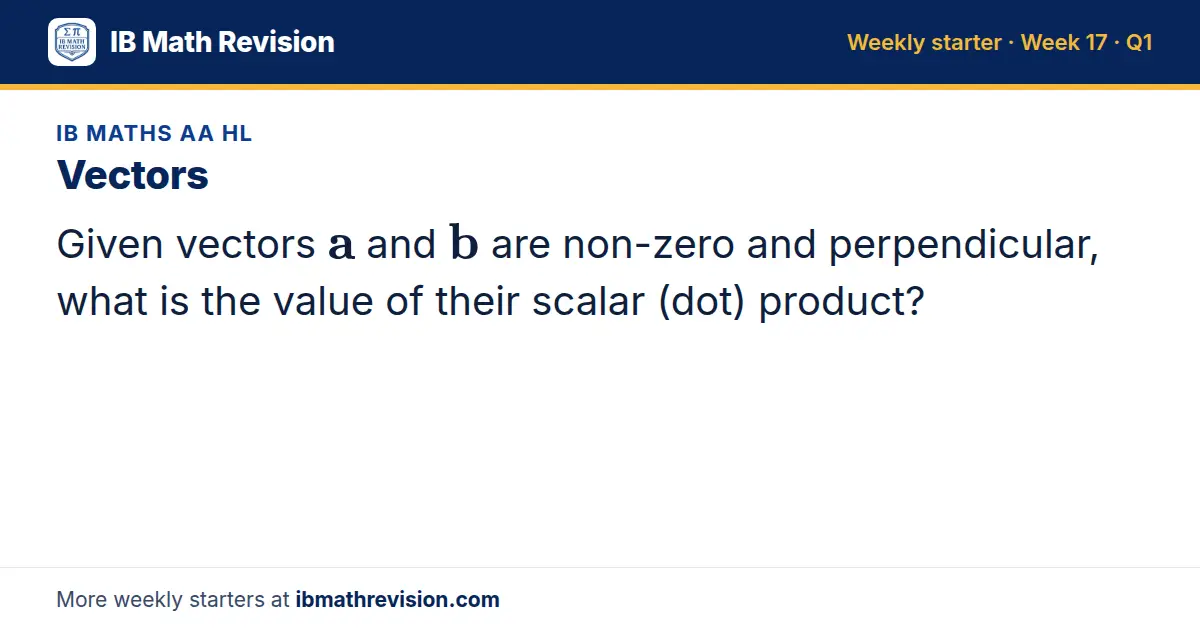
Question 1: Vectors
Given vectors a and b are non-zero and perpendicular, what is the value of their scalar (dot) product?
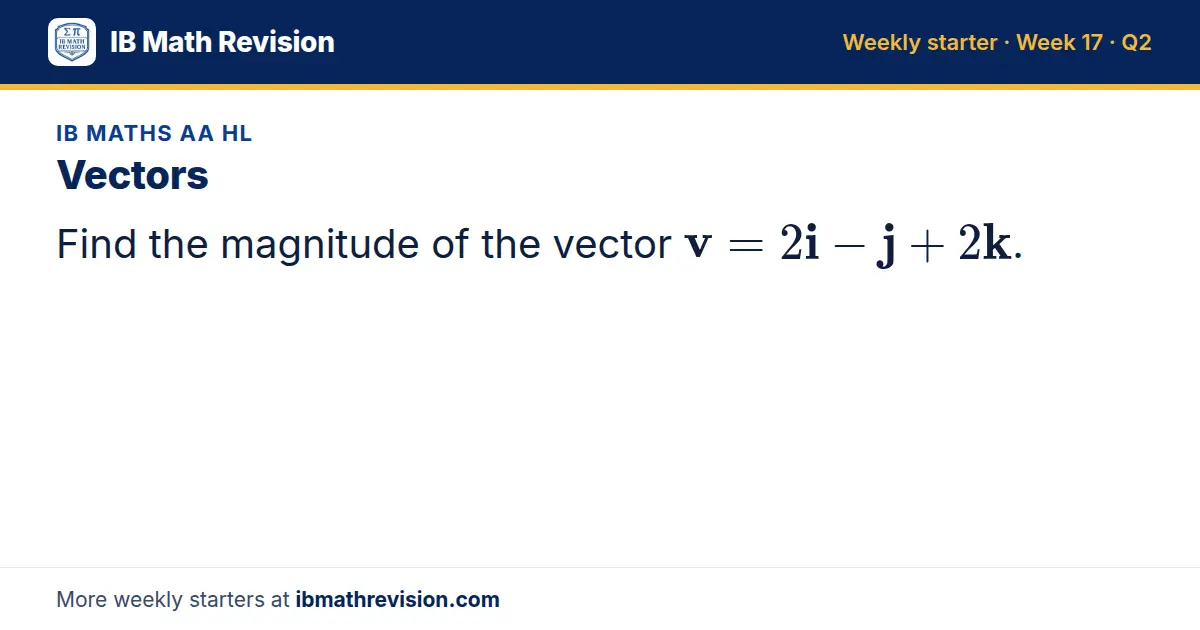
Question 2: Vectors
Find the magnitude of the vector v = 2i - j + 2k.
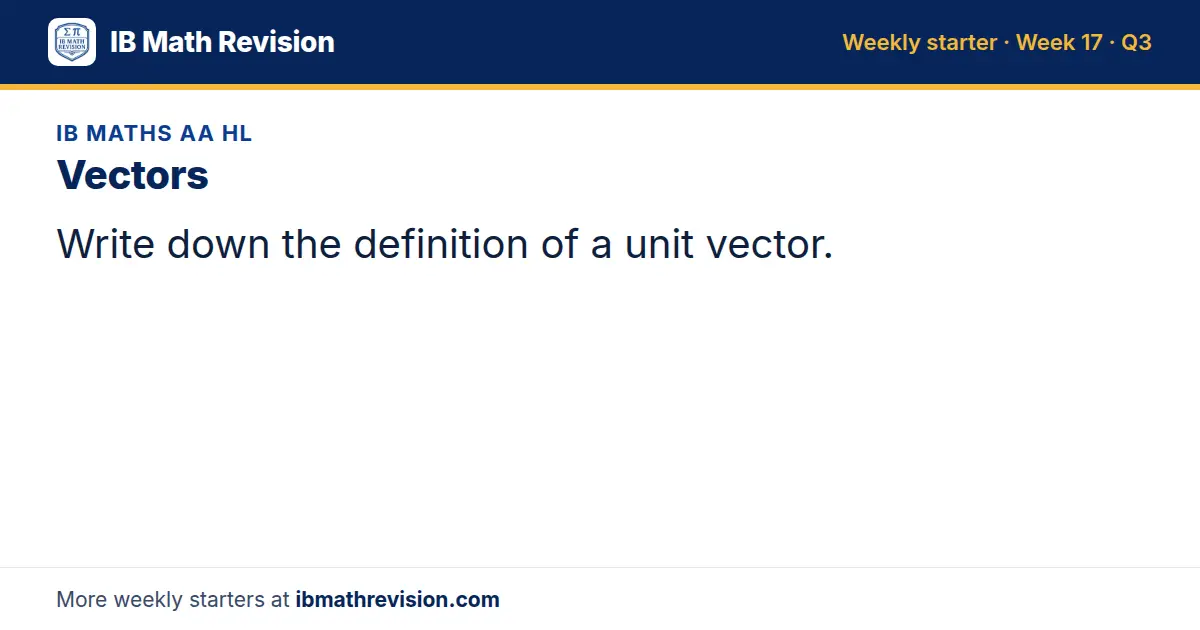
Question 3: Vectors
Write down the definition of a unit vector.
Week 18
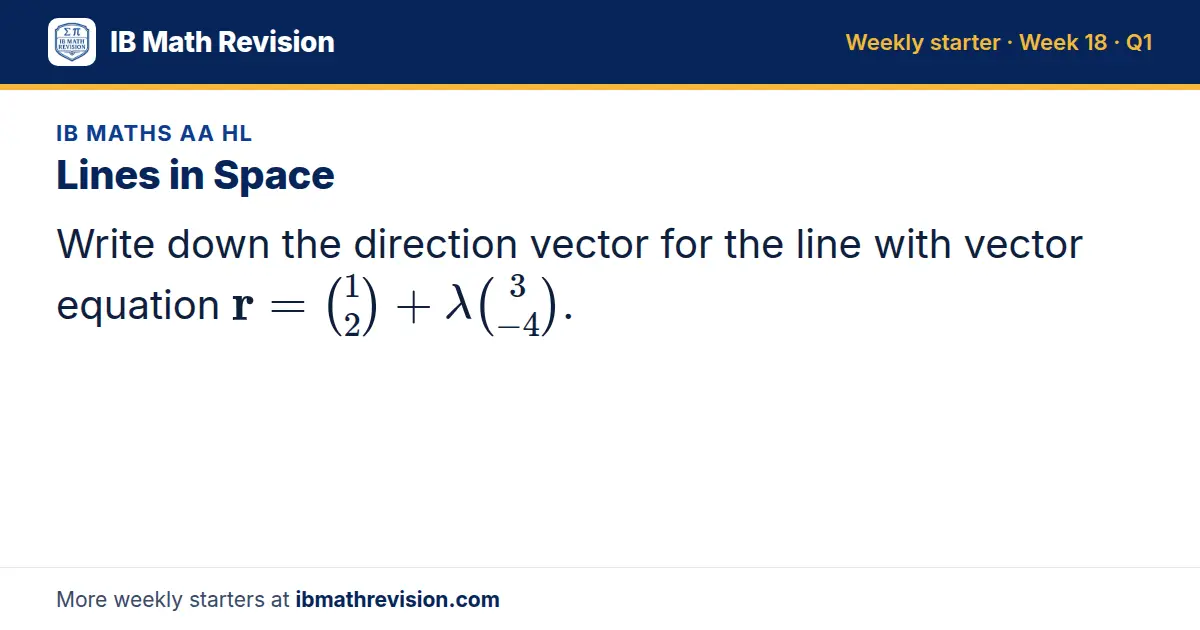
Question 1: Lines in Space
Write down the direction vector for the line with vector equation r = 12 + λ 3-4.
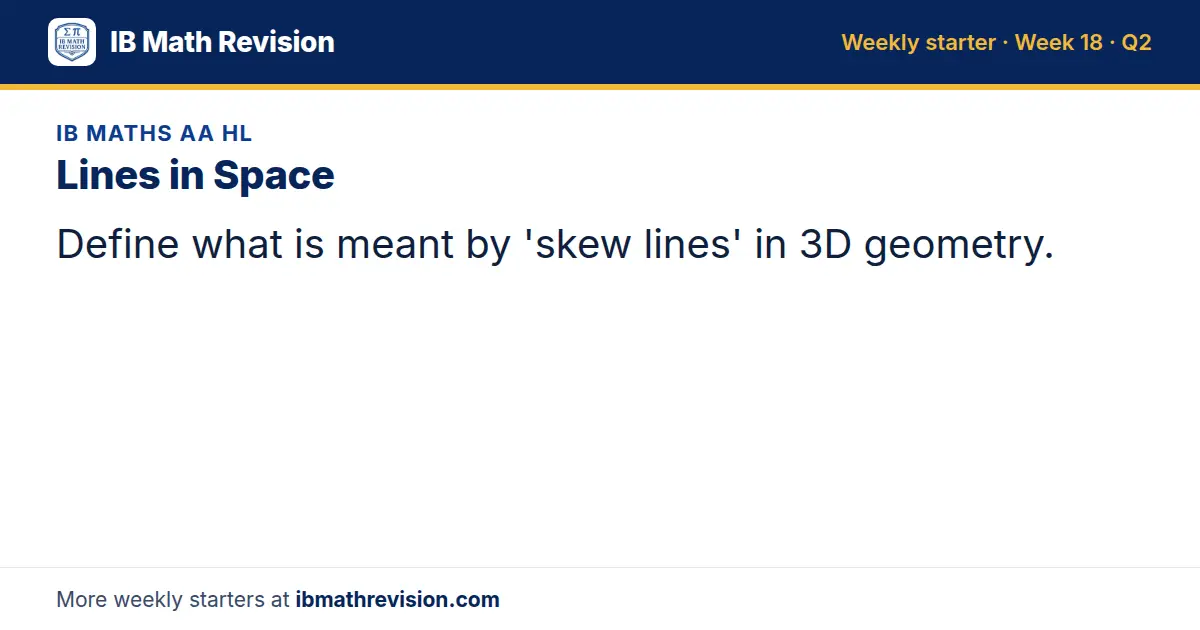
Question 2: Lines in Space
Define what is meant by 'skew lines' in 3D geometry.
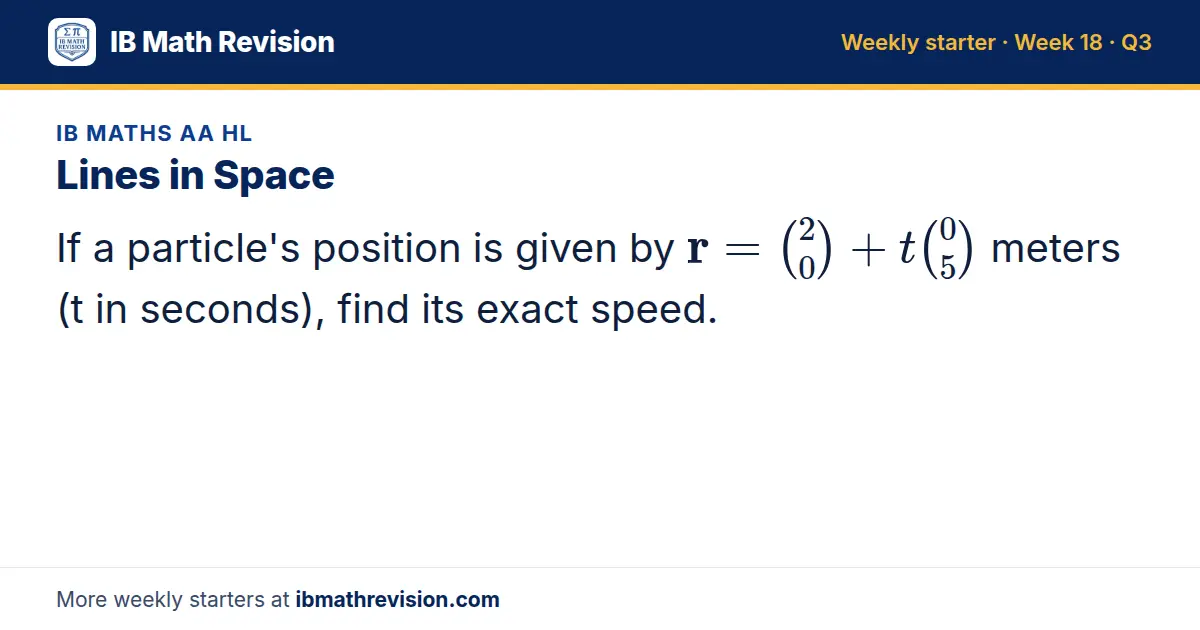
Question 3: Lines in Space
If a particle's position is given by r = 20 + t 05 meters (t in seconds), find its exact speed.
Week 19
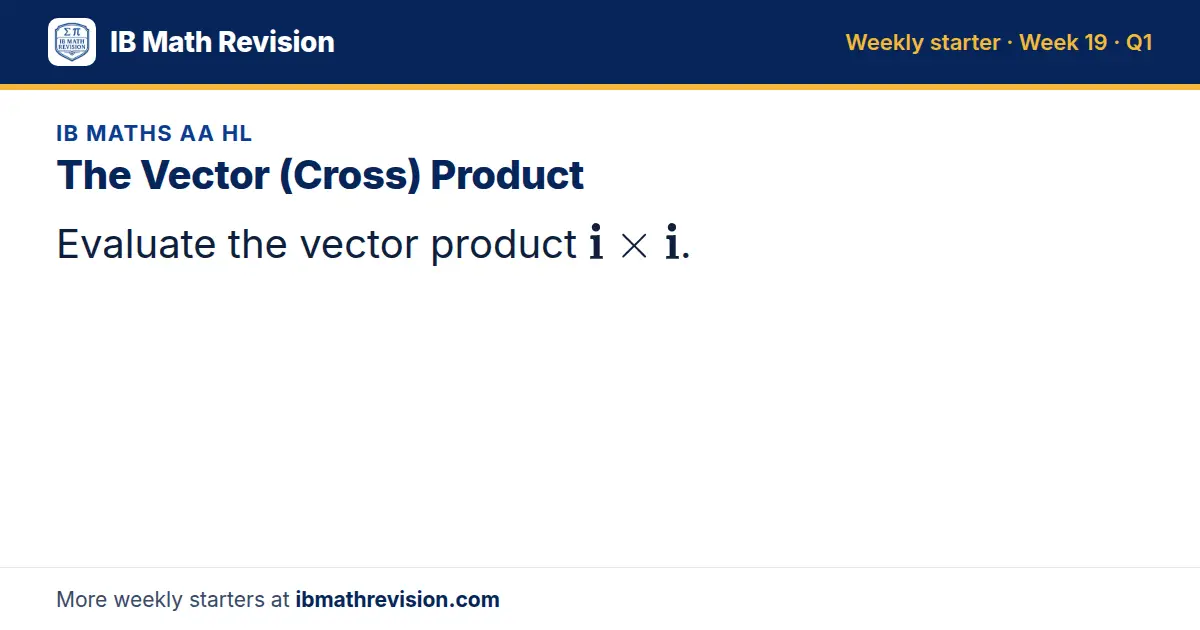
Question 1: The Vector (Cross) Product
Evaluate the vector product i × i.
Question 2: The Vector (Cross) Product
Evaluate the vector product i × j.
Question 3: The Vector (Cross) Product
How can the vector product a × b be used to find the area of the parallelogram formed by vectors a and b?
Week 20
Question 1: Planes in Space
Write down a normal vector to the plane with Cartesian equation 3x - 2y + 4z = 10.
Question 2: Planes in Space
Does the point (1, 2, 1) lie on the plane x + y + z = 4?
Question 3: Planes in Space
State the scalar dot product normal form equation of a plane.
Week 21
Question 1: Intersections & Angles
When finding the angle between two intersecting planes, which vectors do you use in the dot product formula?
Question 2: Intersections & Angles
What geometric object is typically formed by the intersection of two non-parallel planes?
Question 3: Intersections & Angles
If a line is parallel to a plane, what is the value of the dot product between the line's direction vector and the plane's normal vector?
Week 22
Question 1: Descriptive Statistics
State the mathematical relationship between the variance and the standard deviation of a dataset.
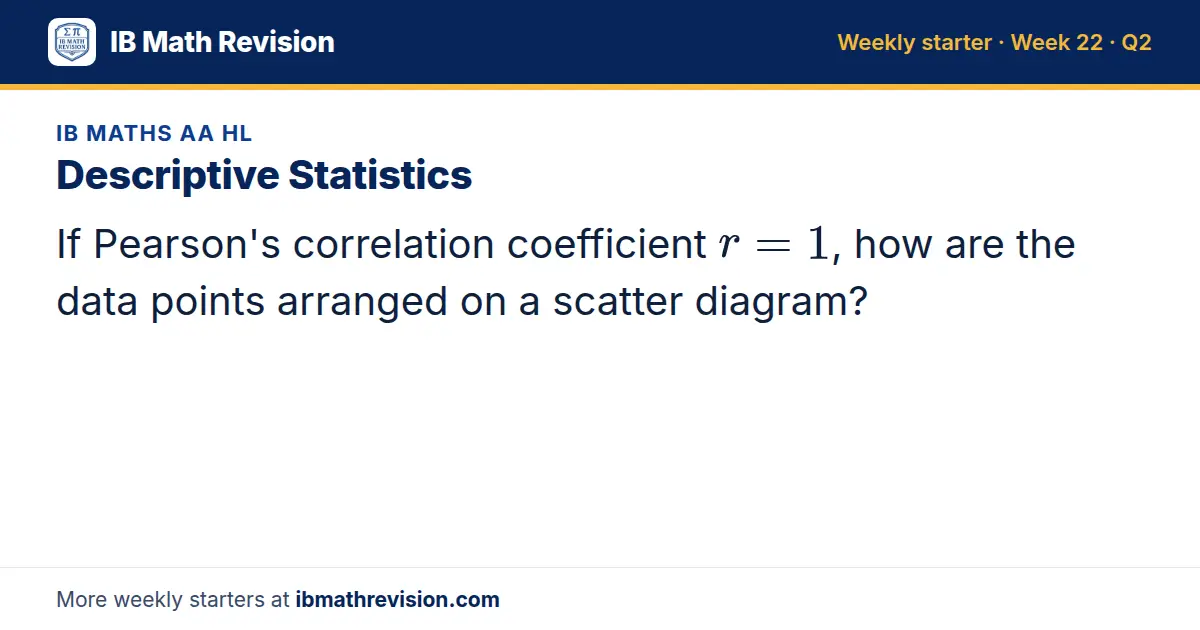
Question 2: Descriptive Statistics
If Pearson's correlation coefficient r = 1, how are the data points arranged on a scatter diagram?
Question 3: Descriptive Statistics
Explain the difference between a discrete and a continuous variable.
Week 23
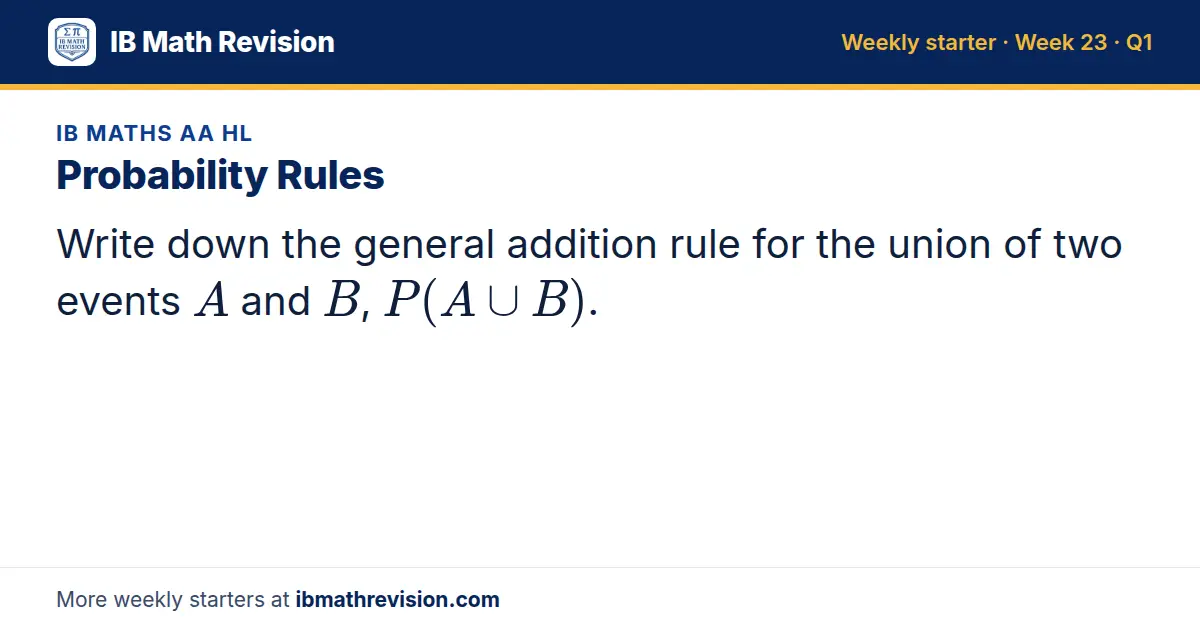
Question 1: Probability Rules
Write down the general addition rule for the union of two events A and B, P(A ∪ B).
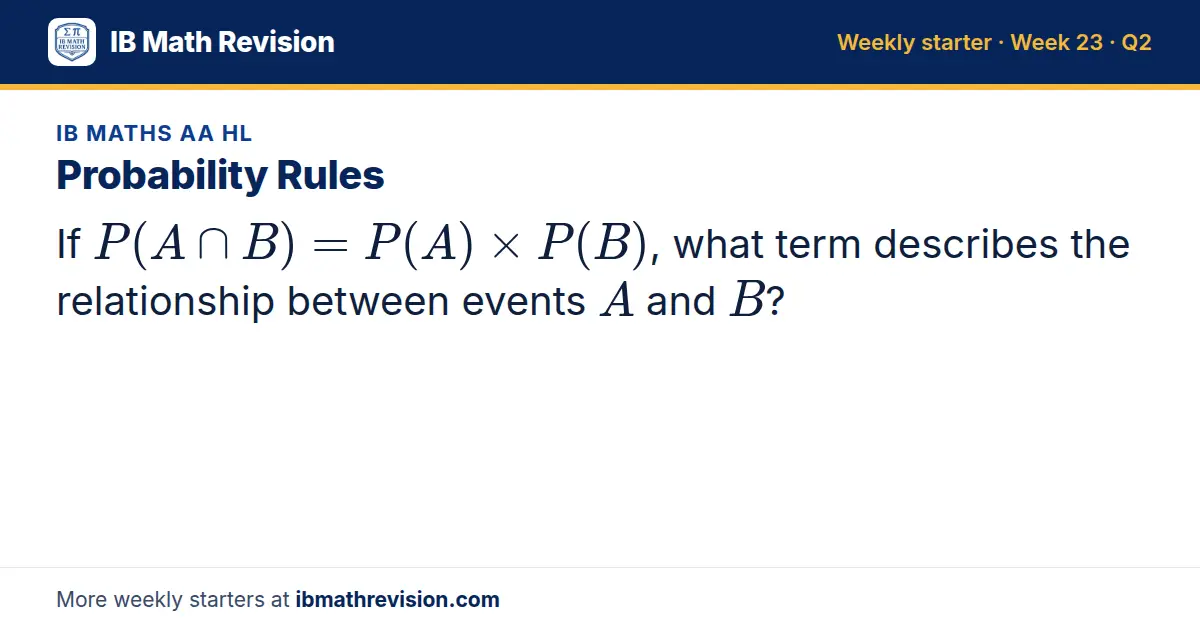
Question 2: Probability Rules
If P(A ∩ B) = P(A) × P(B), what term describes the relationship between events A and B?
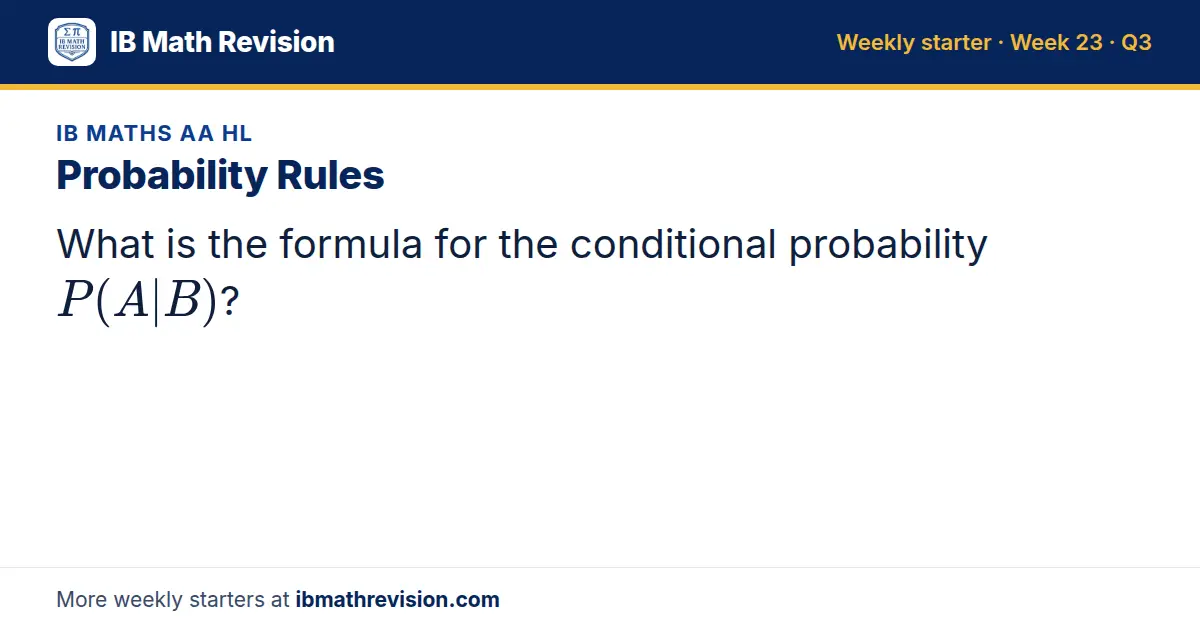
Question 3: Probability Rules
What is the formula for the conditional probability P(A|B)?
Week 24
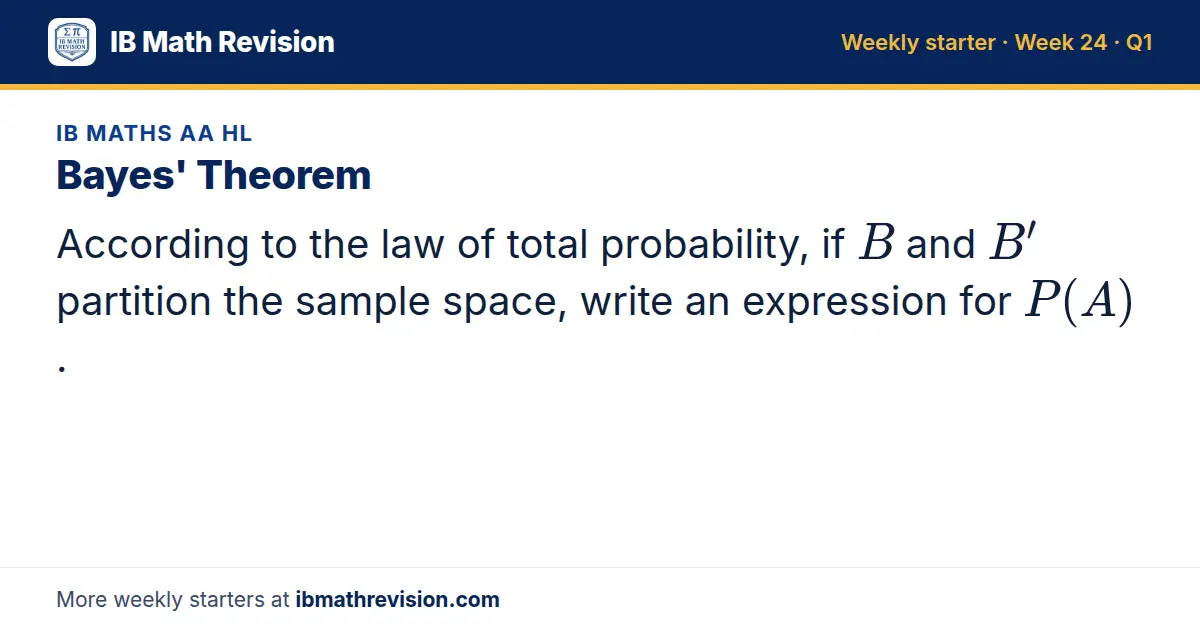
Question 1: Bayes' Theorem
According to the law of total probability, if B and B' partition the sample space, write an expression for P(A).
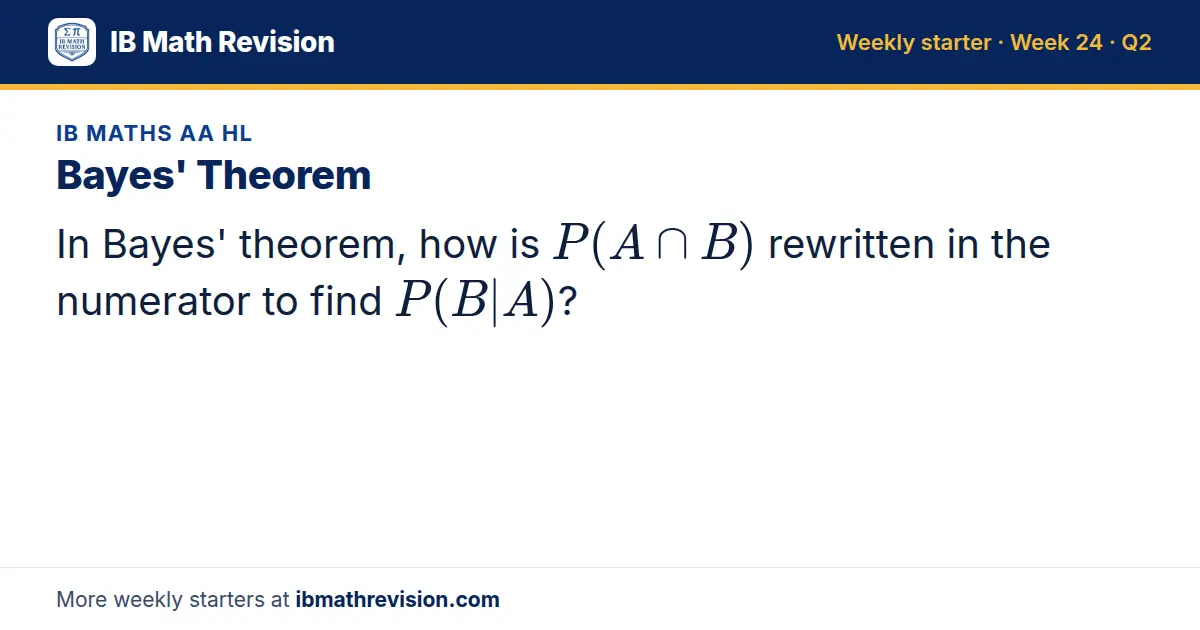
Question 2: Bayes' Theorem
In Bayes' theorem, how is P(A ∩ B) rewritten in the numerator to find P(B|A)?
Question 3: Bayes' Theorem
If drawing without replacement from a deck of cards, are the consecutive draws independent or dependent?
Week 25
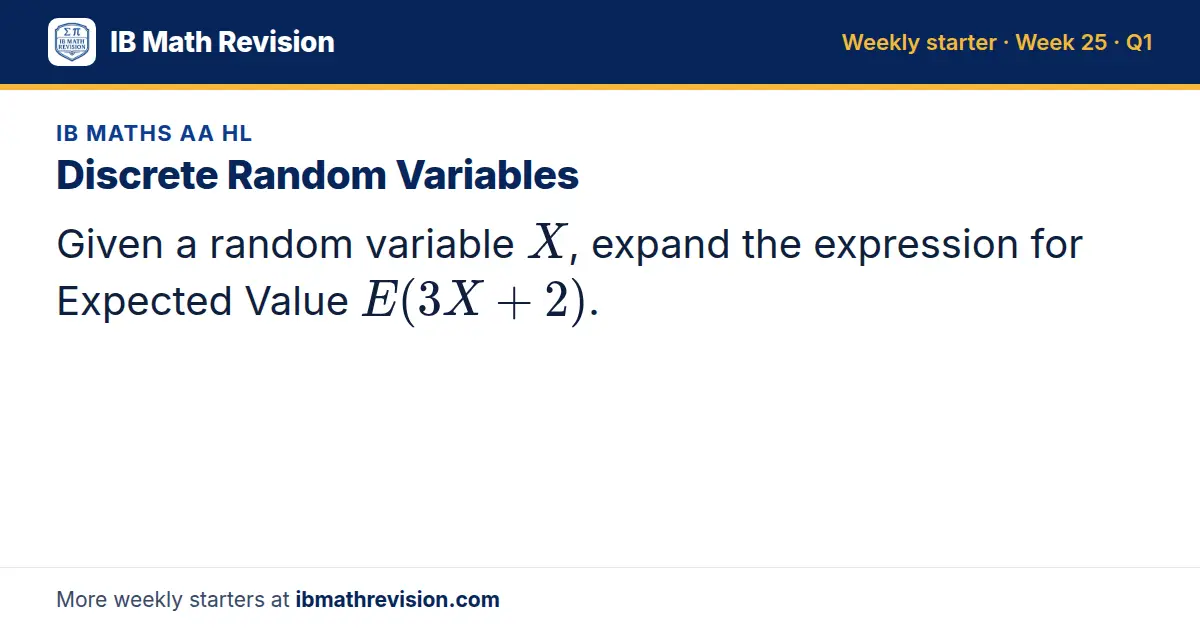
Question 1: Discrete Random Variables
Given a random variable X, expand the expression for Expected Value E(3X + 2).
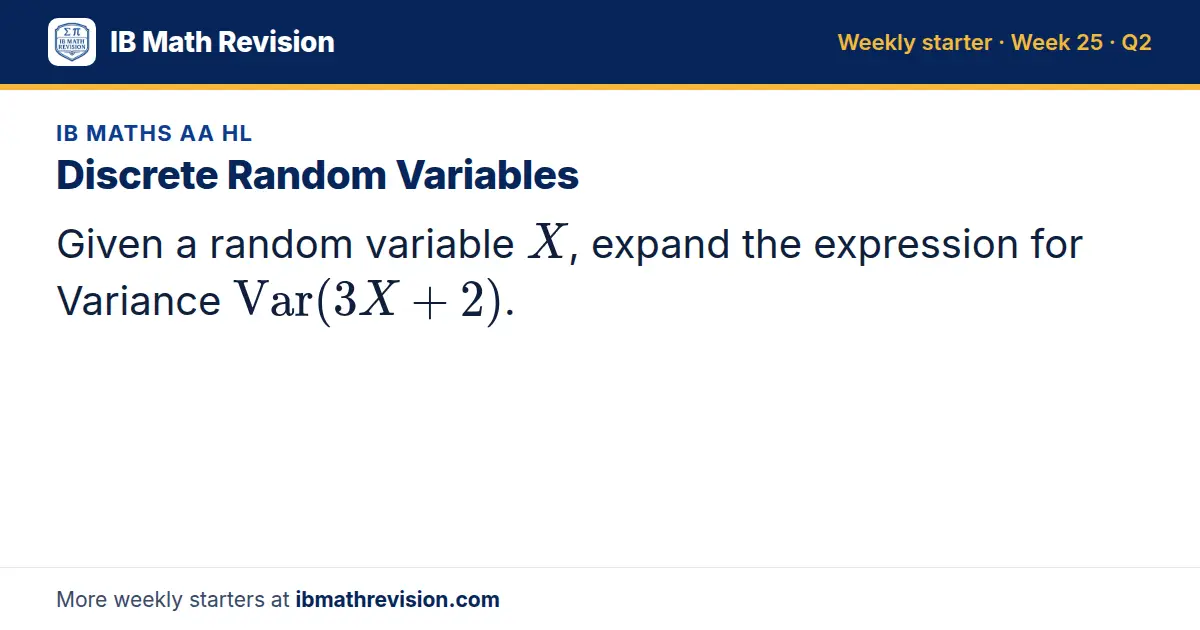
Question 2: Discrete Random Variables
Given a random variable X, expand the expression for Variance Var(3X + 2).
Question 3: Discrete Random Variables
How is the expected value E(X) of a discrete random variable calculated from its probability distribution?
Week 26
Question 1: Probability Distributions
State the formula for the variance of a binomial distribution X B(n, p).
Question 2: Probability Distributions
Write down the formula used to standardise a normal variable X into a Z-score.
Question 3: Probability Distributions
In a binomial distribution, what does the parameter p represent?
More starter questions
Other weeks: Weeks 1–13 · Weeks 14–26 · Weeks 27–40. Answers and mark schemes are in the starter tasks for teachers.