IB Maths AA HL starter questions: weeks 27–40
42 short questions to open a lesson for IB Maths Analysis and Approaches HL, weeks 27–40 of the teaching year, three or four a week. Each question is shown as an image with its text underneath; answers and mark schemes stay with teachers.
Week 27
Question 1: Limits & L'Hôpital's Rule
What are the two standard indeterminate forms that allow the direct use of L'Hôpital's Rule?
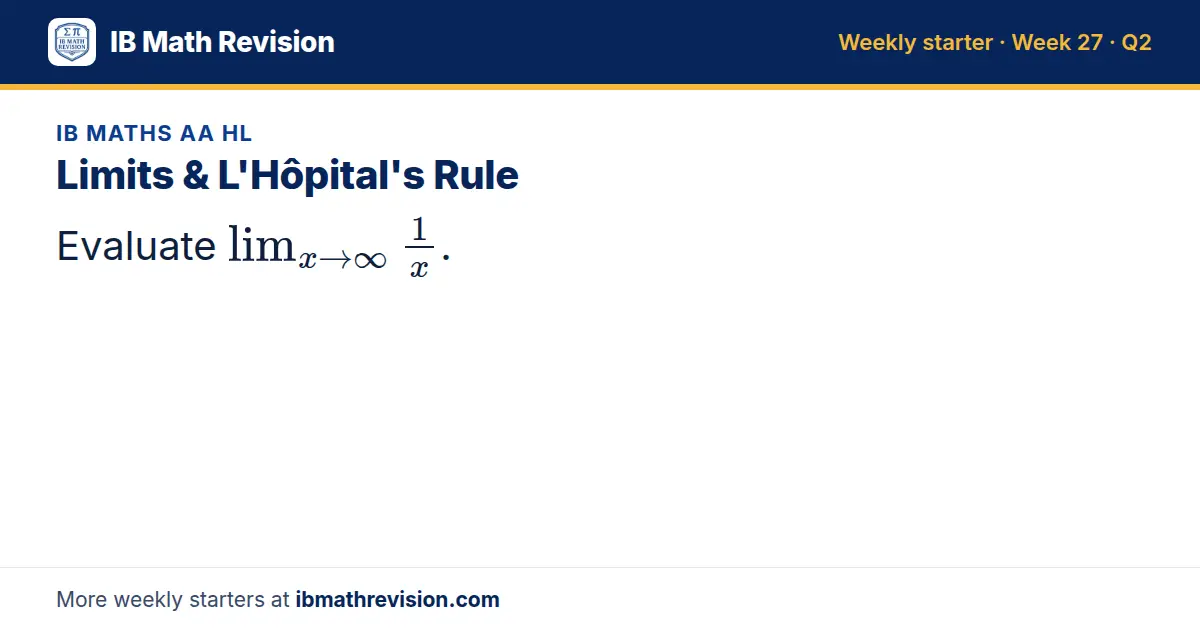
Question 2: Limits & L'Hôpital's Rule
Evaluate lim_x → ∞ 1/x.
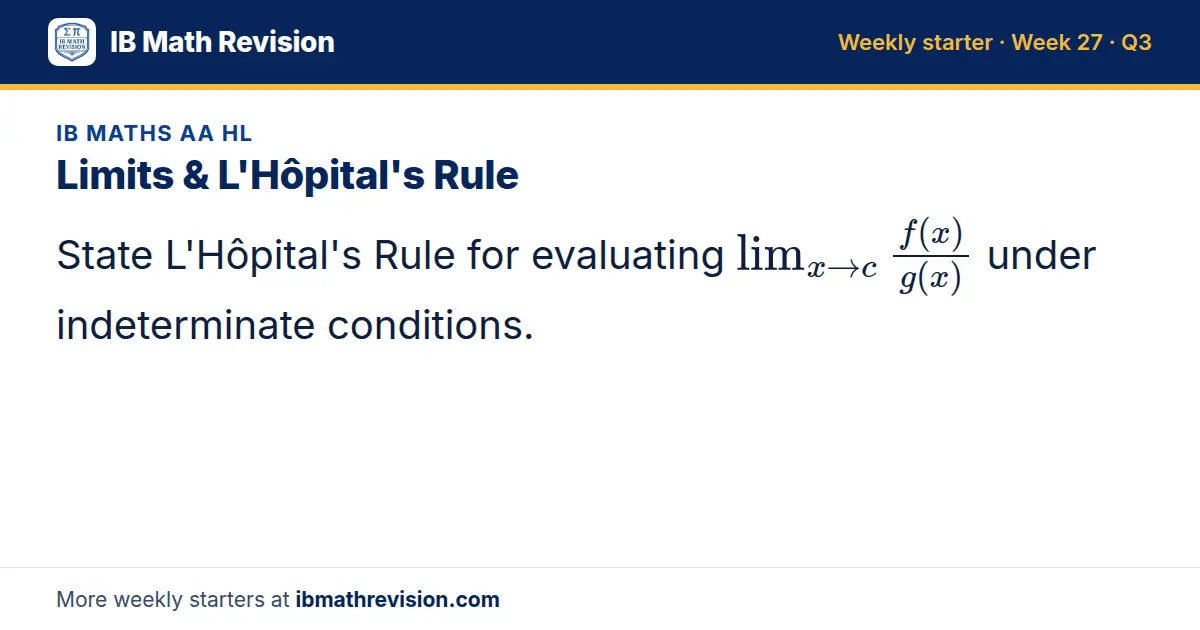
Question 3: Limits & L'Hôpital's Rule
State L'Hôpital's Rule for evaluating lim_x → c (f(x))/(g(x)) under indeterminate conditions.
Week 28
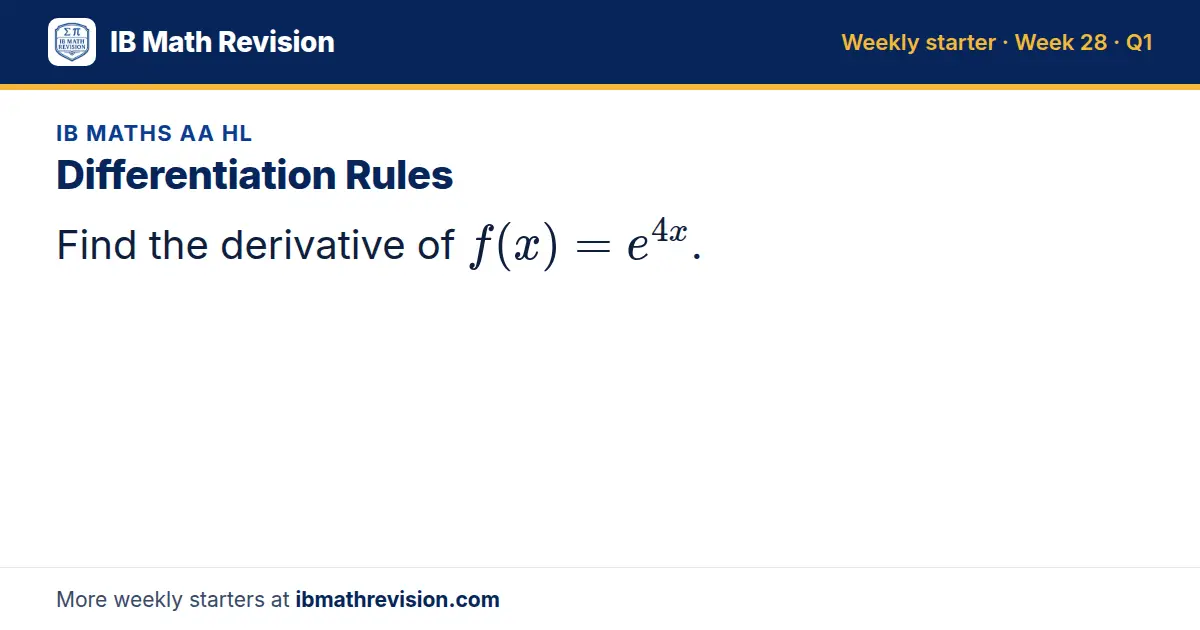
Question 1: Differentiation Rules
Find the derivative of f(x) = e^(4x).
Question 2: Differentiation Rules
State the Product Rule for finding the derivative of y = uv.
Question 3: Differentiation Rules
Find the derivative of f(x) = cos(x).
Week 29
Question 1: Advanced Differentiation
Using implicit differentiation, find the derivative of y² with respect to x.
Question 2: Advanced Differentiation
Write down the exact derivative of f(x) = arcsin(x).
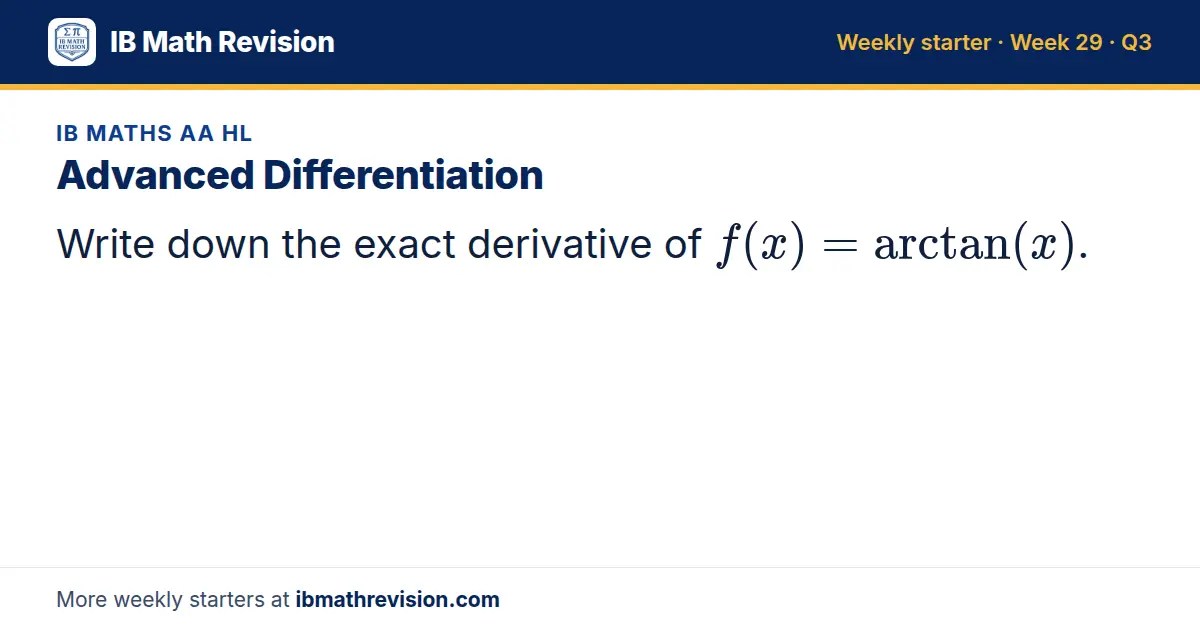
Question 3: Advanced Differentiation
Write down the exact derivative of f(x) = arctan(x).
Week 30
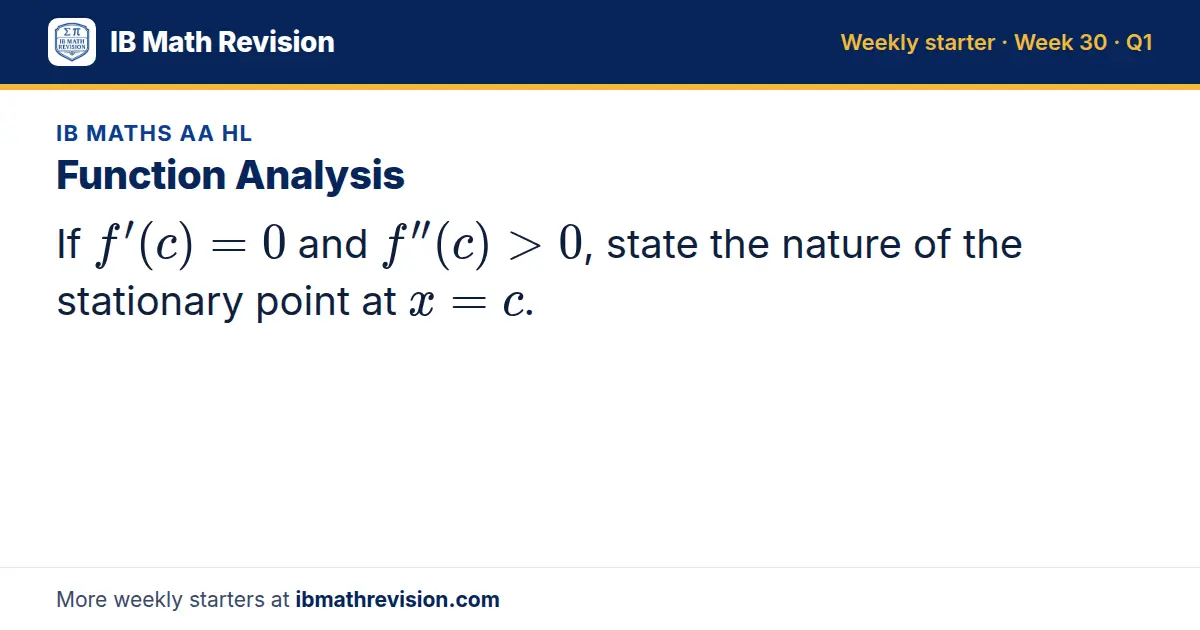
Question 1: Function Analysis
If f'(c) = 0 and f''(c) > 0, state the nature of the stationary point at x=c.
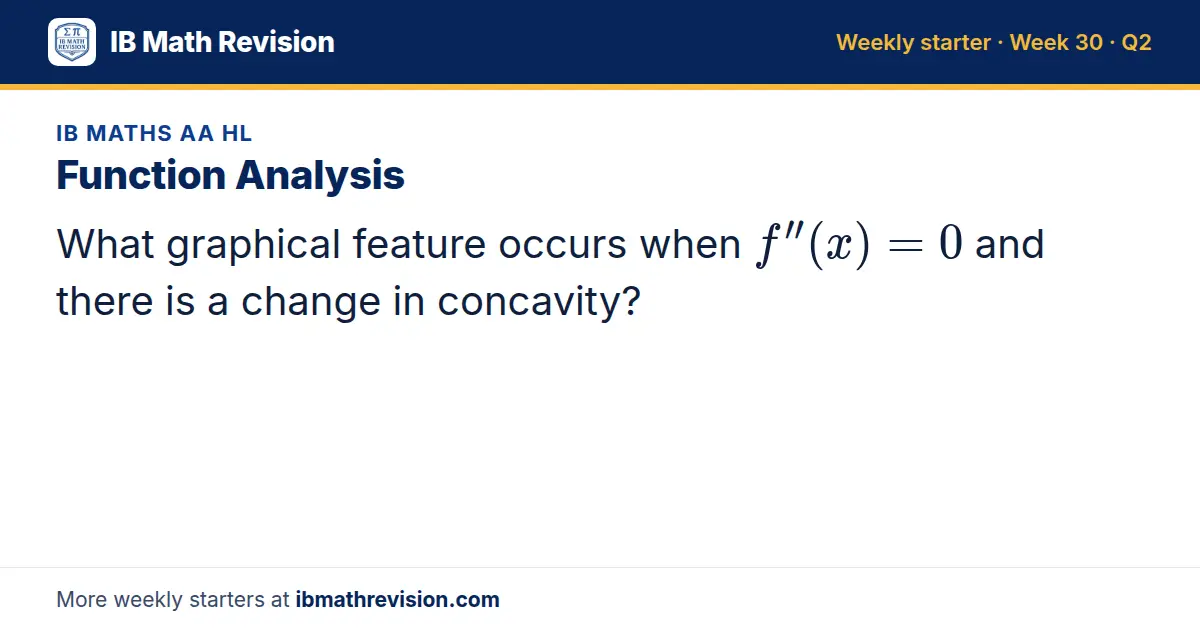
Question 2: Function Analysis
What graphical feature occurs when f''(x) = 0 and there is a change in concavity?
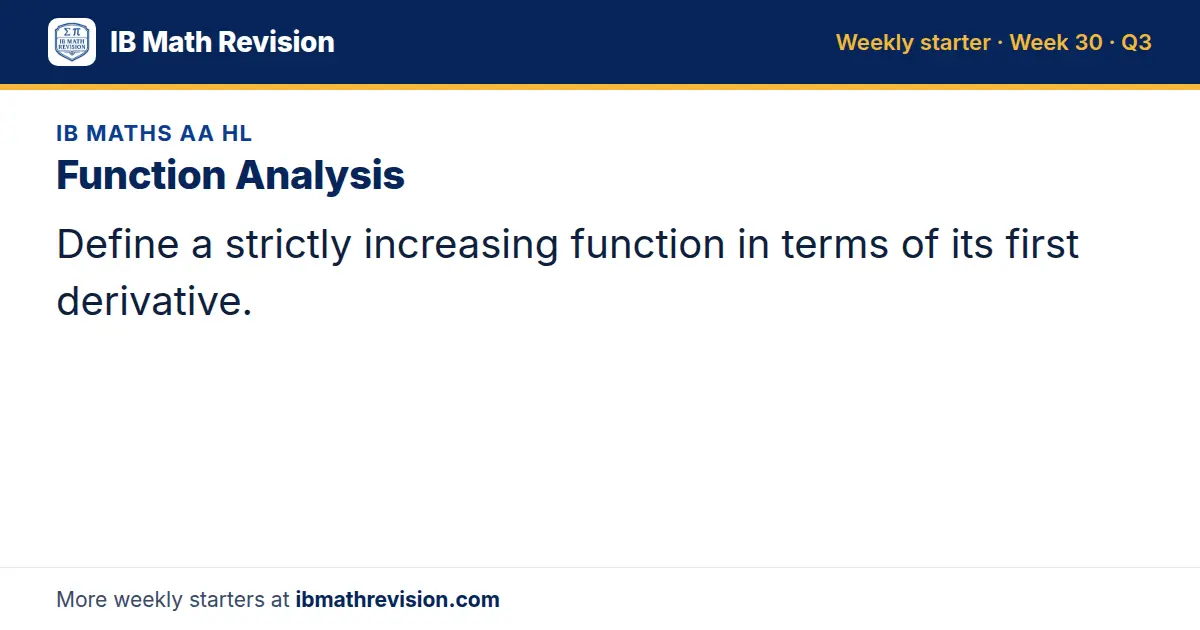
Question 3: Function Analysis
Define a strictly increasing function in terms of its first derivative.
Week 31
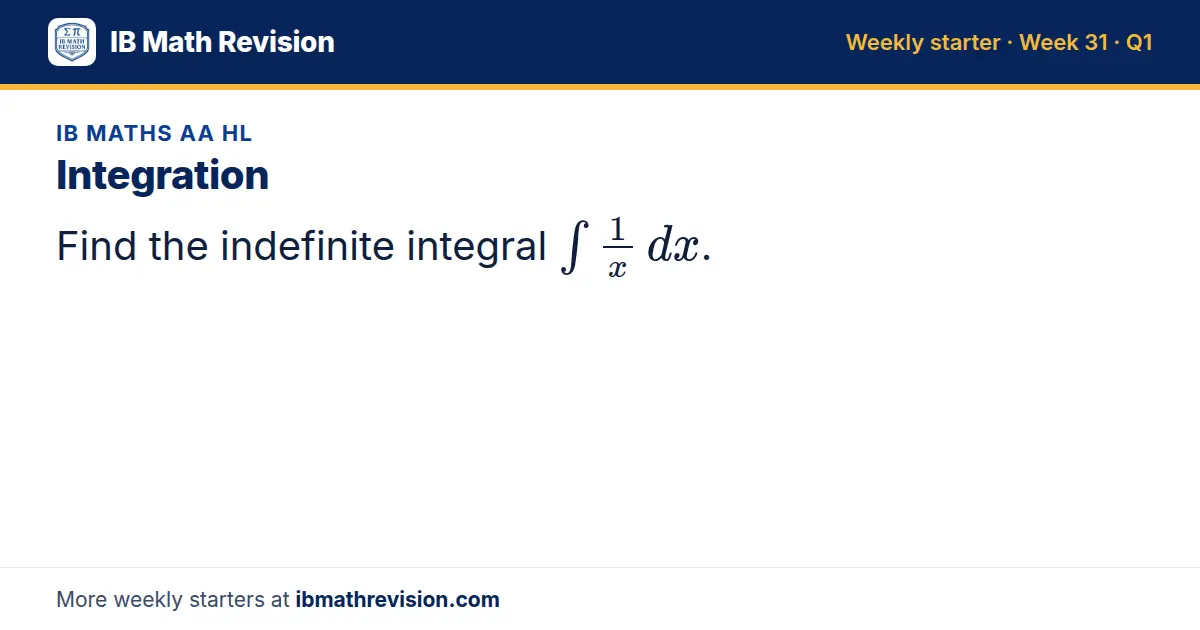
Question 1: Integration
Find the indefinite integral ∫ 1/x dx.
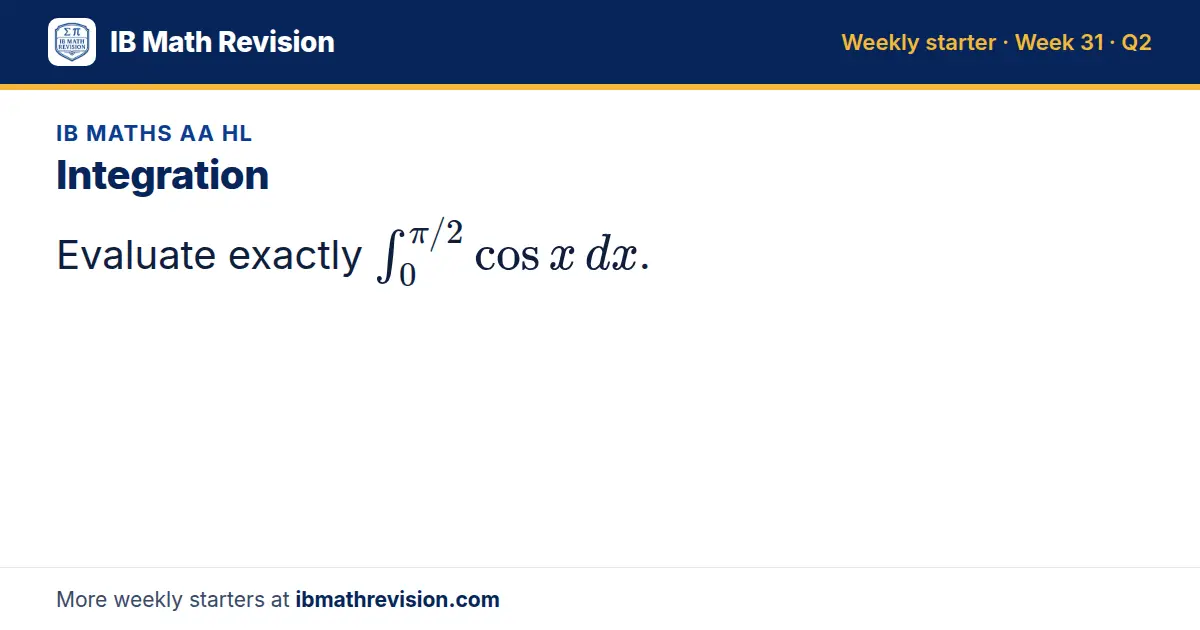
Question 2: Integration
Evaluate exactly ∫_0^(π/2) cos x dx.
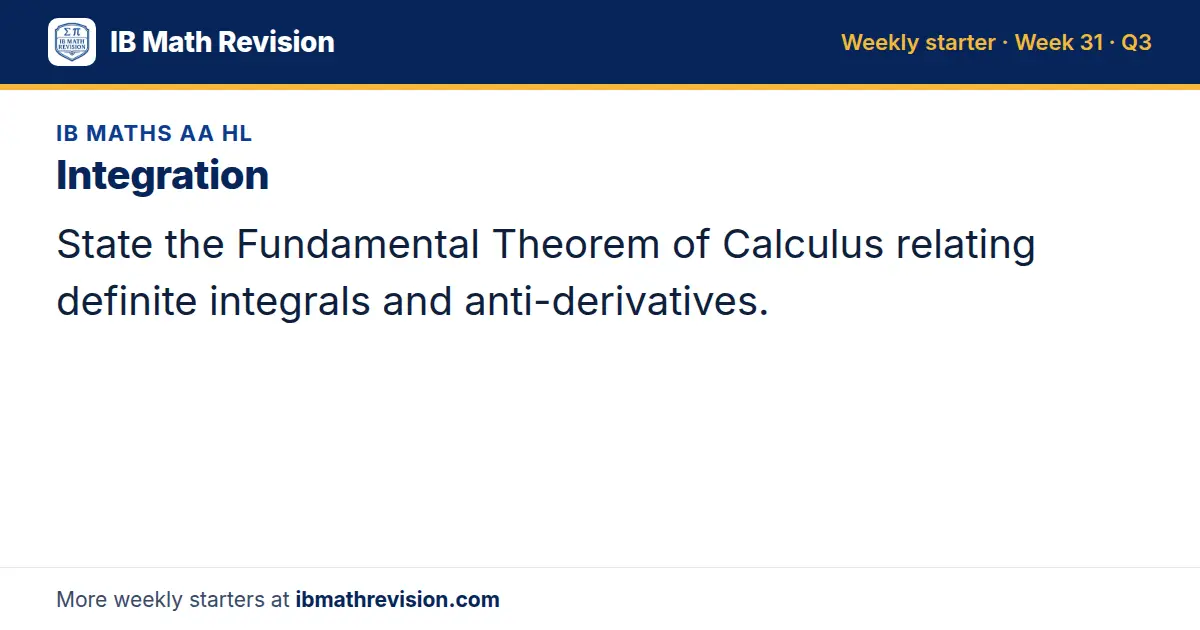
Question 3: Integration
State the Fundamental Theorem of Calculus relating definite integrals and anti-derivatives.
Week 32
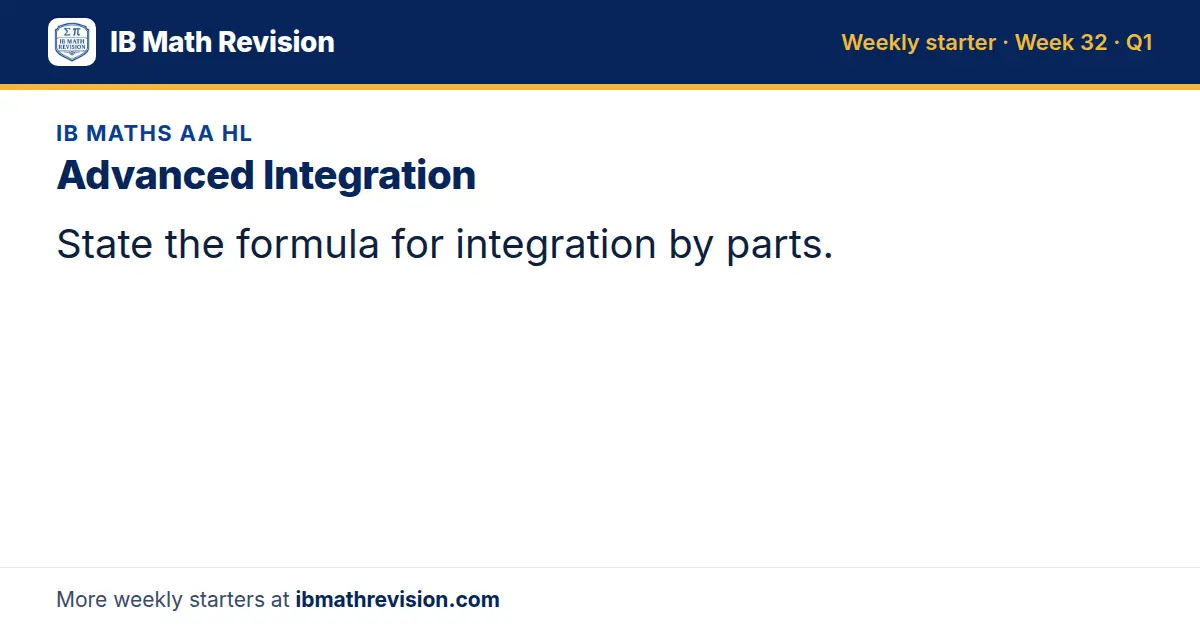
Question 1: Advanced Integration
State the formula for integration by parts.
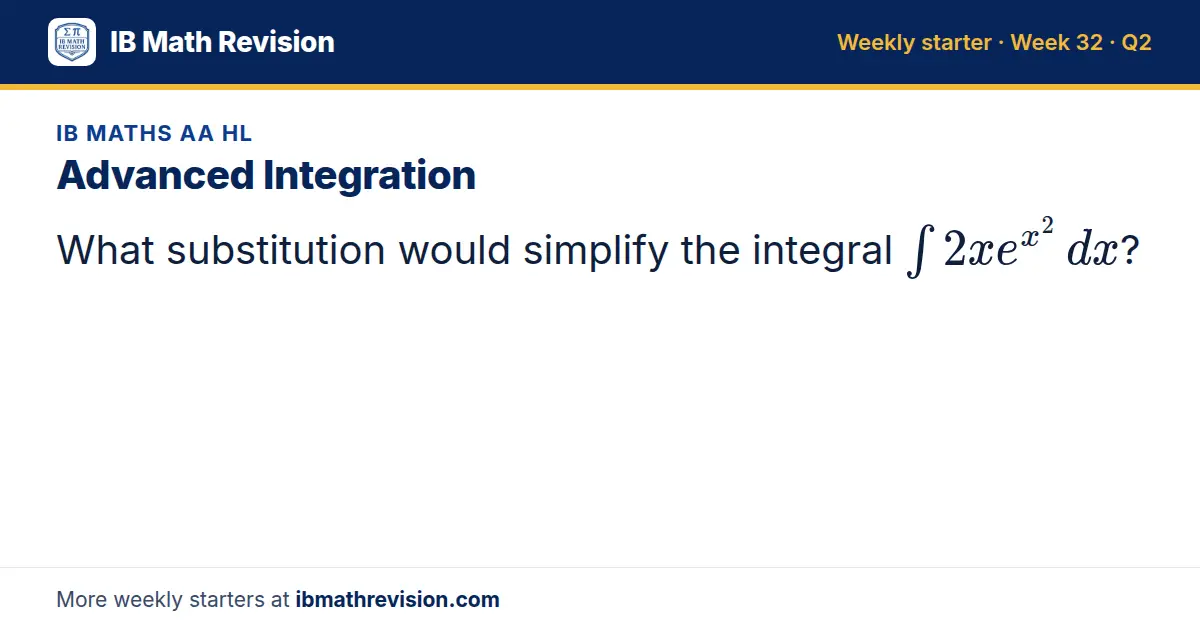
Question 2: Advanced Integration
What substitution would simplify the integral ∫ 2x e^(x²) dx?
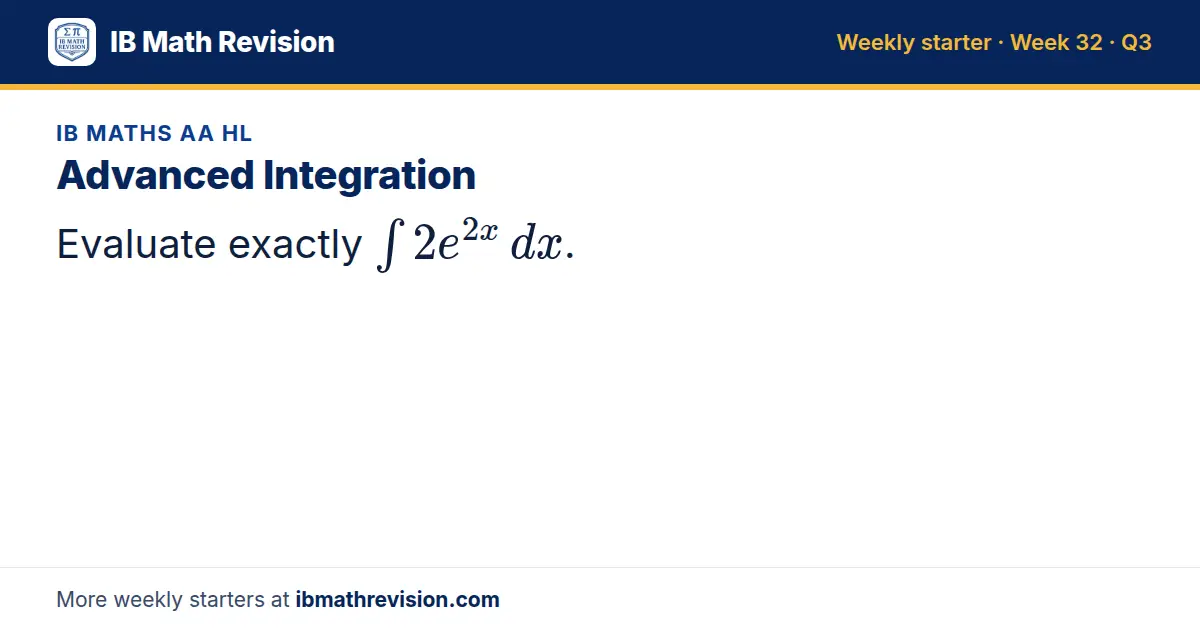
Question 3: Advanced Integration
Evaluate exactly ∫ 2e^(2x) dx.
Week 33
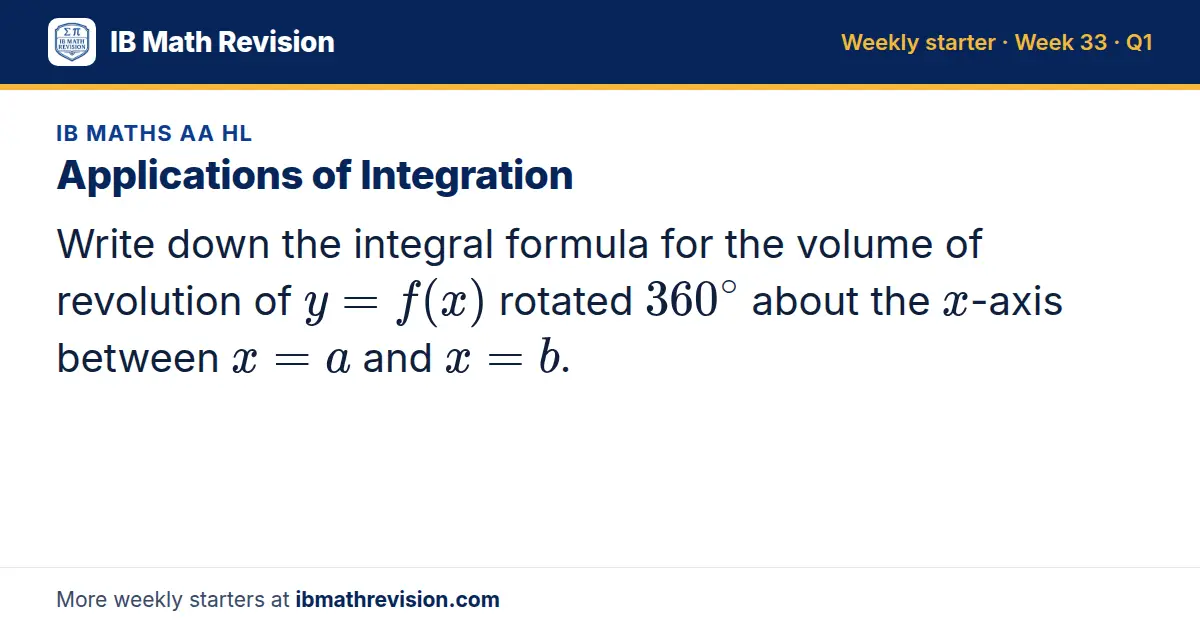
Question 1: Applications of Integration
Write down the integral formula for the volume of revolution of y=f(x) rotated 360^∘ about the x-axis between x=a and x=b.
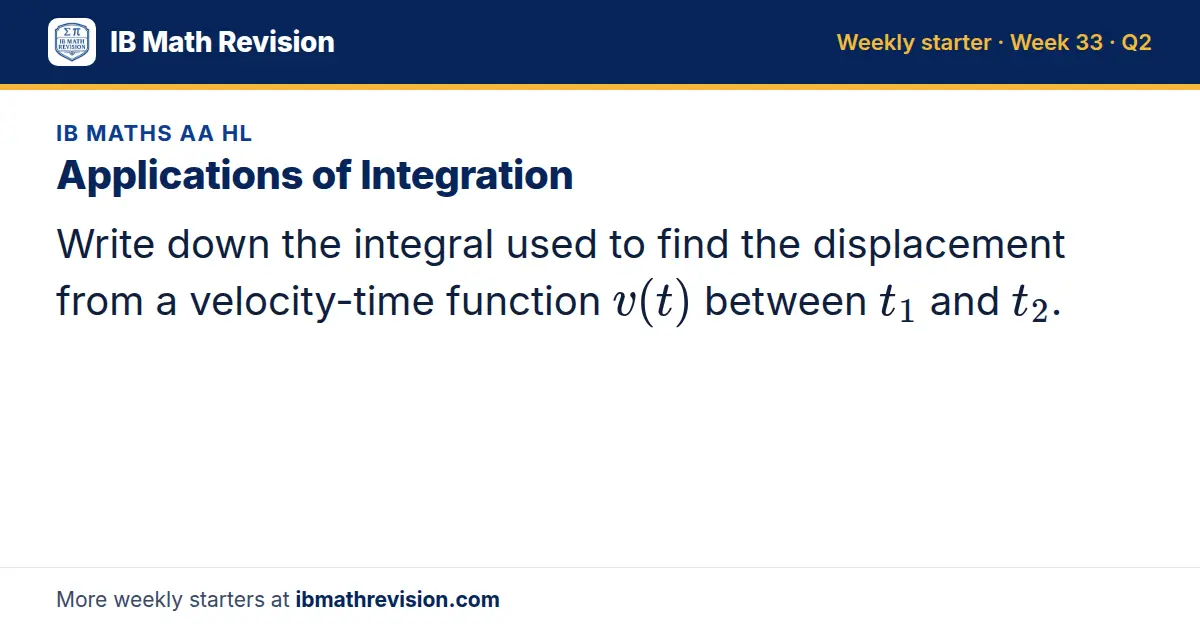
Question 2: Applications of Integration
Write down the integral used to find the displacement from a velocity-time function v(t) between t_1 and t_2.
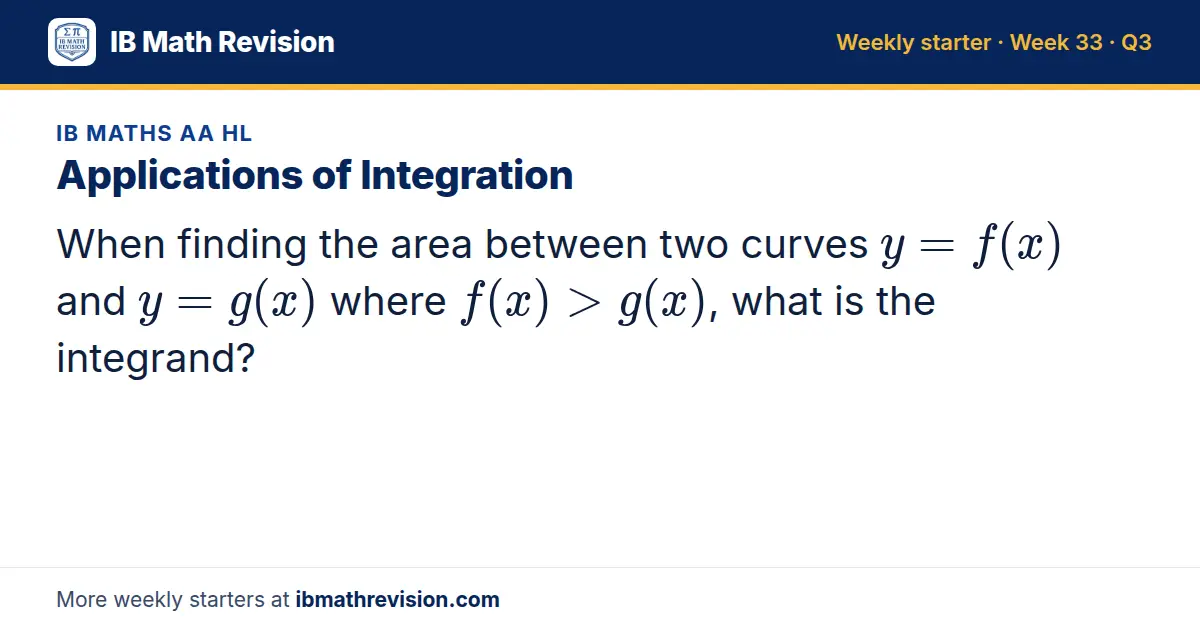
Question 3: Applications of Integration
When finding the area between two curves y=f(x) and y=g(x) where f(x) > g(x), what is the integrand?
Week 34
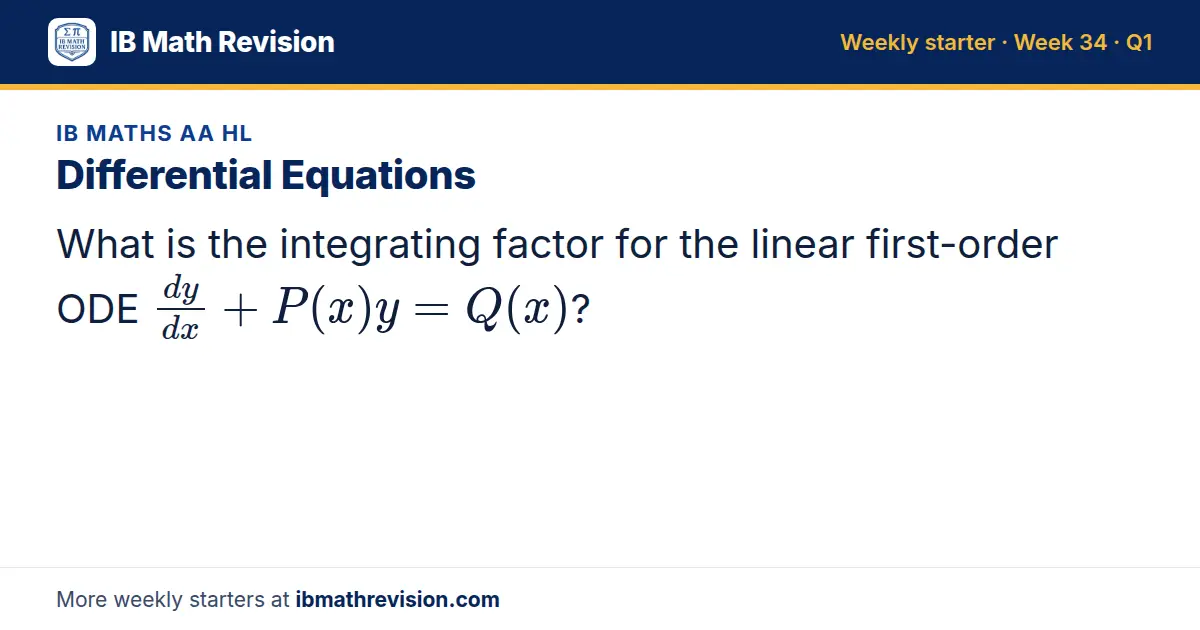
Question 1: Differential Equations
What is the integrating factor for the linear first-order ODE dy/dx + P(x)y = Q(x)?
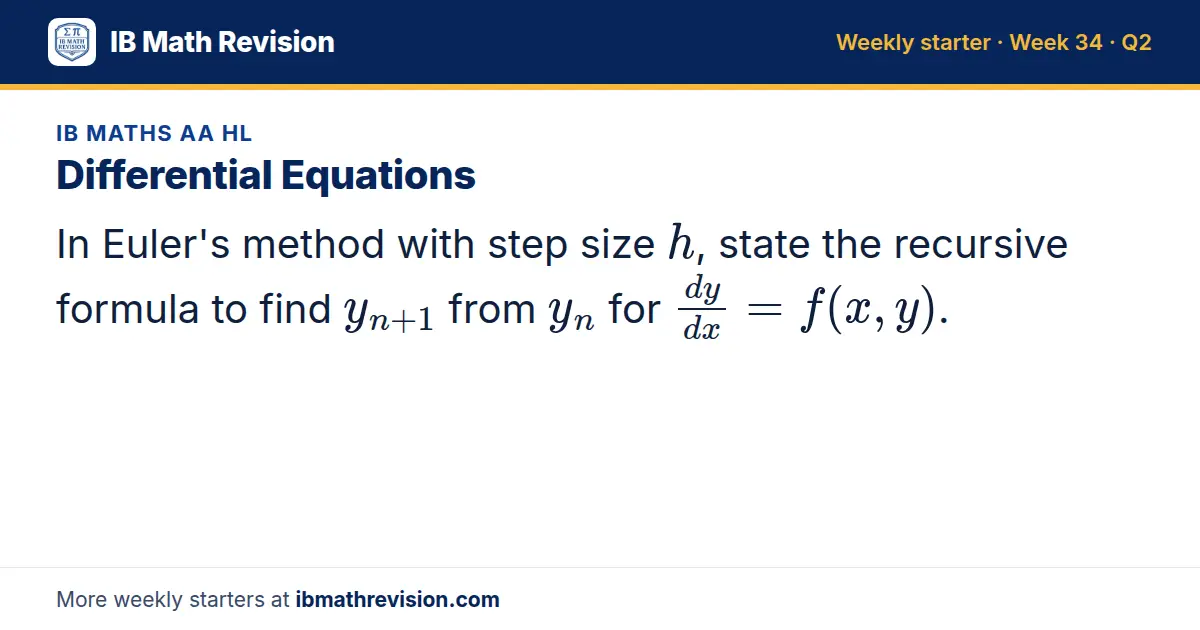
Question 2: Differential Equations
In Euler's method with step size h, state the recursive formula to find y_n+1 from y_n for dy/dx = f(x,y).
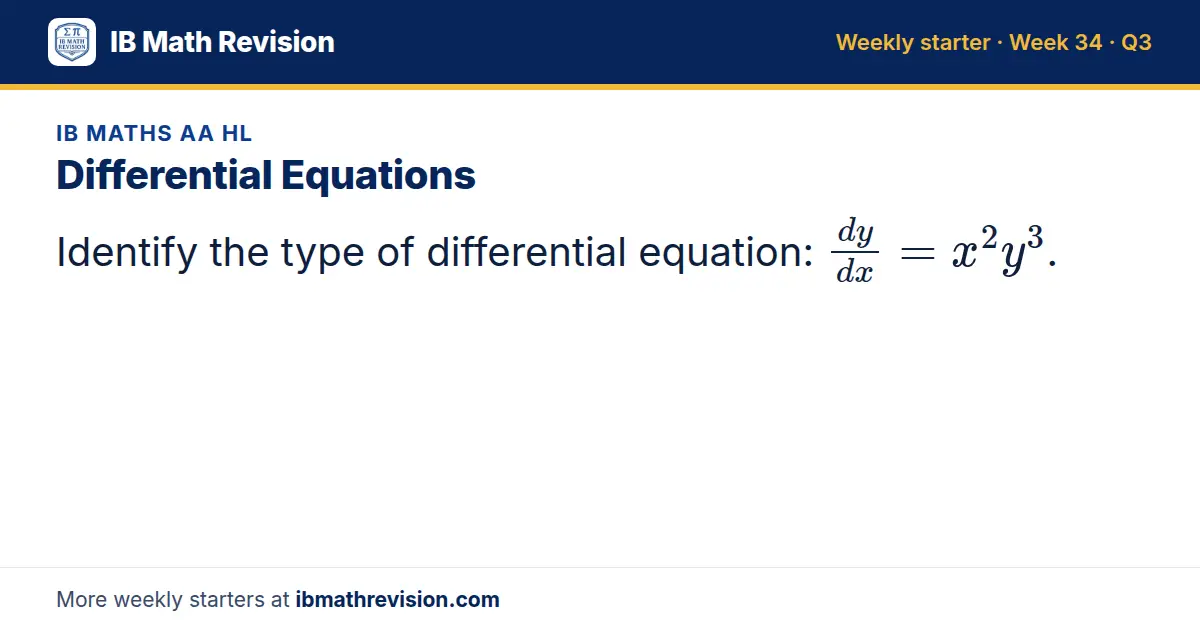
Question 3: Differential Equations
Identify the type of differential equation: dy/dx = x² y^3.
Week 35
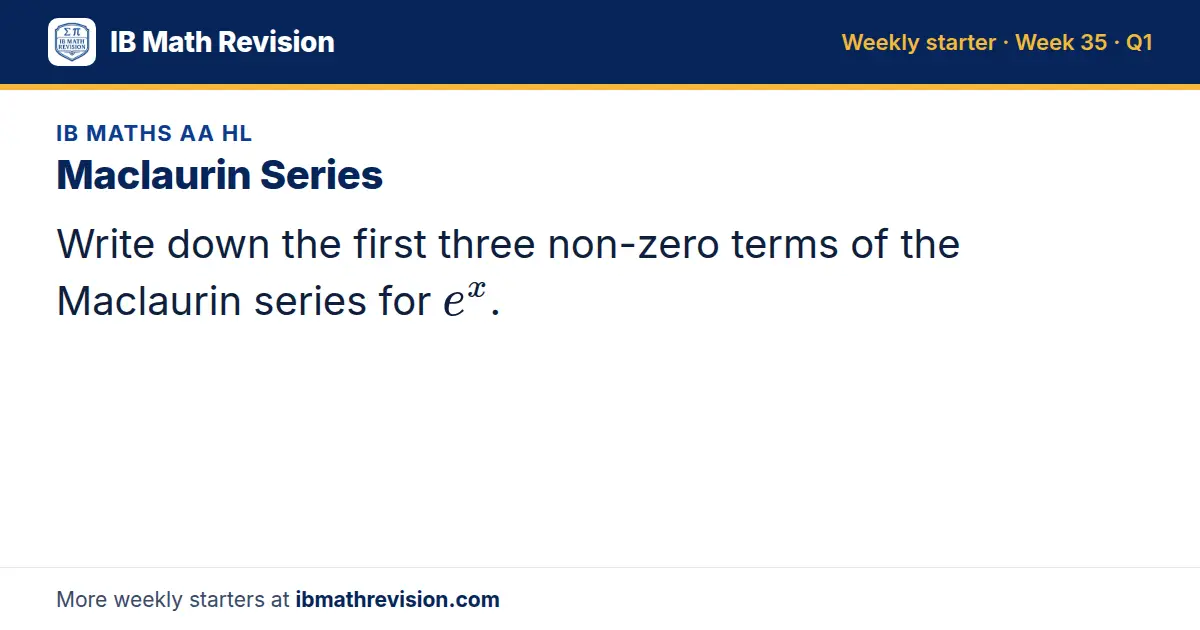
Question 1: Maclaurin Series
Write down the first three non-zero terms of the Maclaurin series for e^x.
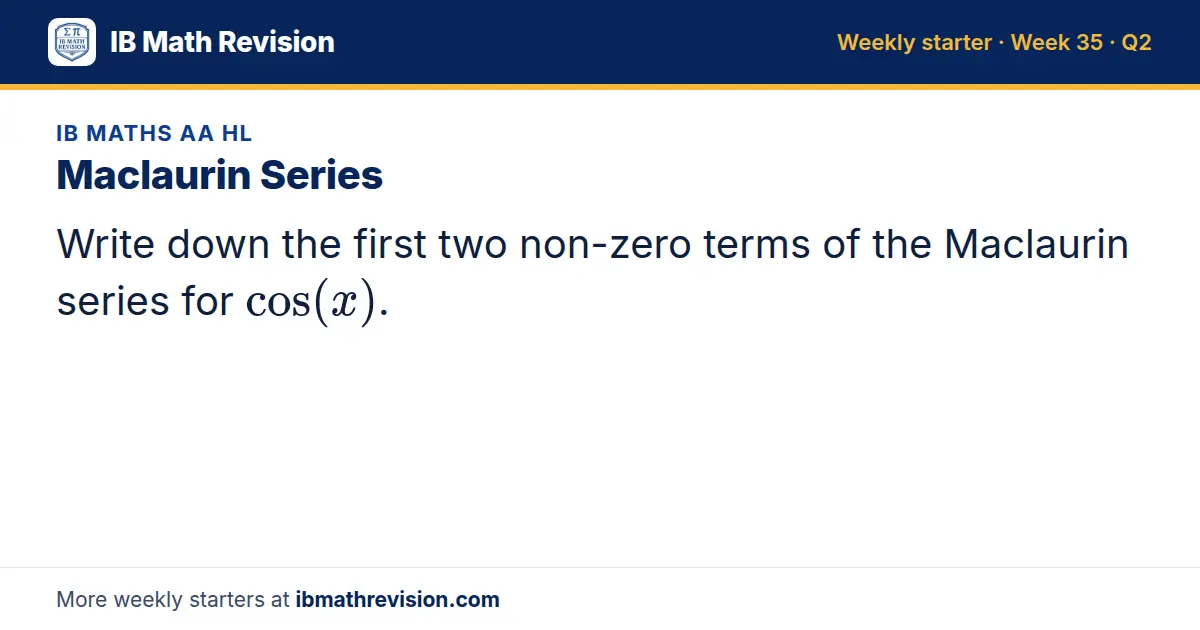
Question 2: Maclaurin Series
Write down the first two non-zero terms of the Maclaurin series for cos(x).
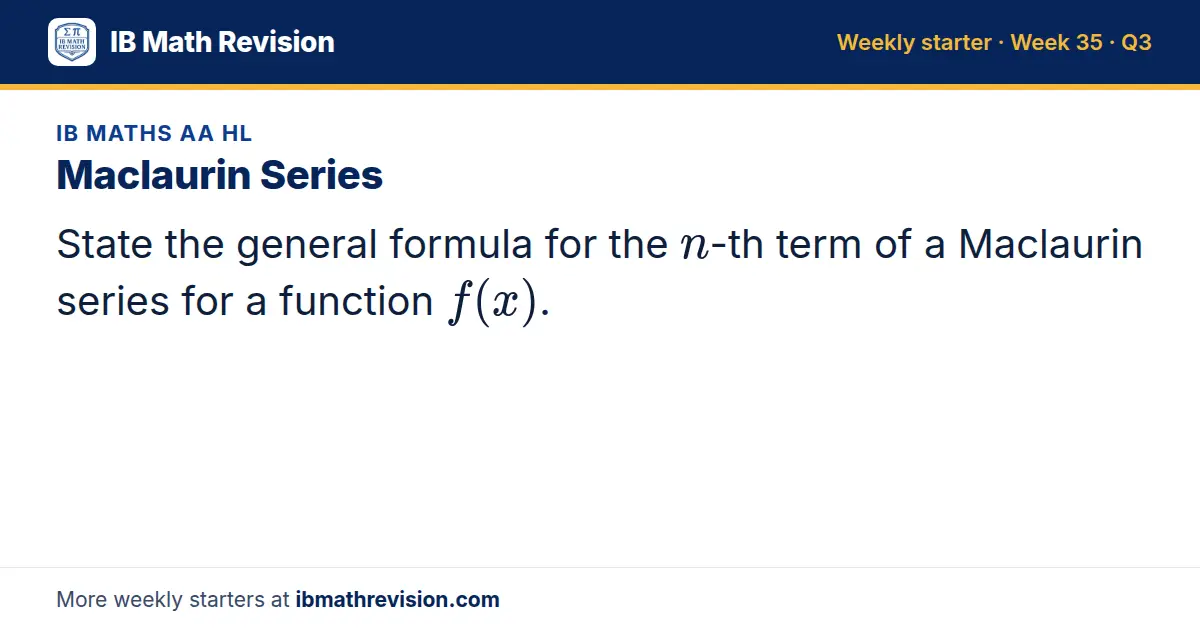
Question 3: Maclaurin Series
State the general formula for the n-th term of a Maclaurin series for a function f(x).
Week 36
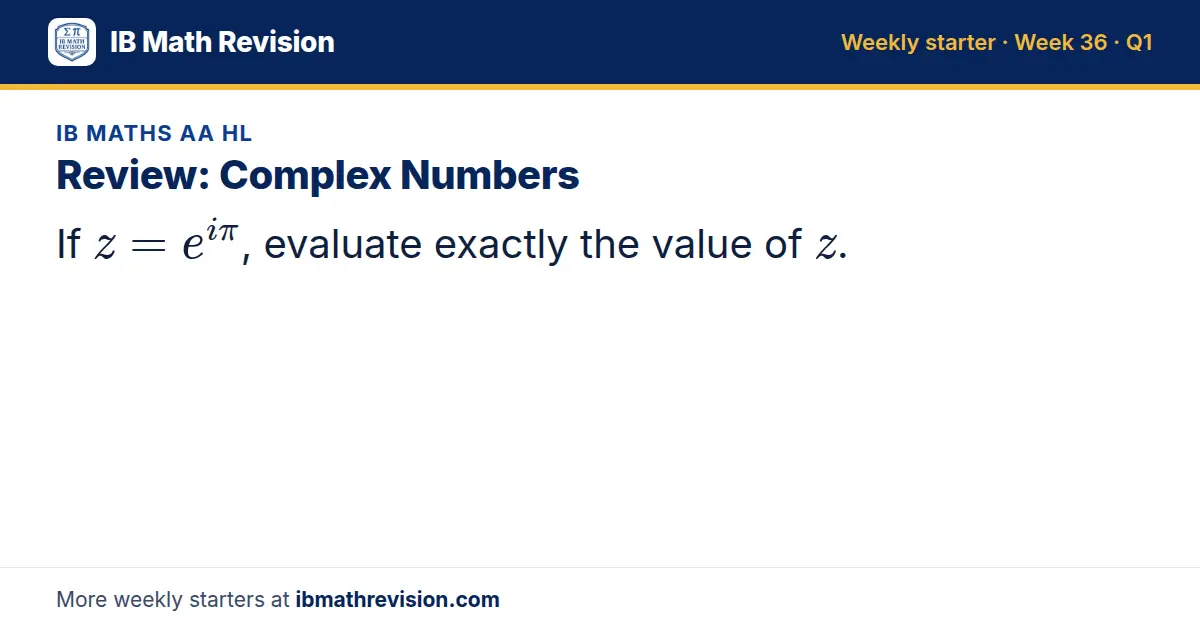
Question 1: Review: Complex Numbers
If z = e^(iπ), evaluate exactly the value of z.
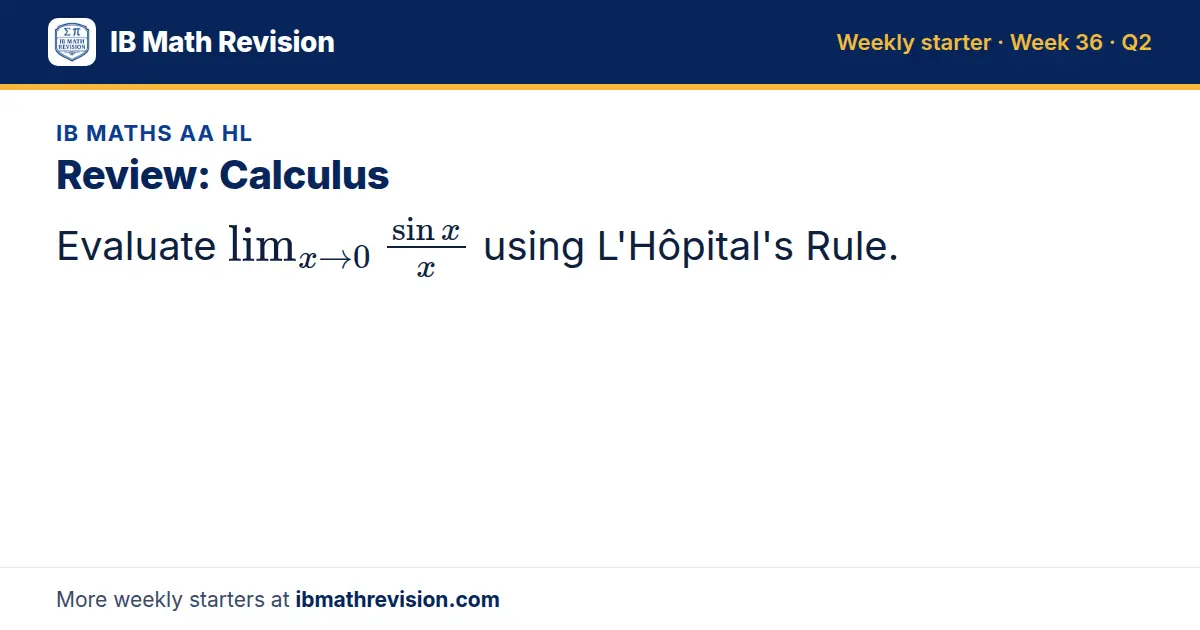
Question 2: Review: Calculus
Evaluate lim_x → 0 (sin x)/x using L'Hôpital's Rule.
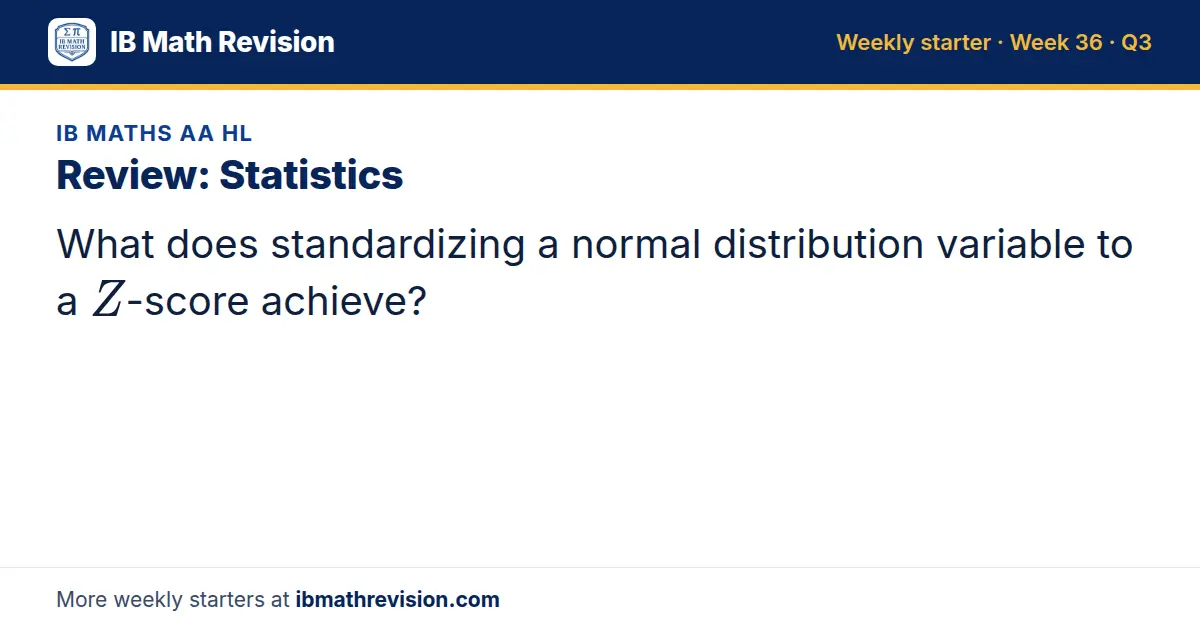
Question 3: Review: Statistics
What does standardizing a normal distribution variable to a Z-score achieve?
Week 37
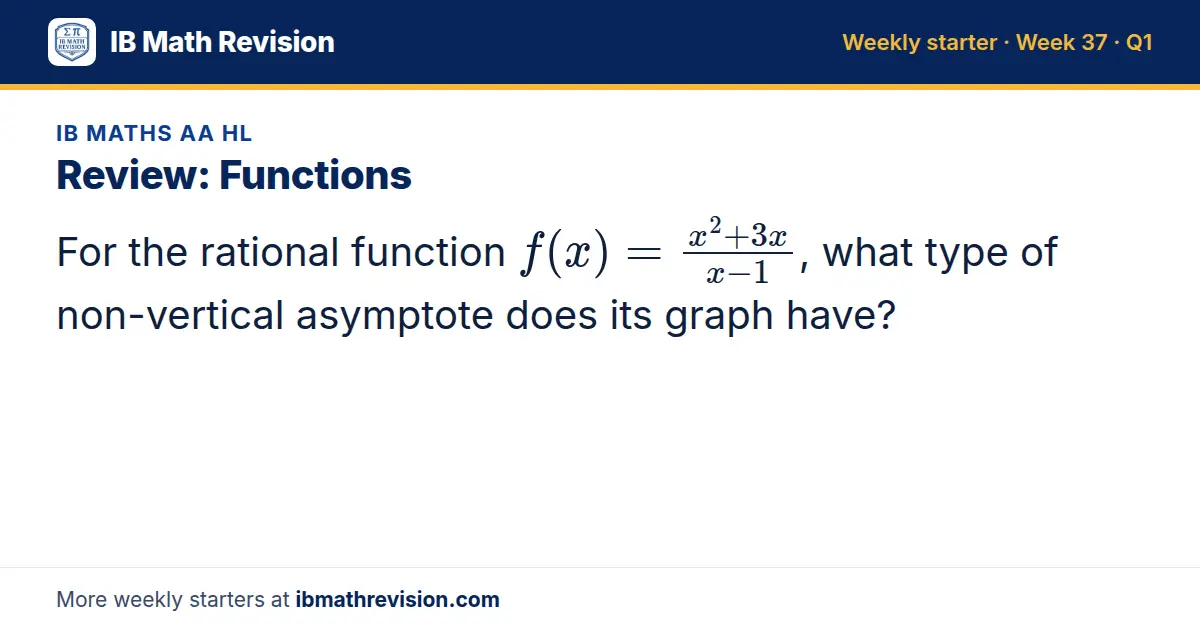
Question 1: Review: Functions
For the rational function f(x) = (x²+3x)/(x-1), what type of non-vertical asymptote does its graph have?
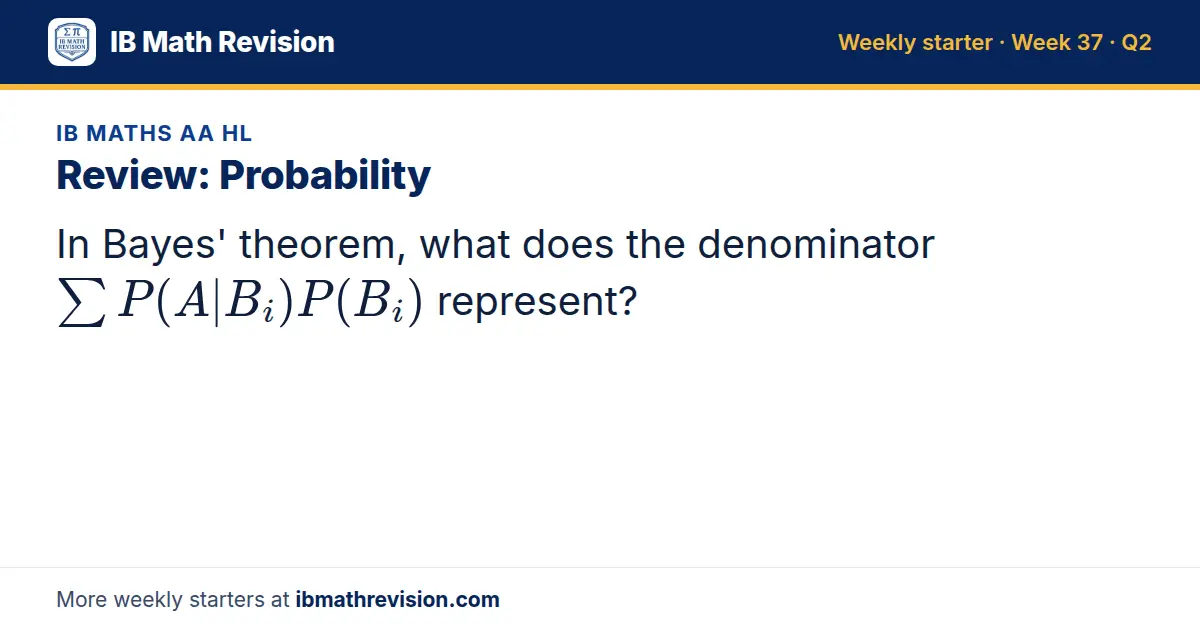
Question 2: Review: Probability
In Bayes' theorem, what does the denominator Σ P(A|B_i)P(B_i) represent?
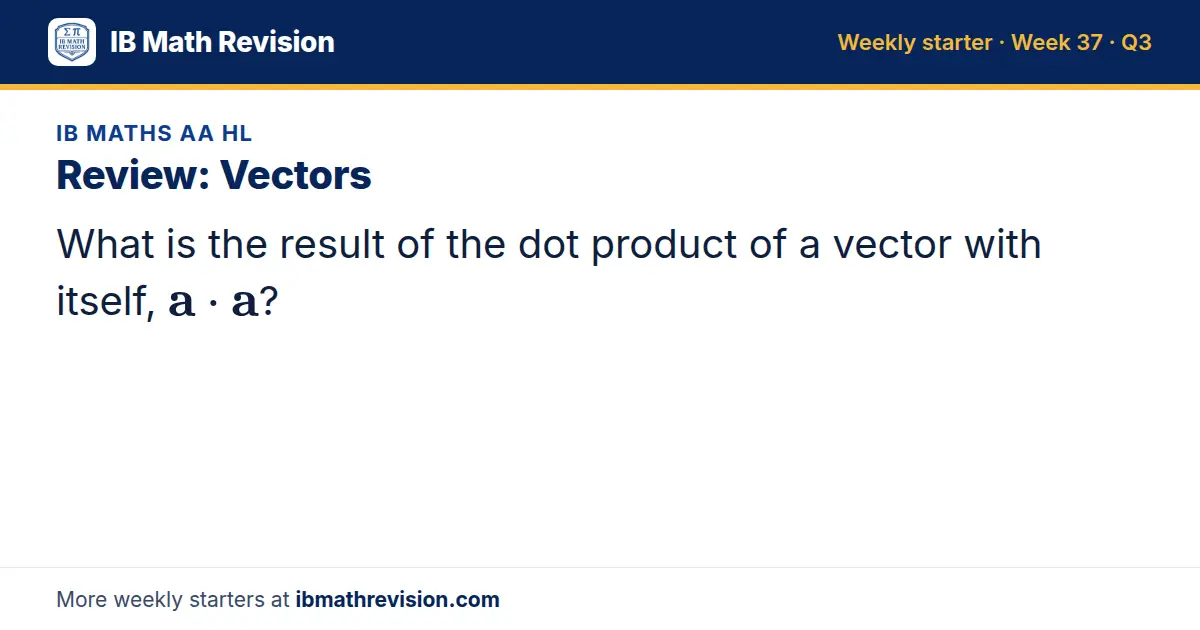
Question 3: Review: Vectors
What is the result of the dot product of a vector with itself, a · a?
Week 38
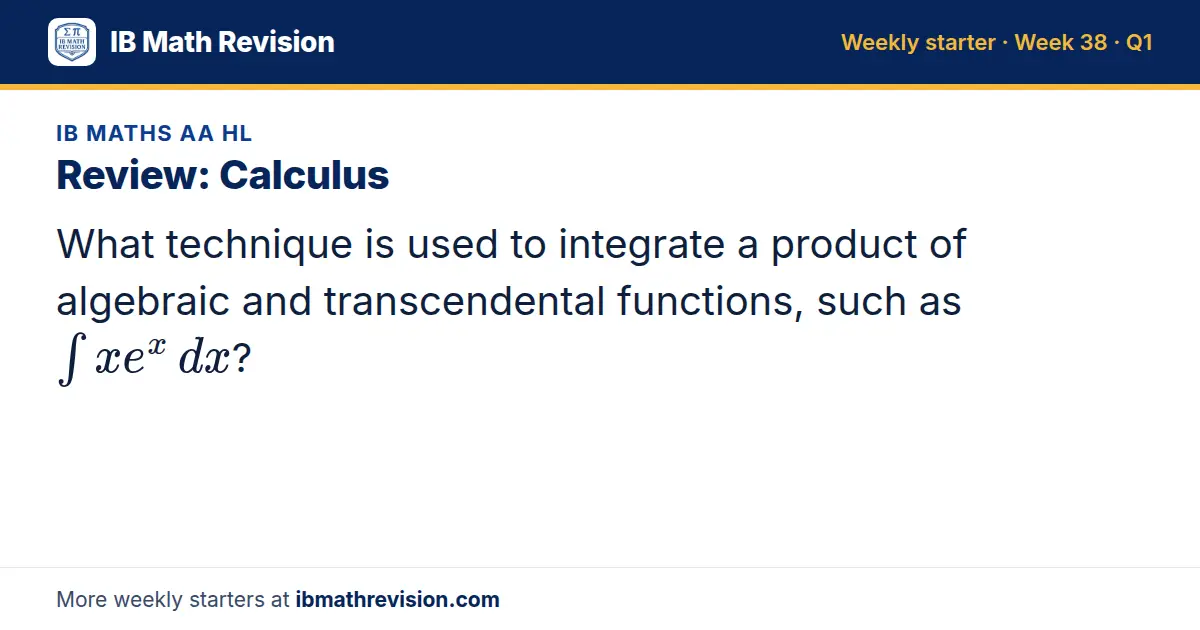
Question 1: Review: Calculus
What technique is used to integrate a product of algebraic and transcendental functions, such as ∫ x e^x dx?
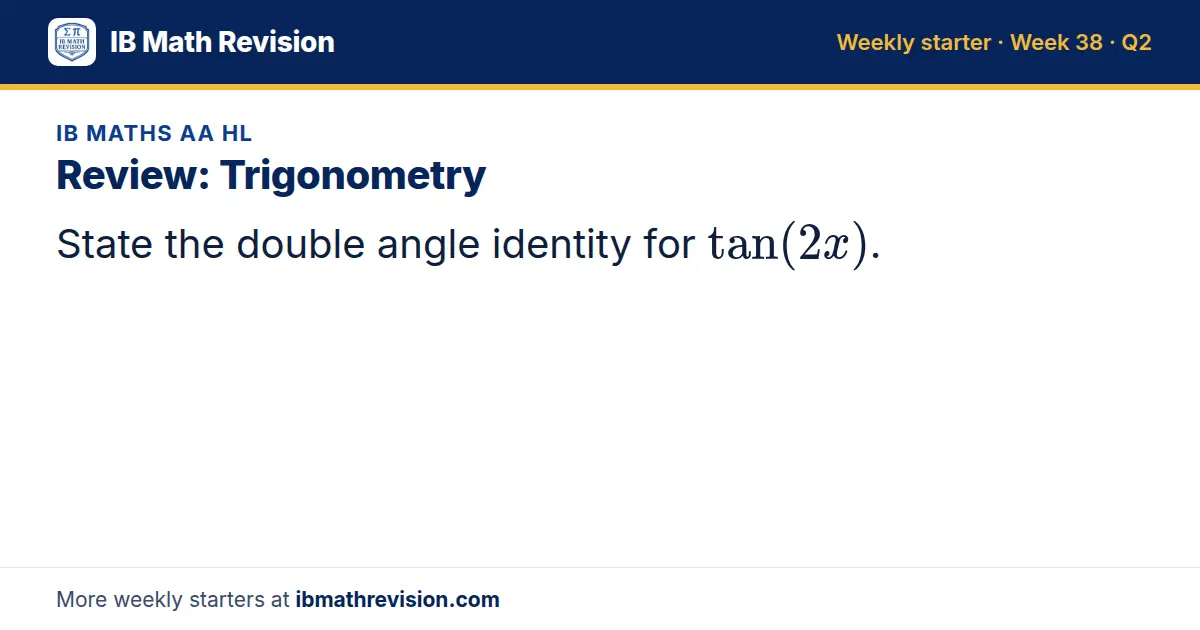
Question 2: Review: Trigonometry
State the double angle identity for tan(2x).
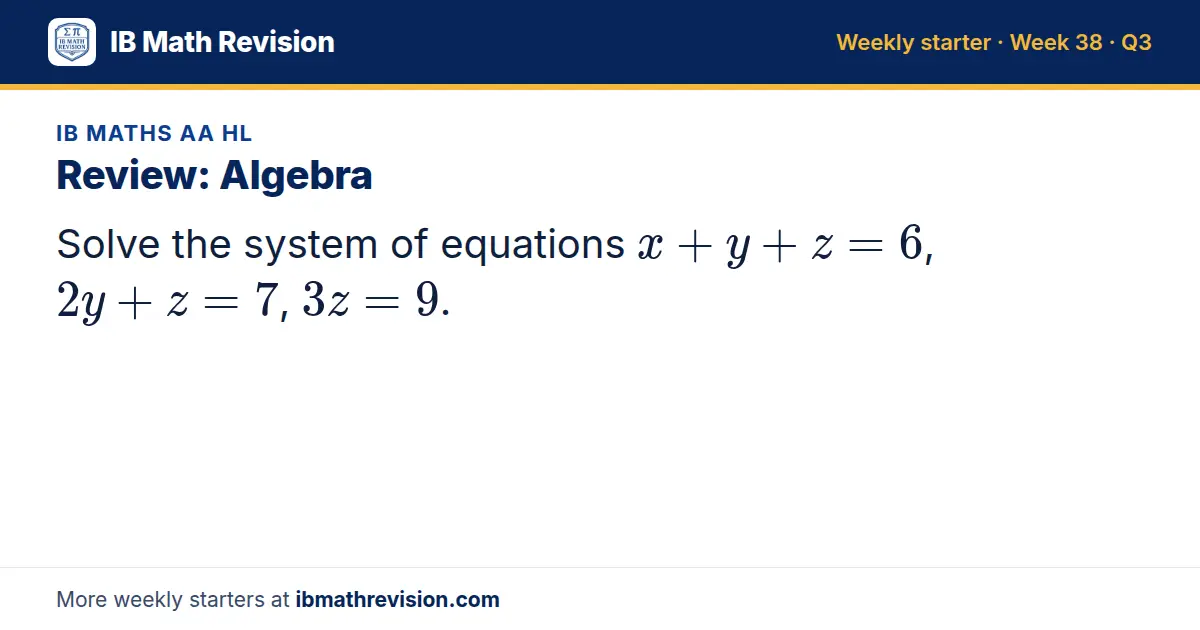
Question 3: Review: Algebra
Solve the system of equations x + y + z = 6, 2y + z = 7, 3z = 9.
Week 39
Question 1: Review: Geometry
Two planes have normal vectors n_1 and n_2. If the planes are parallel, what is the relationship between n_1 and n_2?
Question 2: Review: Maclaurin Series
How can you find the Maclaurin series for sin(x) from the series for cos(x)?
Question 3: Review: Differential Equations
What does Euler's method allow us to approximate?
Week 40
Question 1: Review: Proof
If a mathematical induction proof assumes P(k) is true, what must be shown next?
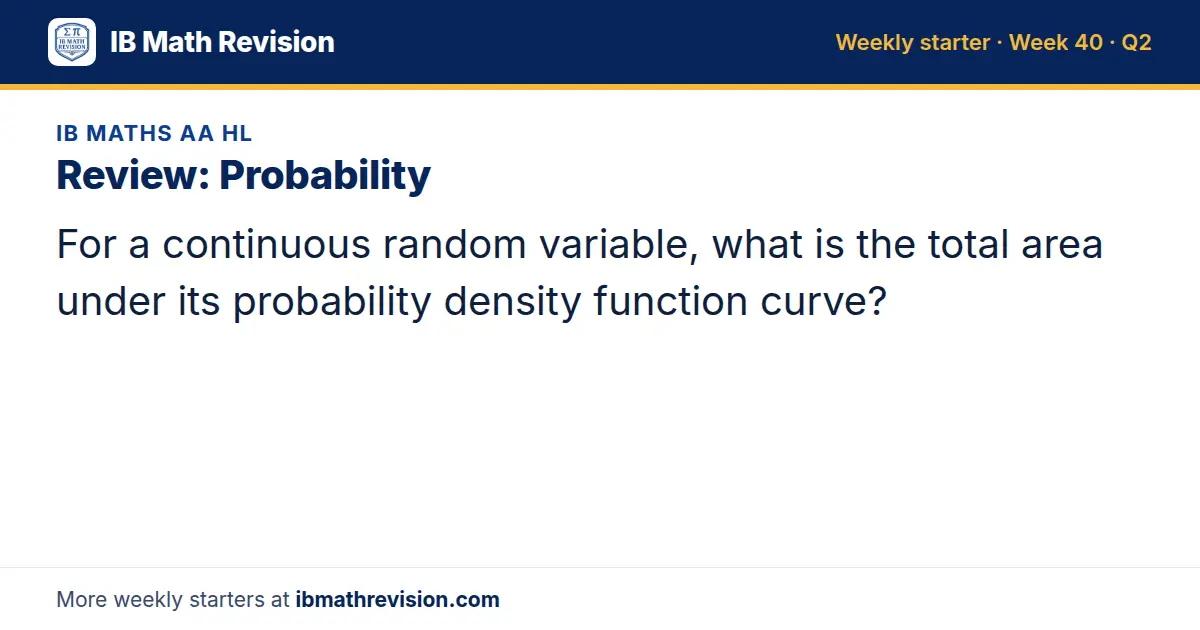
Question 2: Review: Probability
For a continuous random variable, what is the total area under its probability density function curve?
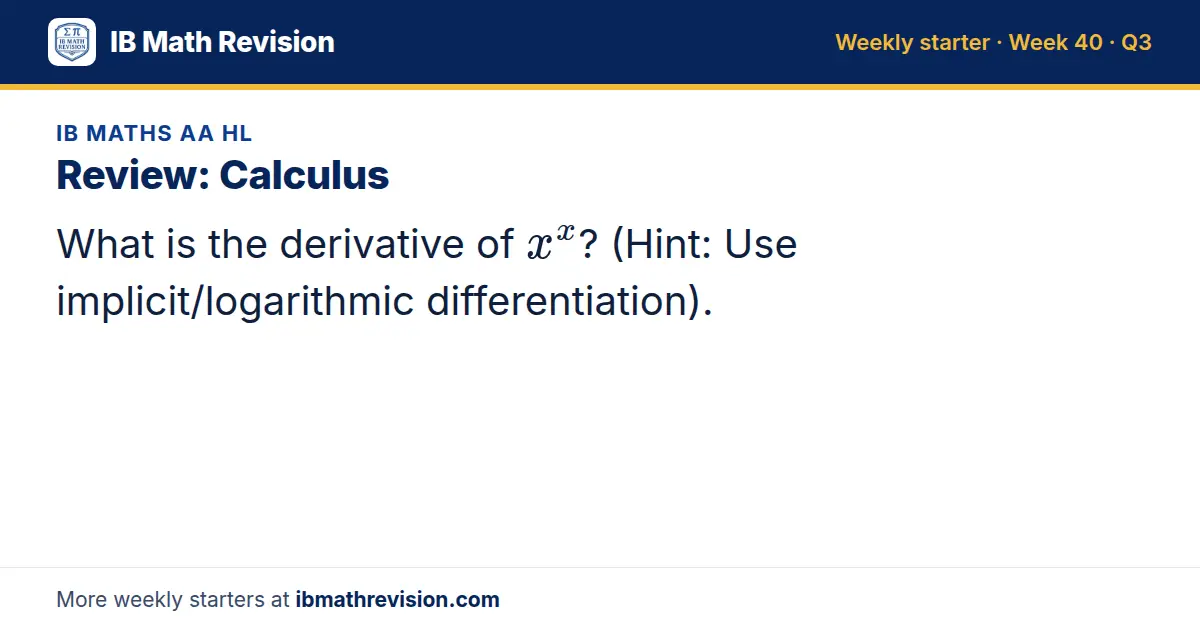
Question 3: Review: Calculus
What is the derivative of x^x? (Hint: Use implicit/logarithmic differentiation).
More starter questions
Other weeks: Weeks 1–13 · Weeks 14–26 · Weeks 27–40. Answers and mark schemes are in the starter tasks for teachers.