IB Maths AA HL starter questions: weeks 1–13
39 short questions to open a lesson for IB Maths Analysis and Approaches HL, weeks 1–13 of the teaching year, three or four a week. Each question is shown as an image with its text underneath; answers and mark schemes stay with teachers.
Week 1
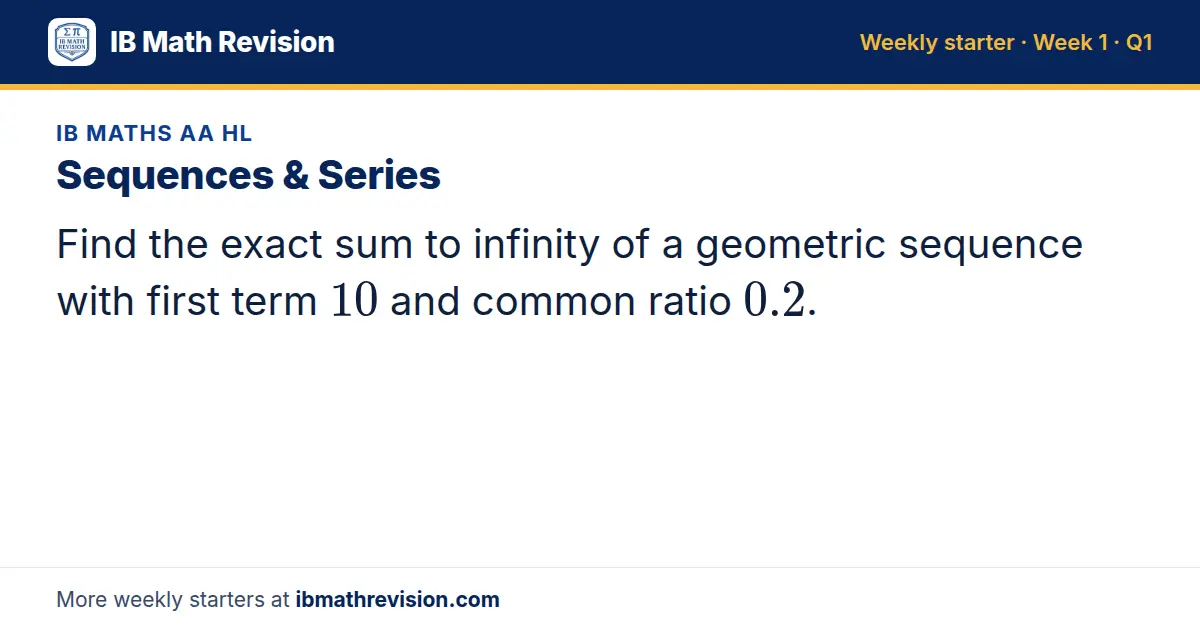
Question 1: Sequences & Series
Find the exact sum to infinity of a geometric sequence with first term 10 and common ratio 0.2.
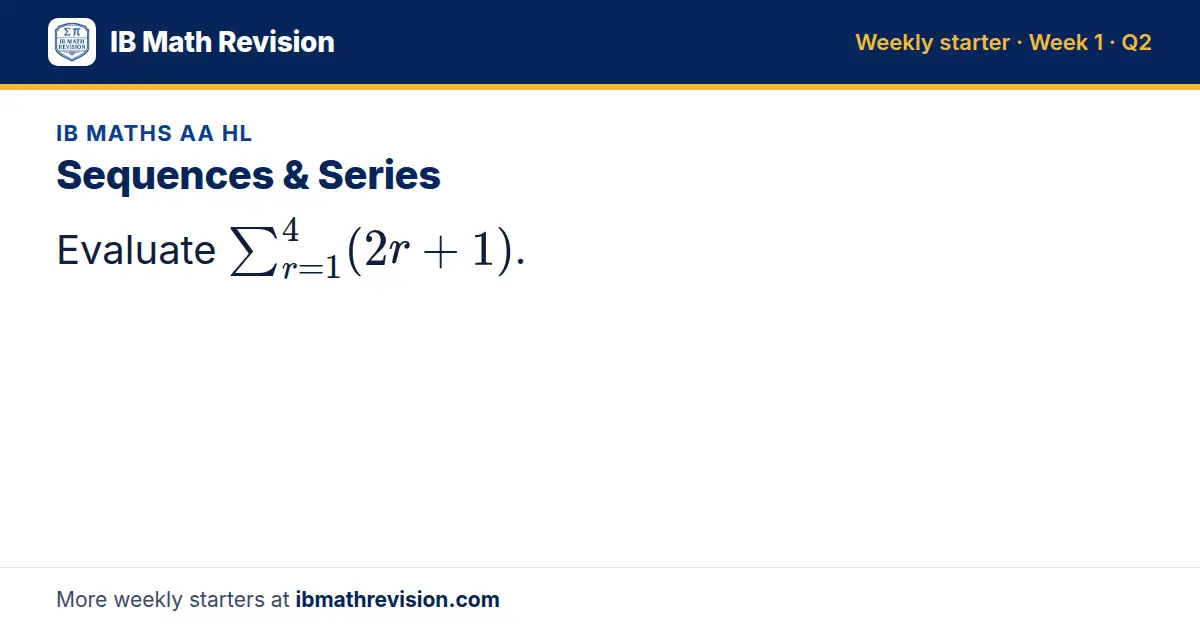
Question 2: Sequences & Series
Evaluate Σ_r=1⁴ (2r + 1).
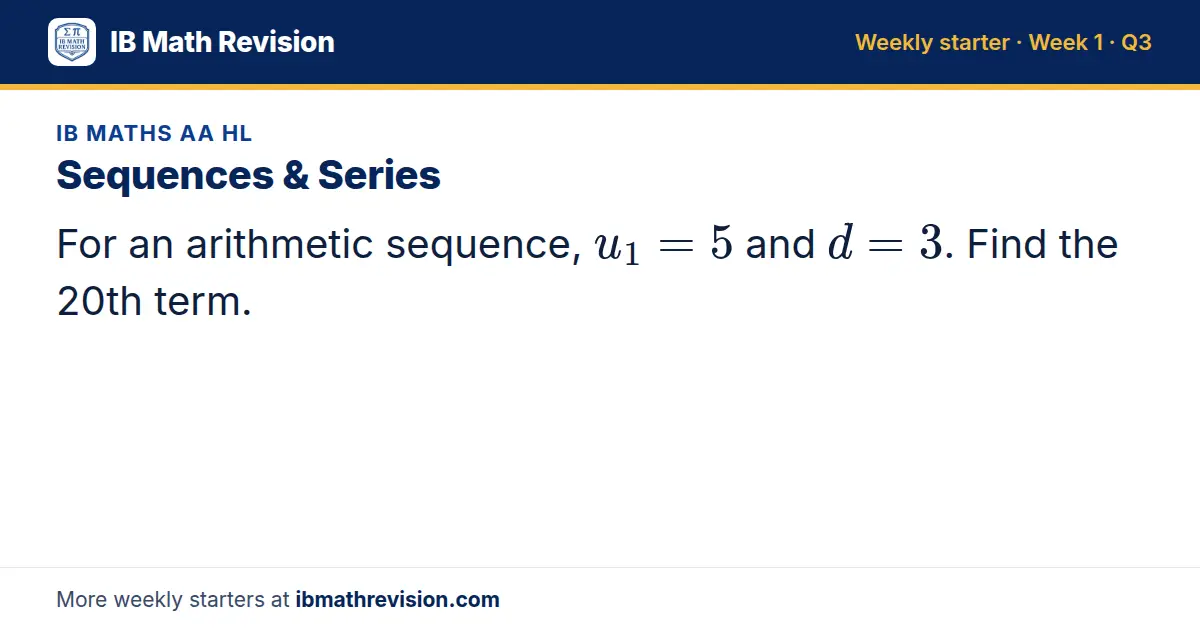
Question 3: Sequences & Series
For an arithmetic sequence, u_1 = 5 and d = 3. Find the 20th term.
Week 2
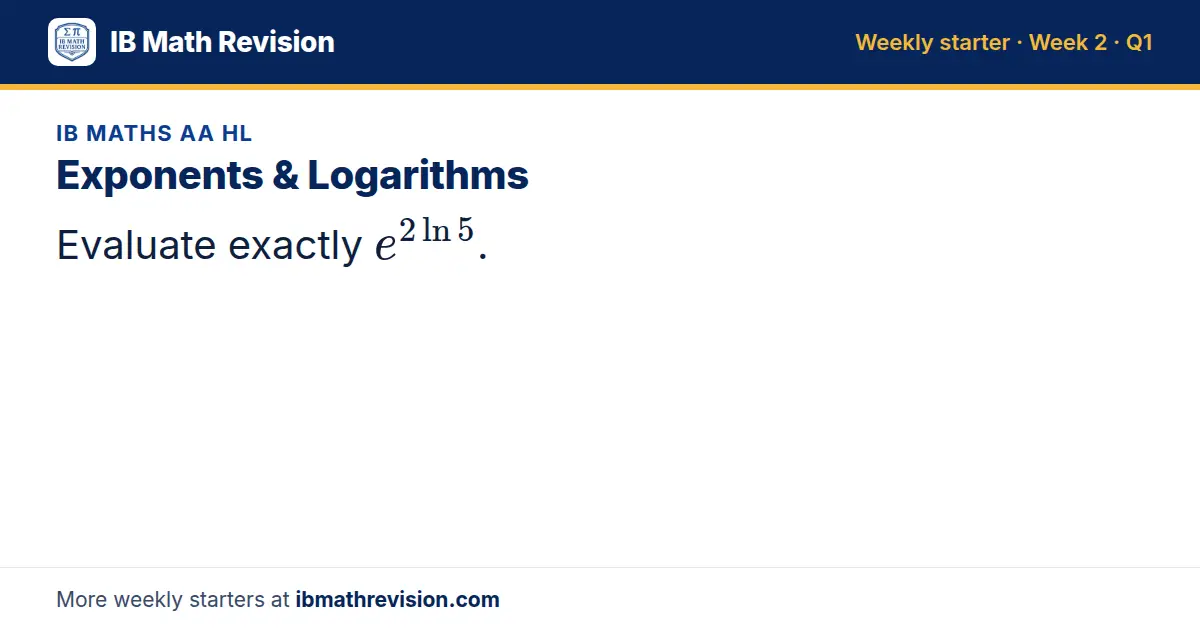
Question 1: Exponents & Logarithms
Evaluate exactly e^(2ln 5).
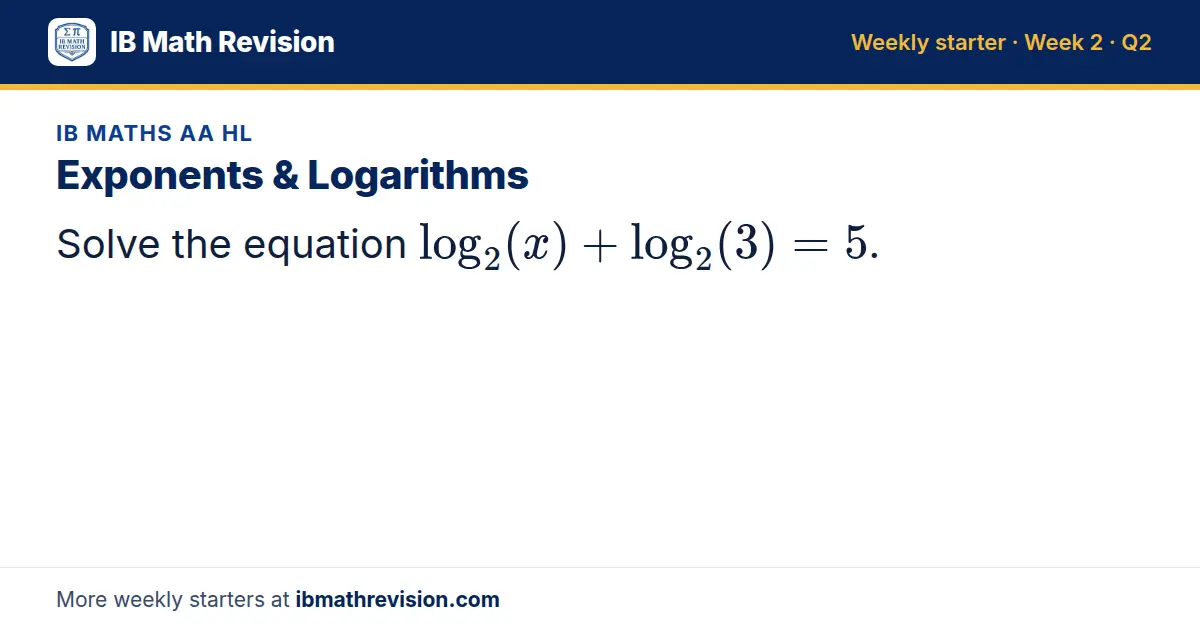
Question 2: Exponents & Logarithms
Solve the equation log_2(x) + log_2(3) = 5.
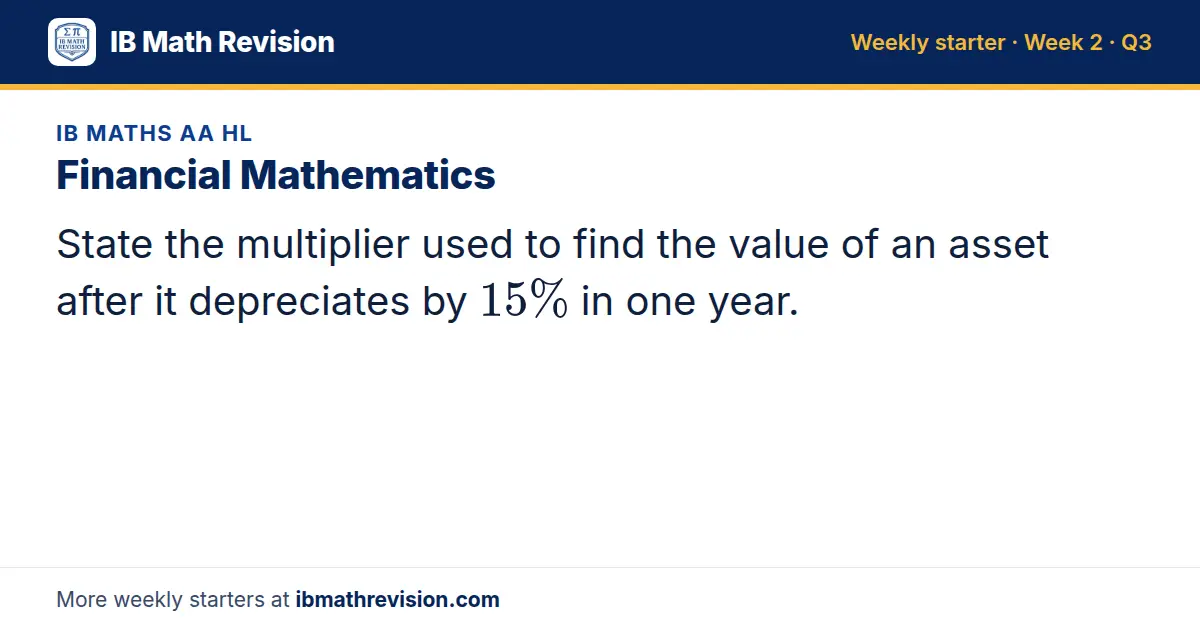
Question 3: Financial Mathematics
State the multiplier used to find the value of an asset after it depreciates by 15% in one year.
Week 3
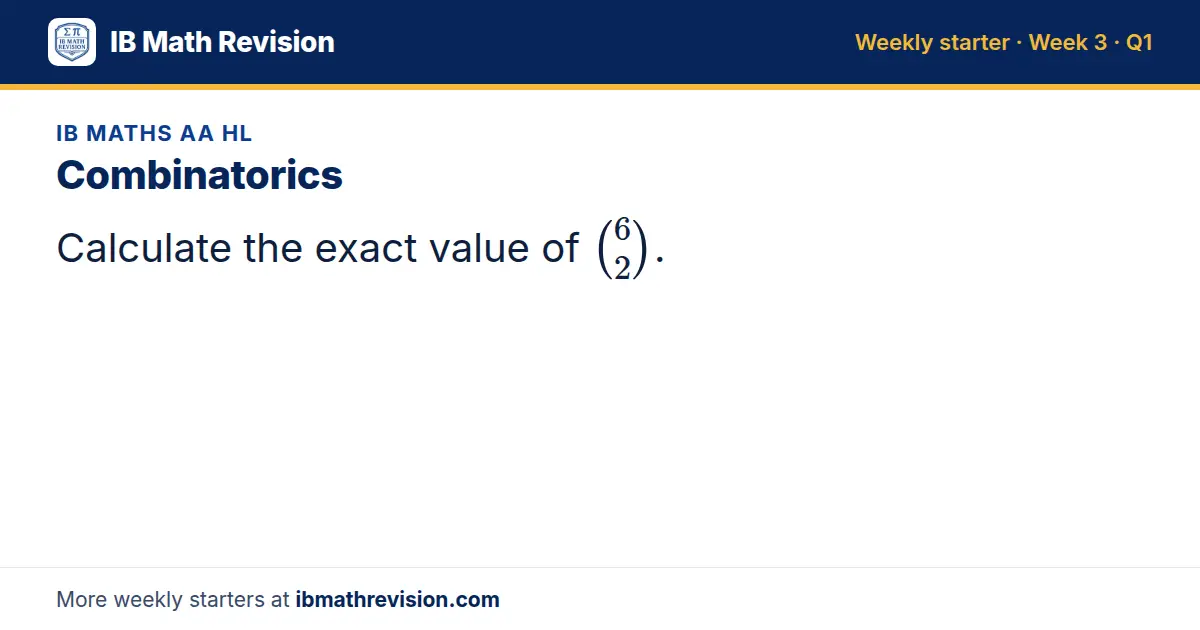
Question 1: Combinatorics
Calculate the exact value of 62.
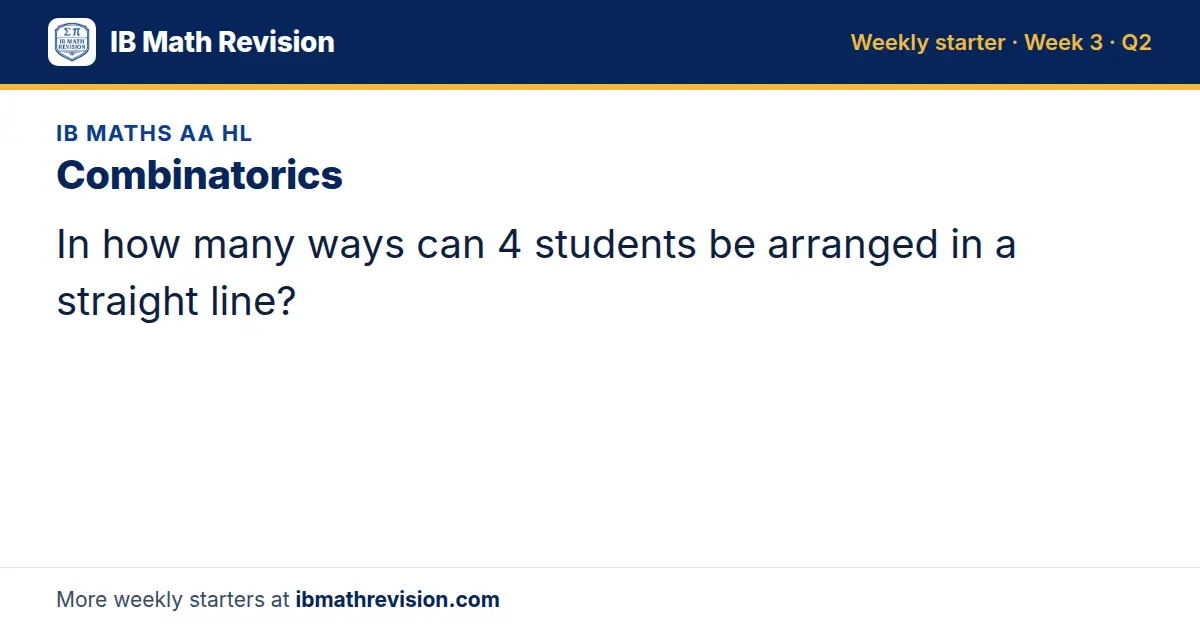
Question 2: Combinatorics
In how many ways can 4 students be arranged in a straight line?
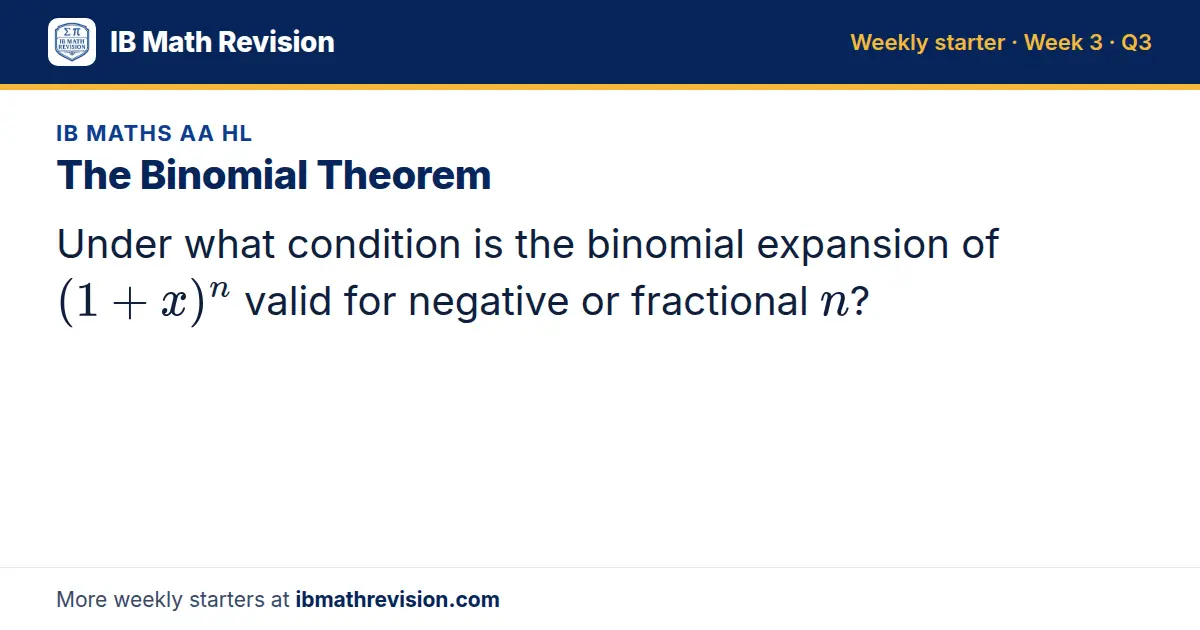
Question 3: The Binomial Theorem
Under what condition is the binomial expansion of (1 + x)^n valid for negative or fractional n?
Week 4
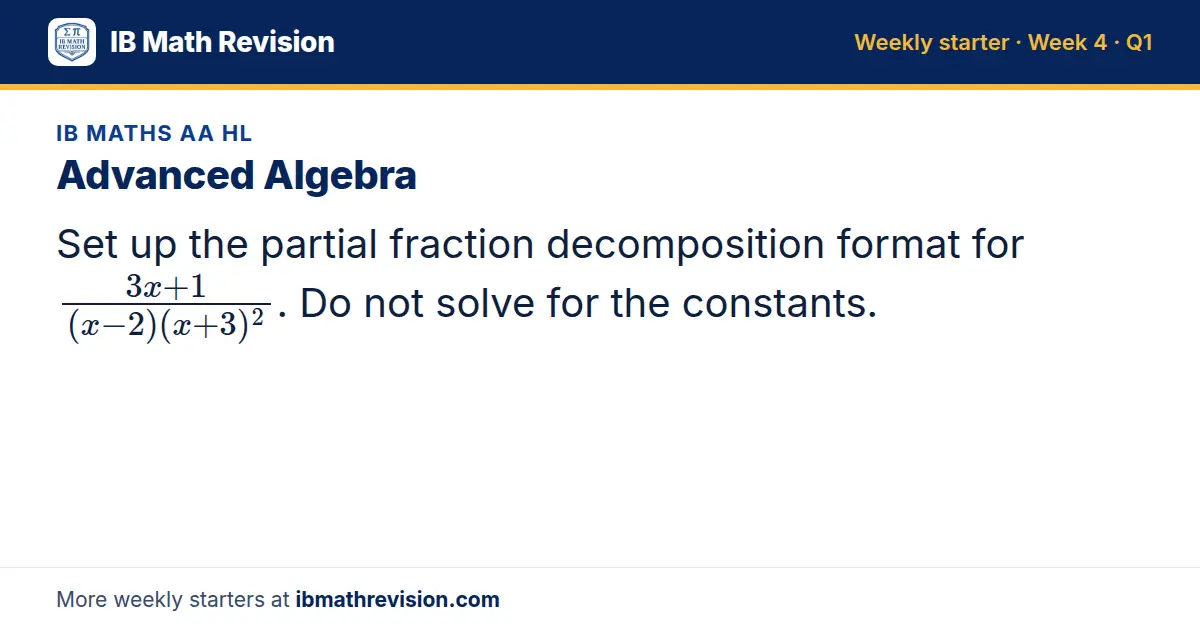
Question 1: Advanced Algebra
Set up the partial fraction decomposition format for (3x + 1)/((x-2)(x+3)²). Do not solve for the constants.
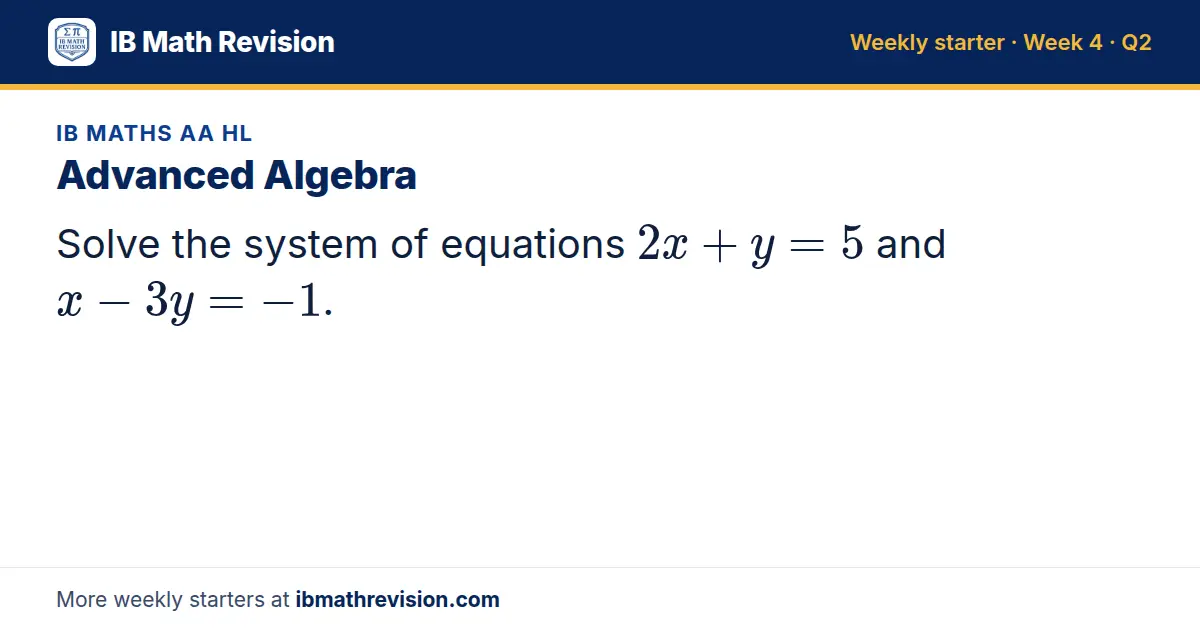
Question 2: Advanced Algebra
Solve the system of equations 2x + y = 5 and x - 3y = -1.
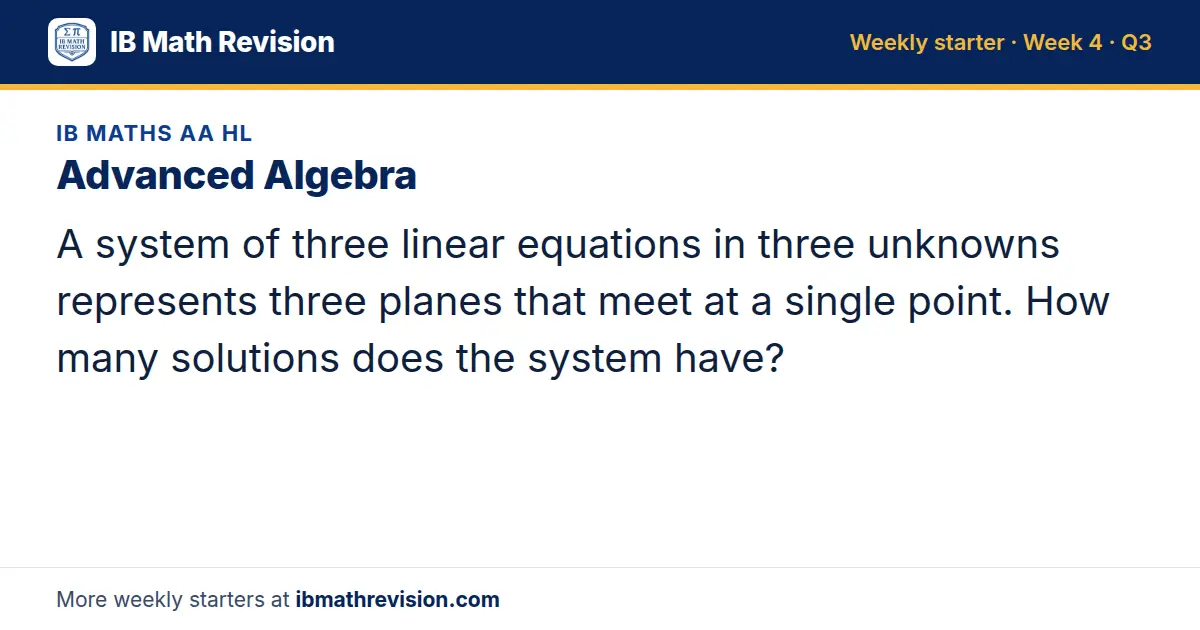
Question 3: Advanced Algebra
A system of three linear equations in three unknowns represents three planes that meet at a single point. How many solutions does the system have?
Week 5
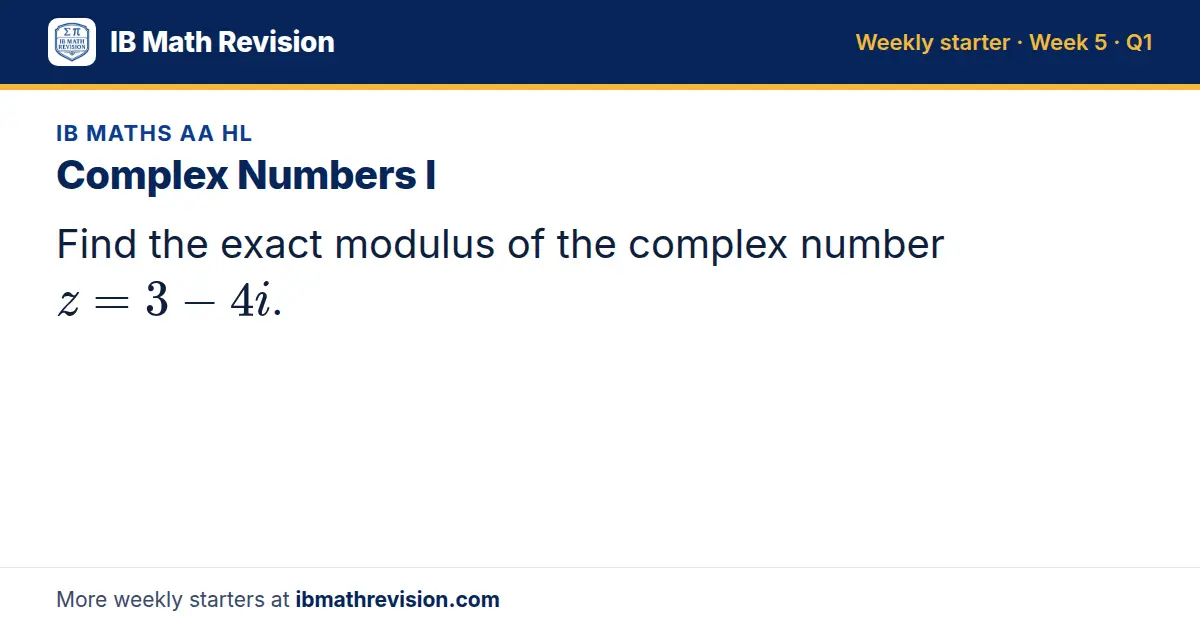
Question 1: Complex Numbers I
Find the exact modulus of the complex number z = 3 - 4i.
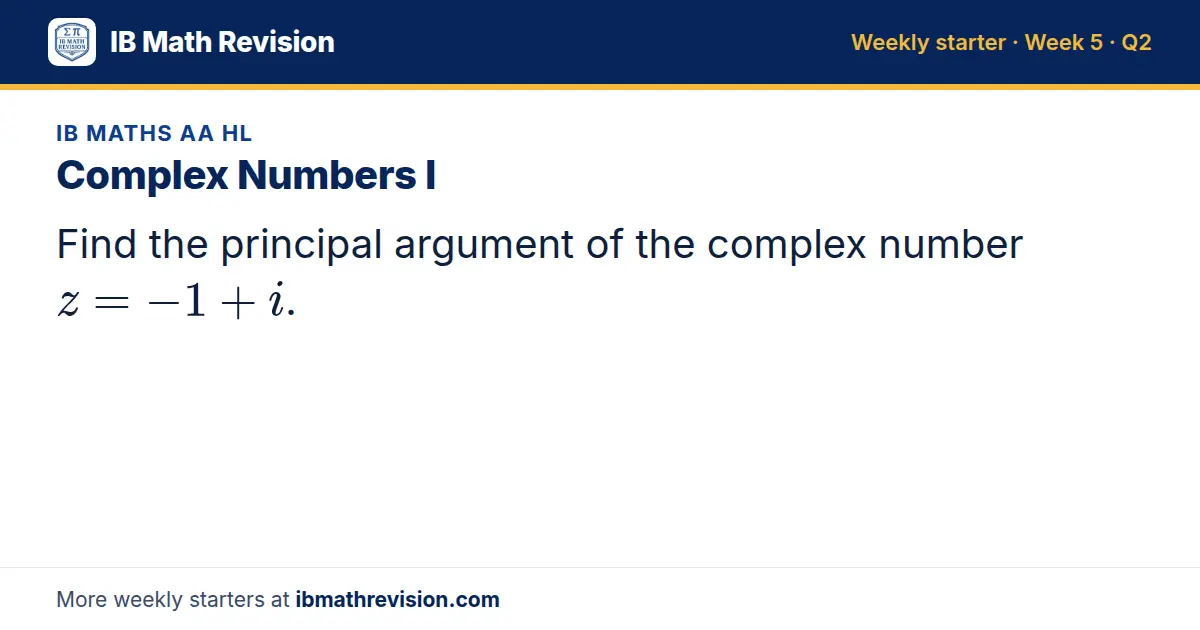
Question 2: Complex Numbers I
Find the principal argument of the complex number z = -1 + i.
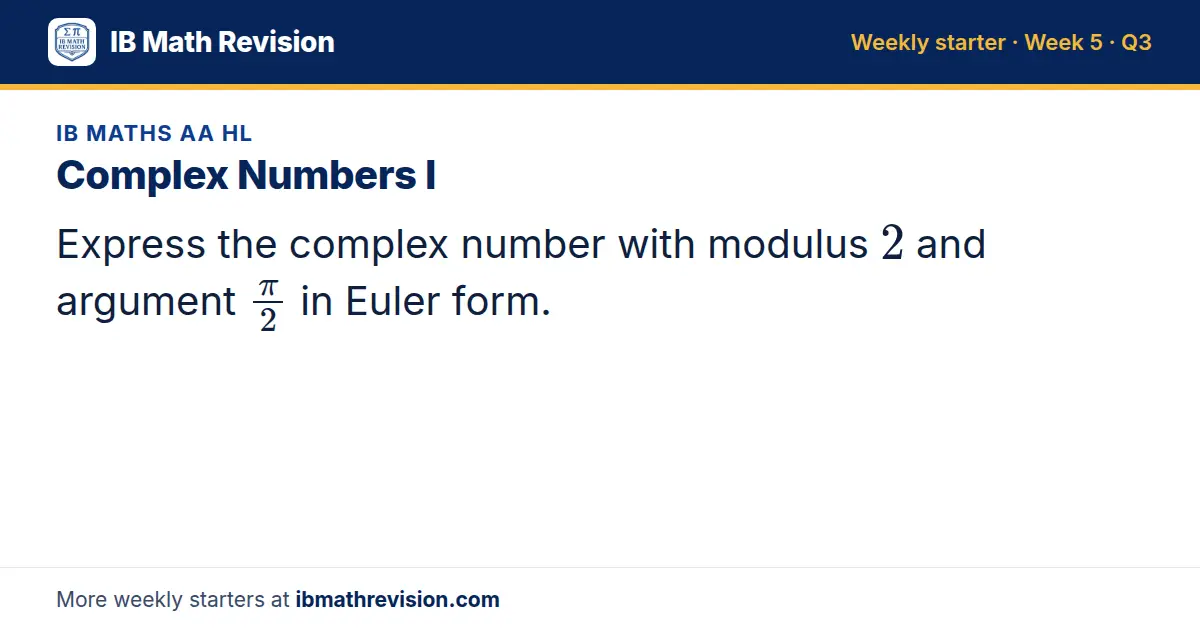
Question 3: Complex Numbers I
Express the complex number with modulus 2 and argument (π)/2 in Euler form.
Week 6
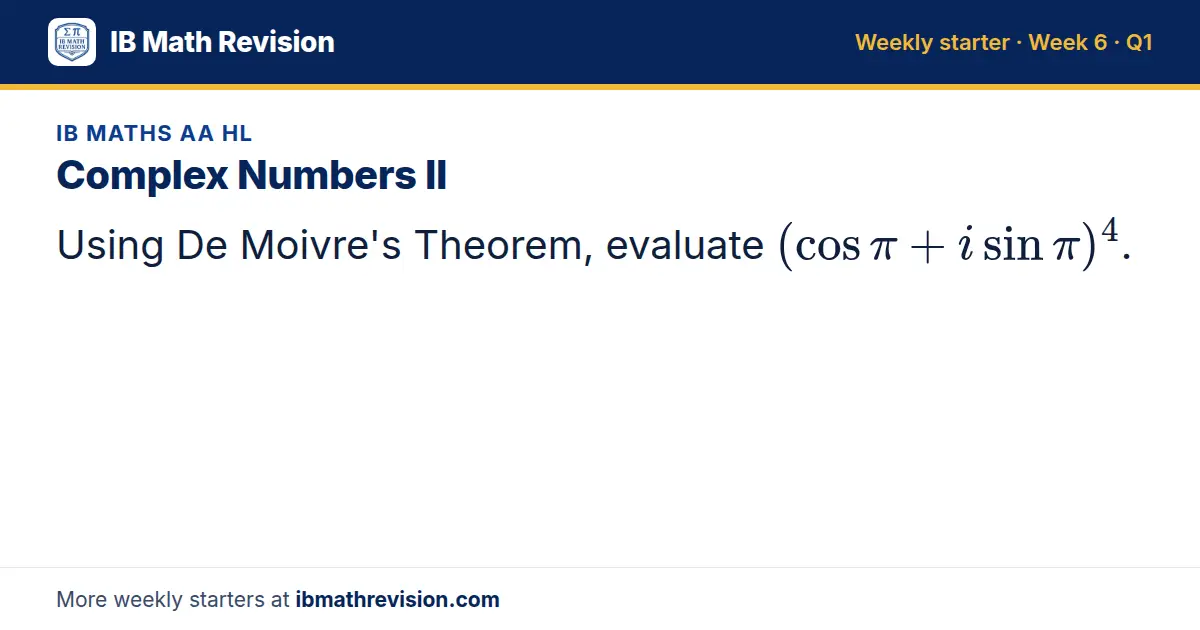
Question 1: Complex Numbers II
Using De Moivre's Theorem, evaluate (cos π + isin π)^4.
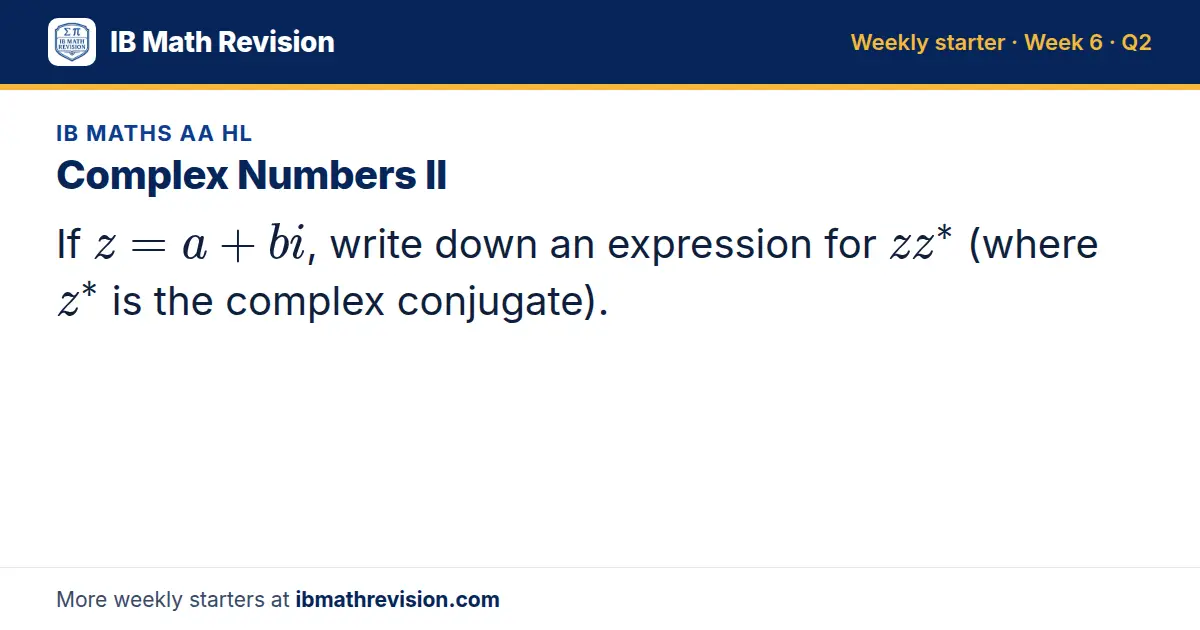
Question 2: Complex Numbers II
If z = a + bi, write down an expression for z z^* (where z^* is the complex conjugate).
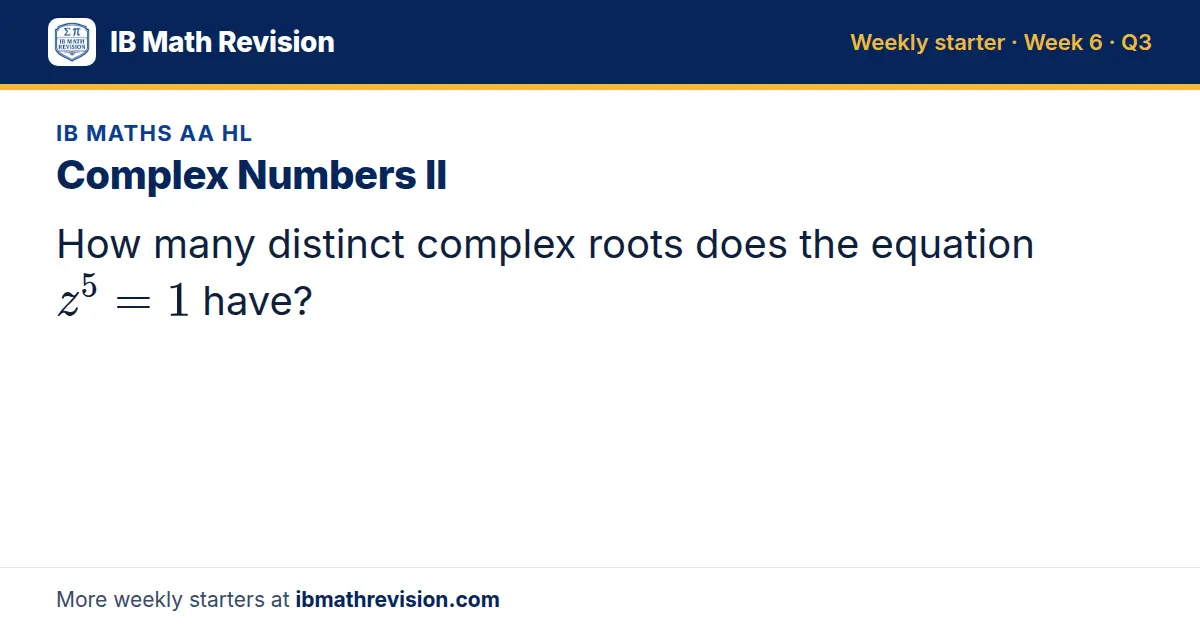
Question 3: Complex Numbers II
How many distinct complex roots does the equation z⁵ = 1 have?
Week 7
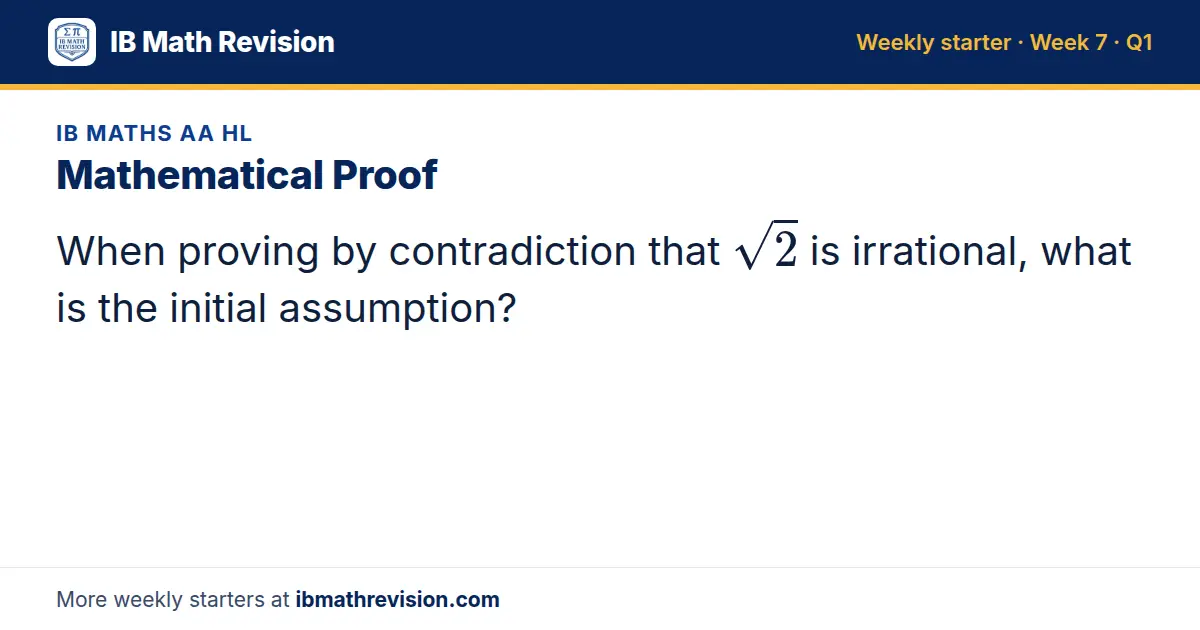
Question 1: Mathematical Proof
When proving by contradiction that √2 is irrational, what is the initial assumption?
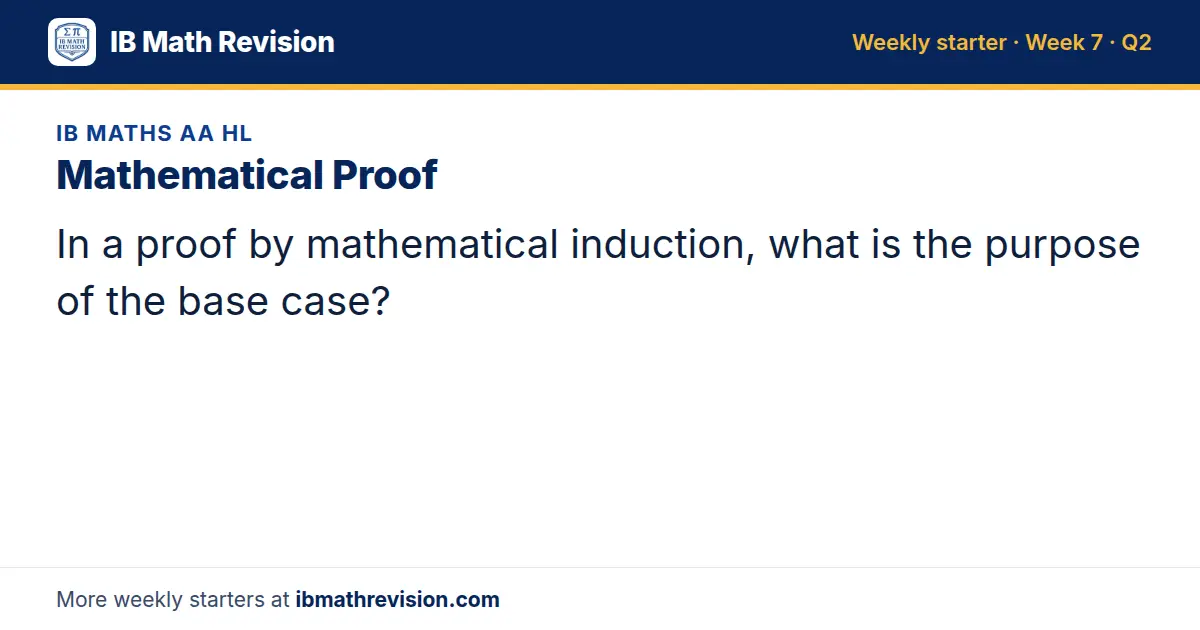
Question 2: Mathematical Proof
In a proof by mathematical induction, what is the purpose of the base case?
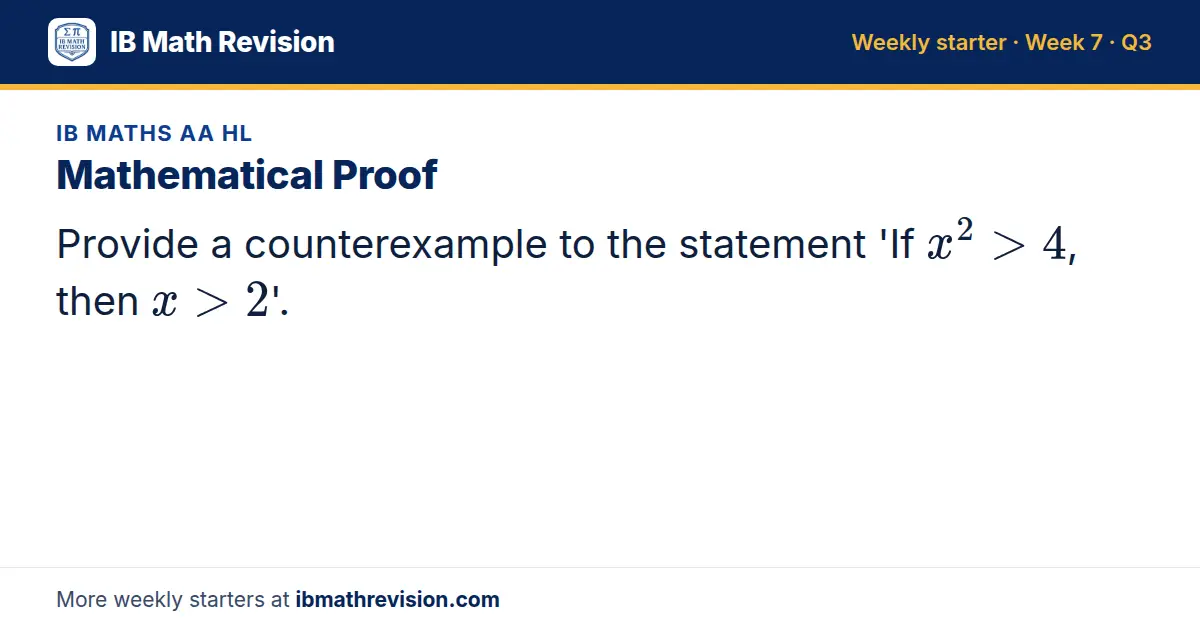
Question 3: Mathematical Proof
Provide a counterexample to the statement 'If x² > 4, then x > 2'.
Week 8
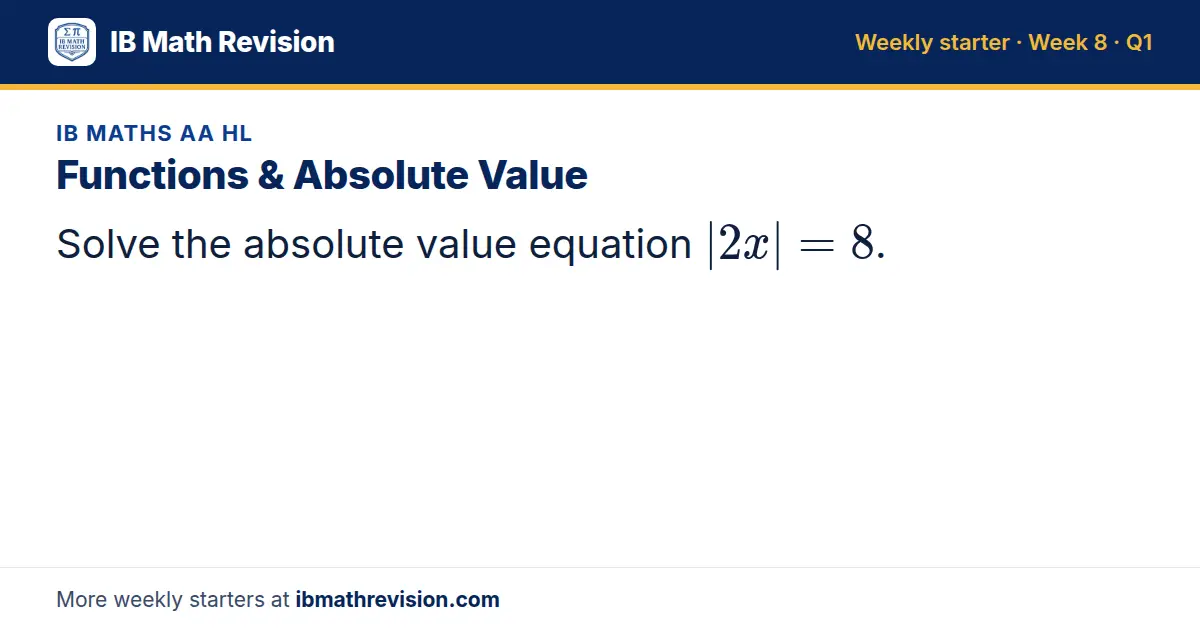
Question 1: Functions & Absolute Value
Solve the absolute value equation |2x| = 8.
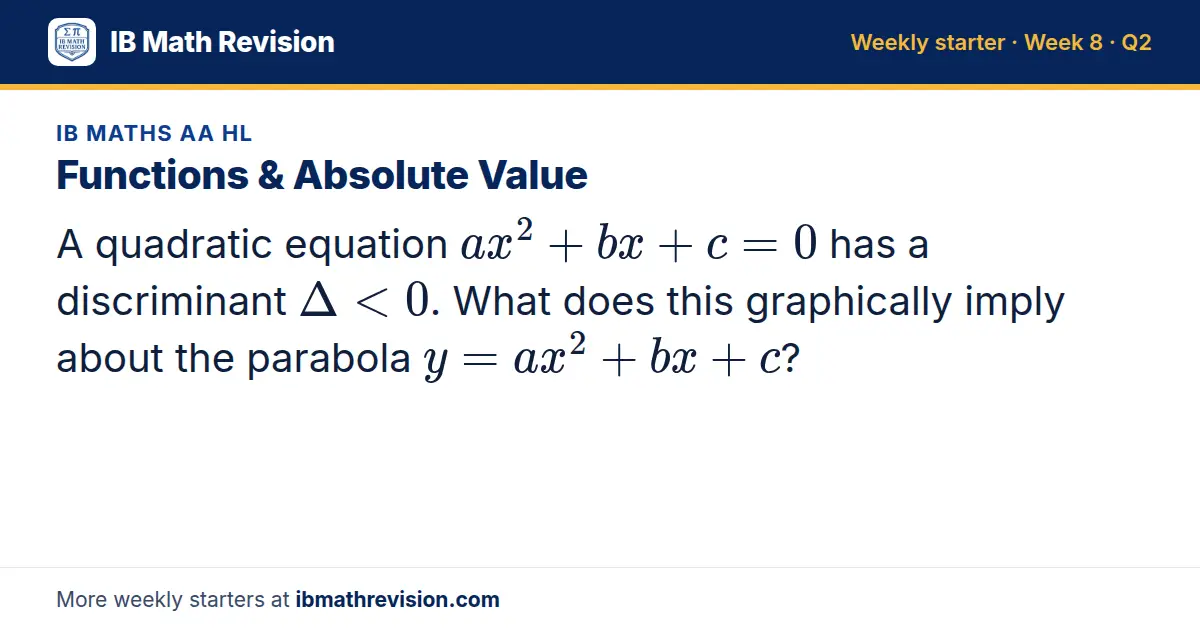
Question 2: Functions & Absolute Value
A quadratic equation ax² + bx + c = 0 has a discriminant Δ < 0. What does this graphically imply about the parabola y = ax² + bx + c?
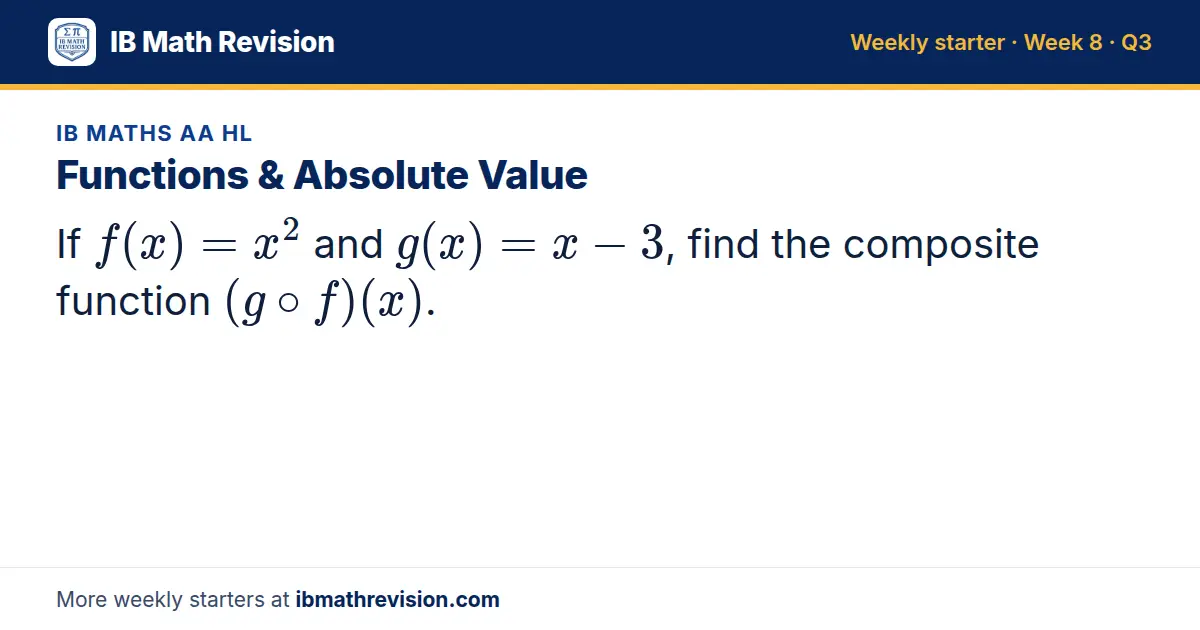
Question 3: Functions & Absolute Value
If f(x) = x² and g(x) = x - 3, find the composite function (g ∘ f)(x).
Week 9
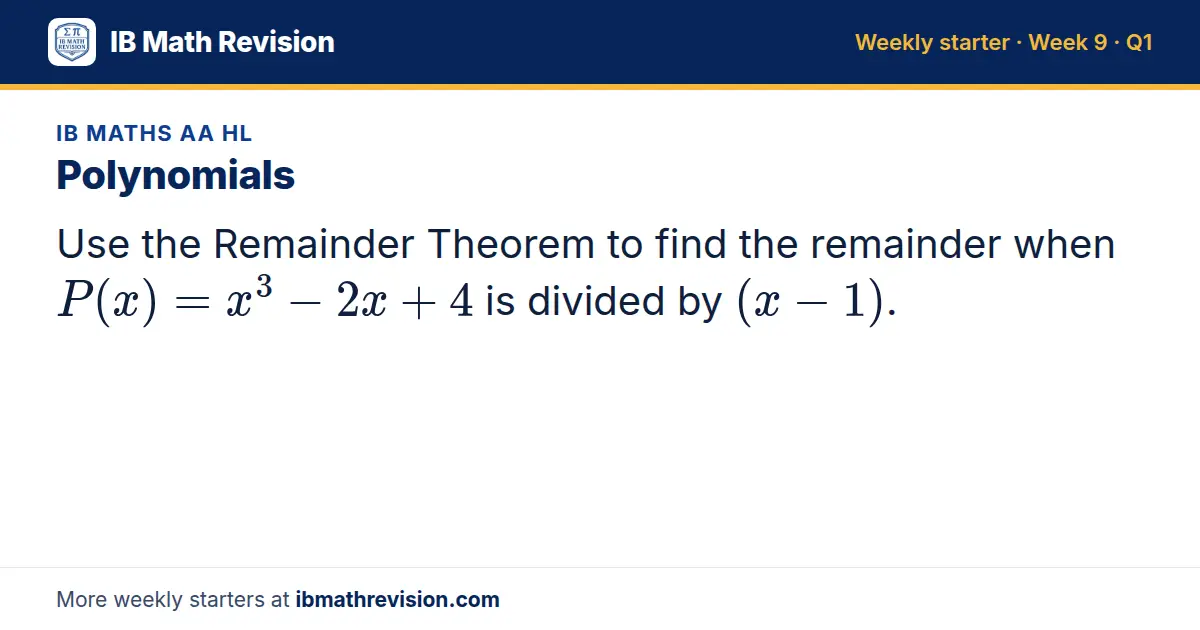
Question 1: Polynomials
Use the Remainder Theorem to find the remainder when P(x) = x³ - 2x + 4 is divided by (x - 1).
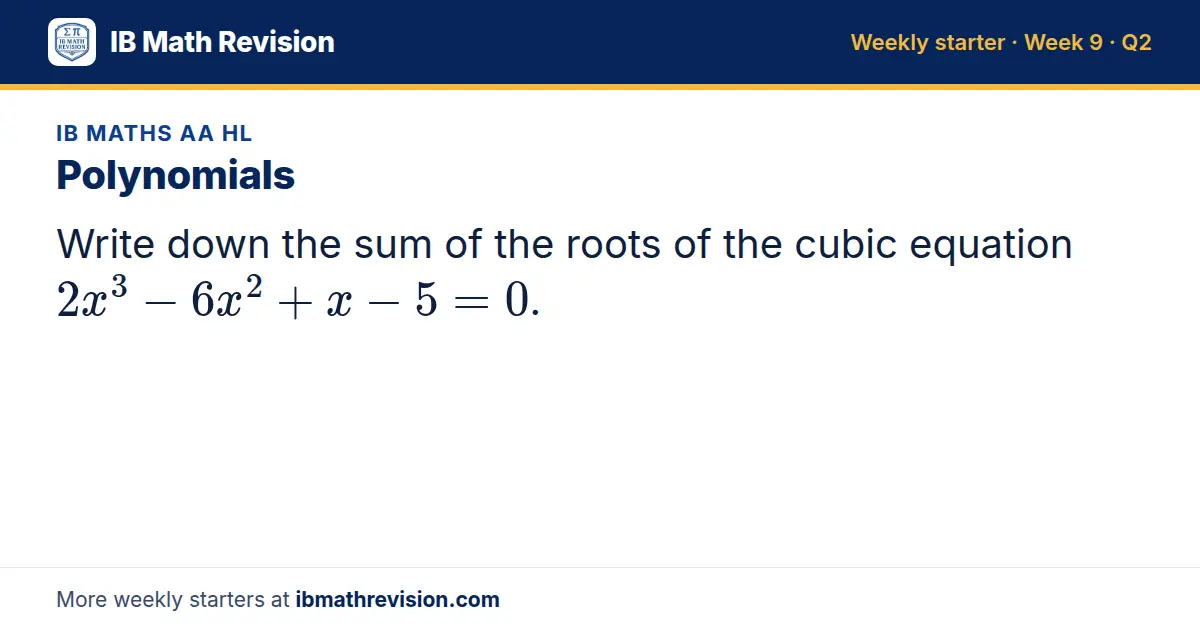
Question 2: Polynomials
Write down the sum of the roots of the cubic equation 2x³ - 6x² + x - 5 = 0.
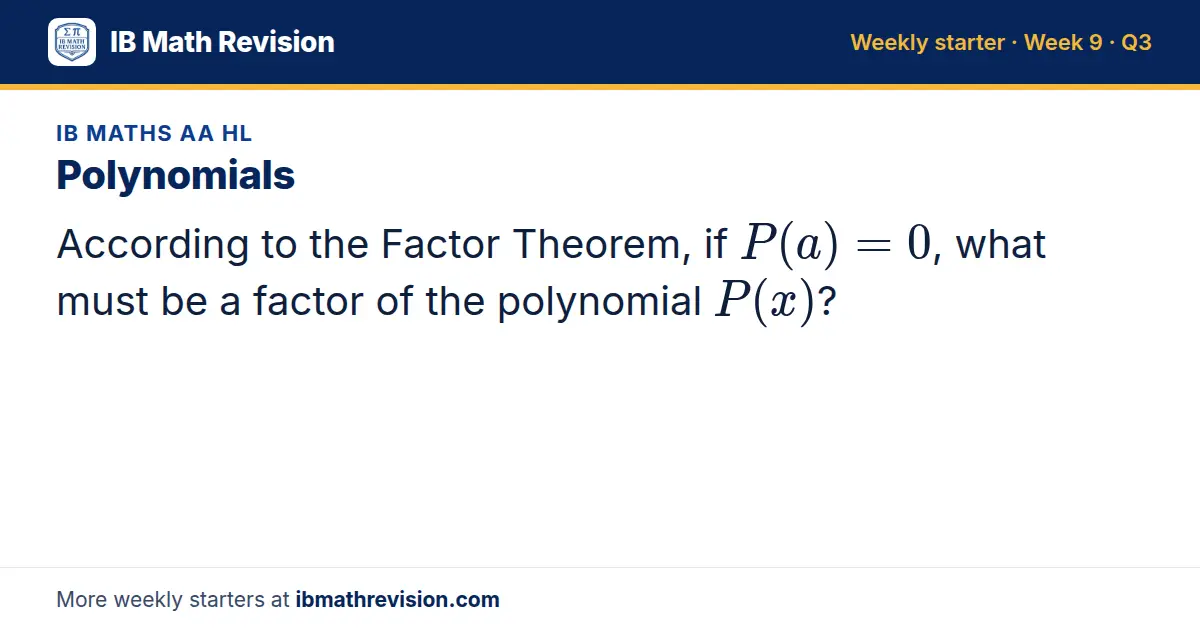
Question 3: Polynomials
According to the Factor Theorem, if P(a) = 0, what must be a factor of the polynomial P(x)?
Week 10
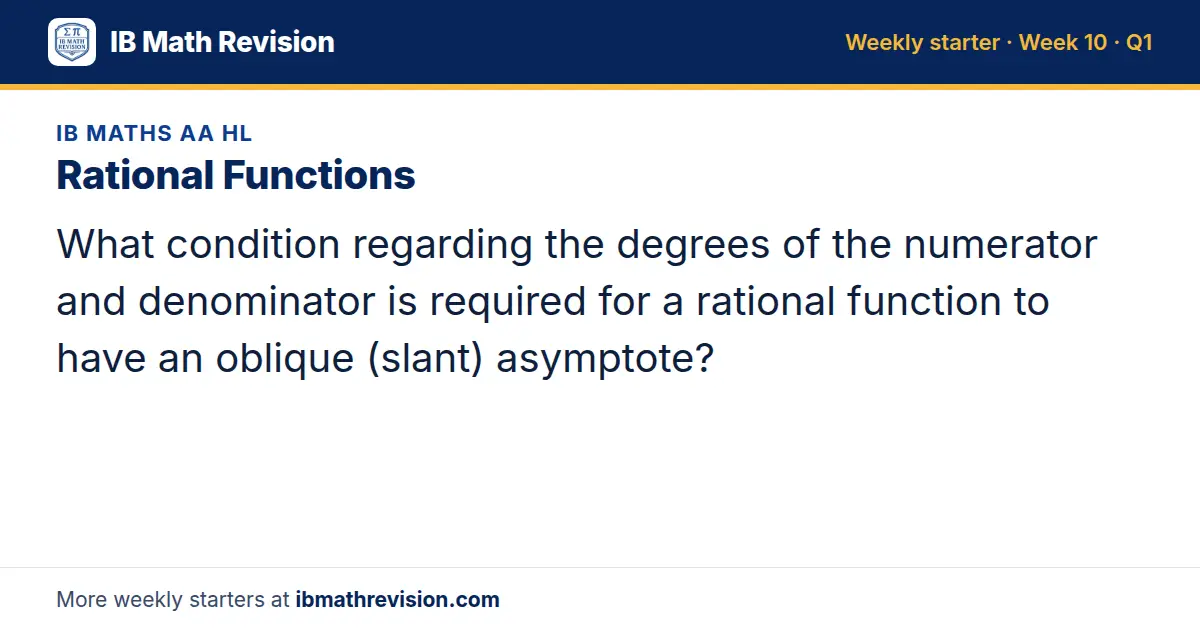
Question 1: Rational Functions
What condition regarding the degrees of the numerator and denominator is required for a rational function to have an oblique (slant) asymptote?
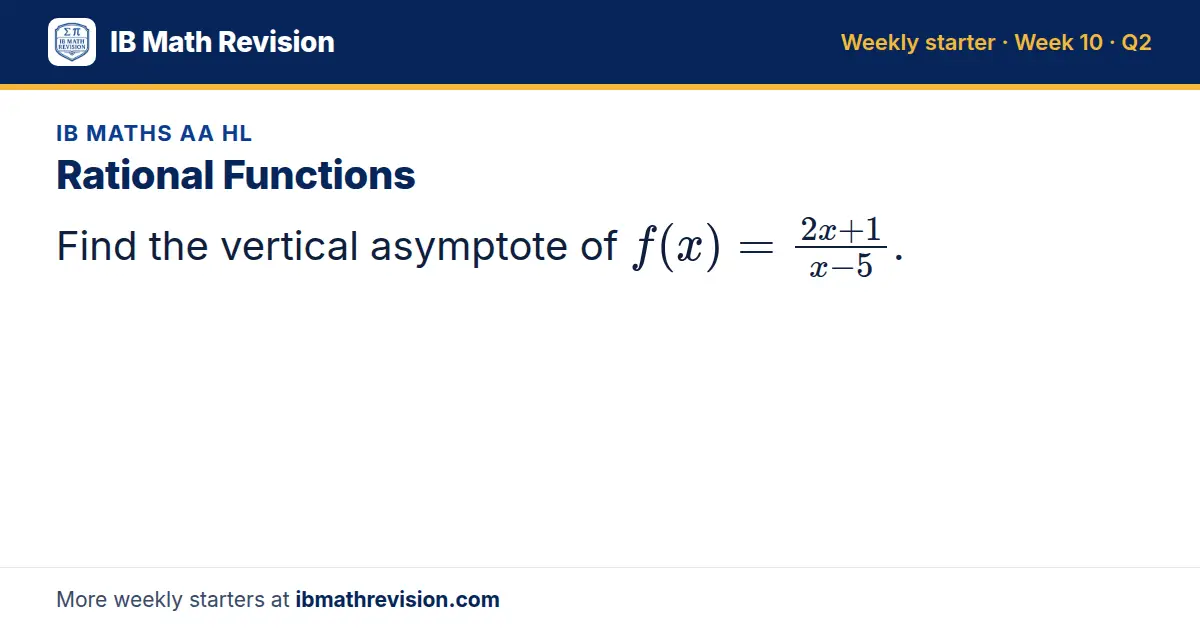
Question 2: Rational Functions
Find the vertical asymptote of f(x) = (2x+1)/(x-5).
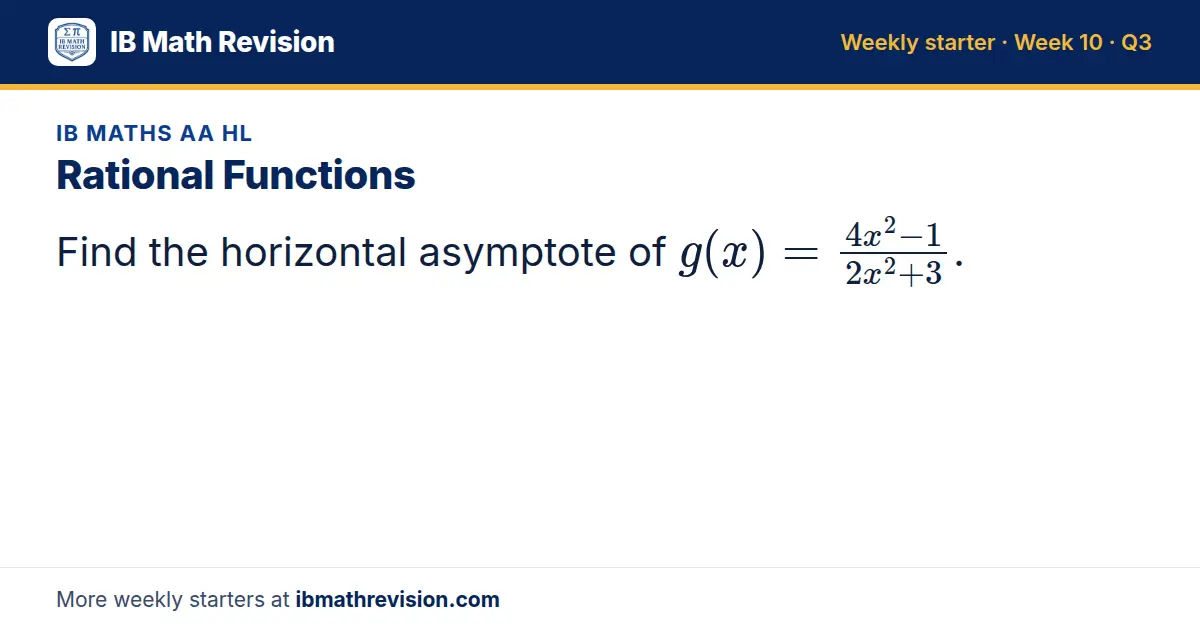
Question 3: Rational Functions
Find the horizontal asymptote of g(x) = (4x² - 1)/(2x² + 3).
Week 11
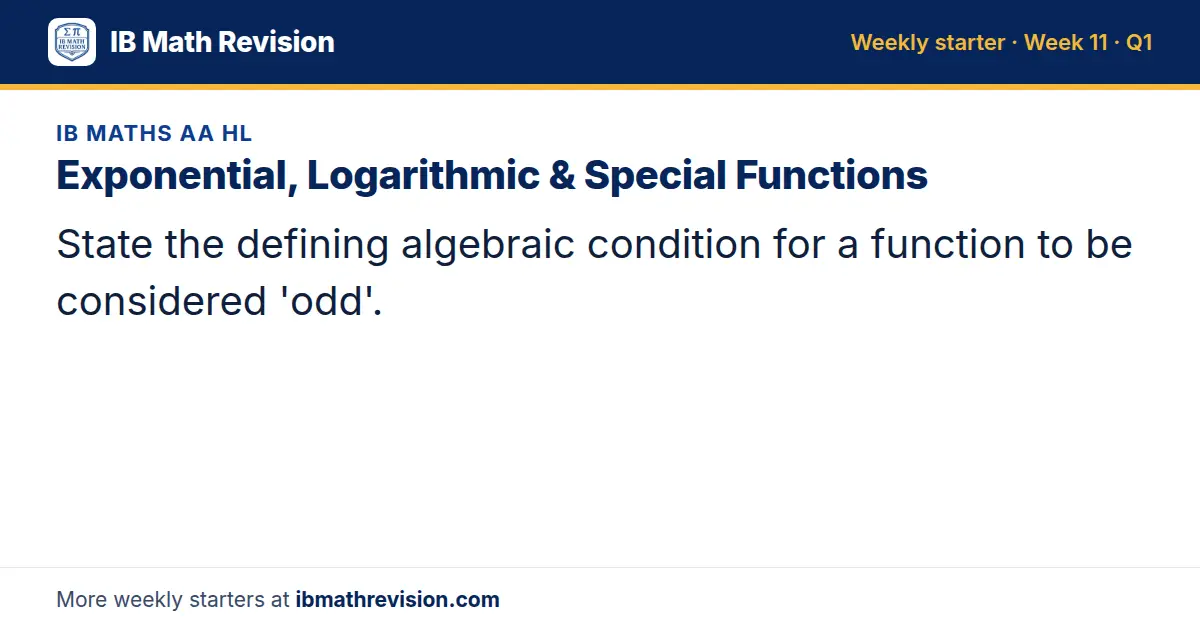
Question 1: Exponential, Logarithmic & Special Functions
State the defining algebraic condition for a function to be considered 'odd'.
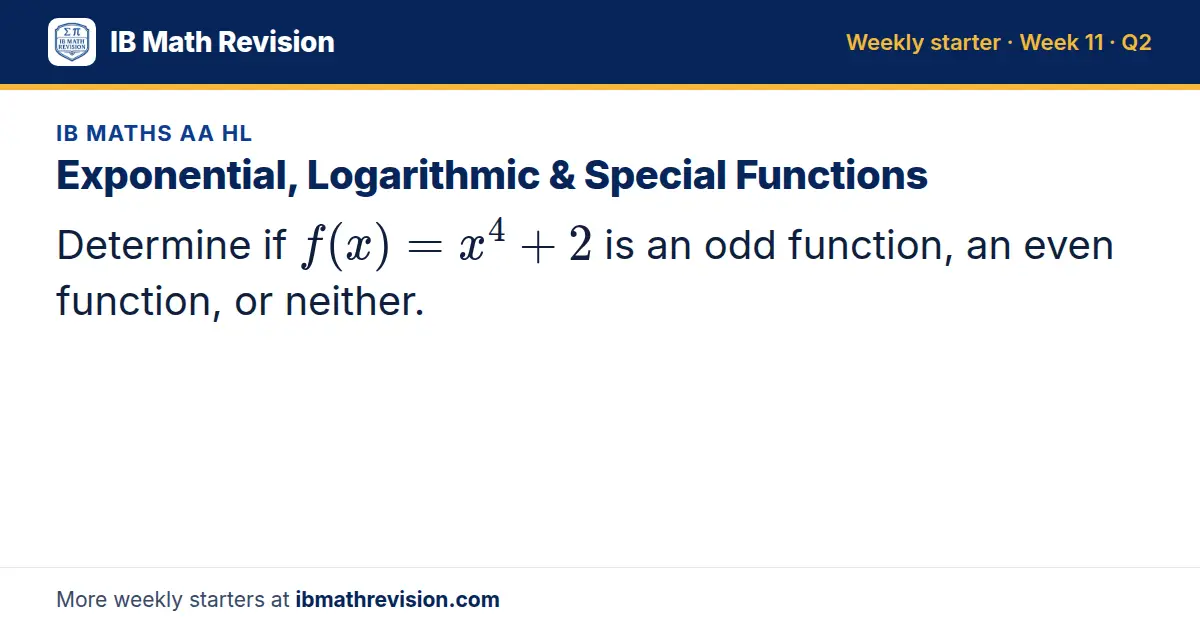
Question 2: Exponential, Logarithmic & Special Functions
Determine if f(x) = x⁴ + 2 is an odd function, an even function, or neither.
Question 3: Exponential, Logarithmic & Special Functions
What geometric property do self-inverse functions possess regarding their graphs?
Week 12
Question 1: Graph Transformations
Describe the effect on the graph of y = f(x) when it is transformed to y = |f(x)|.
Question 2: Graph Transformations
Describe the single transformation mapping y = f(x) to y = f(x) + 4.
Question 3: Graph Transformations
If y = e^x is horizontally stretched by a scale factor of 1/3, what is the new equation?
Week 13
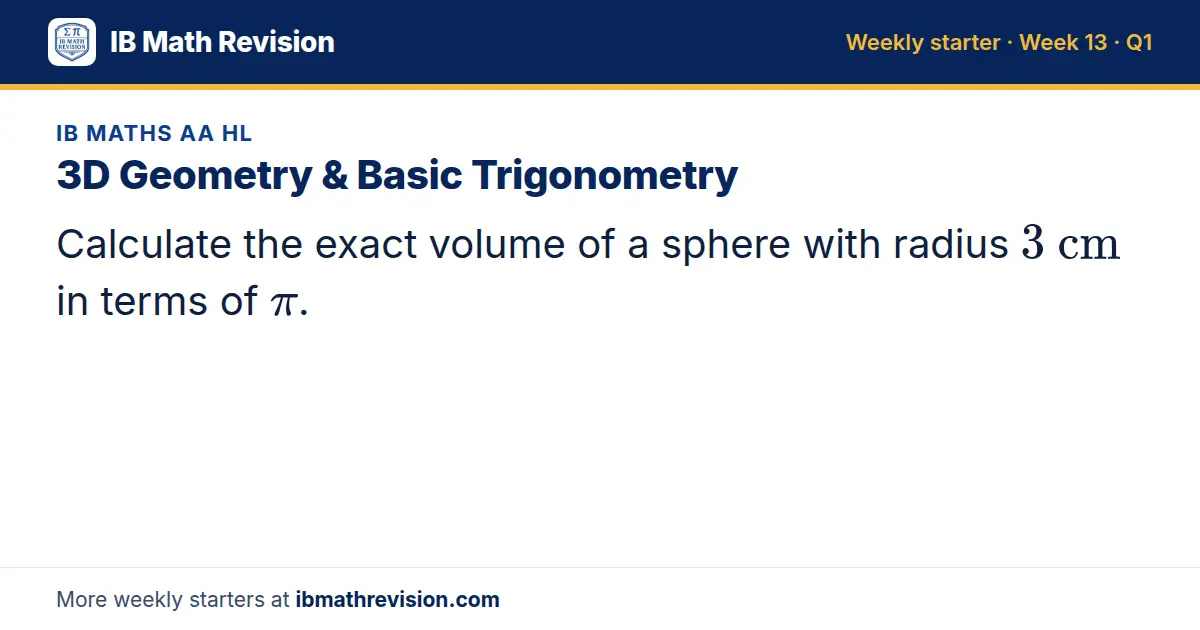
Question 1: 3D Geometry & Basic Trigonometry
Calculate the exact volume of a sphere with radius 3 cm in terms of π.
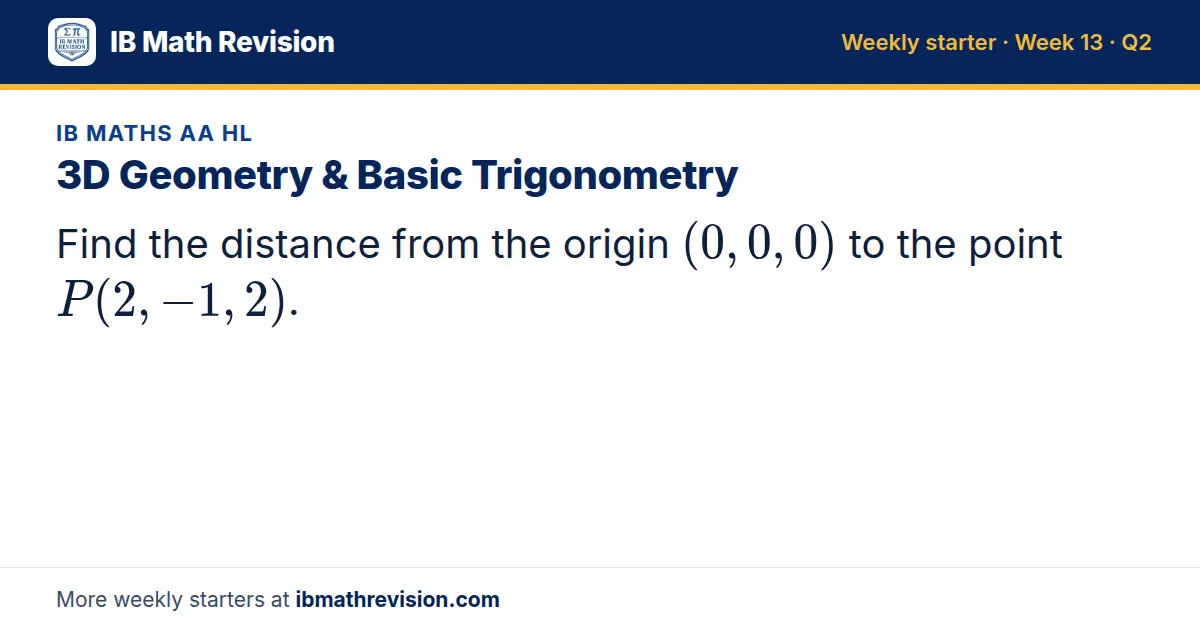
Question 2: 3D Geometry & Basic Trigonometry
Find the distance from the origin (0,0,0) to the point P(2, -1, 2).
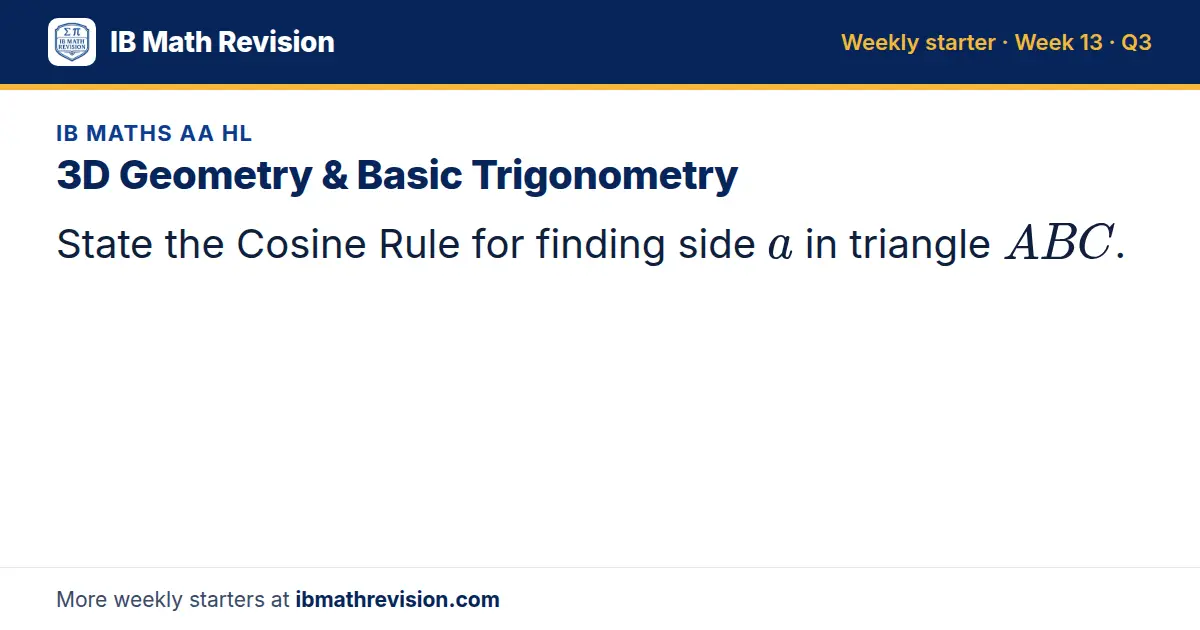
Question 3: 3D Geometry & Basic Trigonometry
State the Cosine Rule for finding side a in triangle ABC.
More starter questions
Other weeks: Weeks 1–13 · Weeks 14–26 · Weeks 27–40. Answers and mark schemes are in the starter tasks for teachers.