IB Maths AA SL starter questions: weeks 27–40
42 short questions to open a lesson for IB Maths Analysis and Approaches SL, weeks 27–40 of the teaching year, three or four a week. Each question is shown as an image with its text underneath; answers and mark schemes stay with teachers.
Week 27
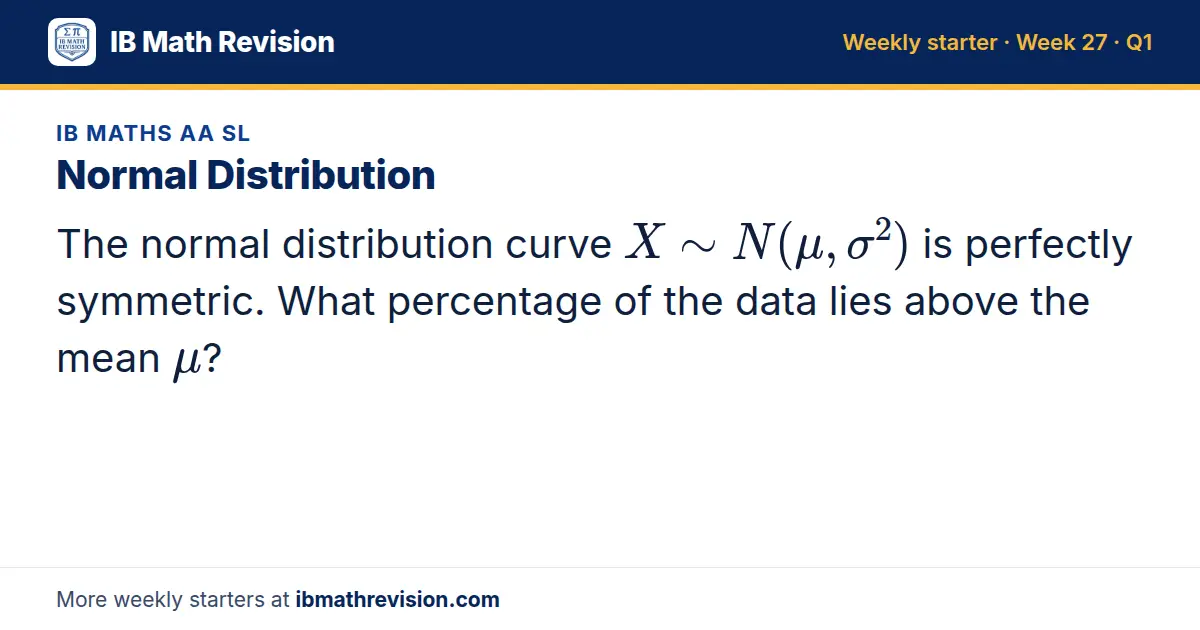
Question 1: Normal Distribution
The normal distribution curve X N(μ, σ²) is perfectly symmetric. What percentage of the data lies above the mean μ?
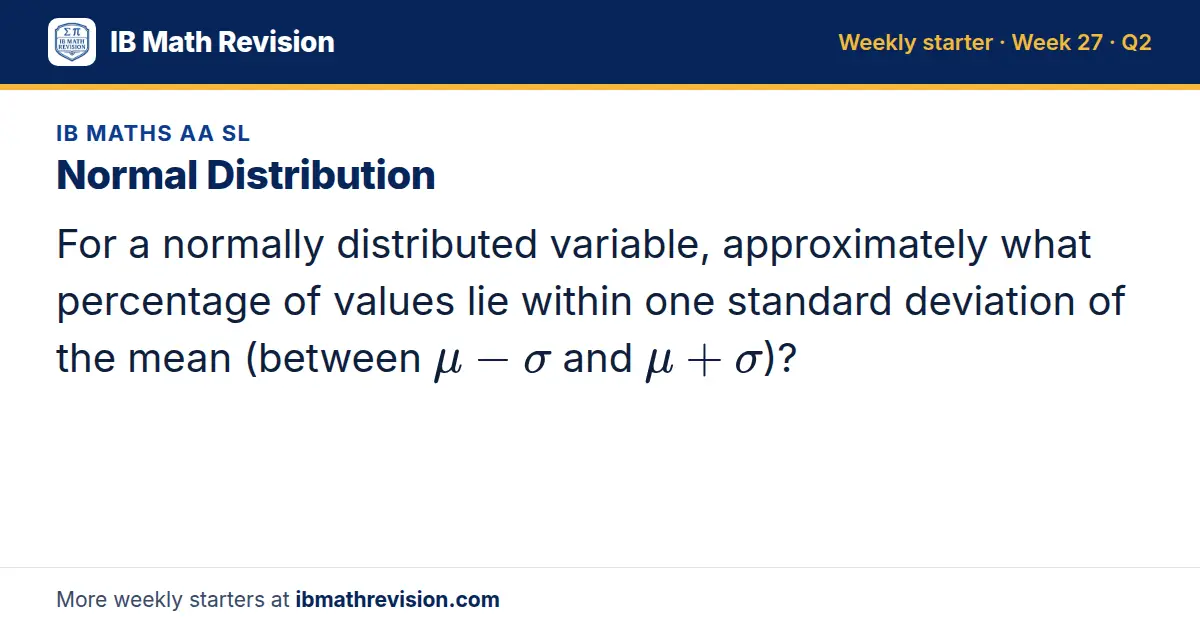
Question 2: Normal Distribution
For a normally distributed variable, approximately what percentage of values lie within one standard deviation of the mean (between μ - σ and μ + σ)?
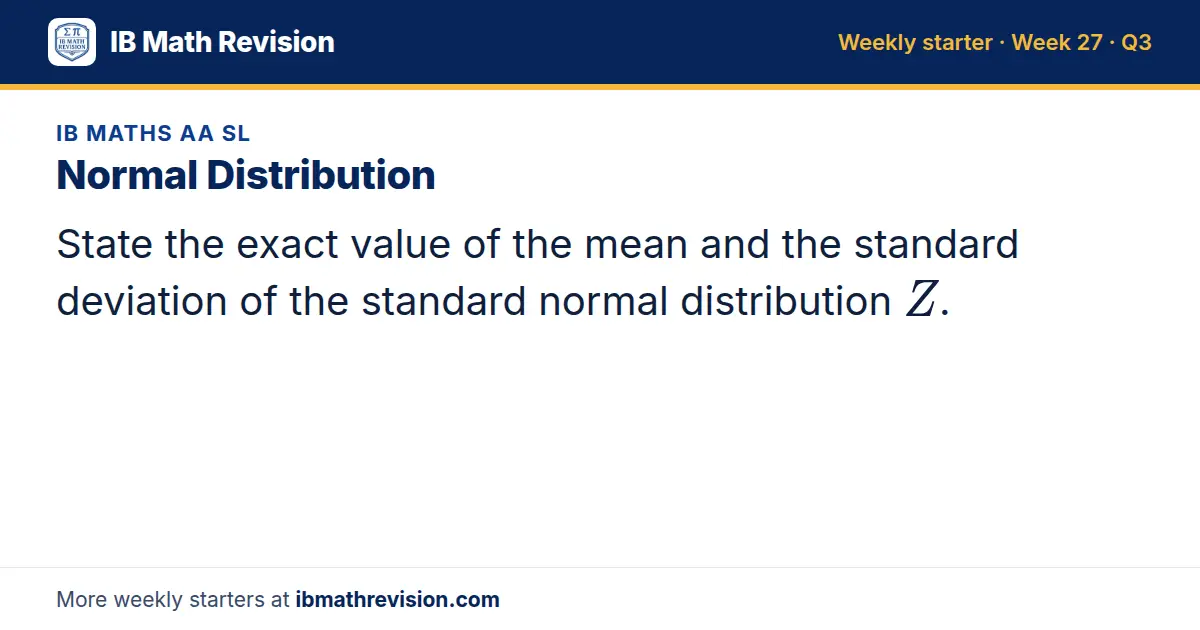
Question 3: Normal Distribution
State the exact value of the mean and the standard deviation of the standard normal distribution Z.
Week 28
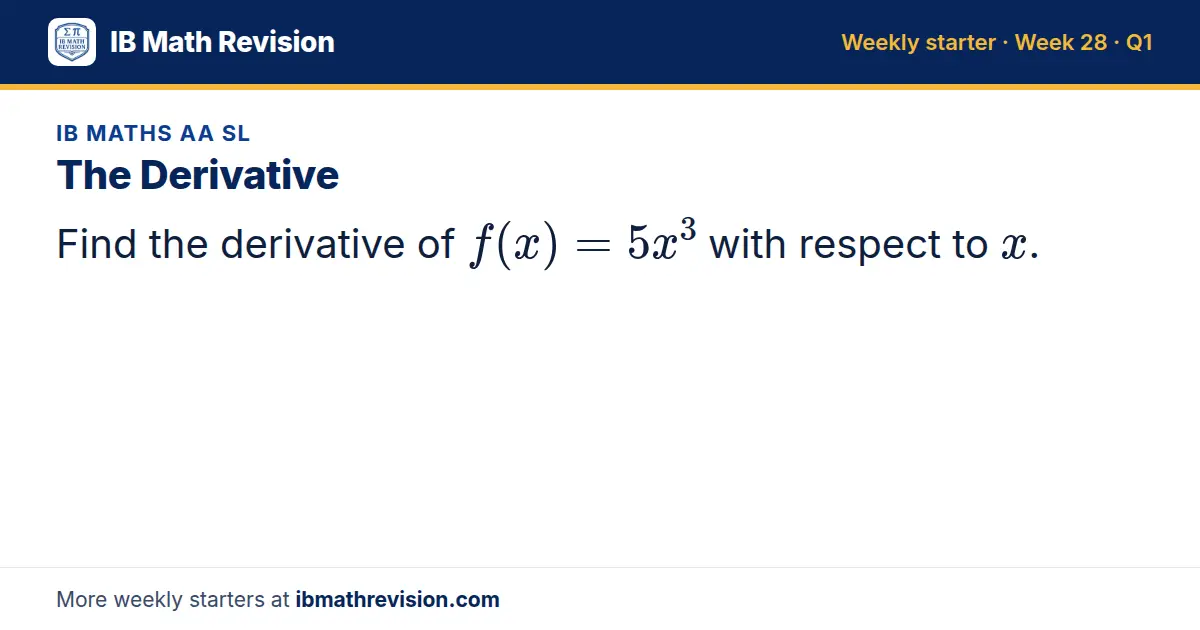
Question 1: The Derivative
Find the derivative of f(x) = 5x³ with respect to x.
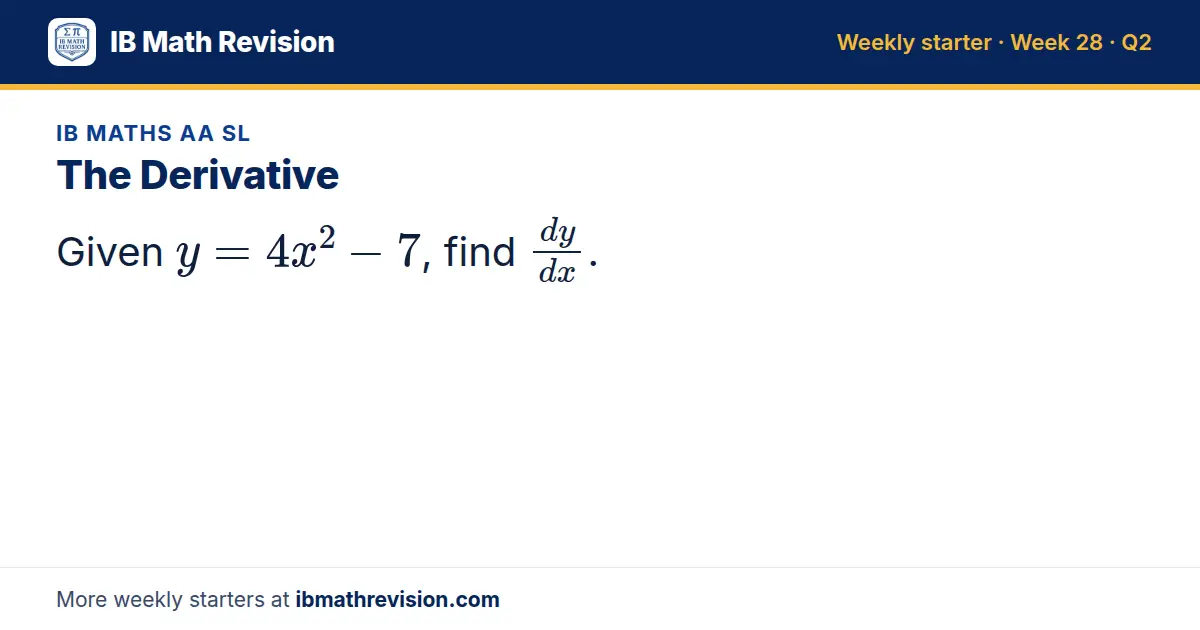
Question 2: The Derivative
Given y = 4x² - 7, find dy/dx.
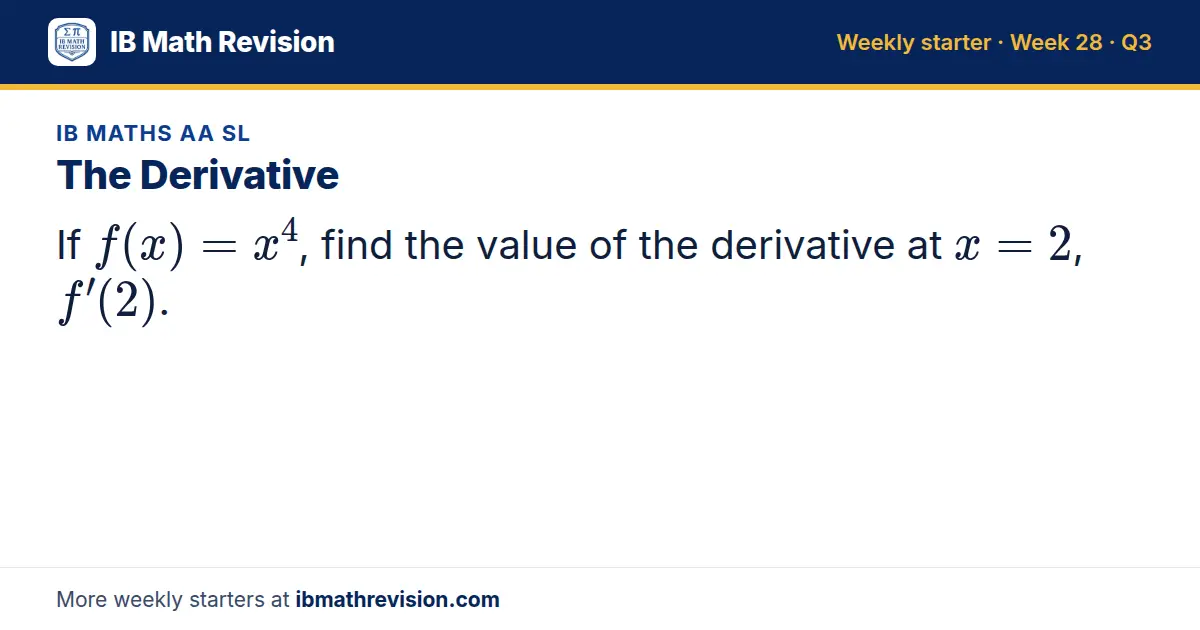
Question 3: The Derivative
If f(x) = x⁴, find the value of the derivative at x = 2, f'(2).
Week 29
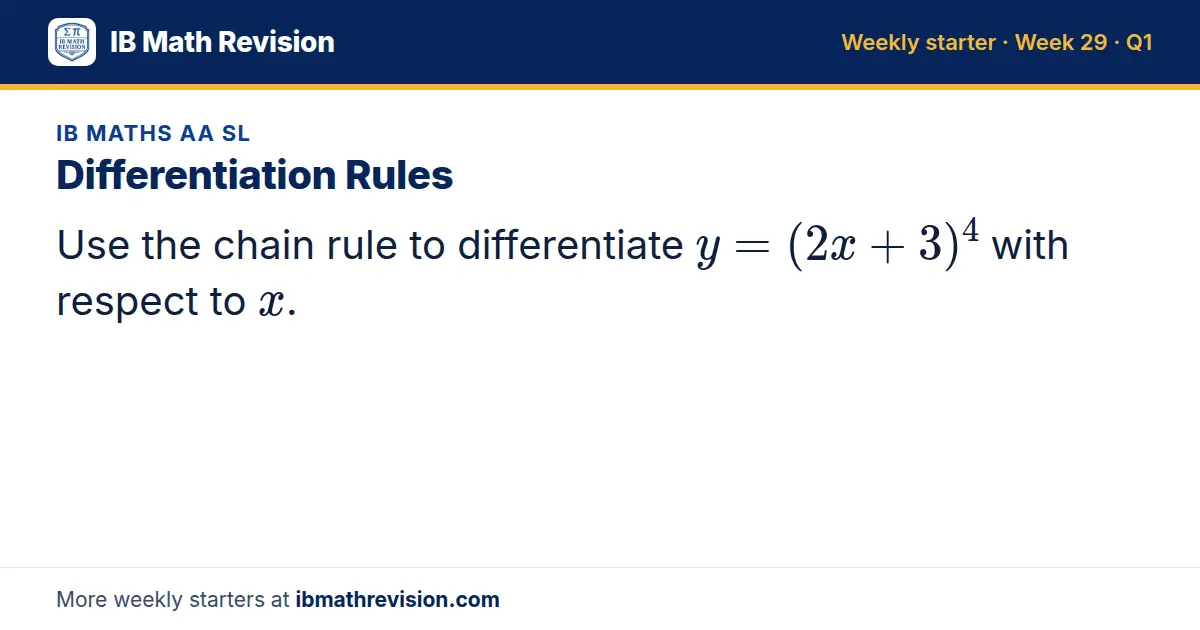
Question 1: Differentiation Rules
Use the chain rule to differentiate y = (2x + 3)⁴ with respect to x.
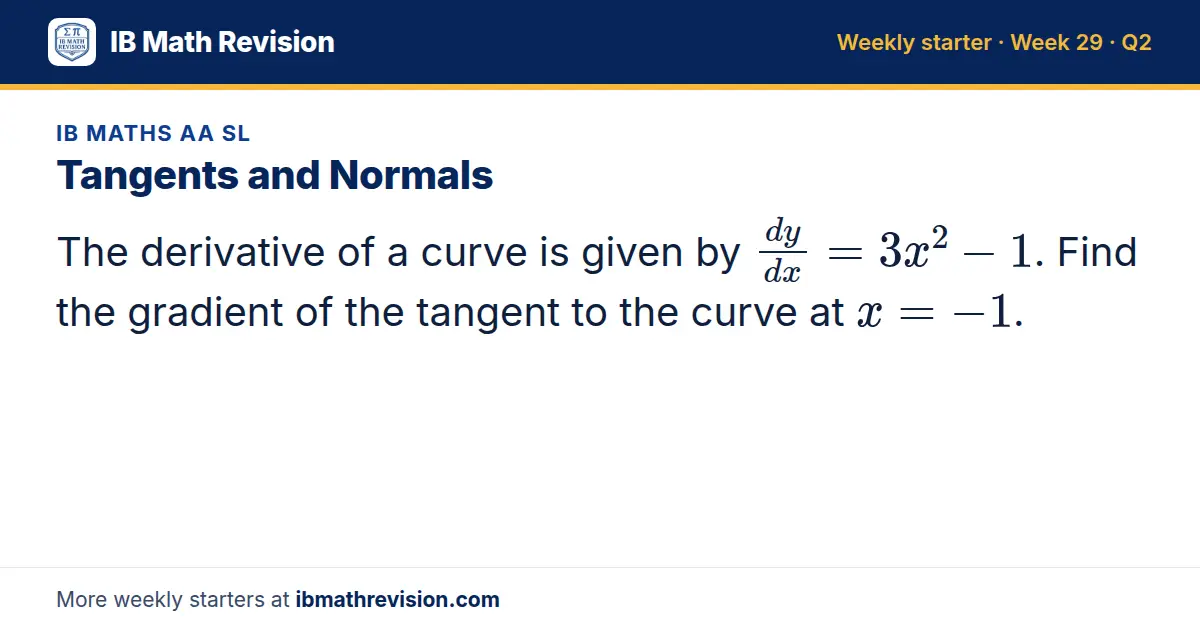
Question 2: Tangents and Normals
The derivative of a curve is given by dy/dx = 3x² - 1. Find the gradient of the tangent to the curve at x = -1.
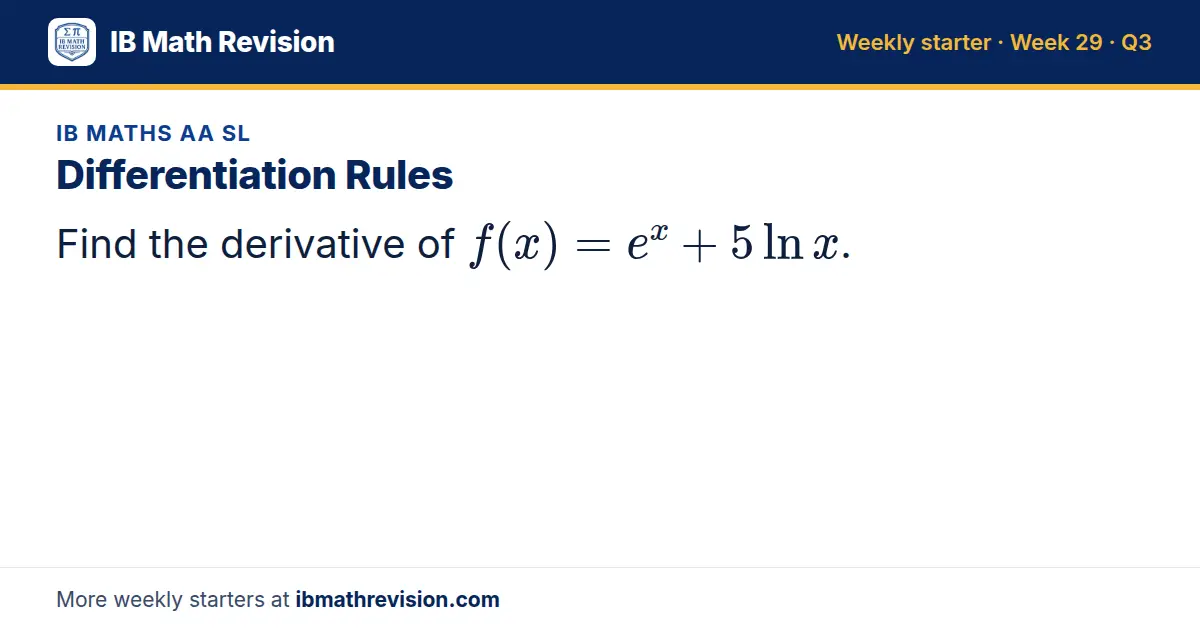
Question 3: Differentiation Rules
Find the derivative of f(x) = e^x + 5ln x.
Week 30
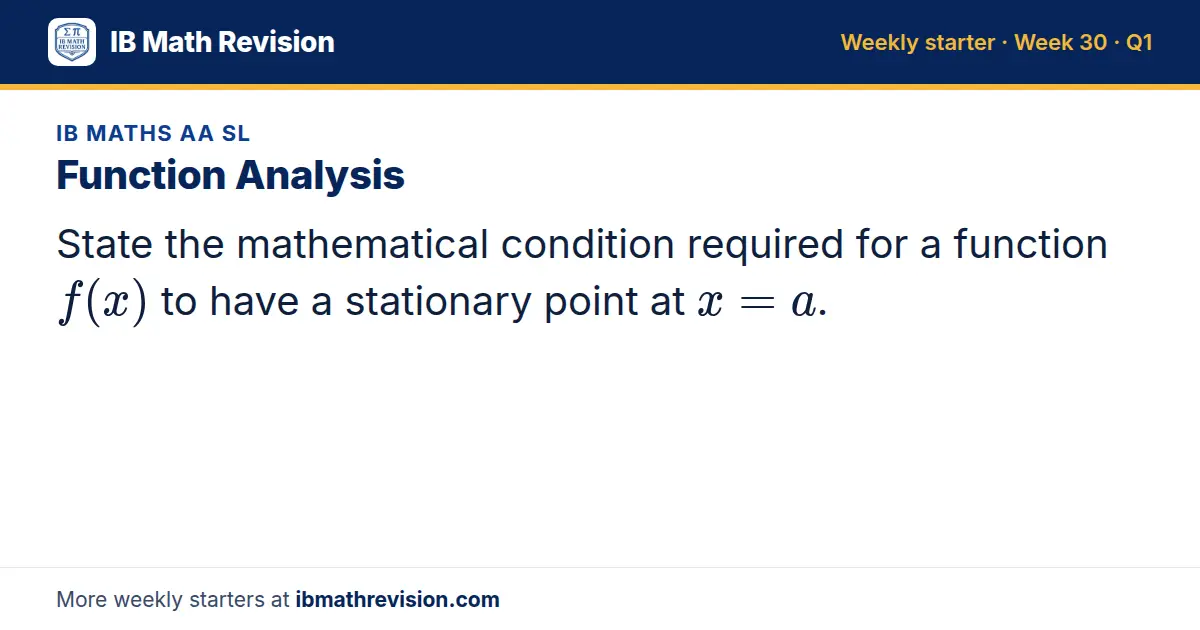
Question 1: Function Analysis
State the mathematical condition required for a function f(x) to have a stationary point at x=a.
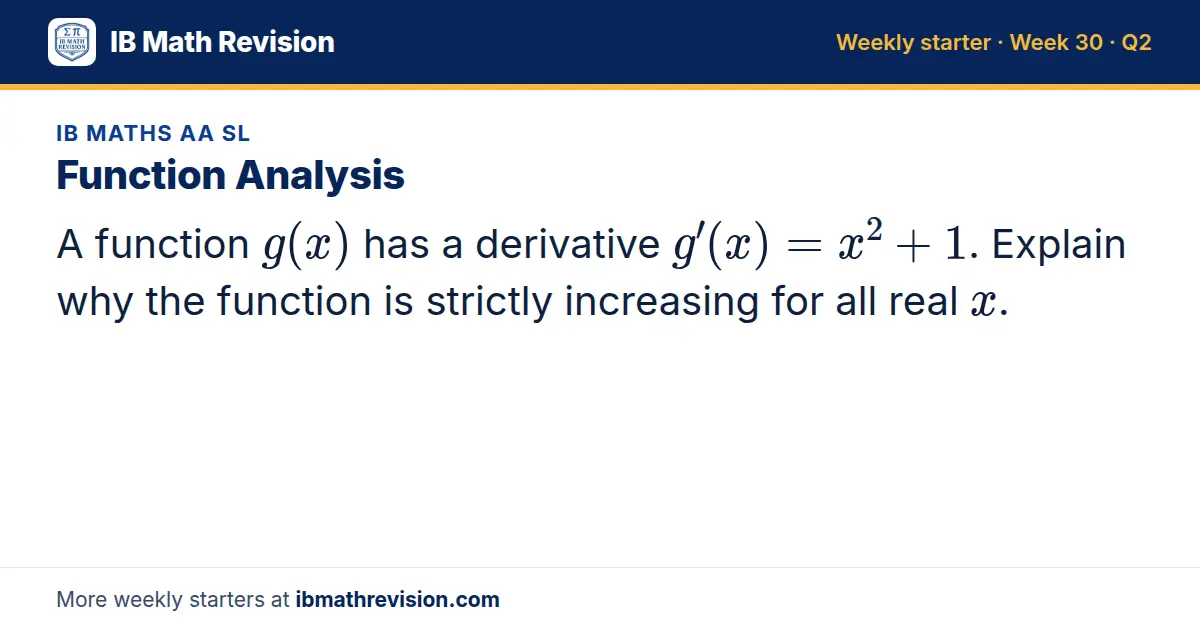
Question 2: Function Analysis
A function g(x) has a derivative g'(x) = x² + 1. Explain why the function is strictly increasing for all real x.
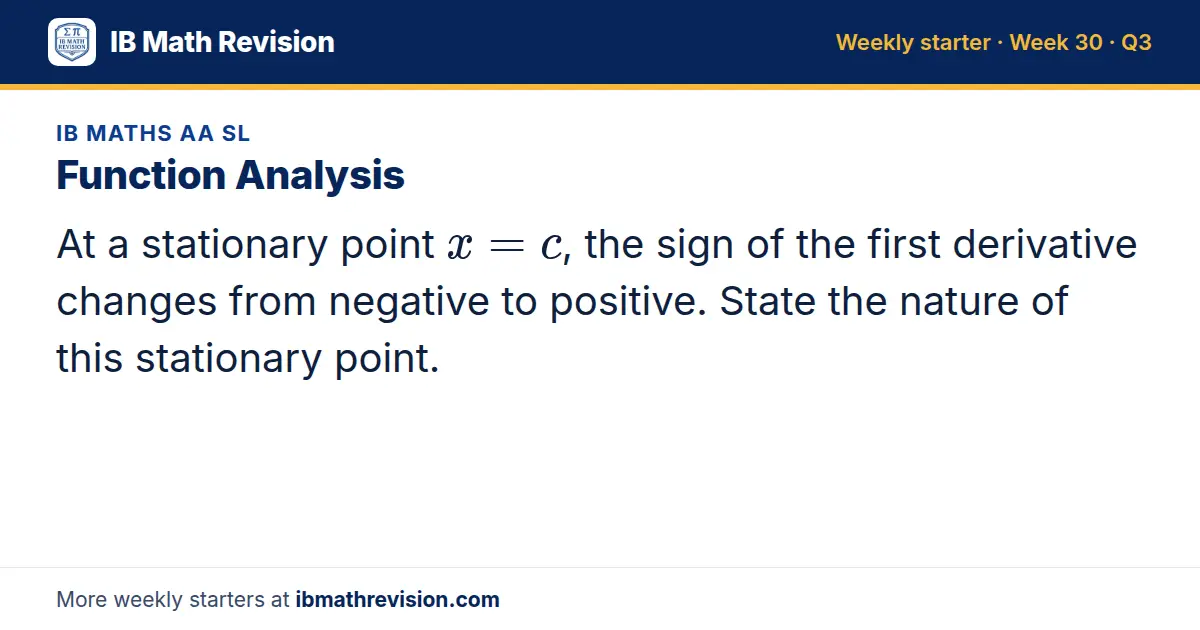
Question 3: Function Analysis
At a stationary point x=c, the sign of the first derivative changes from negative to positive. State the nature of this stationary point.
Week 31
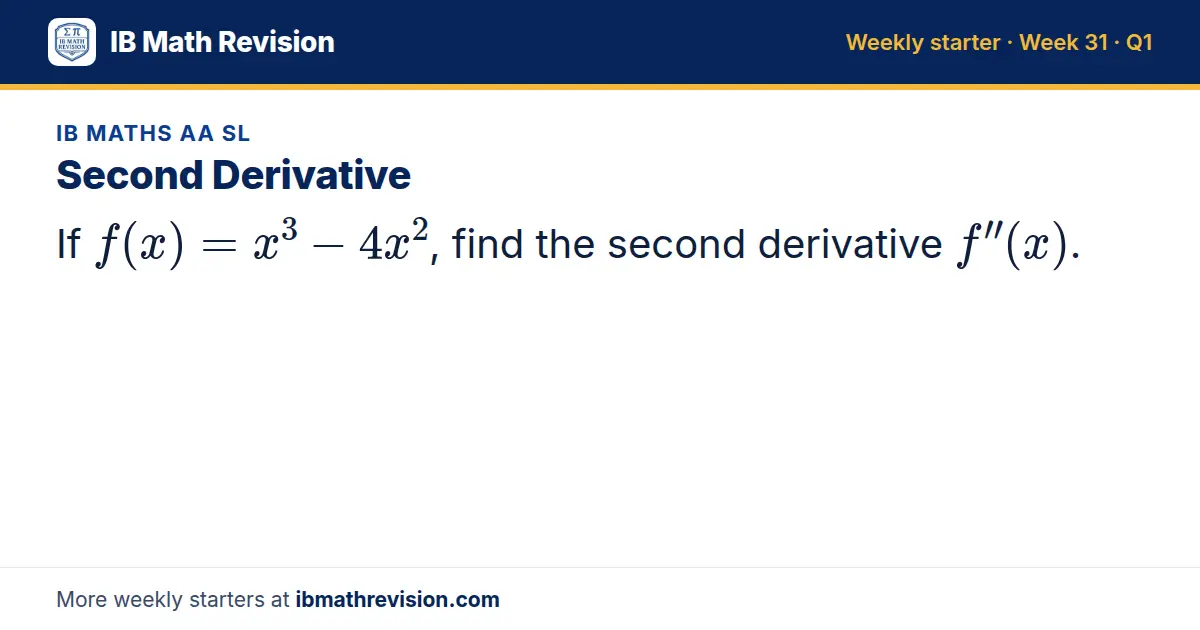
Question 1: Second Derivative
If f(x) = x³ - 4x², find the second derivative f''(x).
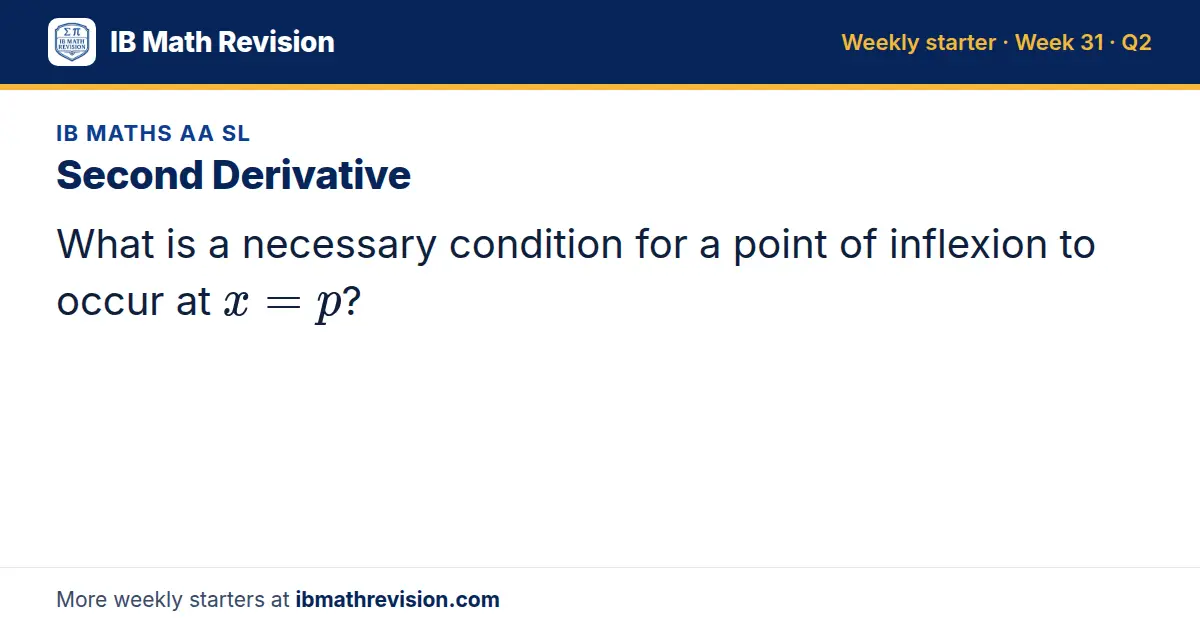
Question 2: Second Derivative
What is a necessary condition for a point of inflexion to occur at x=p?
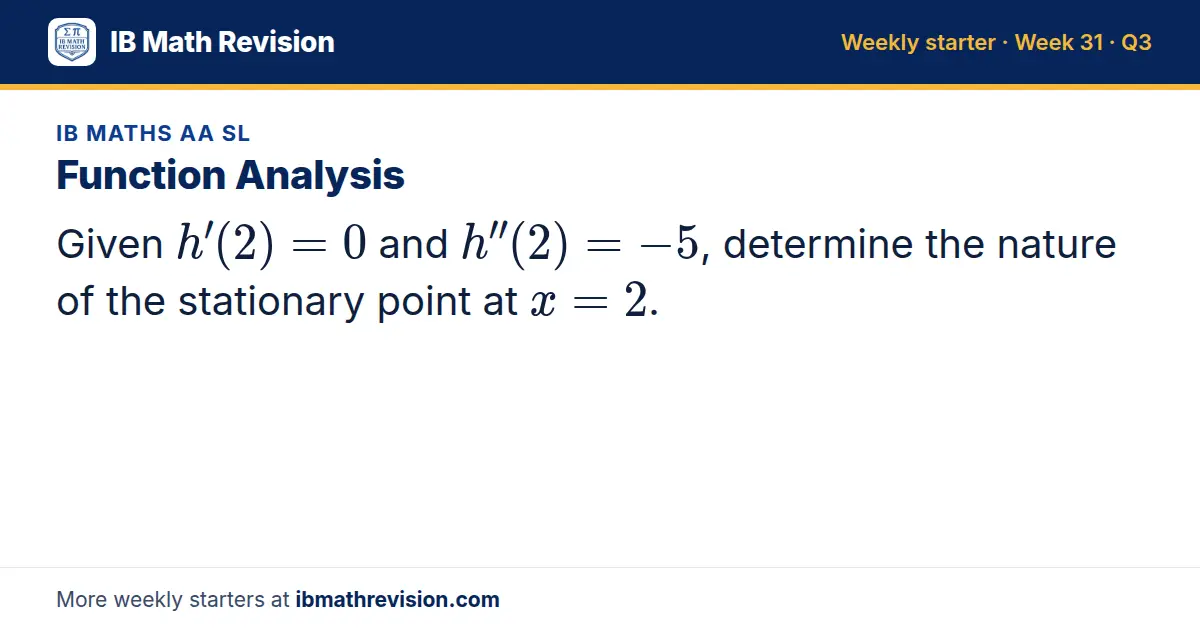
Question 3: Function Analysis
Given h'(2) = 0 and h''(2) = -5, determine the nature of the stationary point at x=2.
Week 32
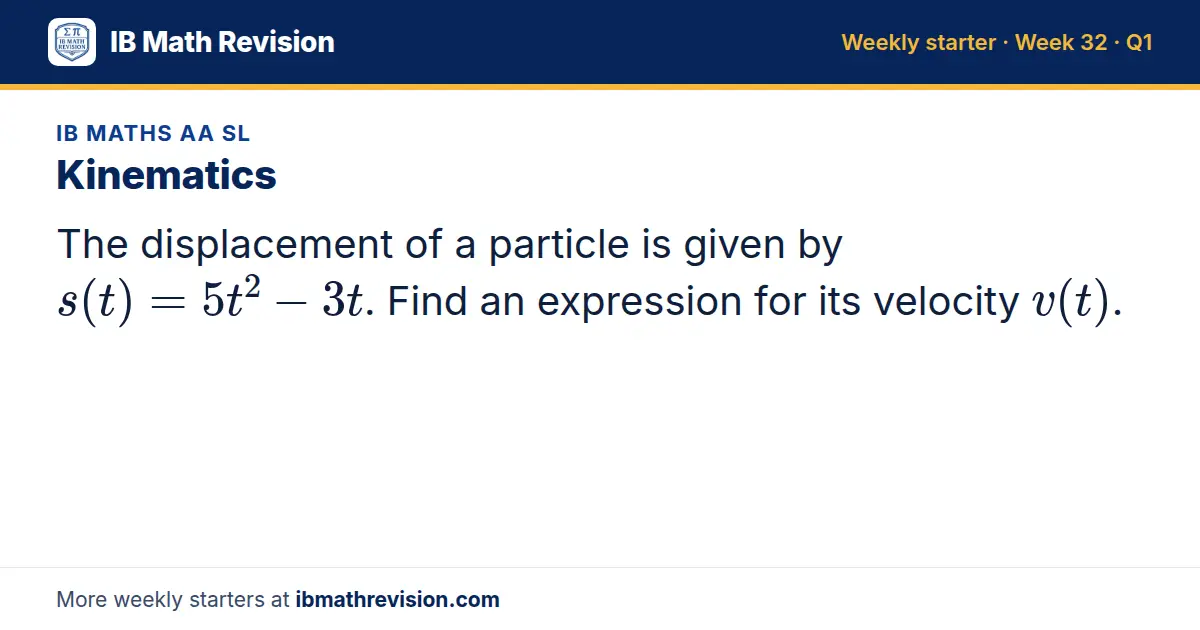
Question 1: Kinematics
The displacement of a particle is given by s(t) = 5t² - 3t. Find an expression for its velocity v(t).
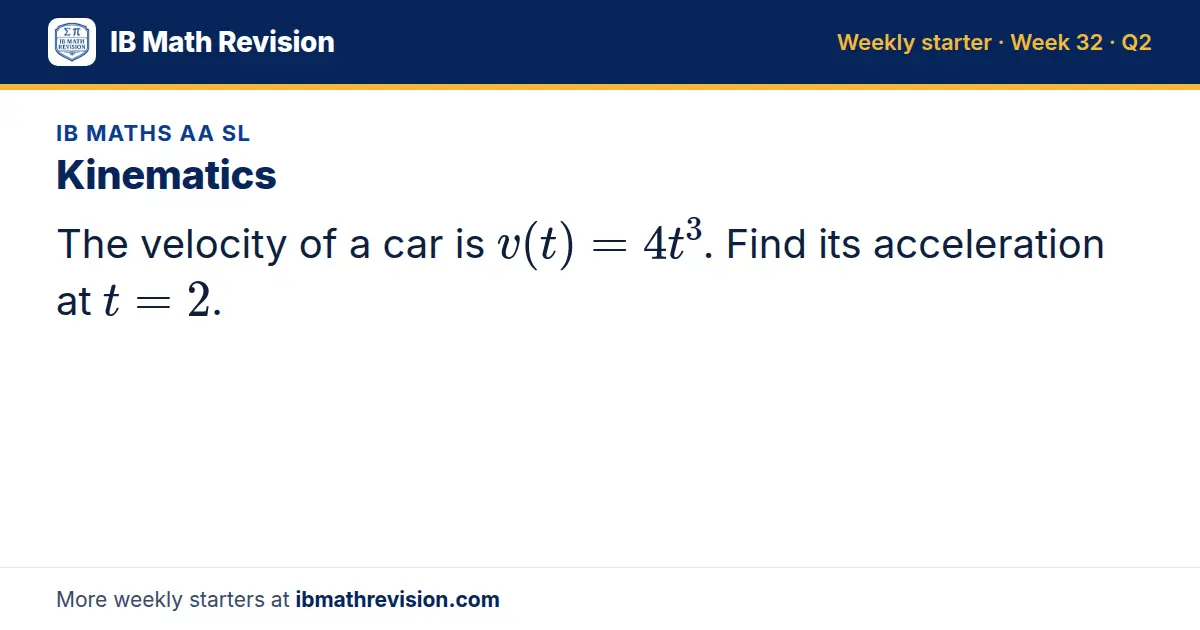
Question 2: Kinematics
The velocity of a car is v(t) = 4t^3. Find its acceleration at t = 2.
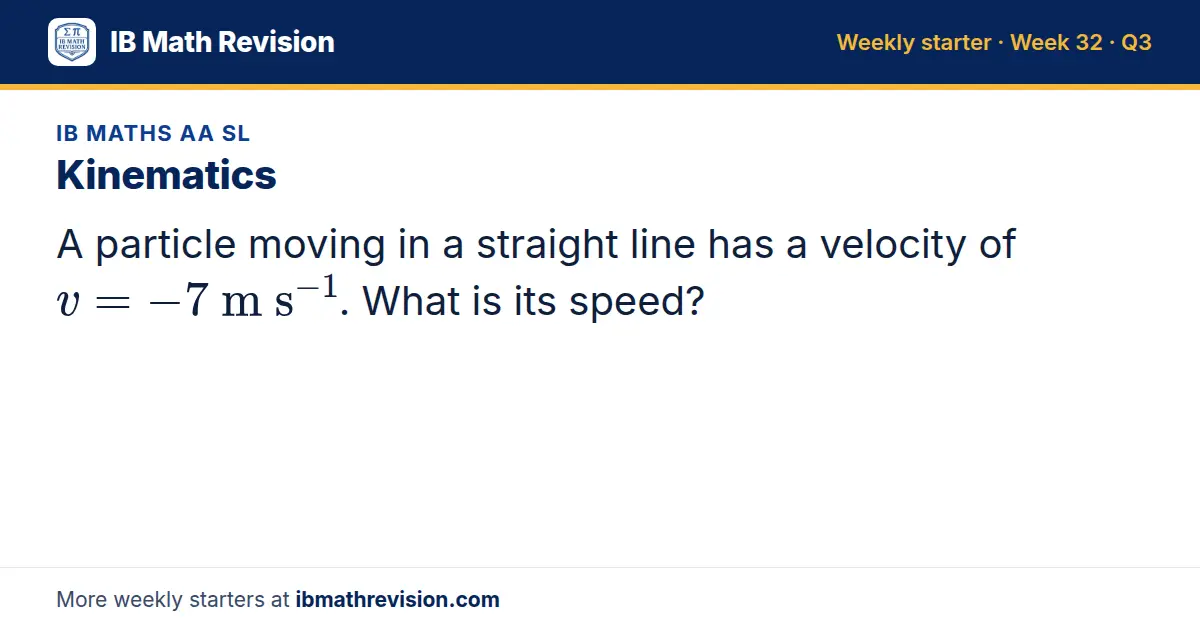
Question 3: Kinematics
A particle moving in a straight line has a velocity of v = -7 m s⁻¹. What is its speed?
Week 33
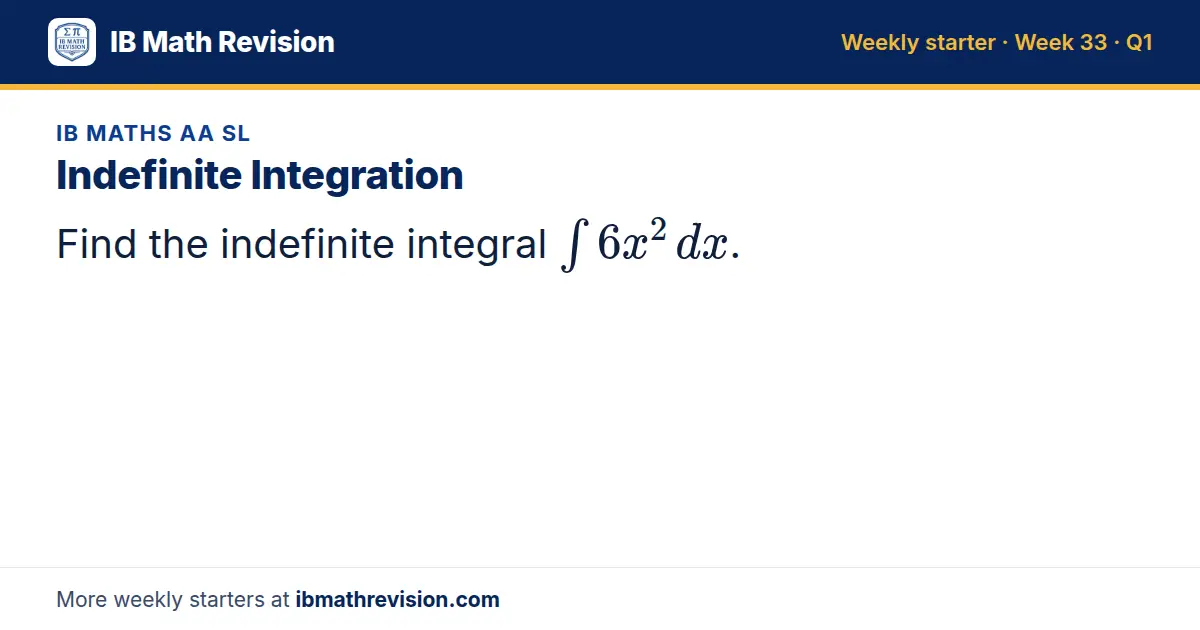
Question 1: Indefinite Integration
Find the indefinite integral ∫ 6x² dx.
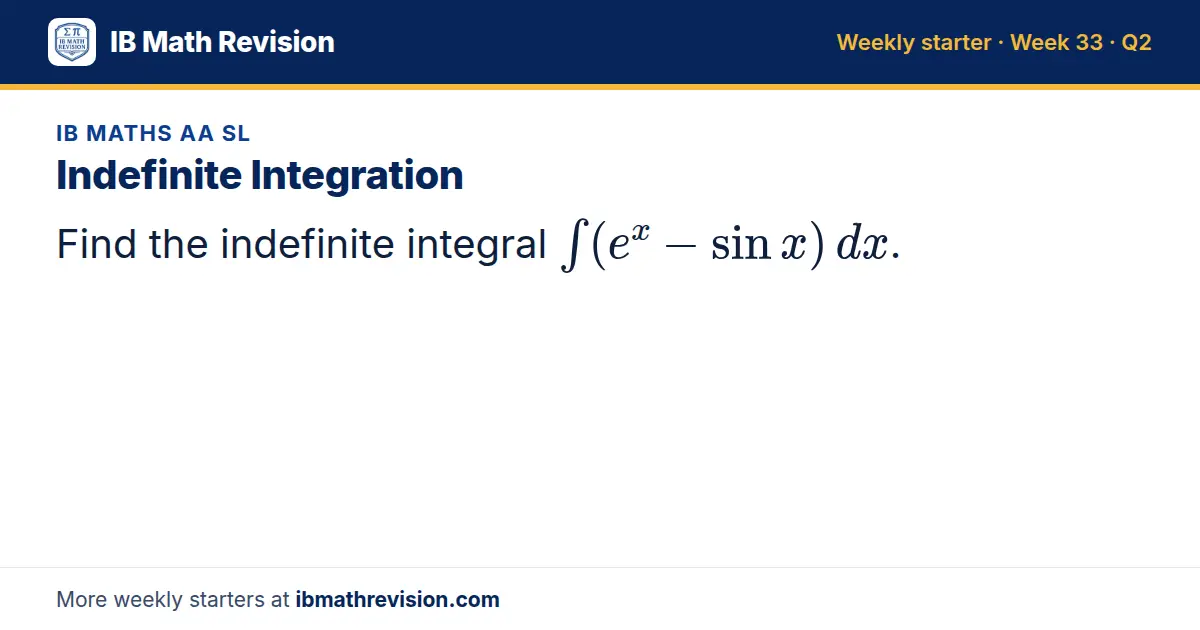
Question 2: Indefinite Integration
Find the indefinite integral ∫ (e^x - sin x) dx.
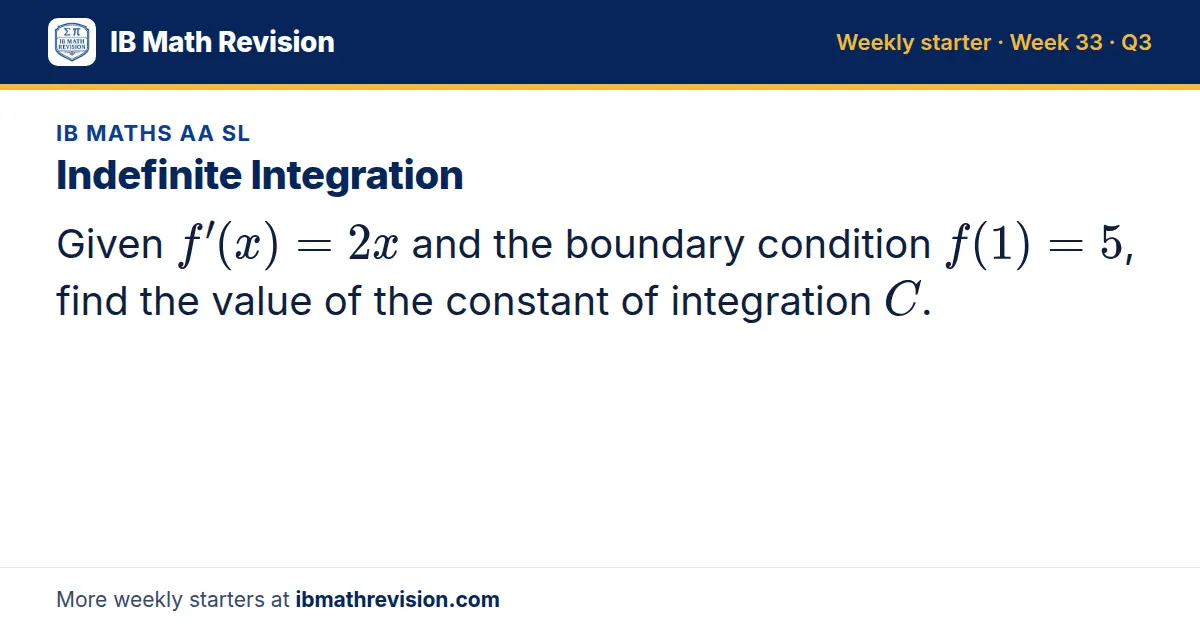
Question 3: Indefinite Integration
Given f'(x) = 2x and the boundary condition f(1) = 5, find the value of the constant of integration C.
Week 34
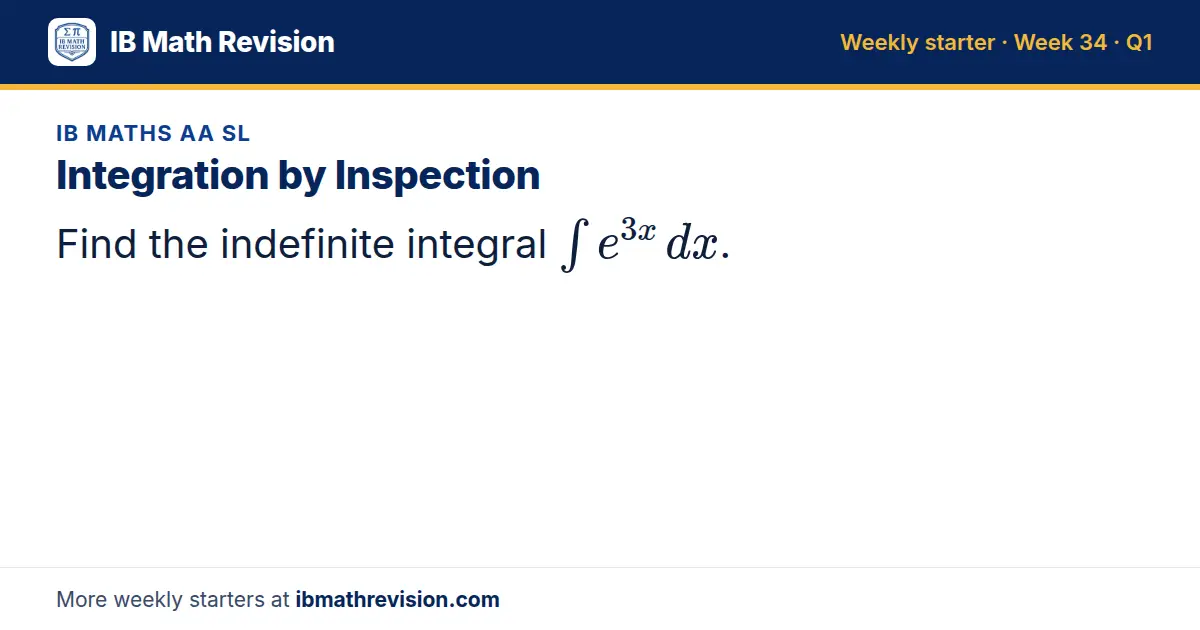
Question 1: Integration by Inspection
Find the indefinite integral ∫ e^(3x) dx.
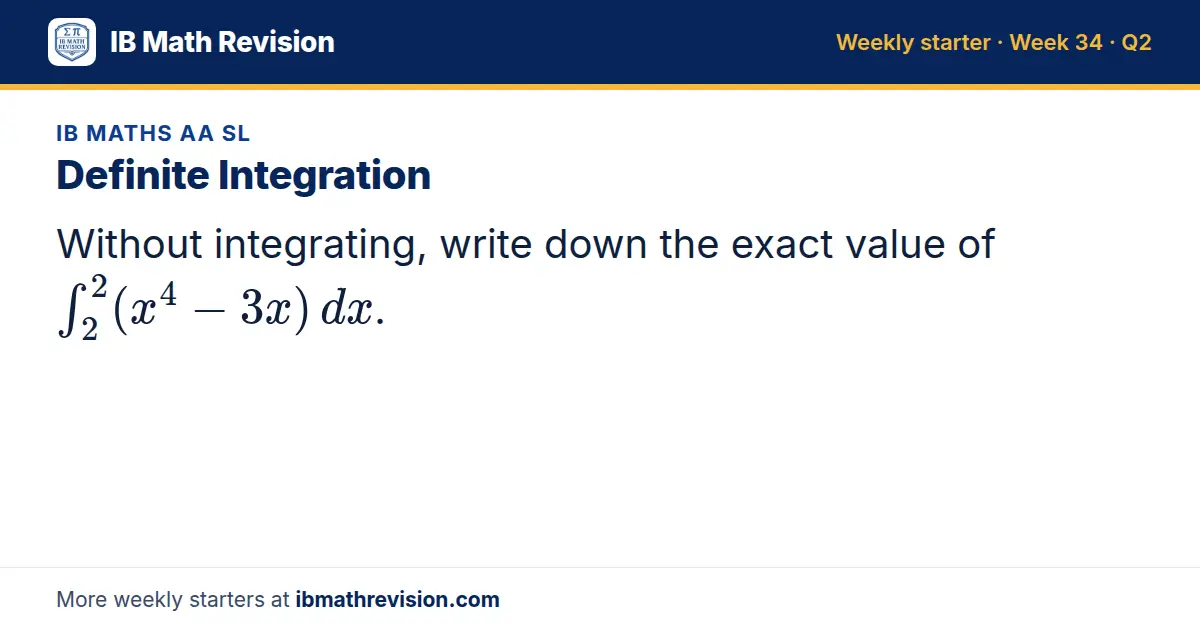
Question 2: Definite Integration
Without integrating, write down the exact value of ∫_2² (x⁴ - 3x) dx.
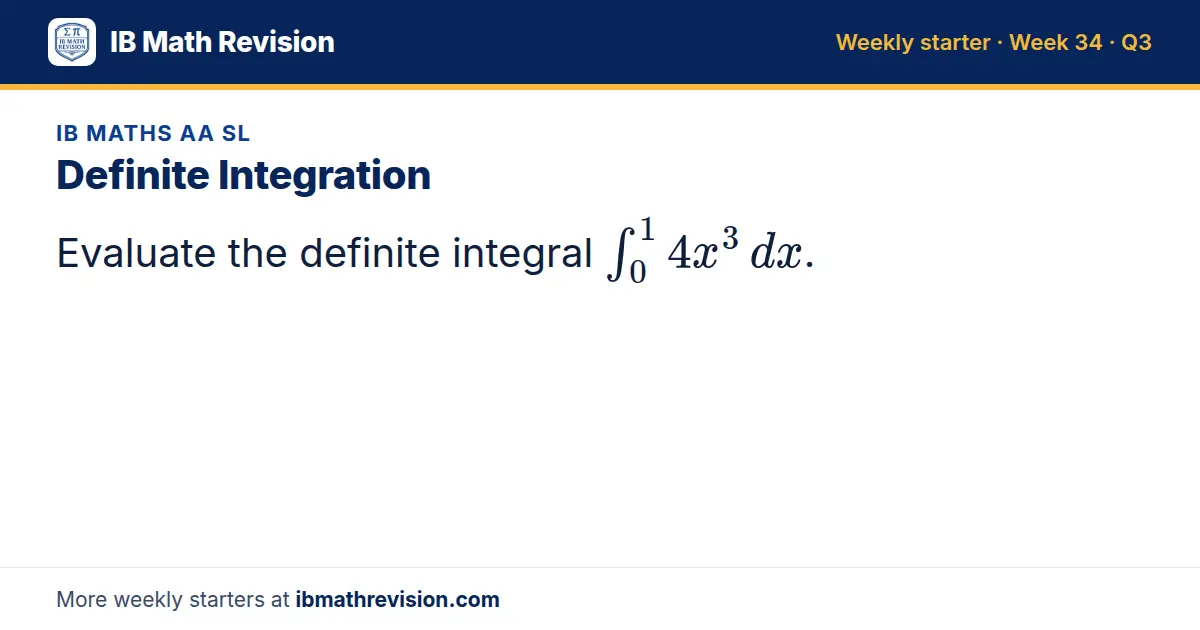
Question 3: Definite Integration
Evaluate the definite integral ∫_0¹ 4x³ dx.
Week 35
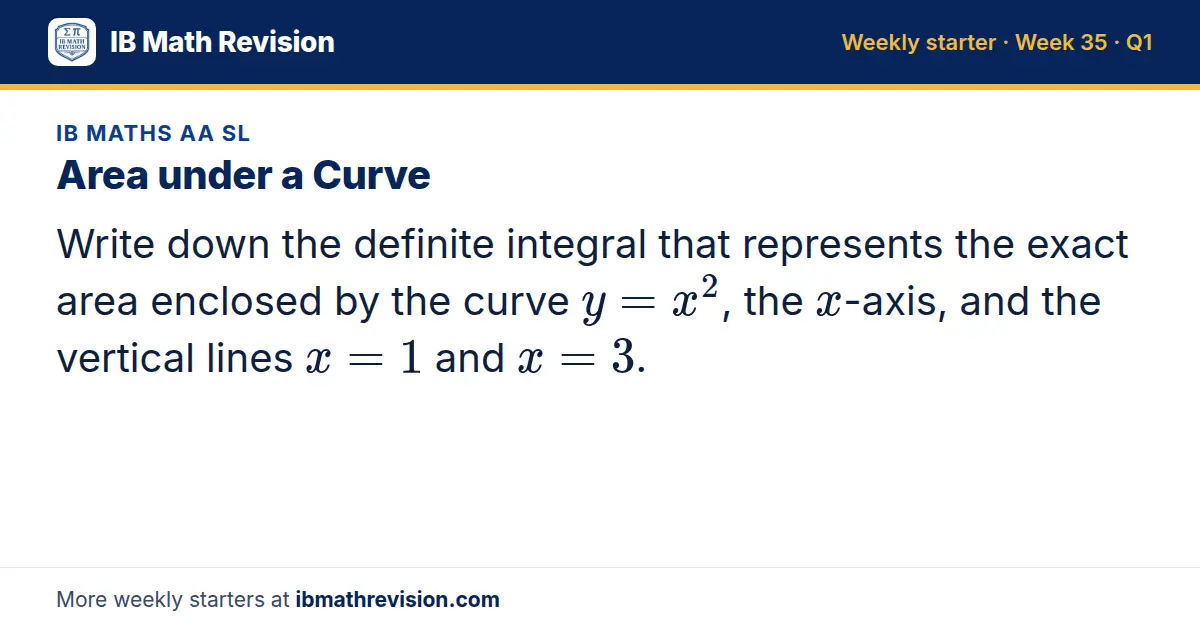
Question 1: Area under a Curve
Write down the definite integral that represents the exact area enclosed by the curve y = x², the x-axis, and the vertical lines x = 1 and x = 3.
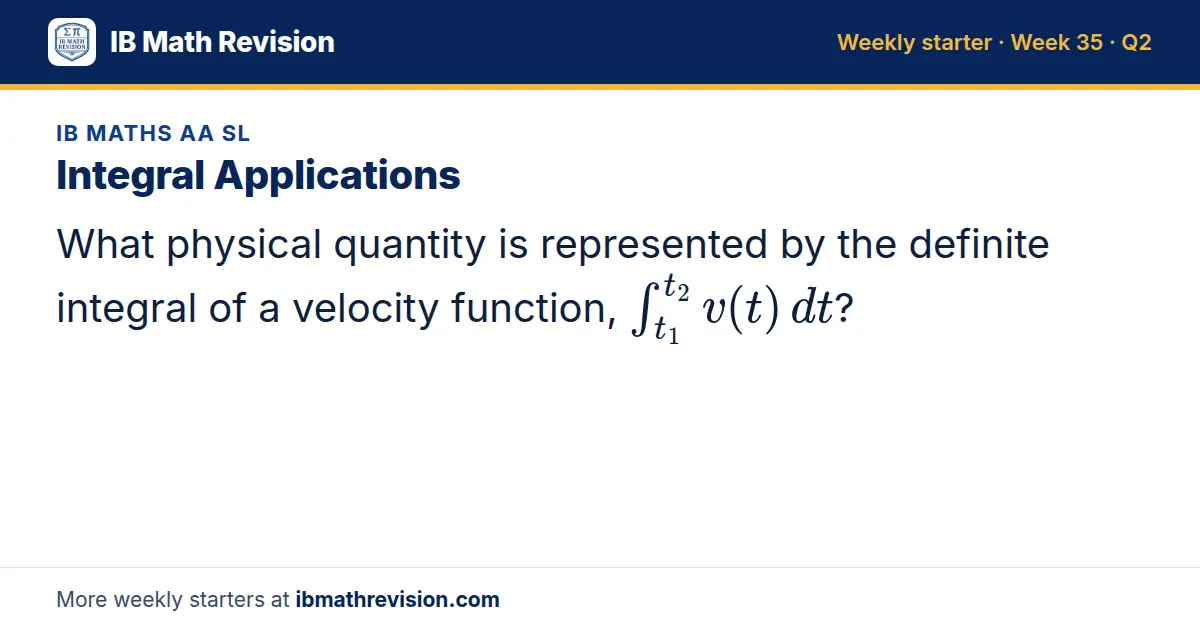
Question 2: Integral Applications
What physical quantity is represented by the definite integral of a velocity function, ∫_t_1^(t_2) v(t) dt?
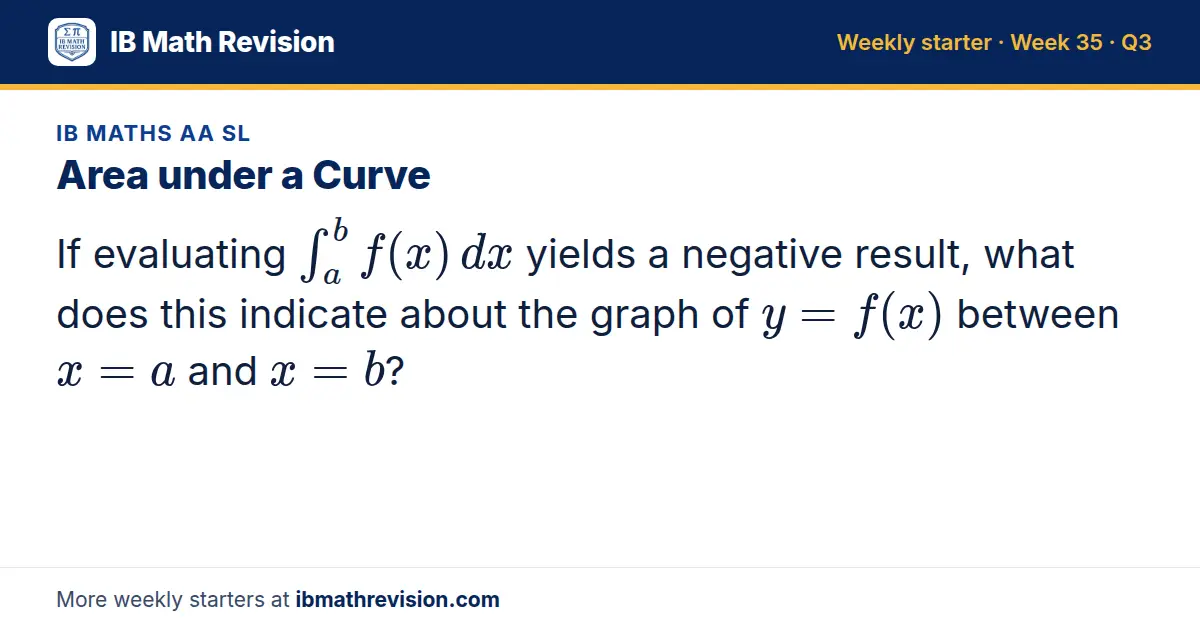
Question 3: Area under a Curve
If evaluating ∫_a^b f(x) dx yields a negative result, what does this indicate about the graph of y = f(x) between x=a and x=b?
Week 36
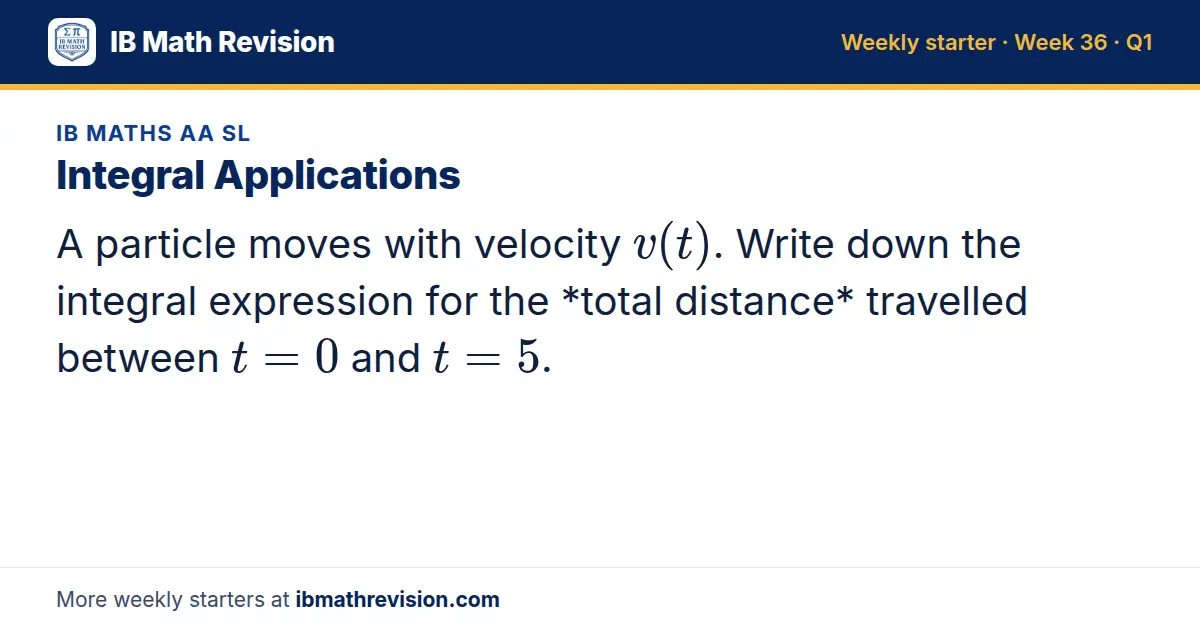
Question 1: Integral Applications
A particle moves with velocity v(t). Write down the integral expression for the *total distance* travelled between t=0 and t=5.
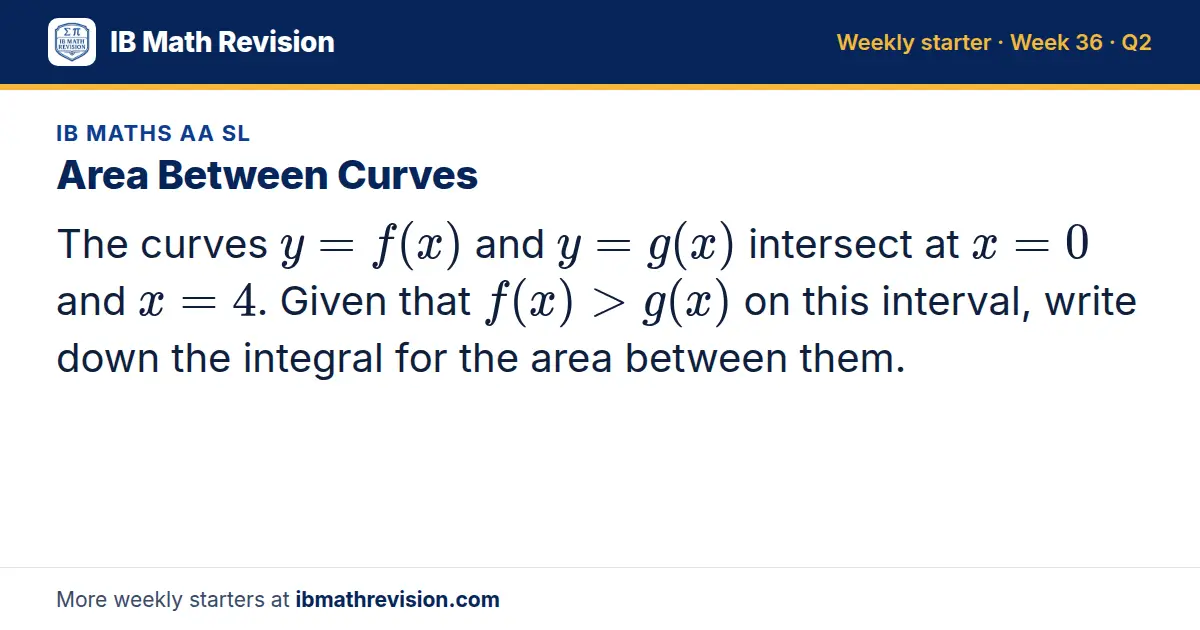
Question 2: Area Between Curves
The curves y = f(x) and y = g(x) intersect at x = 0 and x = 4. Given that f(x) > g(x) on this interval, write down the integral for the area between them.
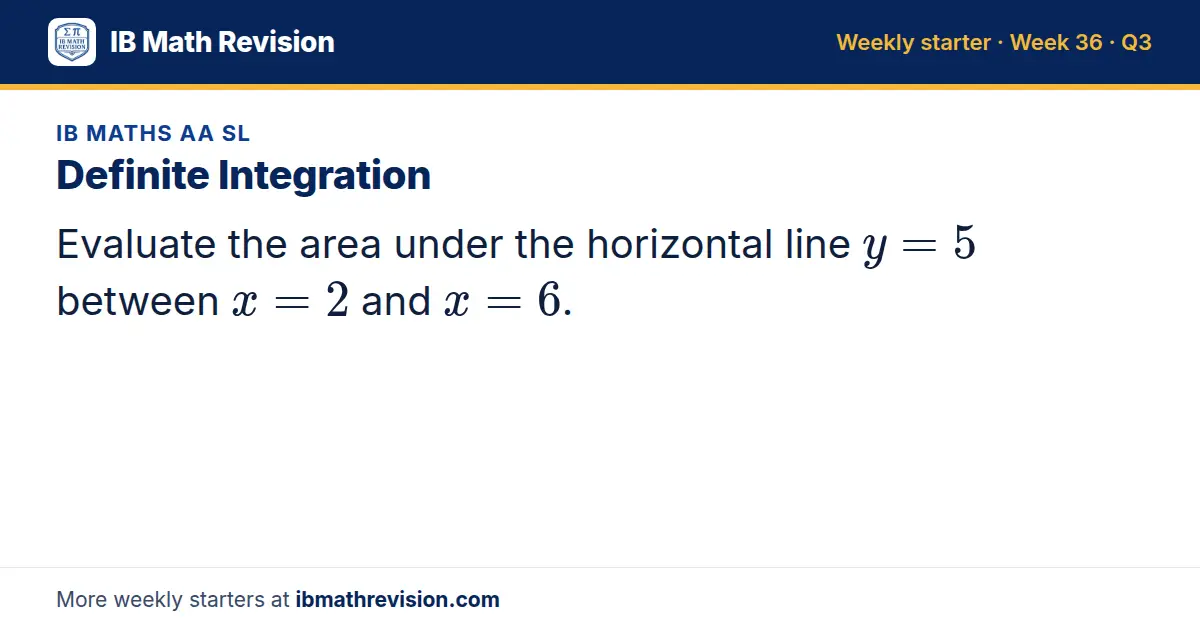
Question 3: Definite Integration
Evaluate the area under the horizontal line y = 5 between x = 2 and x = 6.
Week 37
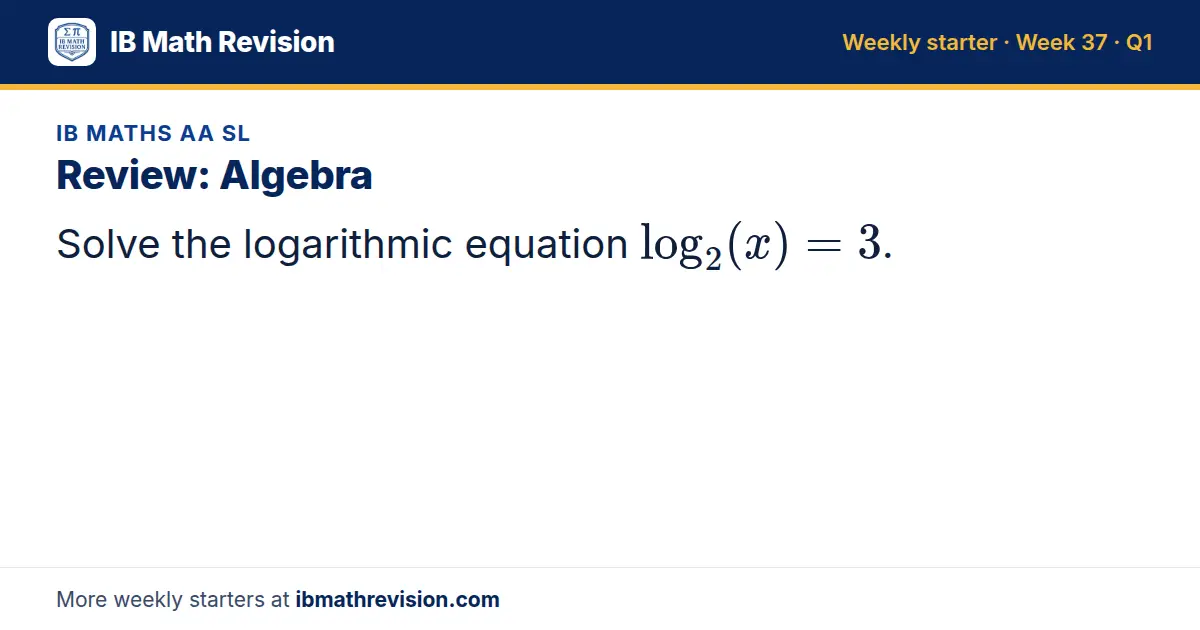
Question 1: Review: Algebra
Solve the logarithmic equation log_2(x) = 3.
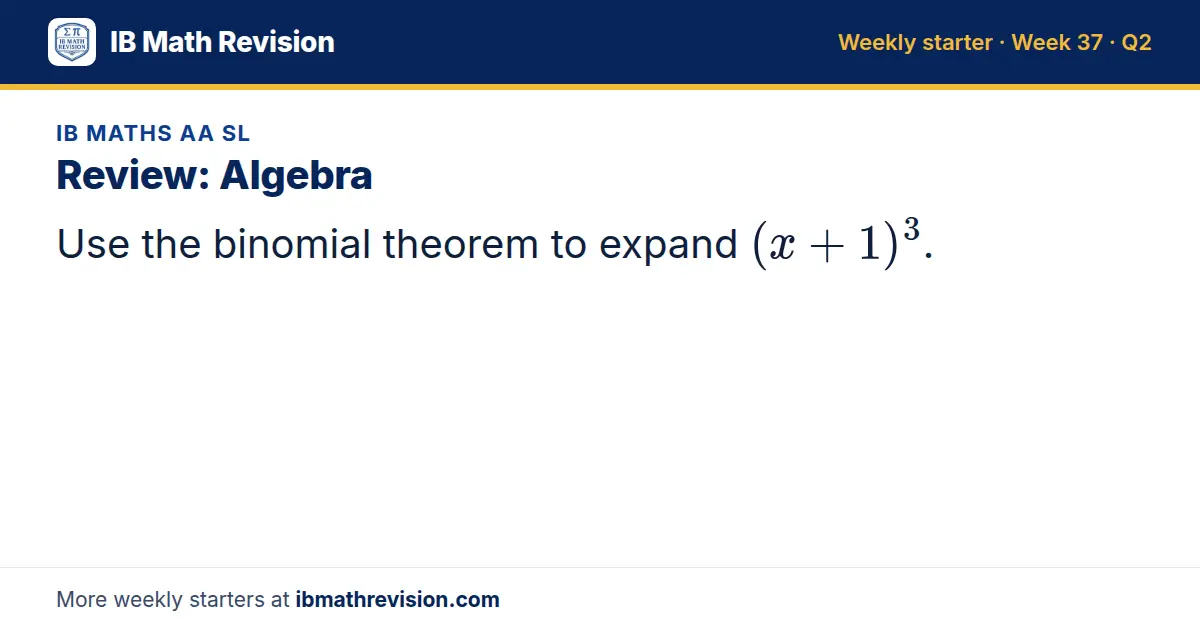
Question 2: Review: Algebra
Use the binomial theorem to expand (x+1)^3.
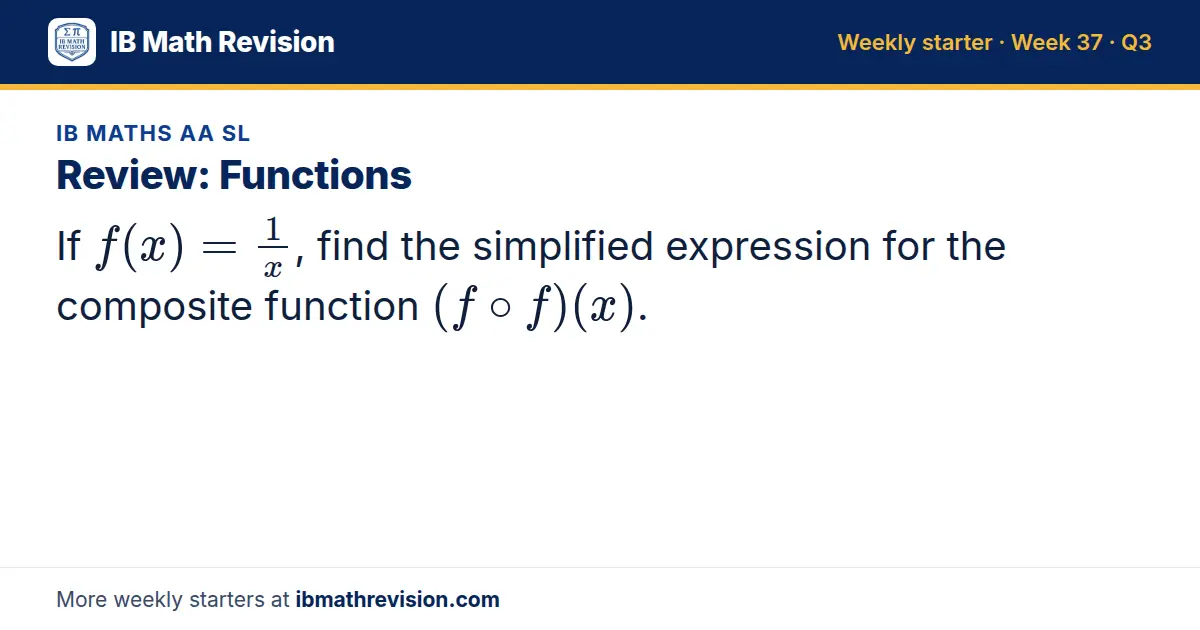
Question 3: Review: Functions
If f(x) = 1/x, find the simplified expression for the composite function (f ∘ f)(x).
Week 38
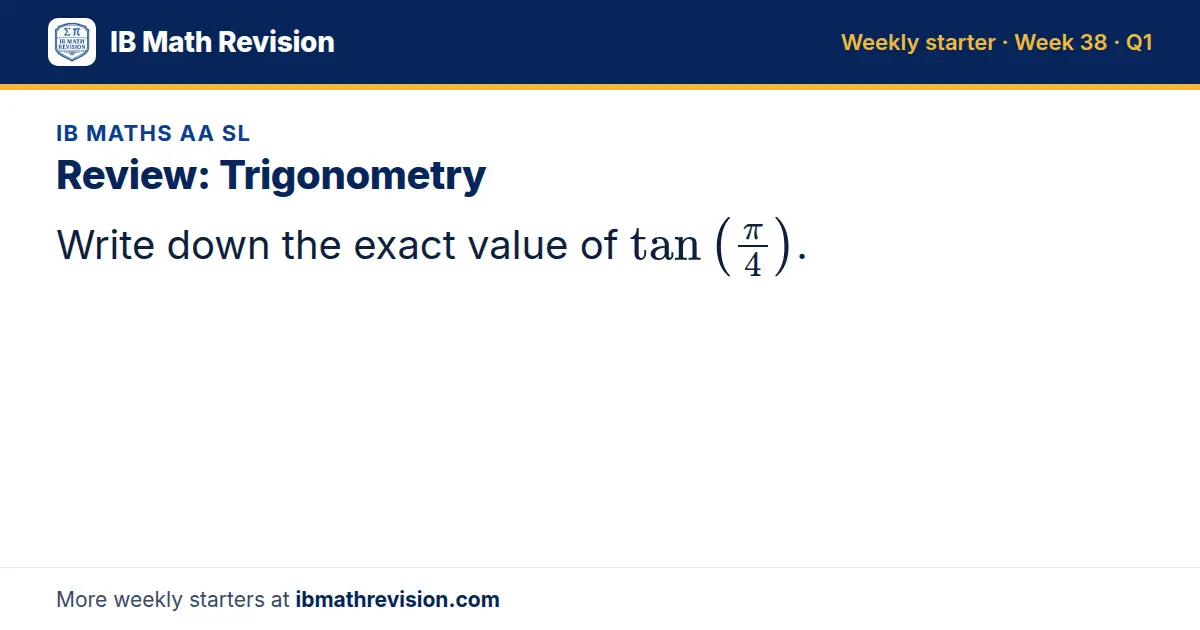
Question 1: Review: Trigonometry
Write down the exact value of tan((π)/4).
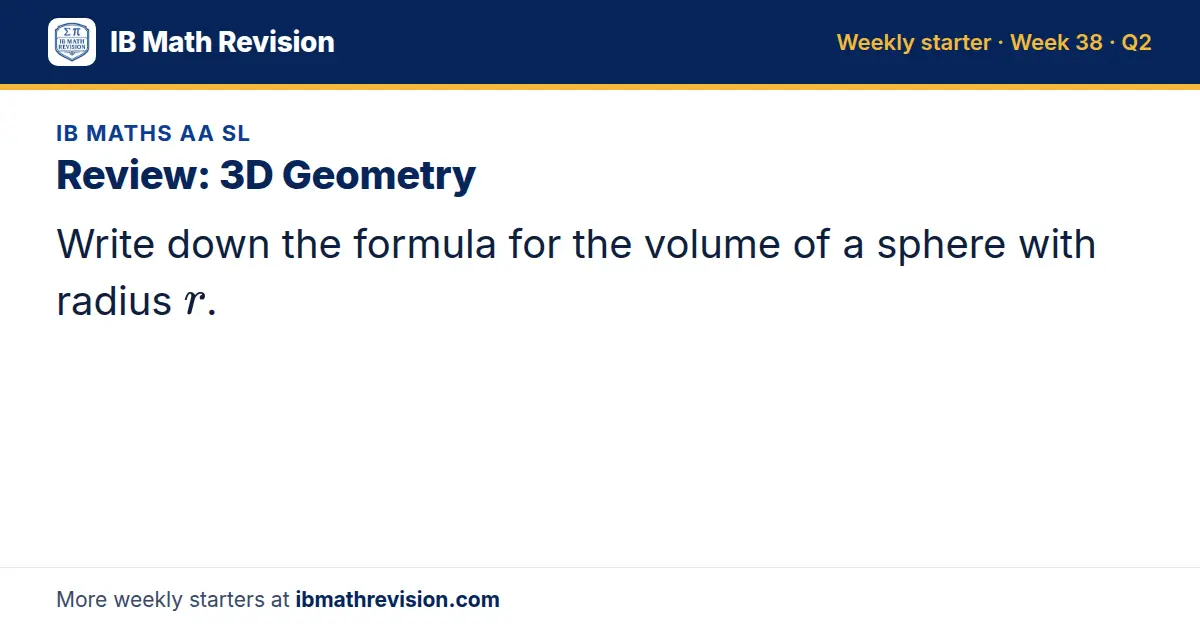
Question 2: Review: 3D Geometry
Write down the formula for the volume of a sphere with radius r.
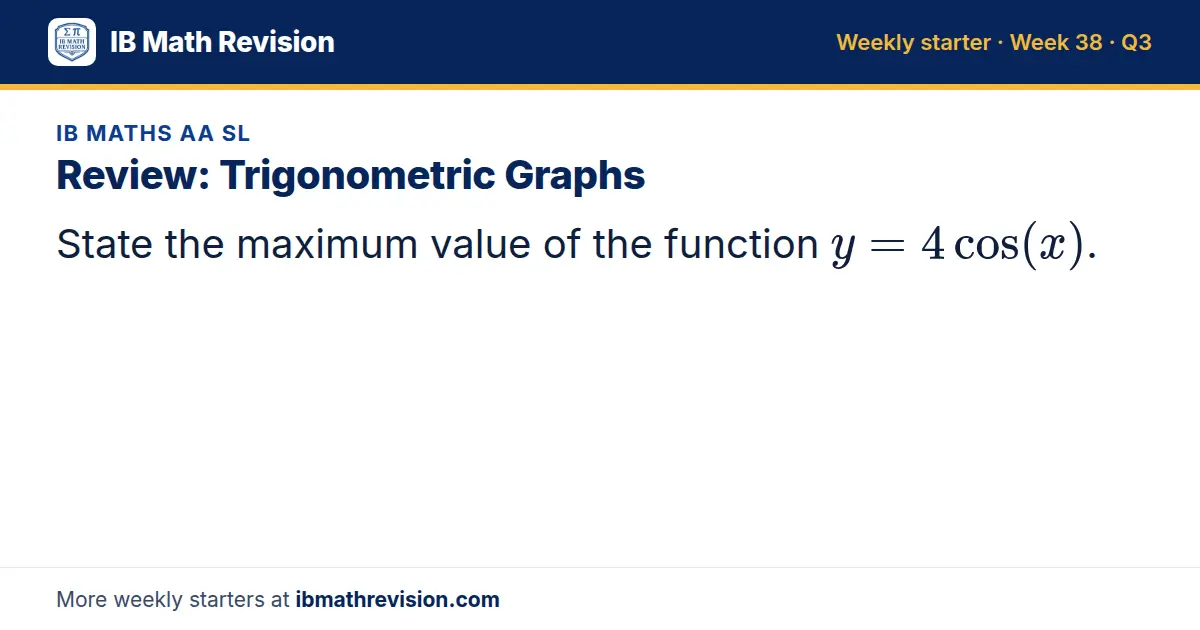
Question 3: Review: Trigonometric Graphs
State the maximum value of the function y = 4cos(x).
Week 39
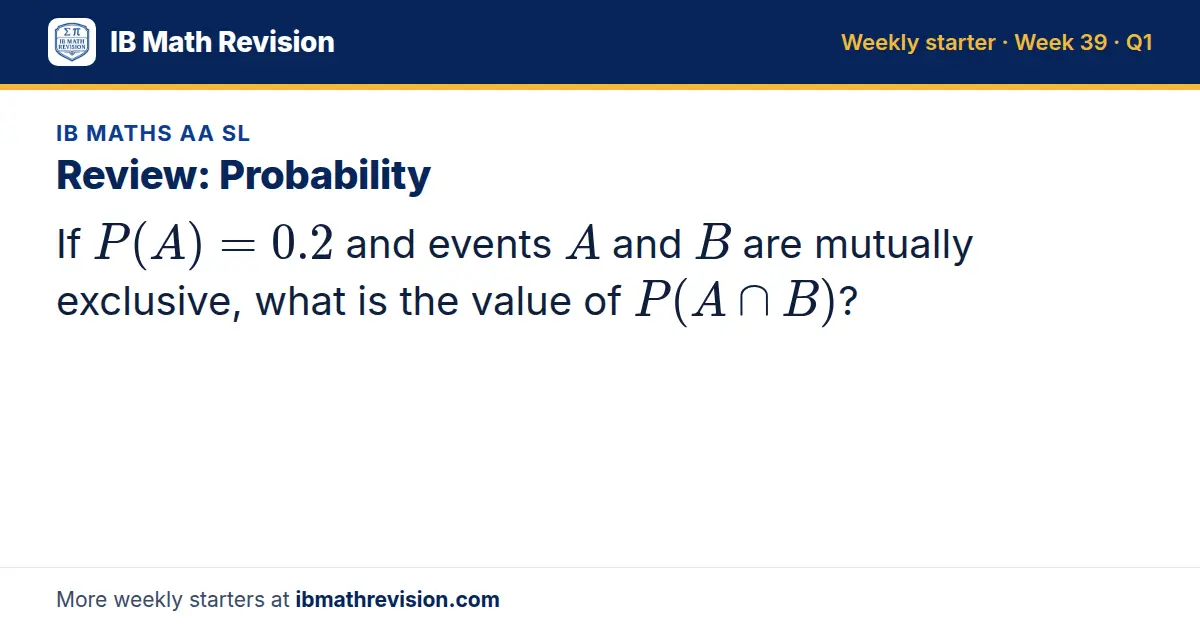
Question 1: Review: Probability
If P(A) = 0.2 and events A and B are mutually exclusive, what is the value of P(A ∩ B)?
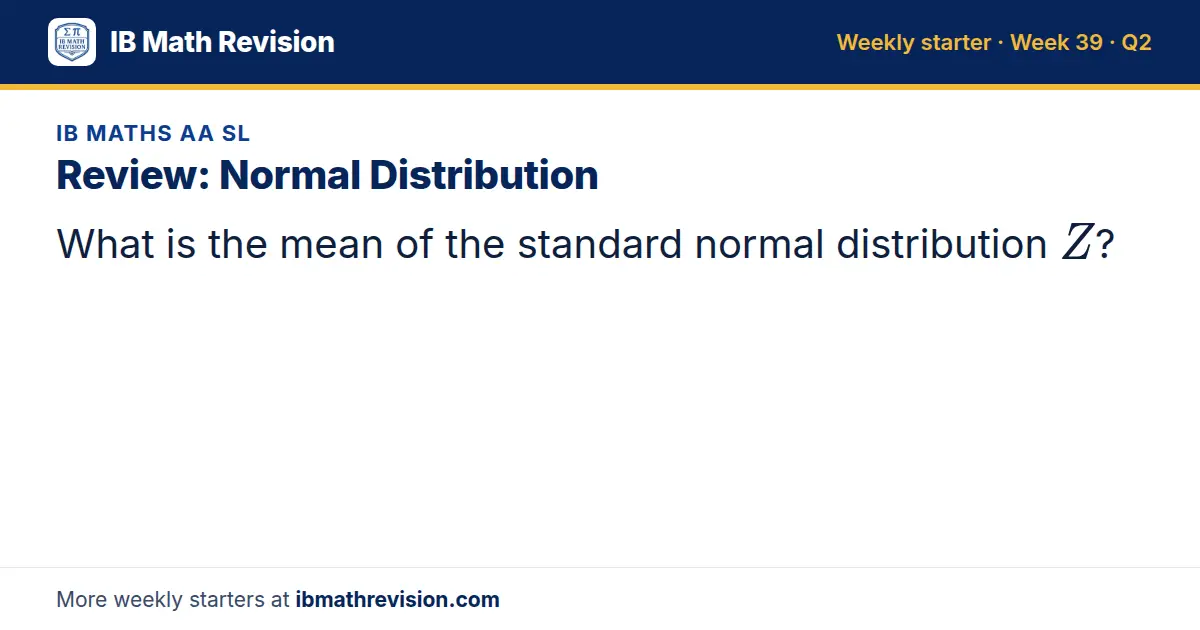
Question 2: Review: Normal Distribution
What is the mean of the standard normal distribution Z?
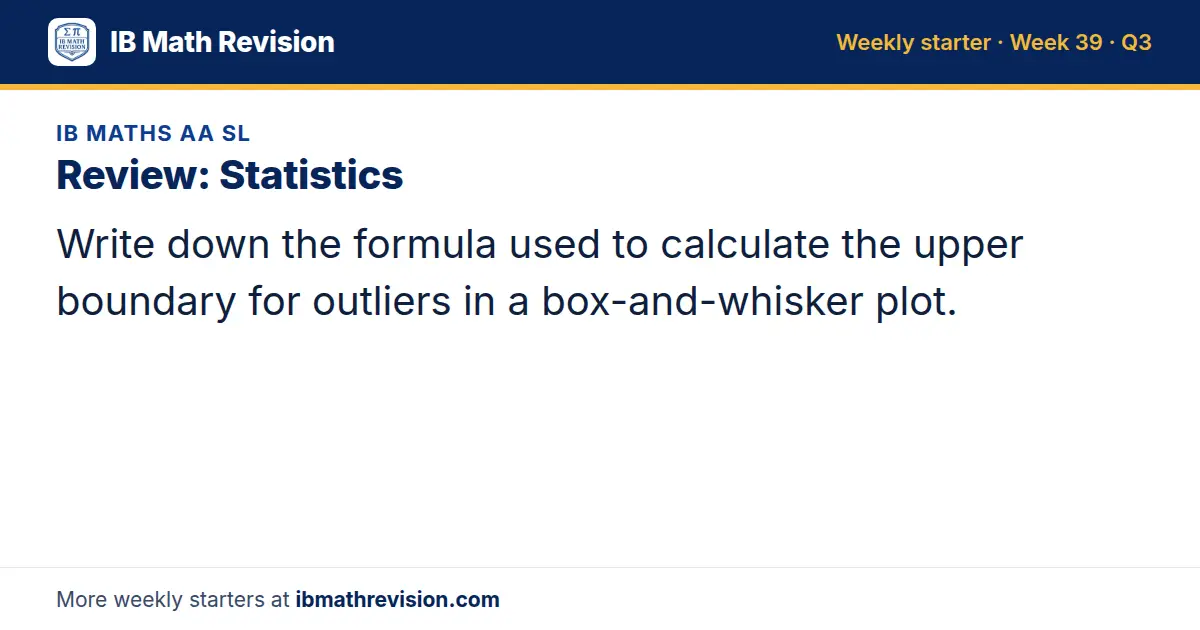
Question 3: Review: Statistics
Write down the formula used to calculate the upper boundary for outliers in a box-and-whisker plot.
Week 40
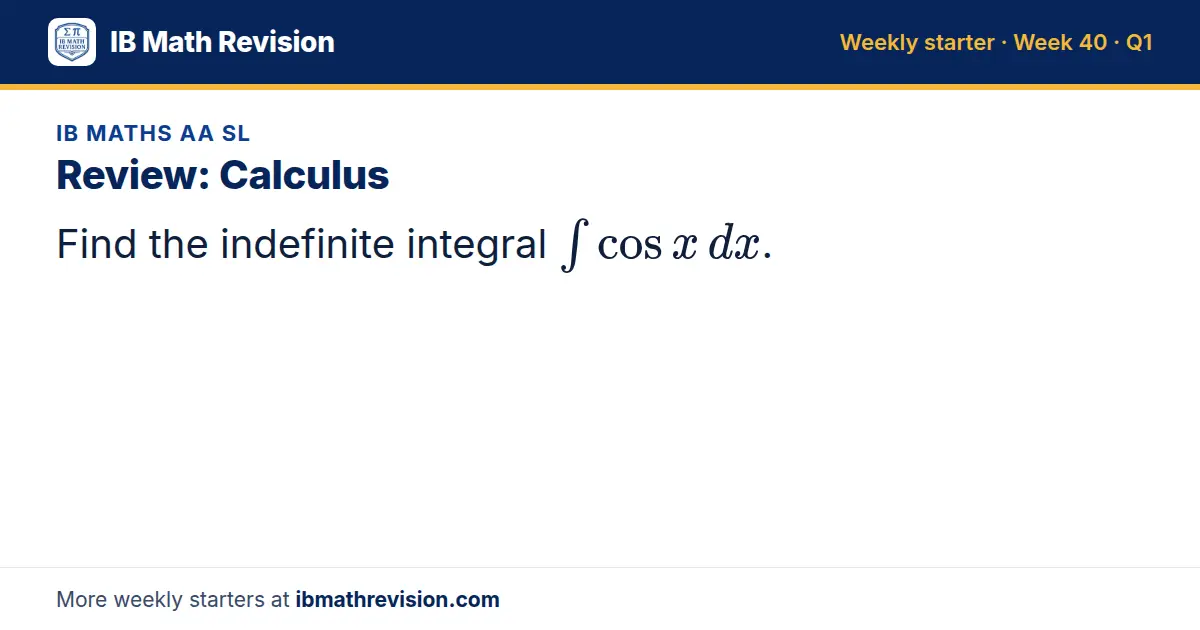
Question 1: Review: Calculus
Find the indefinite integral ∫ cos x dx.
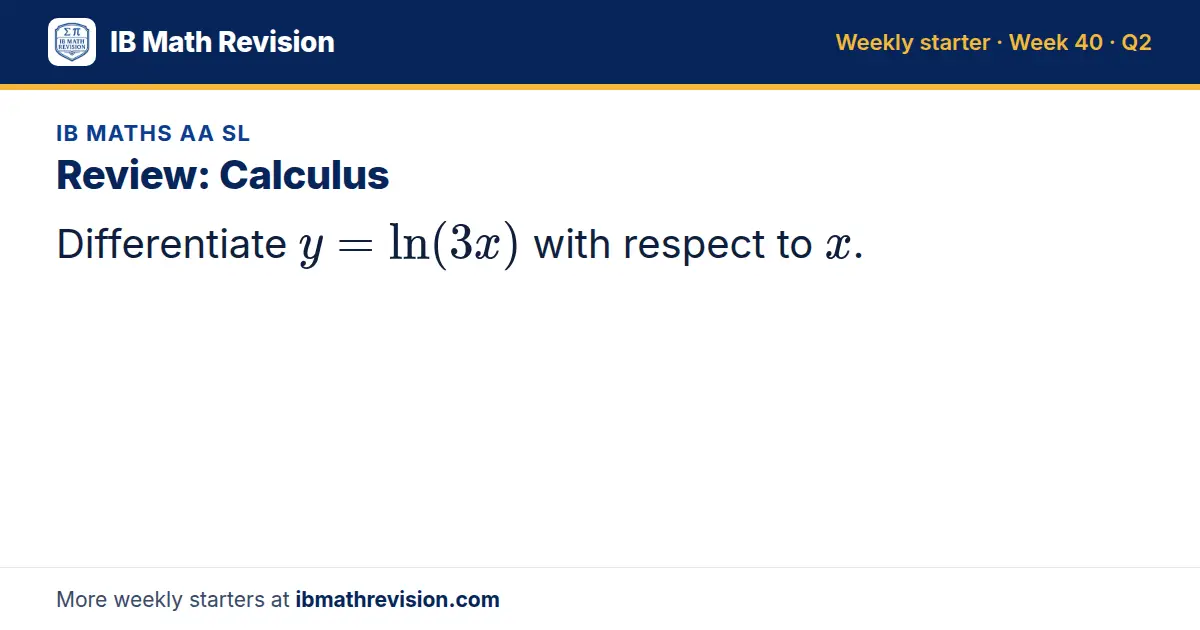
Question 2: Review: Calculus
Differentiate y = ln(3x) with respect to x.
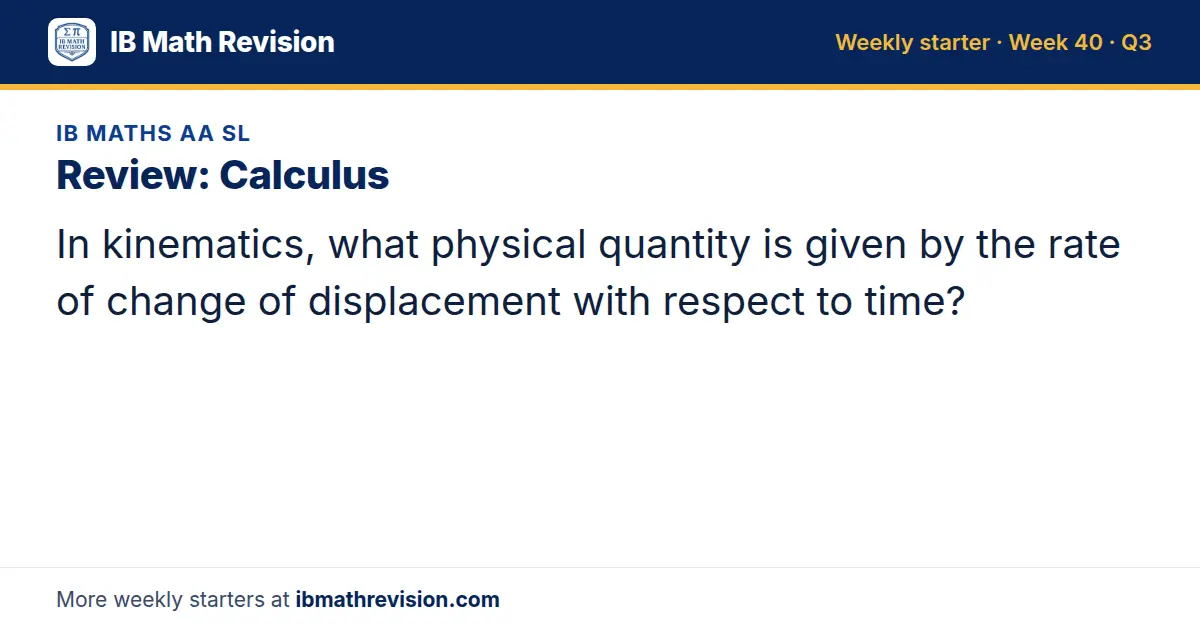
Question 3: Review: Calculus
In kinematics, what physical quantity is given by the rate of change of displacement with respect to time?
More starter questions
Other weeks: Weeks 1–13 · Weeks 14–26 · Weeks 27–40. Answers and mark schemes are in the starter tasks for teachers.