IB Maths AA SL starter questions: weeks 14–26
39 short questions to open a lesson for IB Maths Analysis and Approaches SL, weeks 14–26 of the teaching year, three or four a week. Each question is shown as an image with its text underneath; answers and mark schemes stay with teachers.
Week 14
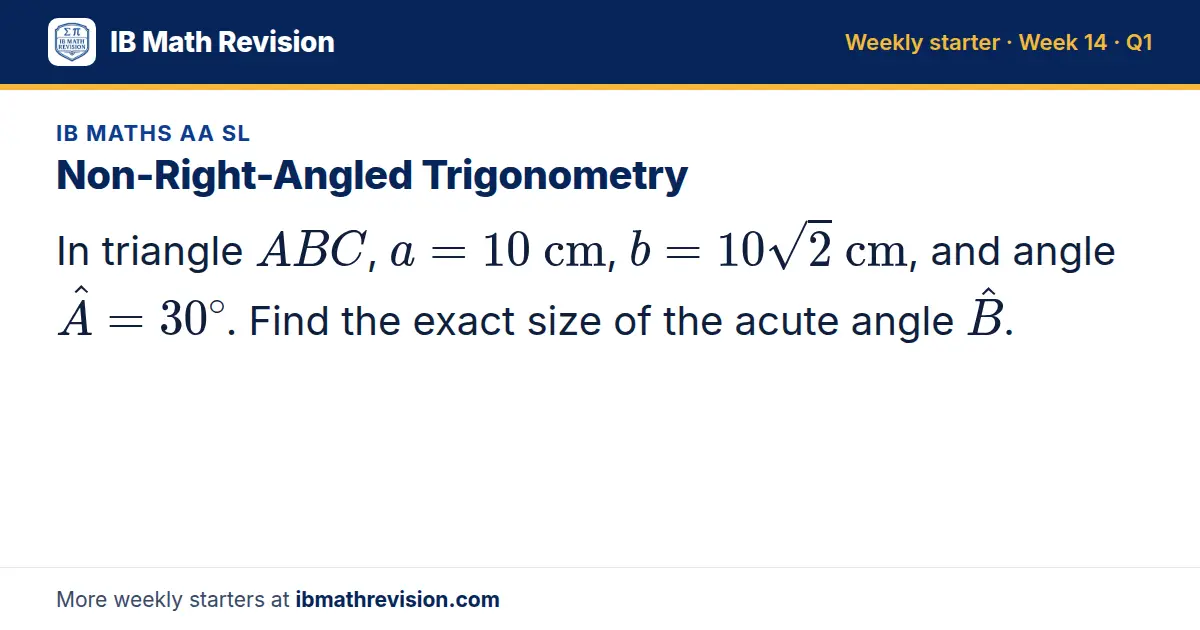
Question 1: Non-Right-Angled Trigonometry
In triangle ABC, a = 10 cm, b = 10√2 cm, and angle A = 30^∘. Find the exact size of the acute angle B.
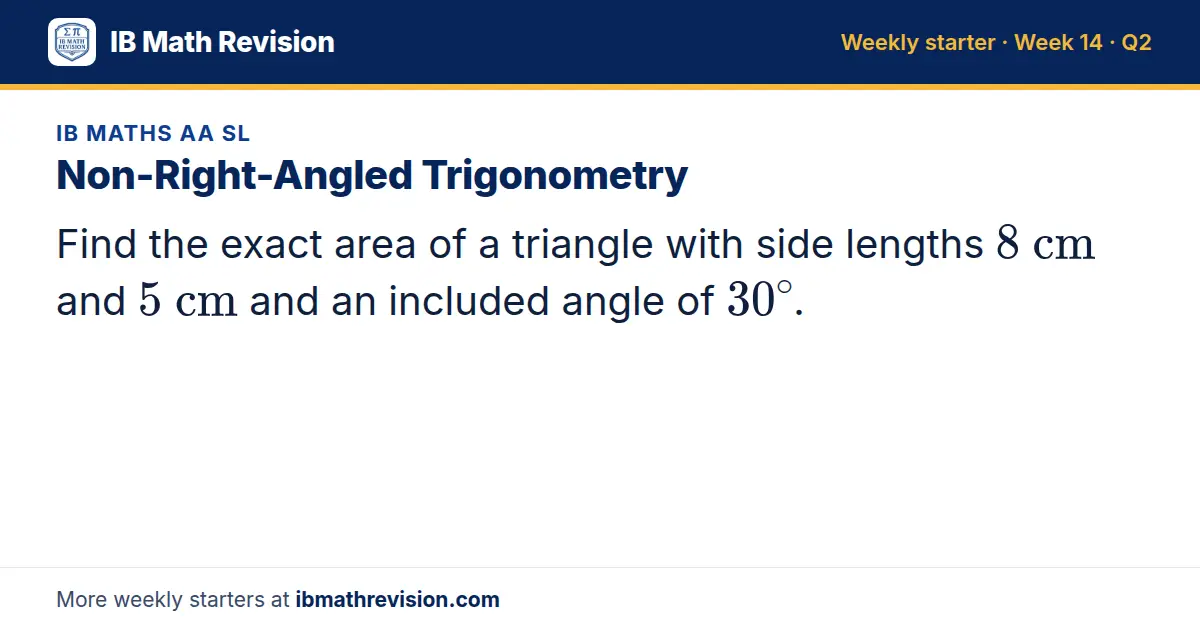
Question 2: Non-Right-Angled Trigonometry
Find the exact area of a triangle with side lengths 8 cm and 5 cm and an included angle of 30^∘.
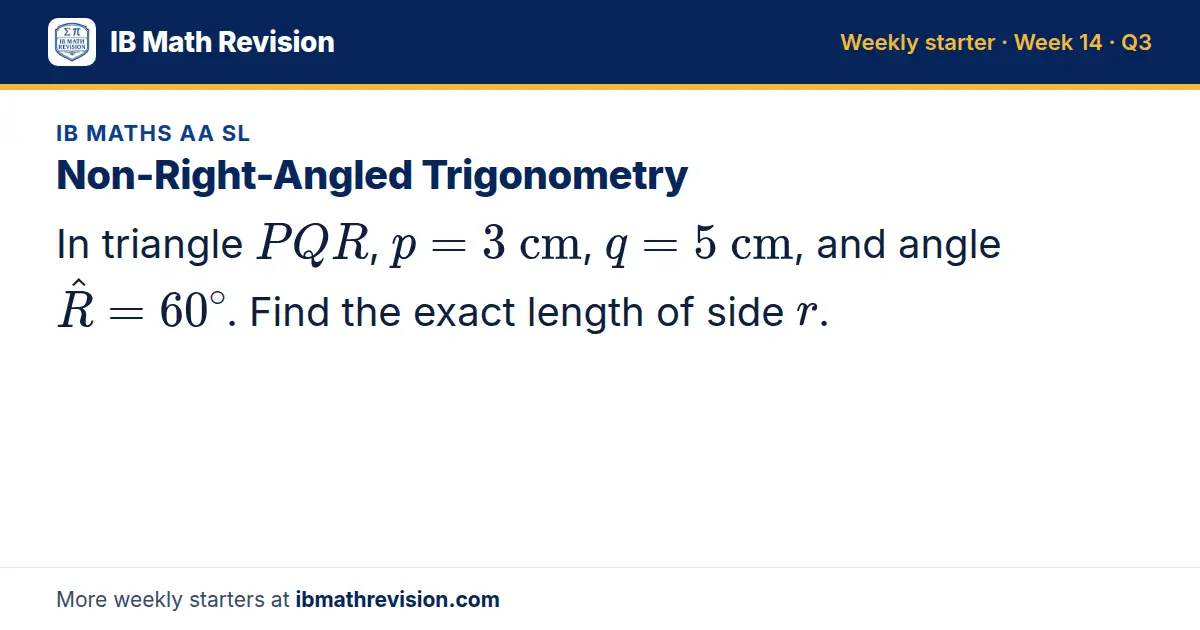
Question 3: Non-Right-Angled Trigonometry
In triangle PQR, p = 3 cm, q = 5 cm, and angle R = 60^∘. Find the exact length of side r.
Week 15
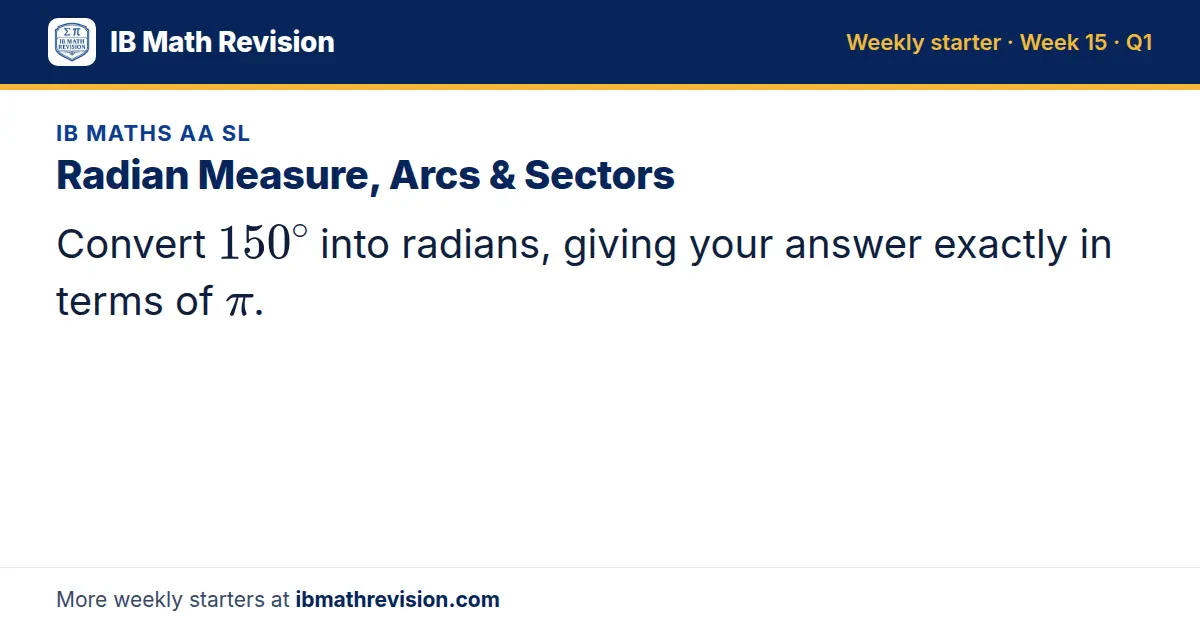
Question 1: Radian Measure, Arcs & Sectors
Convert 150^∘ into radians, giving your answer exactly in terms of π.
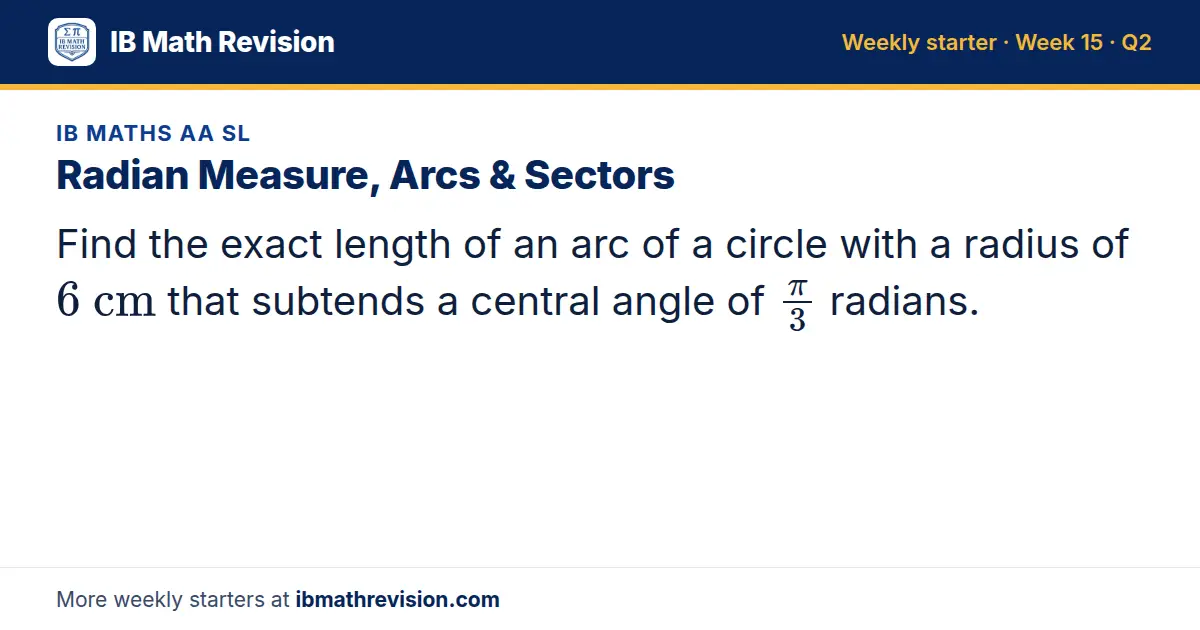
Question 2: Radian Measure, Arcs & Sectors
Find the exact length of an arc of a circle with a radius of 6 cm that subtends a central angle of (π)/3 radians.
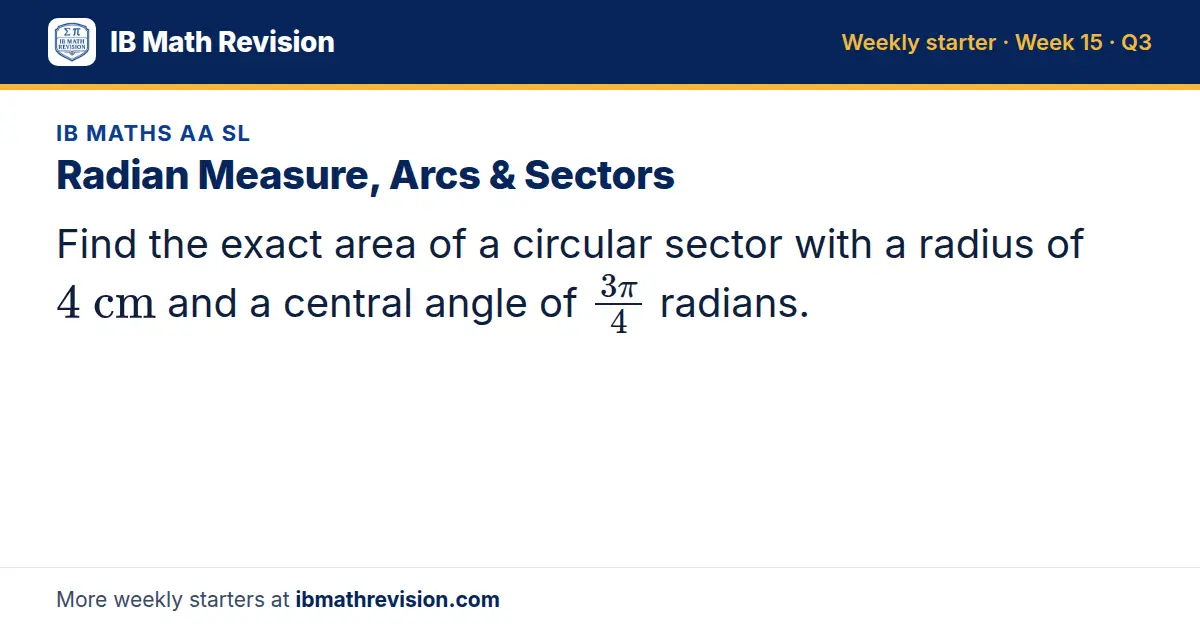
Question 3: Radian Measure, Arcs & Sectors
Find the exact area of a circular sector with a radius of 4 cm and a central angle of (3π)/4 radians.
Week 16
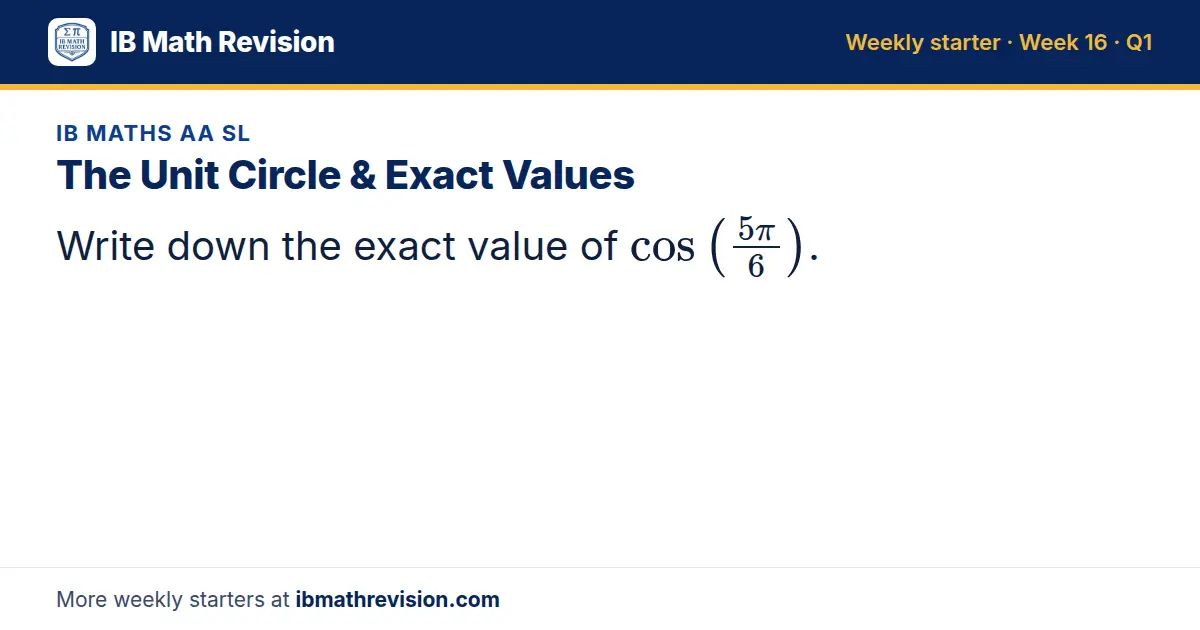
Question 1: The Unit Circle & Exact Values
Write down the exact value of cos((5π)/6).
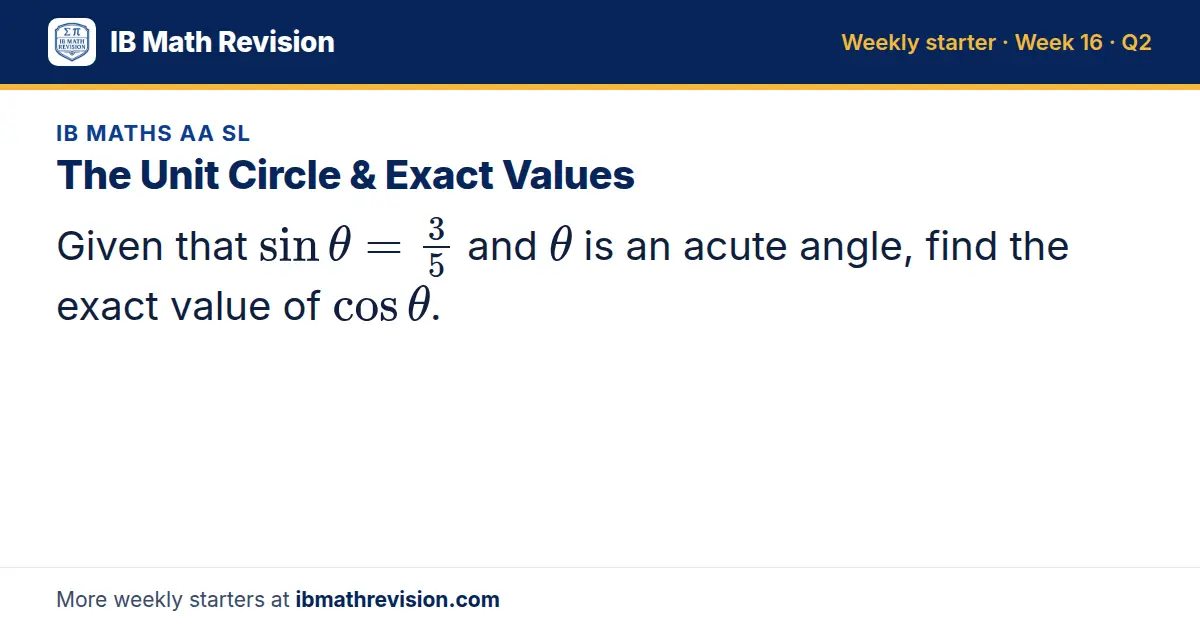
Question 2: The Unit Circle & Exact Values
Given that sin θ = 3/5 and θ is an acute angle, find the exact value of cos θ.
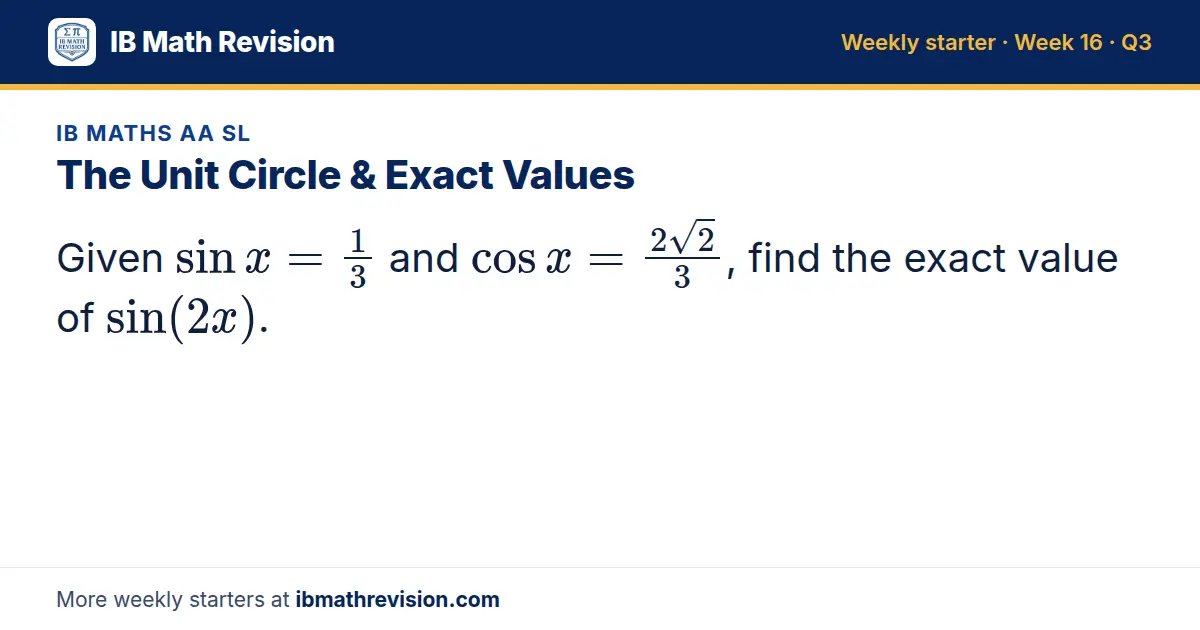
Question 3: The Unit Circle & Exact Values
Given sin x = 1/3 and cos x = (2√2)/3, find the exact value of sin(2x).
Week 17
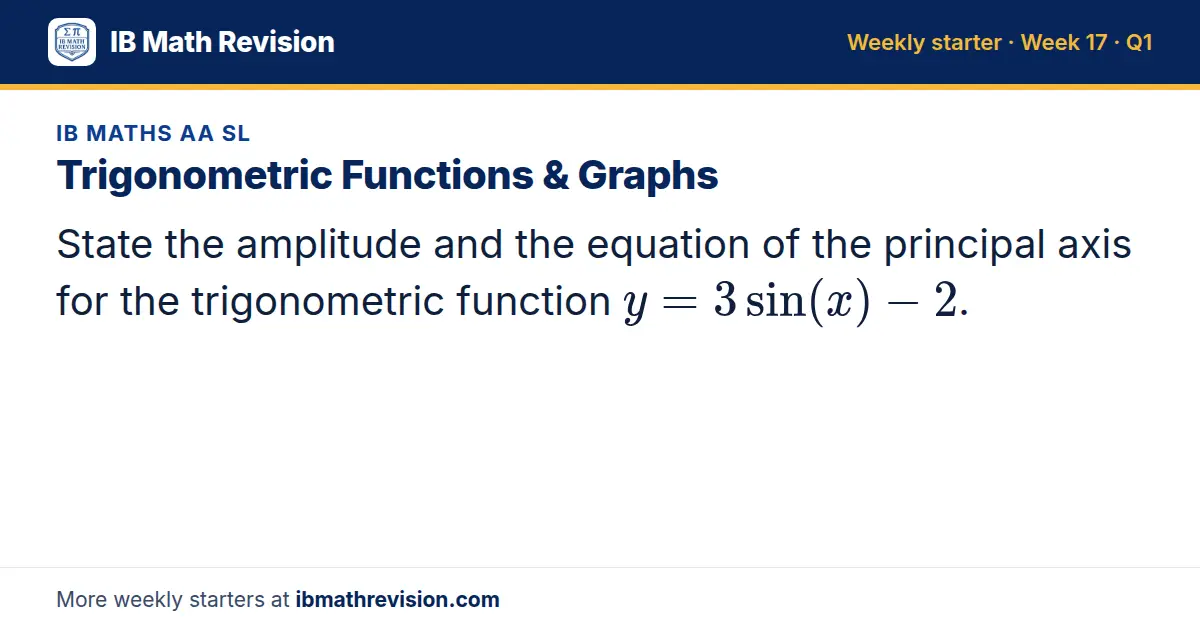
Question 1: Trigonometric Functions & Graphs
State the amplitude and the equation of the principal axis for the trigonometric function y = 3sin(x) - 2.
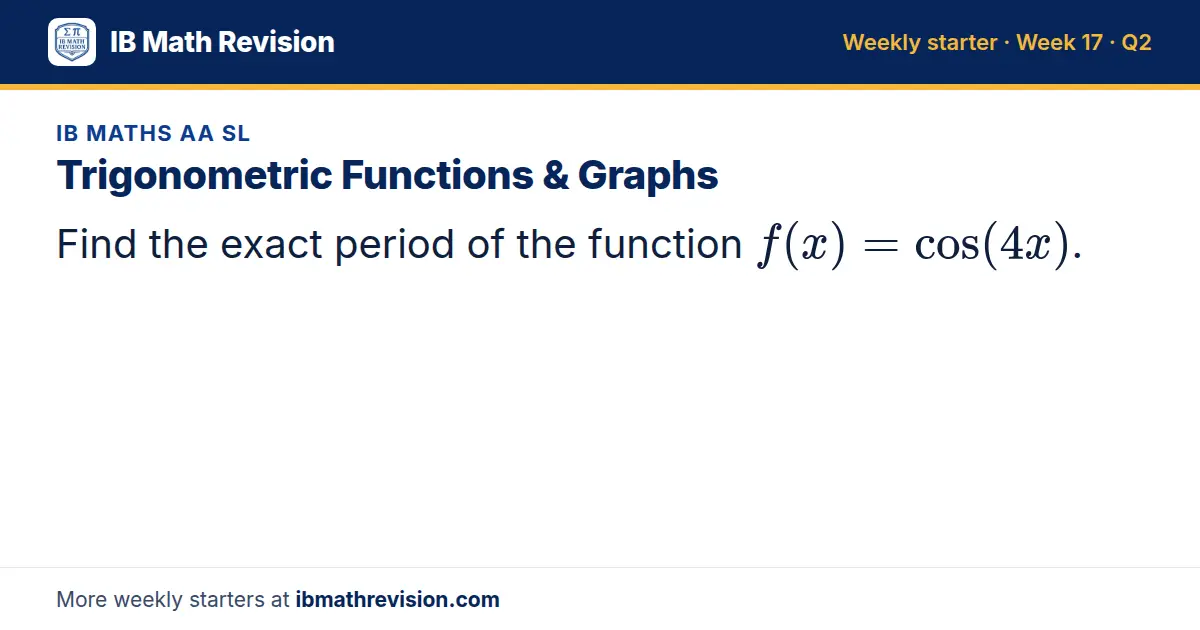
Question 2: Trigonometric Functions & Graphs
Find the exact period of the function f(x) = cos(4x).
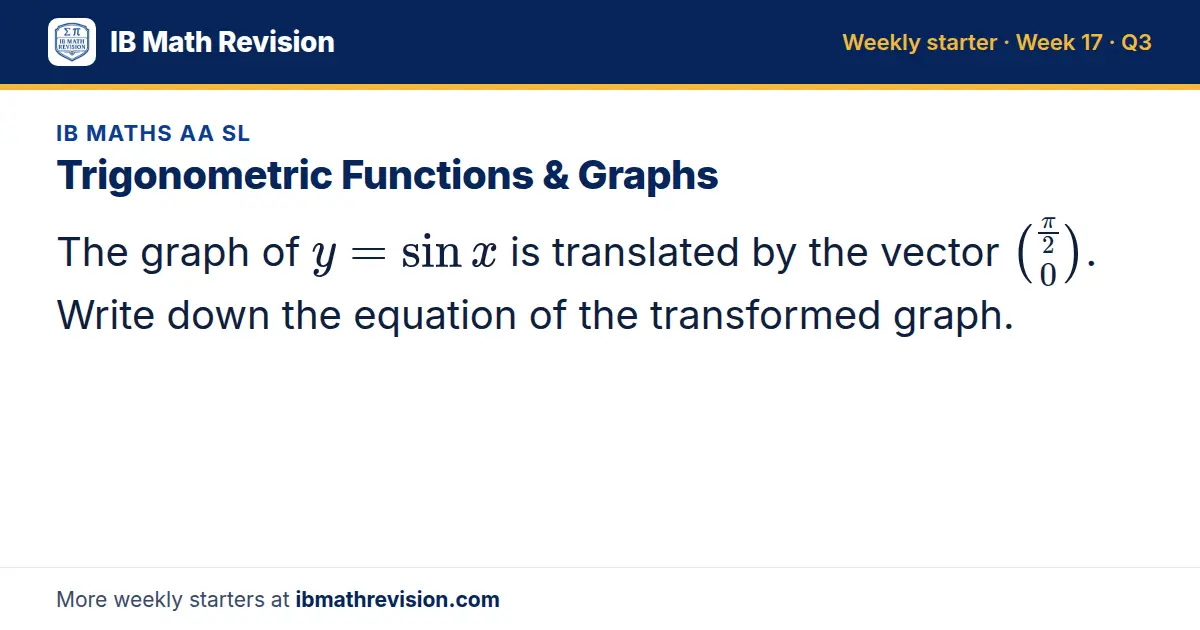
Question 3: Trigonometric Functions & Graphs
The graph of y = sin x is translated by the vector (π)/20. Write down the equation of the transformed graph.
Week 18
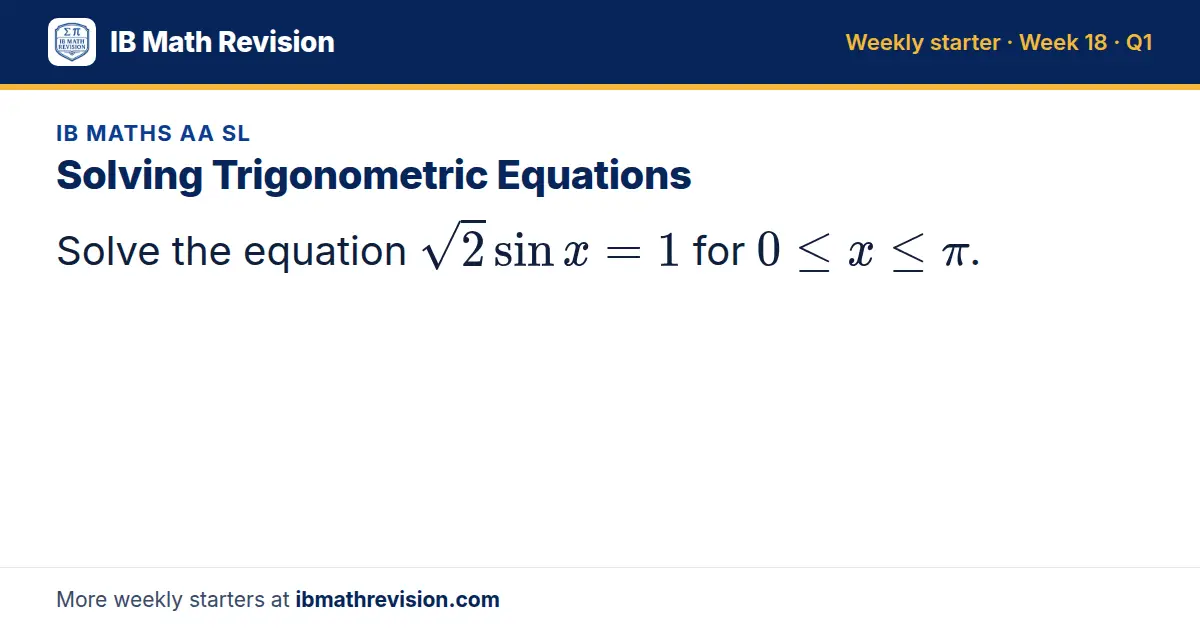
Question 1: Solving Trigonometric Equations
Solve the equation √2sin x = 1 for 0 ≤ x ≤ π.
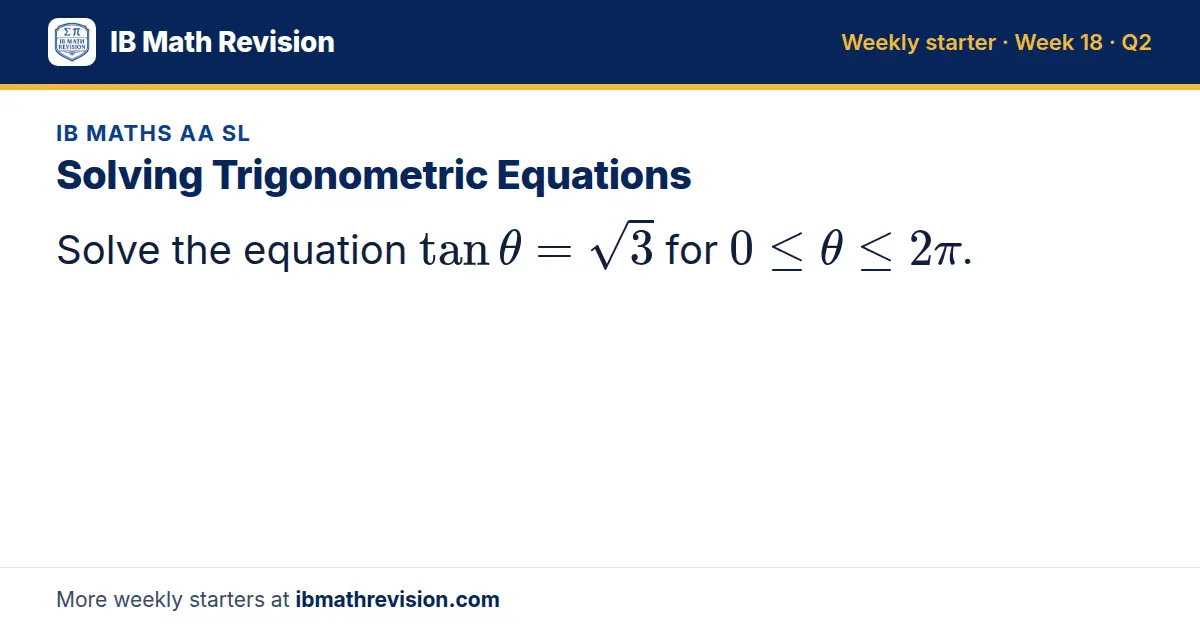
Question 2: Solving Trigonometric Equations
Solve the equation tan θ = √3 for 0 ≤ θ ≤ 2π.
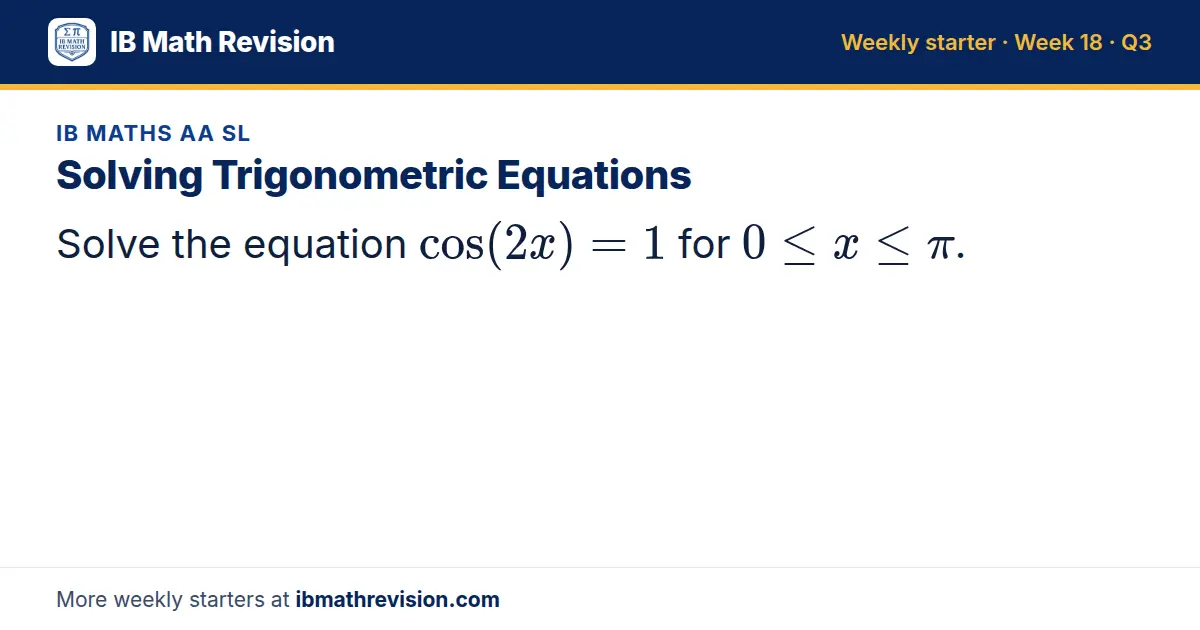
Question 3: Solving Trigonometric Equations
Solve the equation cos(2x) = 1 for 0 ≤ x ≤ π.
Week 19
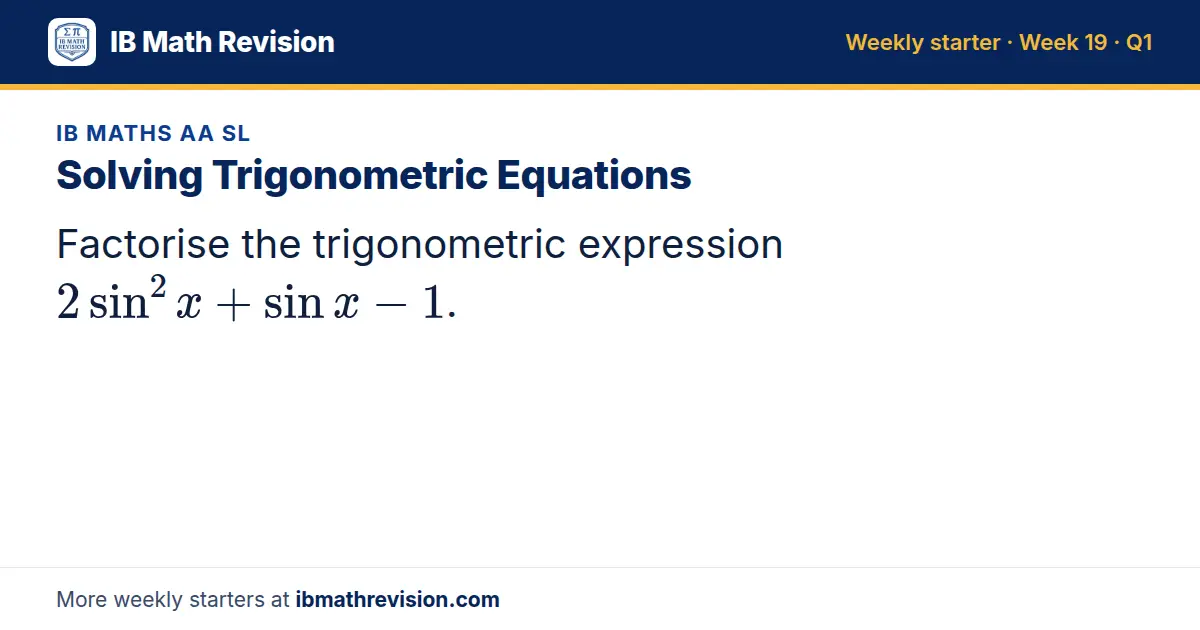
Question 1: Solving Trigonometric Equations
Factorise the trigonometric expression 2sin² x + sin x - 1.
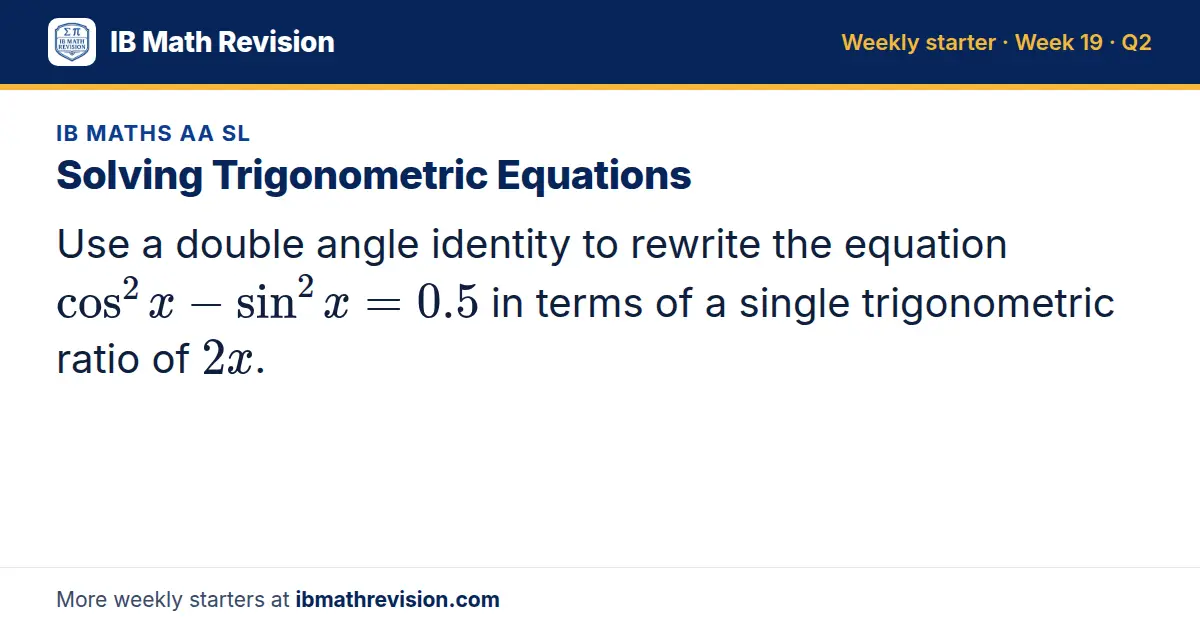
Question 2: Solving Trigonometric Equations
Use a double angle identity to rewrite the equation cos² x - sin² x = 0.5 in terms of a single trigonometric ratio of 2x.
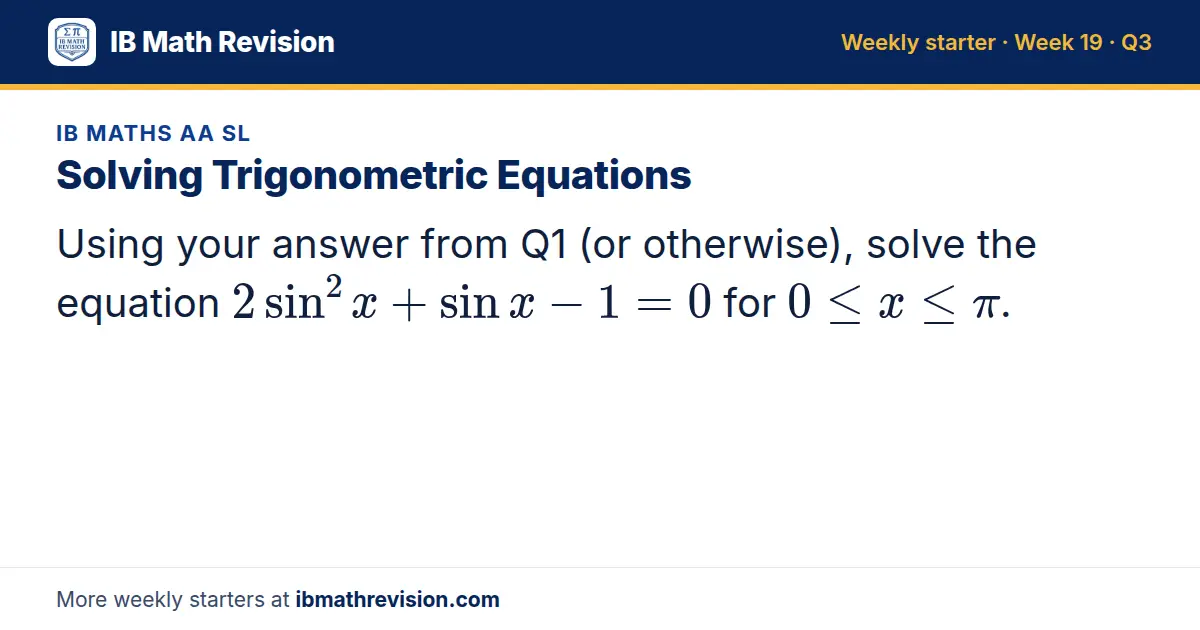
Question 3: Solving Trigonometric Equations
Using your answer from Q1 (or otherwise), solve the equation 2sin² x + sin x - 1 = 0 for 0 ≤ x ≤ π.
Week 20
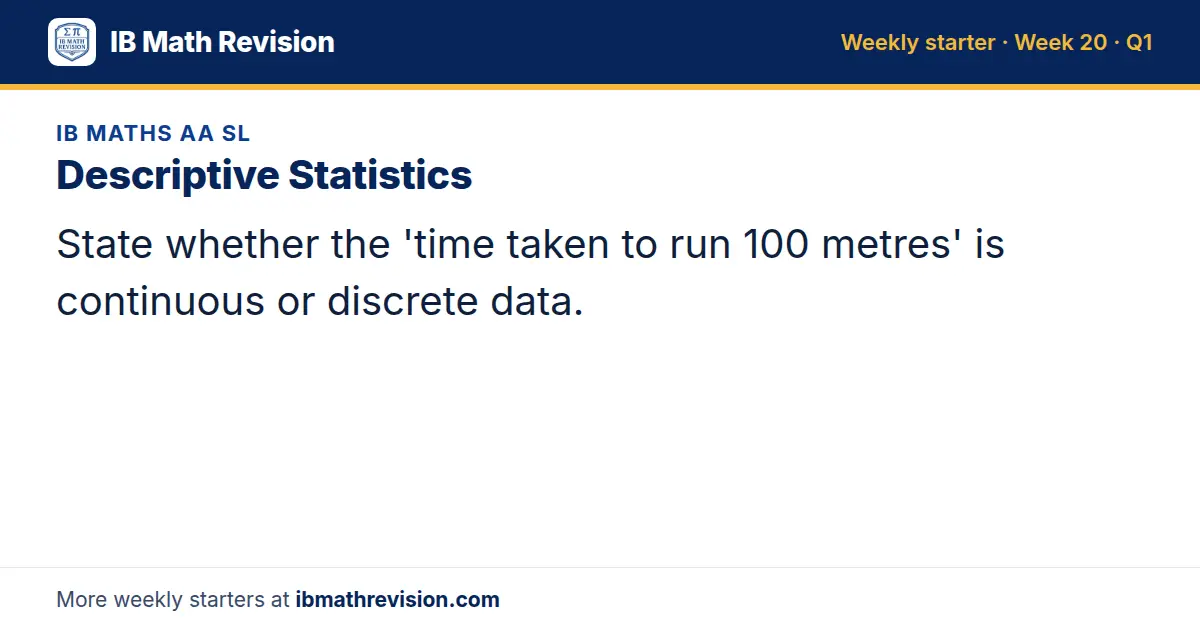
Question 1: Descriptive Statistics
State whether the 'time taken to run 100 metres' is continuous or discrete data.
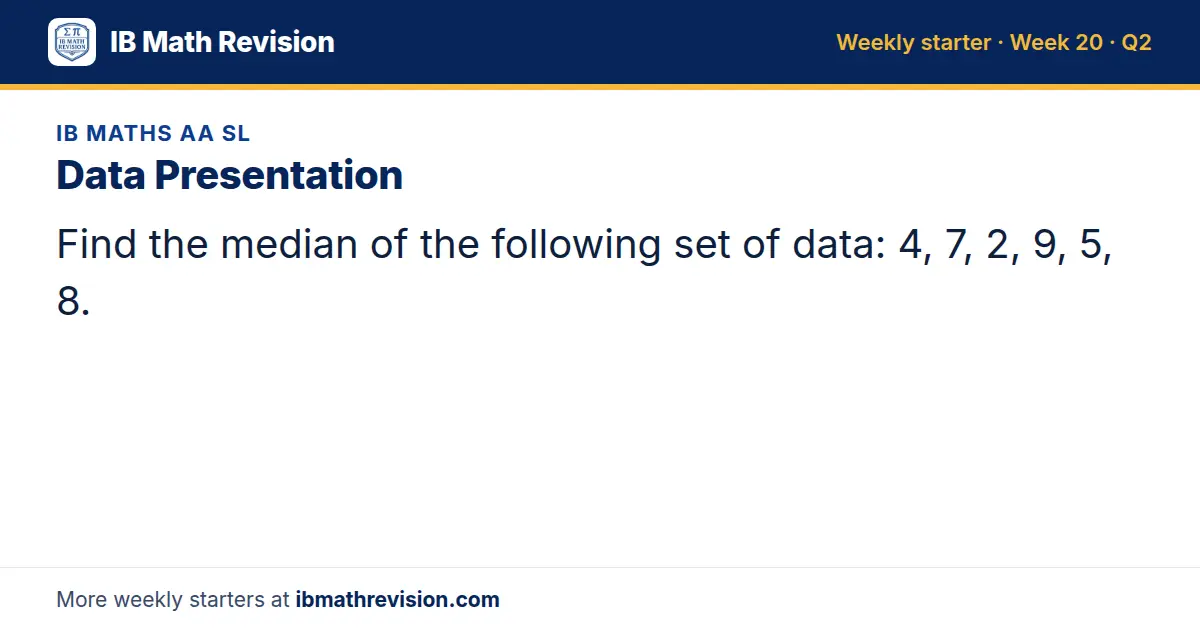
Question 2: Data Presentation
Find the median of the following set of data: 4, 7, 2, 9, 5, 8.
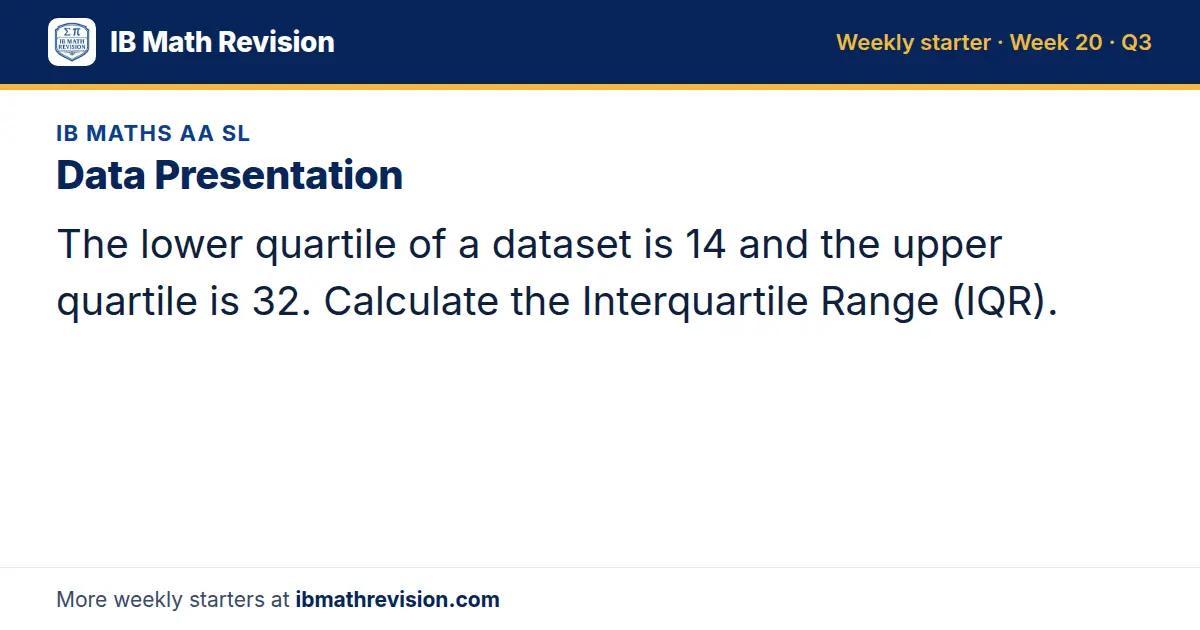
Question 3: Data Presentation
The lower quartile of a dataset is 14 and the upper quartile is 32. Calculate the Interquartile Range (IQR).
Week 21
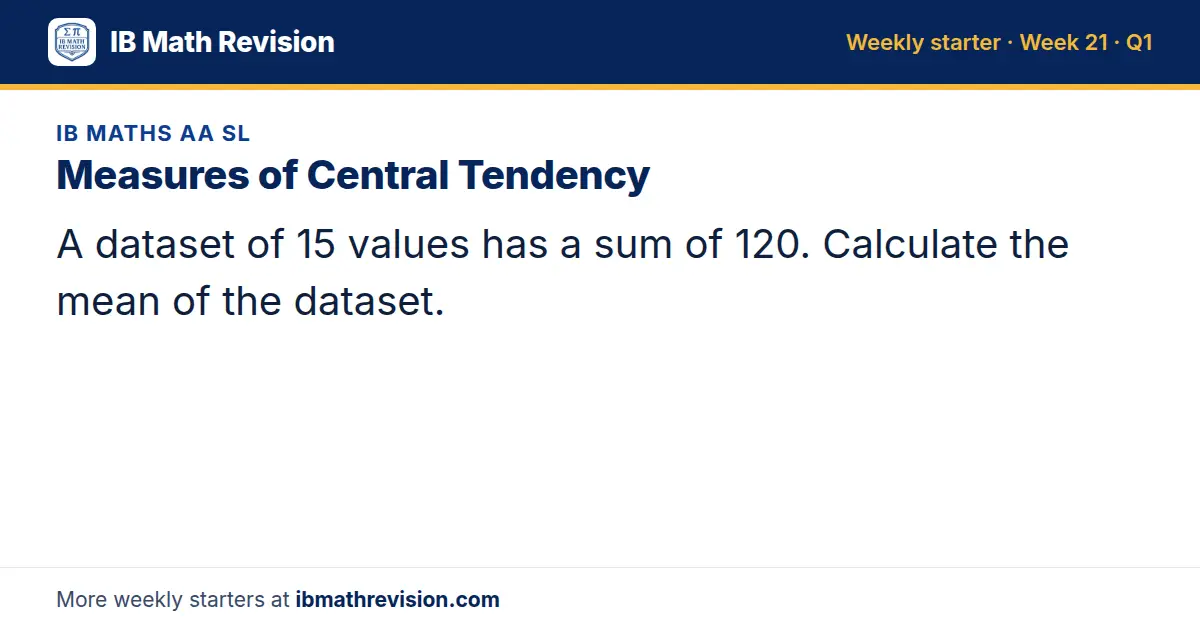
Question 1: Measures of Central Tendency
A dataset of 15 values has a sum of 120. Calculate the mean of the dataset.
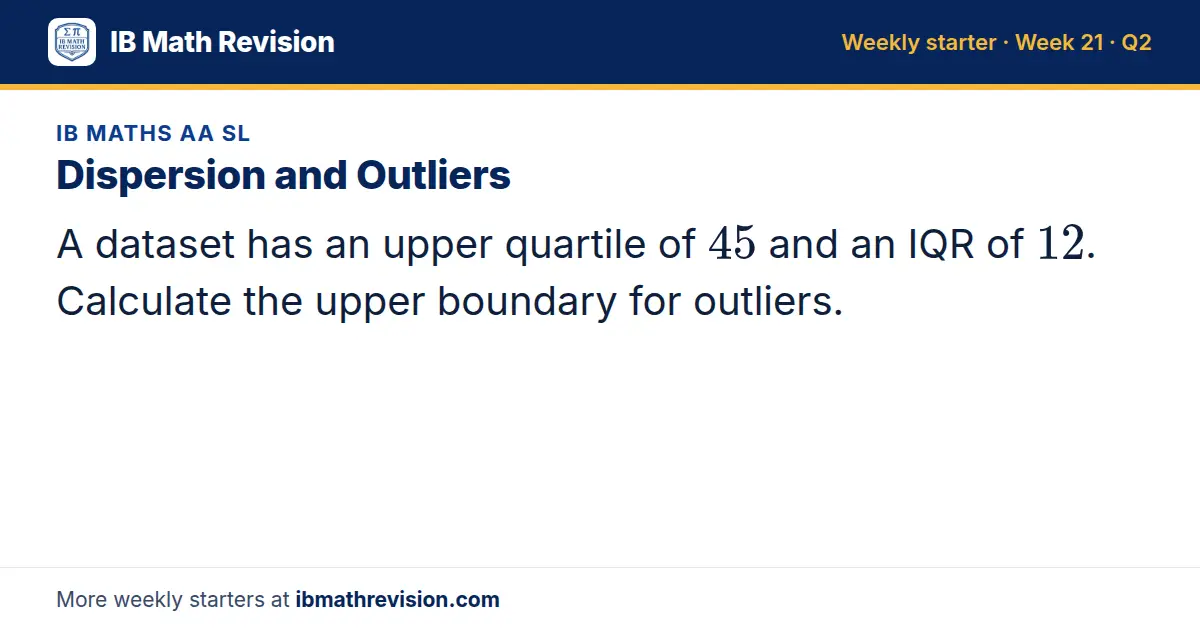
Question 2: Dispersion and Outliers
A dataset has an upper quartile of 45 and an IQR of 12. Calculate the upper boundary for outliers.
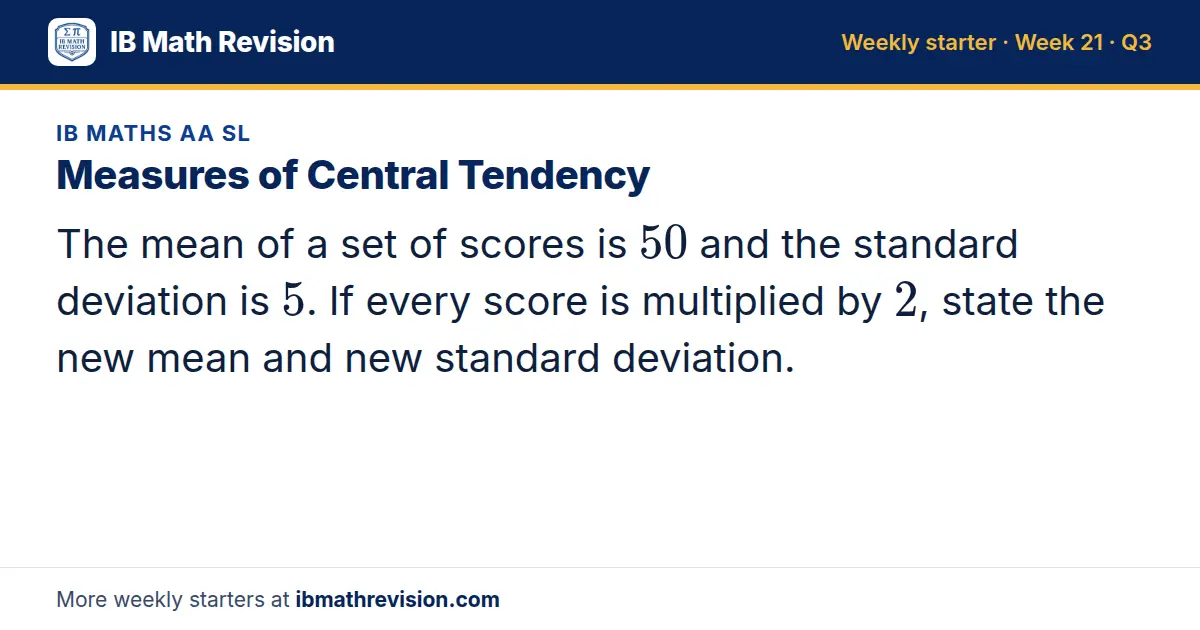
Question 3: Measures of Central Tendency
The mean of a set of scores is 50 and the standard deviation is 5. If every score is multiplied by 2, state the new mean and new standard deviation.
Week 22
Question 1: Bivariate Data
The Pearson's product-moment correlation coefficient for a bivariate dataset is r = -0.92. Describe the linear correlation between the two variables.
Question 2: Linear Regression
The regression line of y on x always passes through a specific coordinate related to the dataset. State the coordinates of this point.
Question 3: Linear Regression
Explain briefly why it might be unreliable to use a linear regression line to predict a y-value for an x-value that lies far outside the range of the original data.
Week 23
Question 1: Probability Foundations
Events A and B are mutually exclusive. Given P(A) = 0.3 and P(B) = 0.4, find P(A ∪ B).
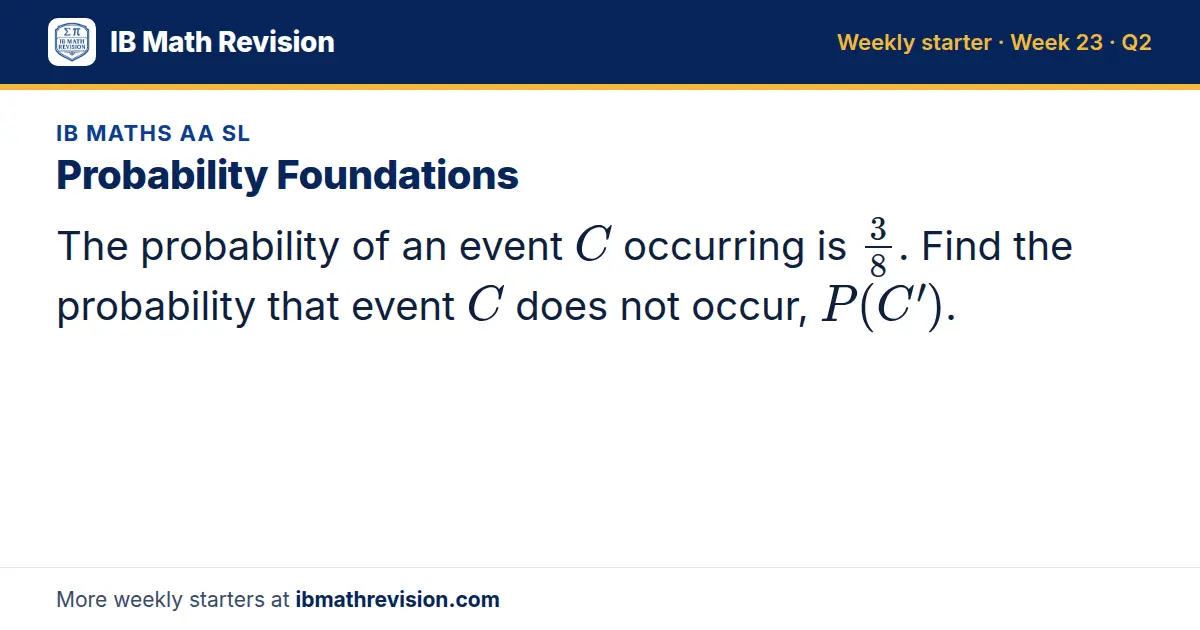
Question 2: Probability Foundations
The probability of an event C occurring is 3/8. Find the probability that event C does not occur, P(C').
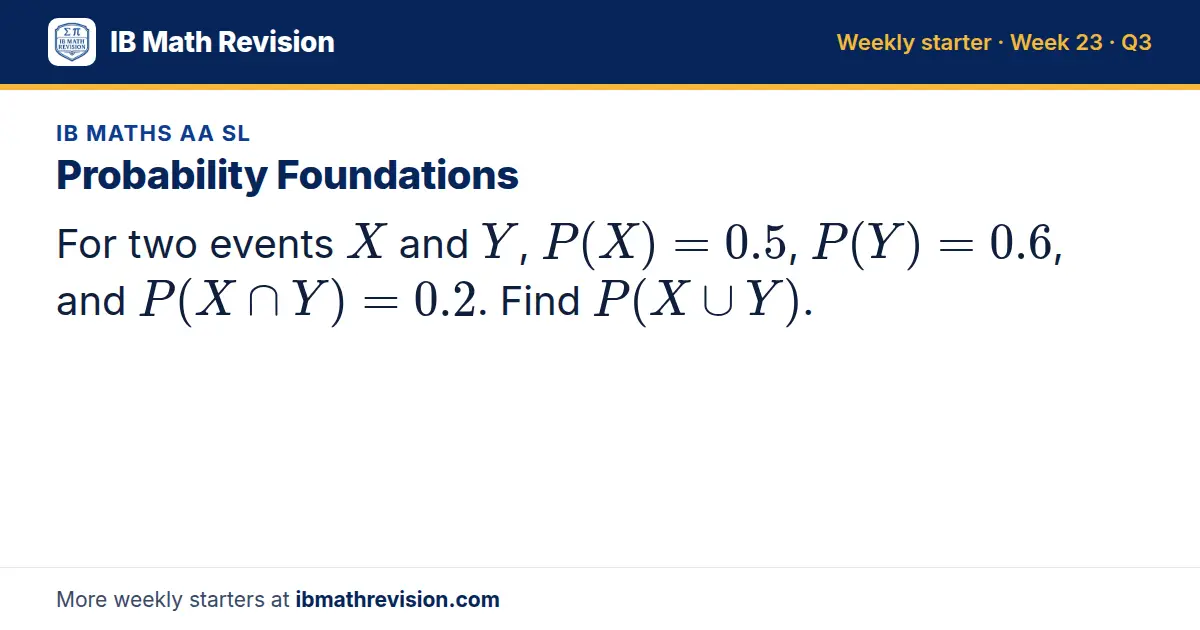
Question 3: Probability Foundations
For two events X and Y, P(X) = 0.5, P(Y) = 0.6, and P(X ∩ Y) = 0.2. Find P(X ∪ Y).
Week 24
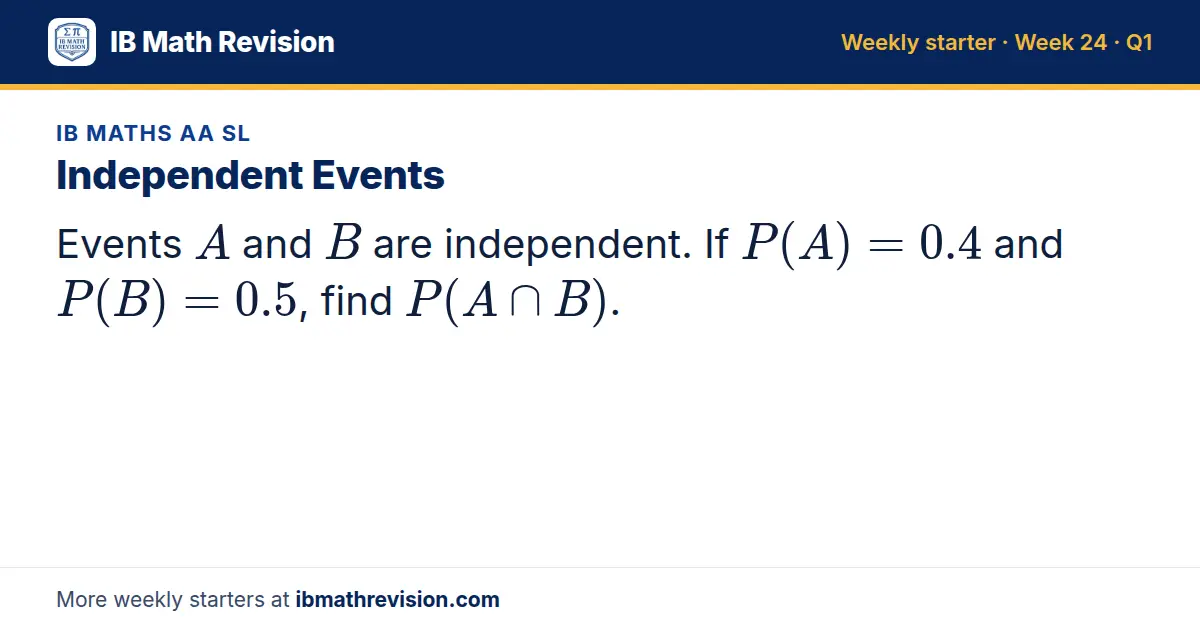
Question 1: Independent Events
Events A and B are independent. If P(A) = 0.4 and P(B) = 0.5, find P(A ∩ B).
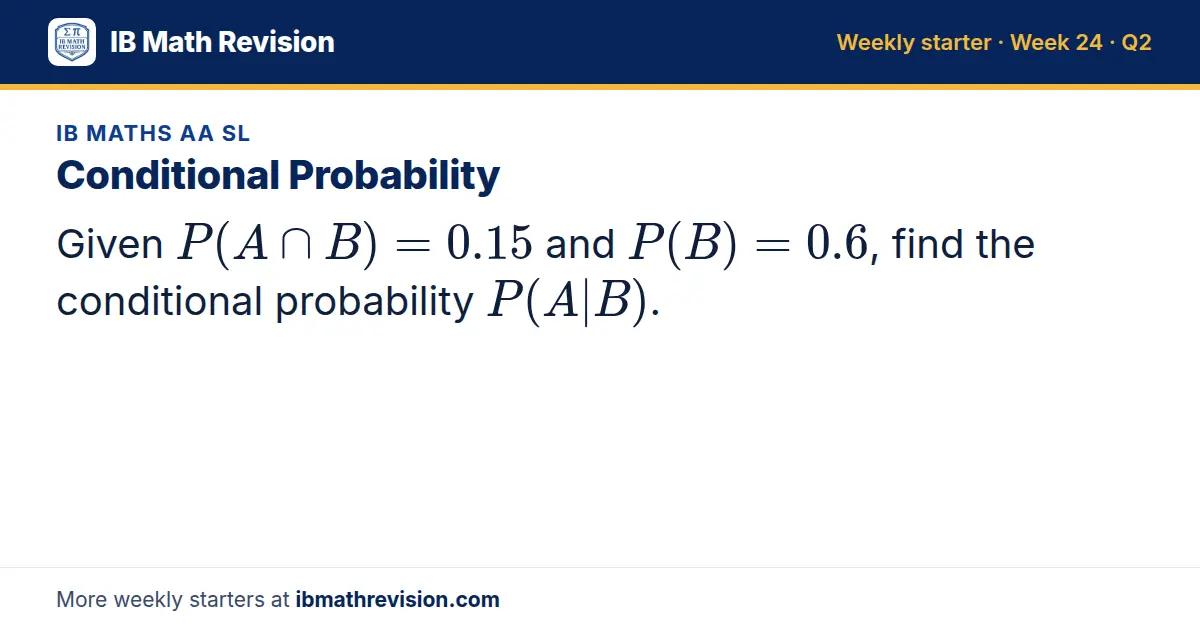
Question 2: Conditional Probability
Given P(A ∩ B) = 0.15 and P(B) = 0.6, find the conditional probability P(A|B).
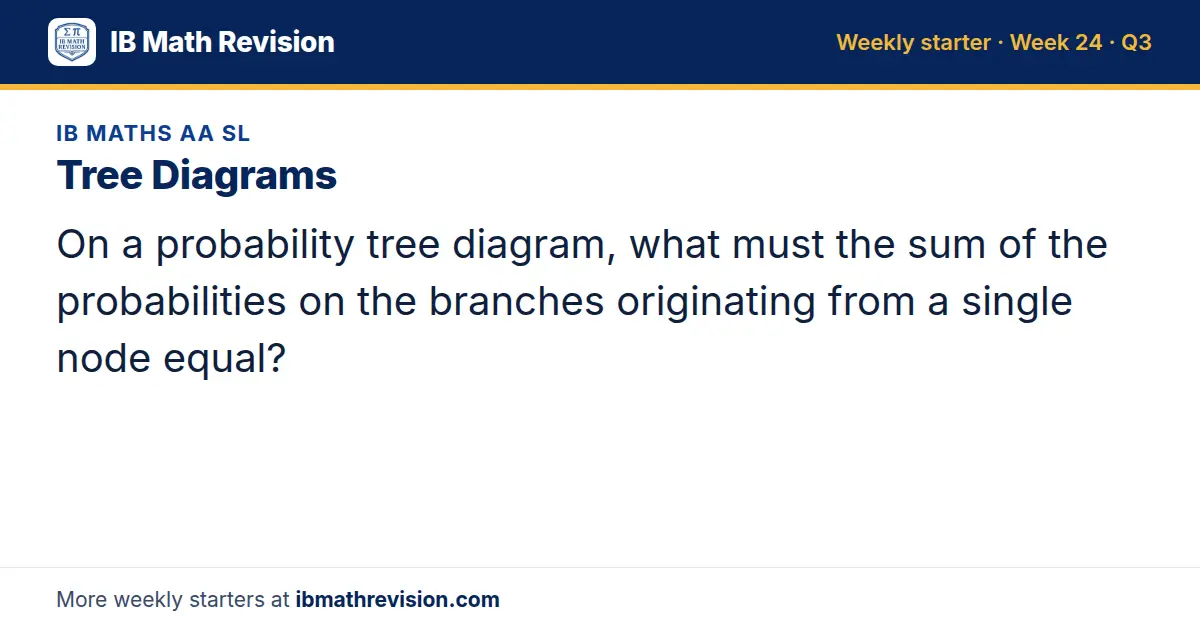
Question 3: Tree Diagrams
On a probability tree diagram, what must the sum of the probabilities on the branches originating from a single node equal?
Week 25
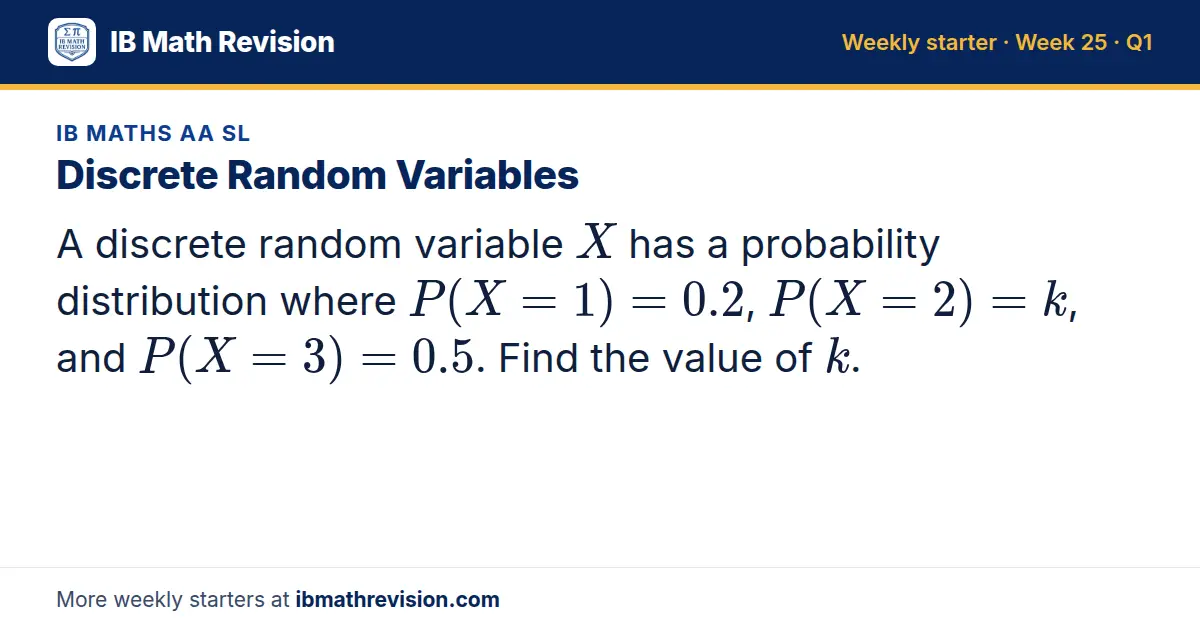
Question 1: Discrete Random Variables
A discrete random variable X has a probability distribution where P(X=1) = 0.2, P(X=2) = k, and P(X=3) = 0.5. Find the value of k.
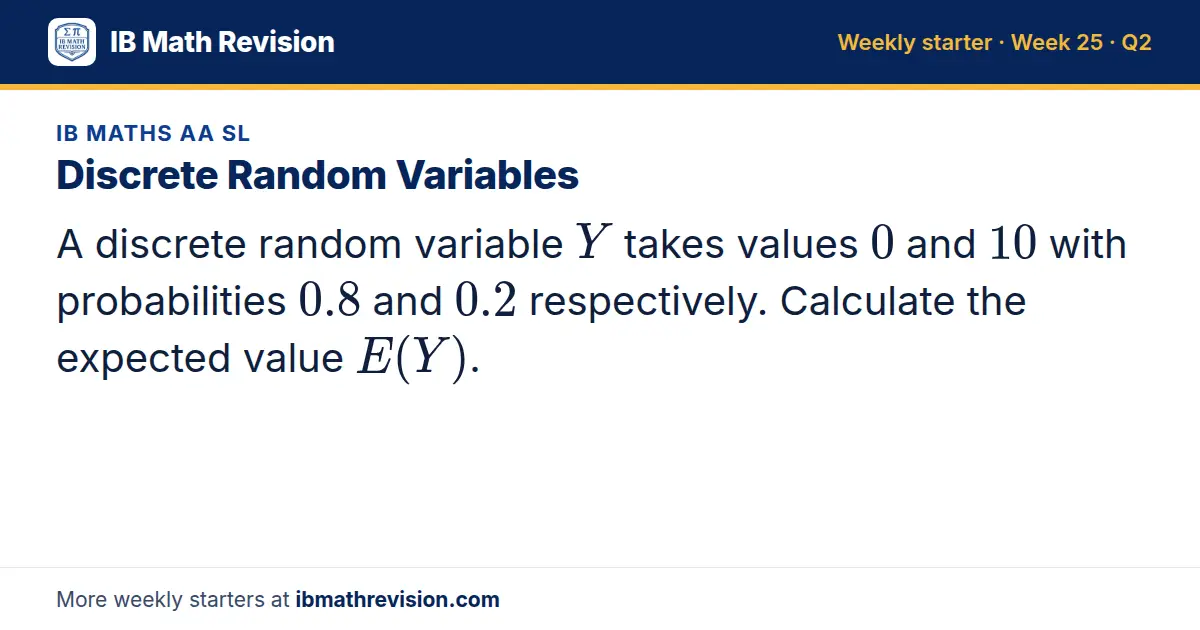
Question 2: Discrete Random Variables
A discrete random variable Y takes values 0 and 10 with probabilities 0.8 and 0.2 respectively. Calculate the expected value E(Y).
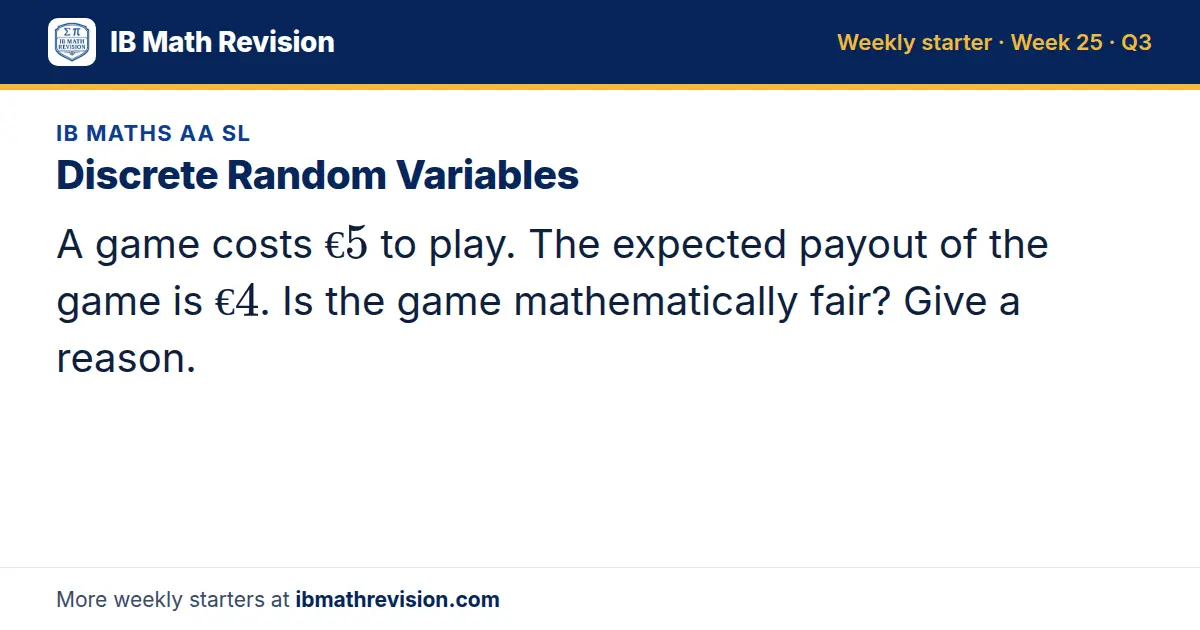
Question 3: Discrete Random Variables
A game costs €5 to play. The expected payout of the game is €4. Is the game mathematically fair? Give a reason.
Week 26
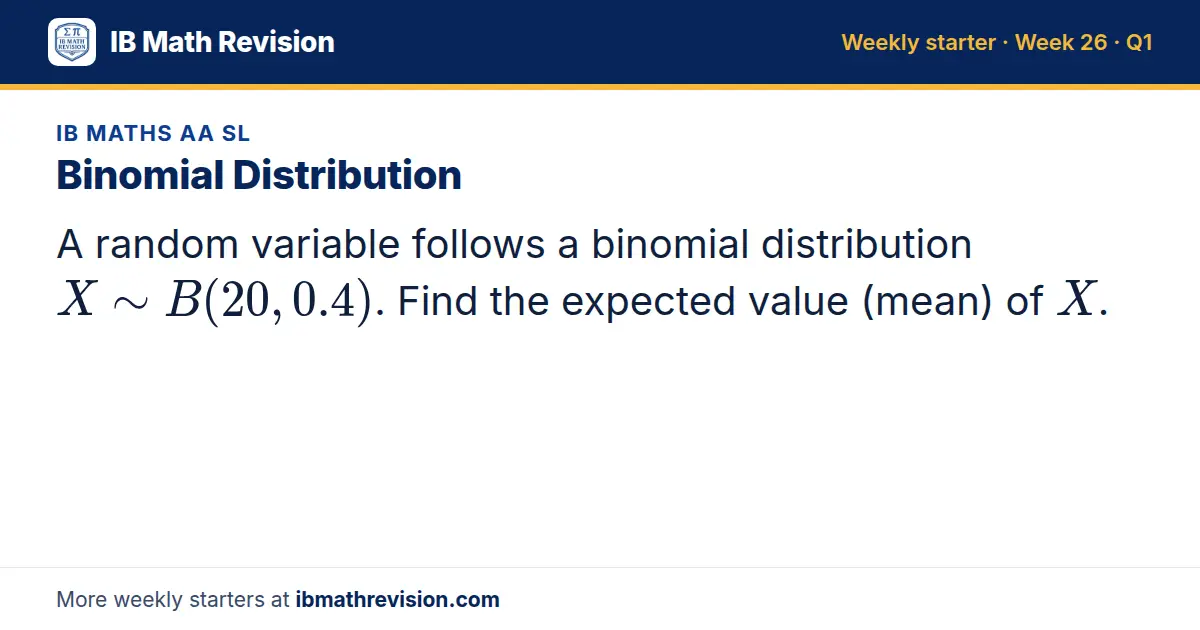
Question 1: Binomial Distribution
A random variable follows a binomial distribution X B(20, 0.4). Find the expected value (mean) of X.
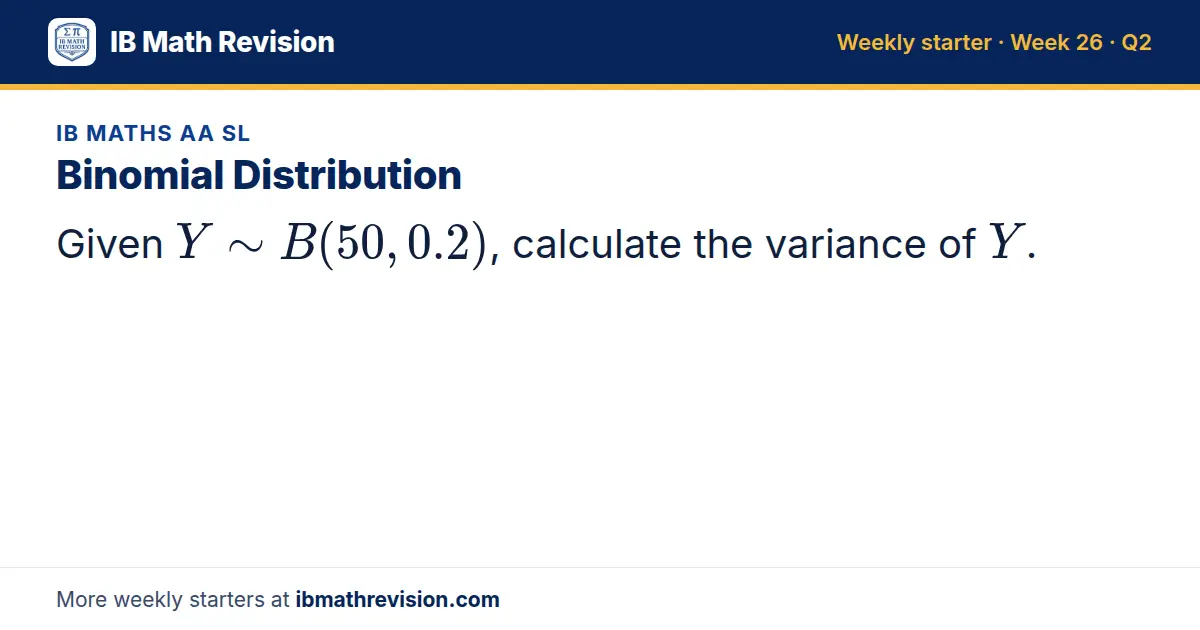
Question 2: Binomial Distribution
Given Y B(50, 0.2), calculate the variance of Y.
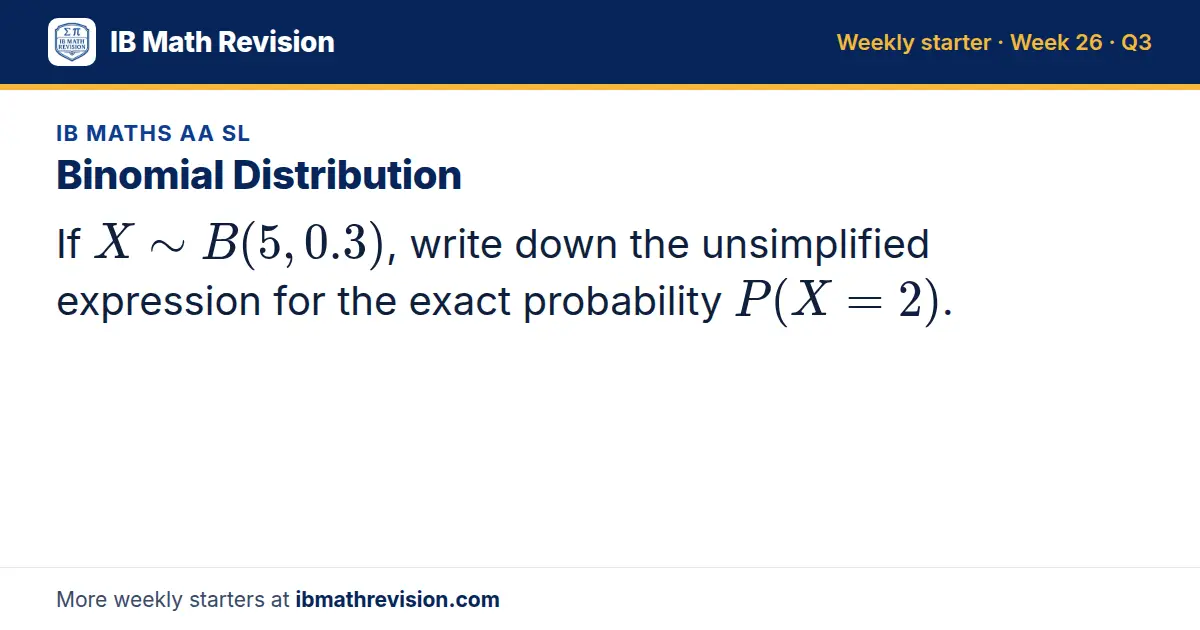
Question 3: Binomial Distribution
If X B(5, 0.3), write down the unsimplified expression for the exact probability P(X=2).
More starter questions
Other weeks: Weeks 1–13 · Weeks 14–26 · Weeks 27–40. Answers and mark schemes are in the starter tasks for teachers.