IB Maths AI HL starter questions: weeks 14–26
39 short questions to open a lesson for IB Maths Applications and Interpretation HL, weeks 14–26 of the teaching year, three or four a week. Each question is shown as an image with its text underneath; answers and mark schemes stay with teachers.
Week 14
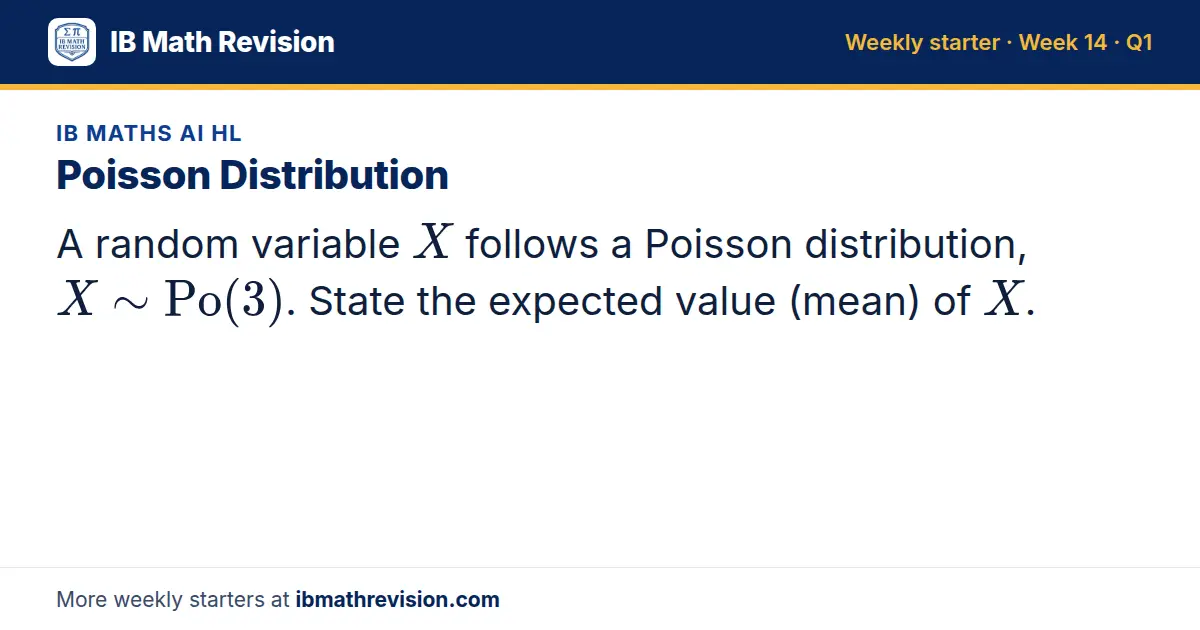
Question 1: Poisson Distribution
A random variable X follows a Poisson distribution, X Po(3). State the expected value (mean) of X.
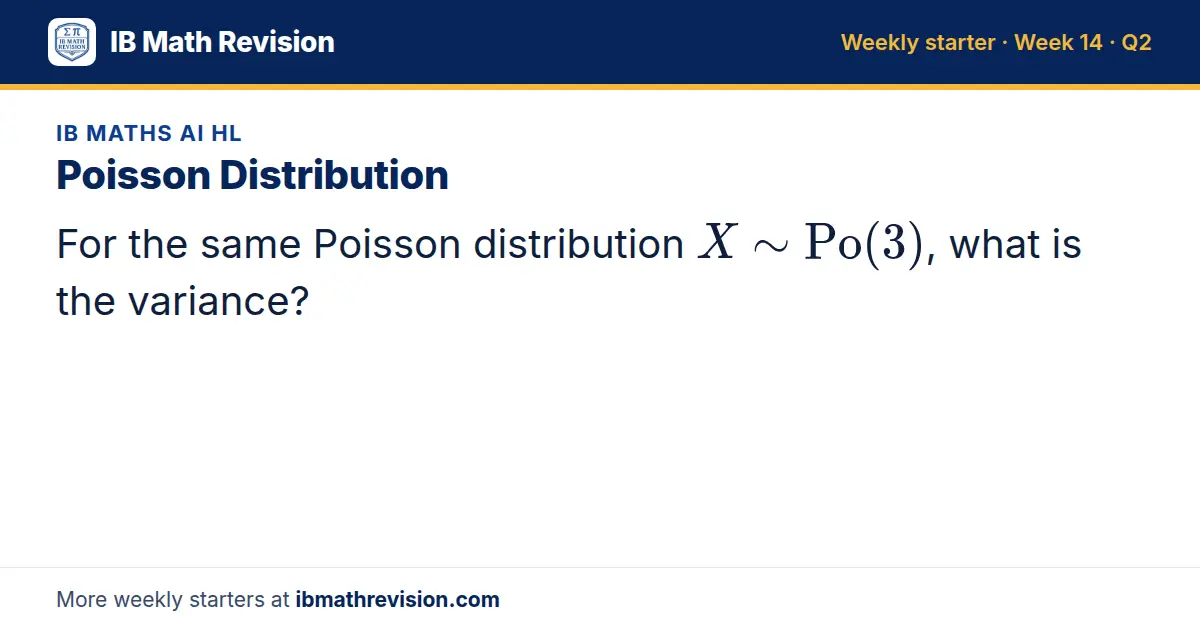
Question 2: Poisson Distribution
For the same Poisson distribution X Po(3), what is the variance?
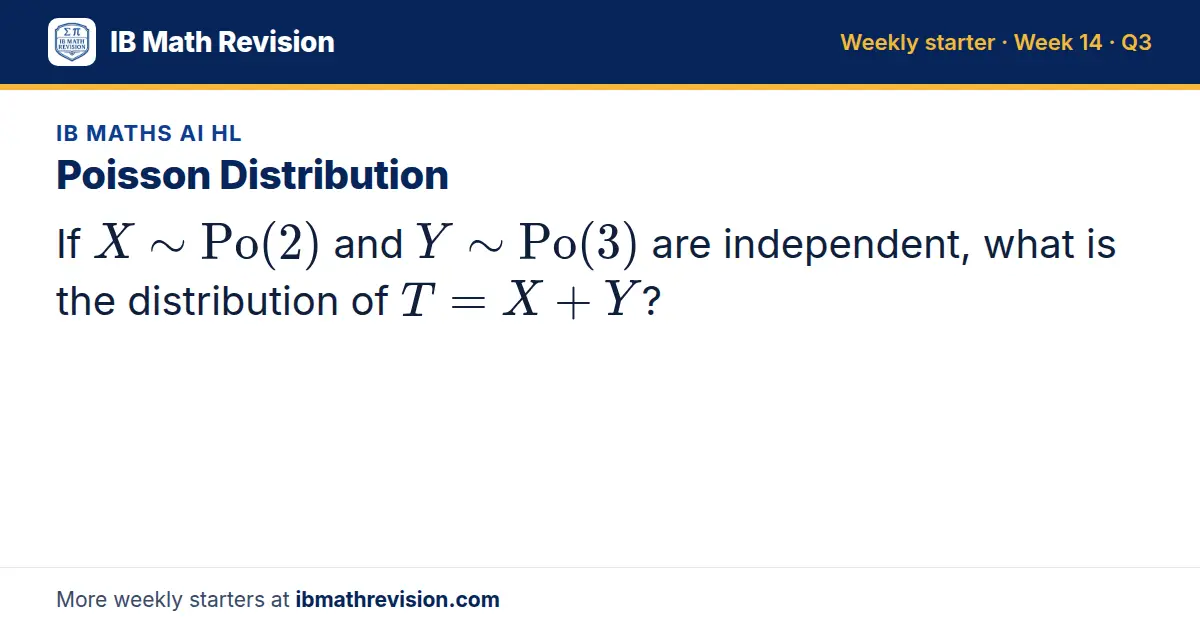
Question 3: Poisson Distribution
If X Po(2) and Y Po(3) are independent, what is the distribution of T = X+Y?
Week 15
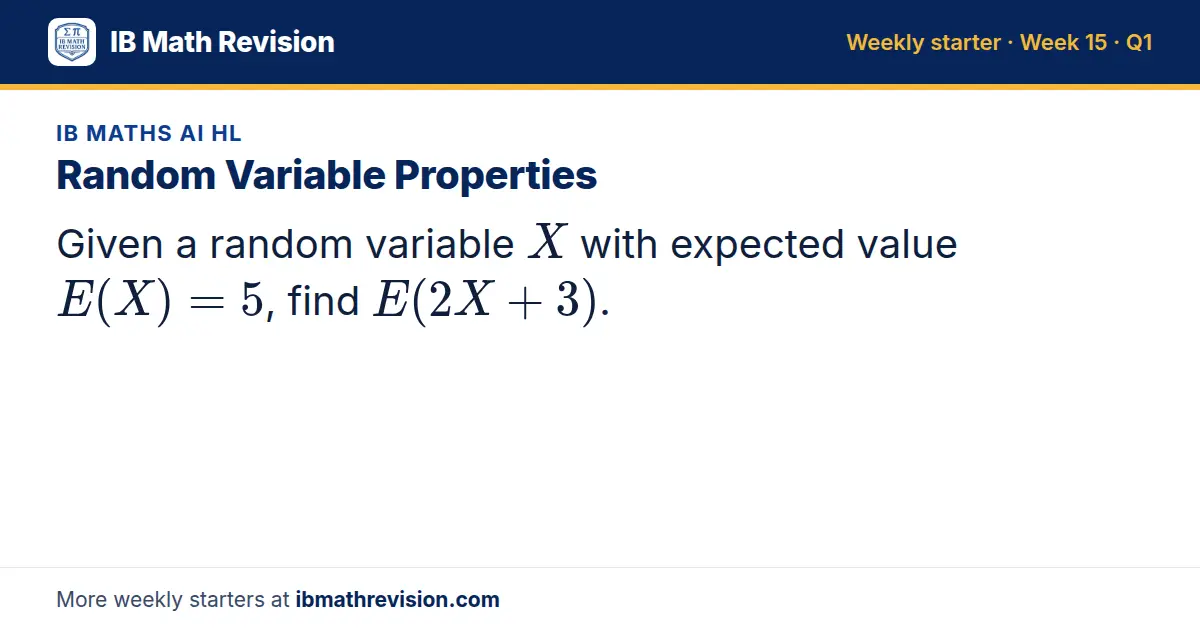
Question 1: Random Variable Properties
Given a random variable X with expected value E(X) = 5, find E(2X + 3).
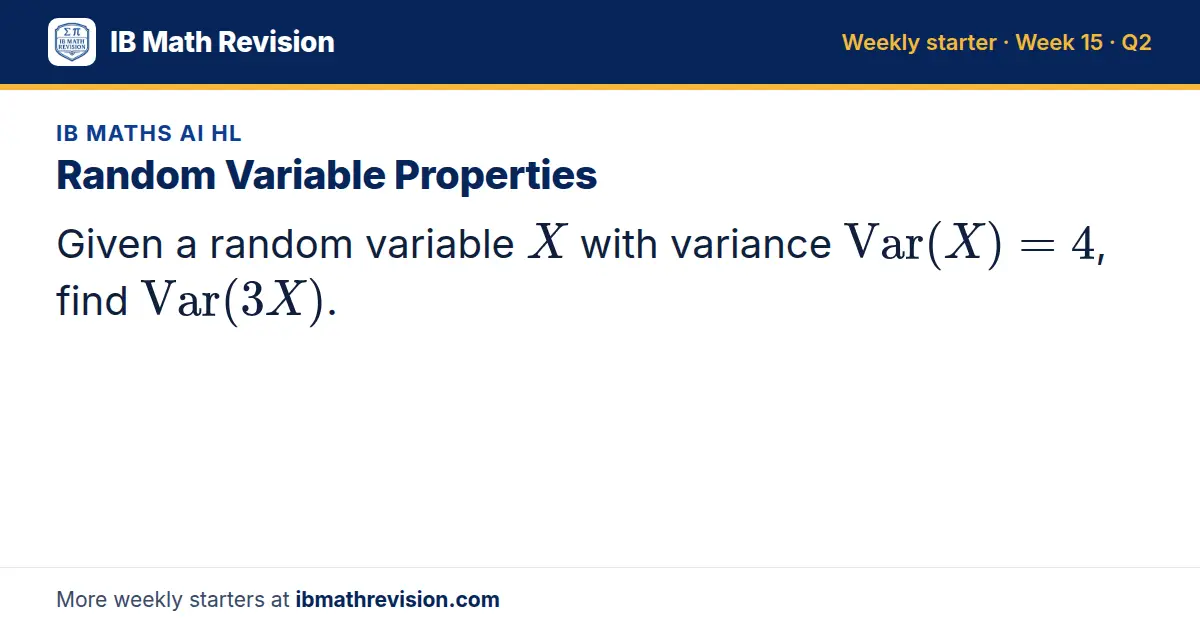
Question 2: Random Variable Properties
Given a random variable X with variance Var(X) = 4, find Var(3X).
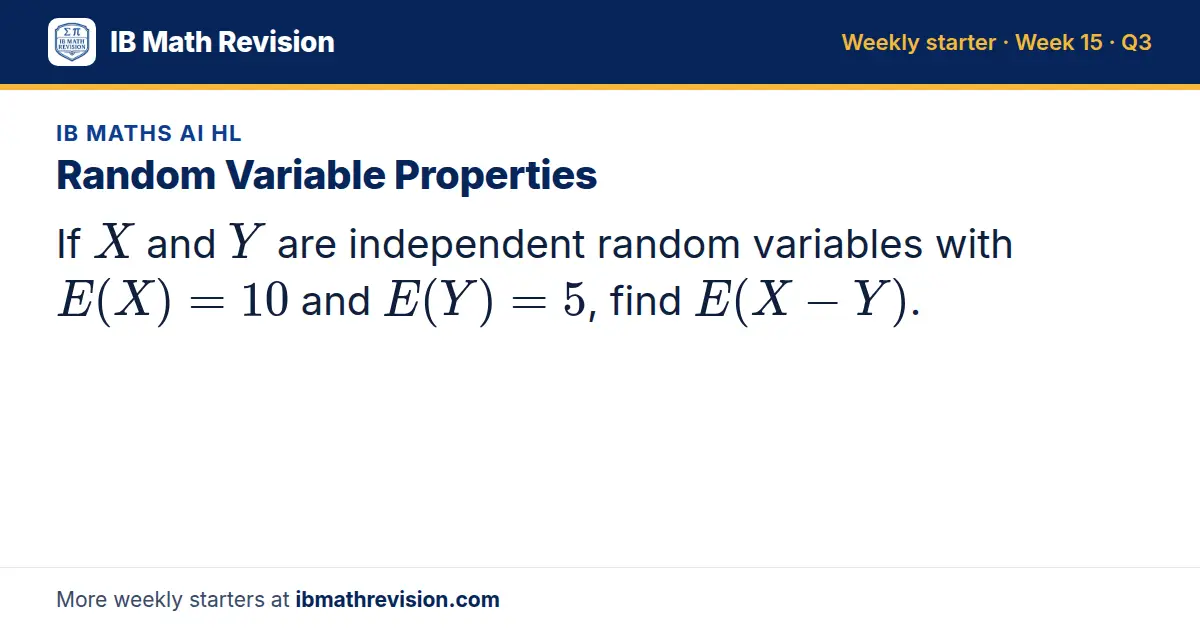
Question 3: Random Variable Properties
If X and Y are independent random variables with E(X)=10 and E(Y)=5, find E(X-Y).
Week 16
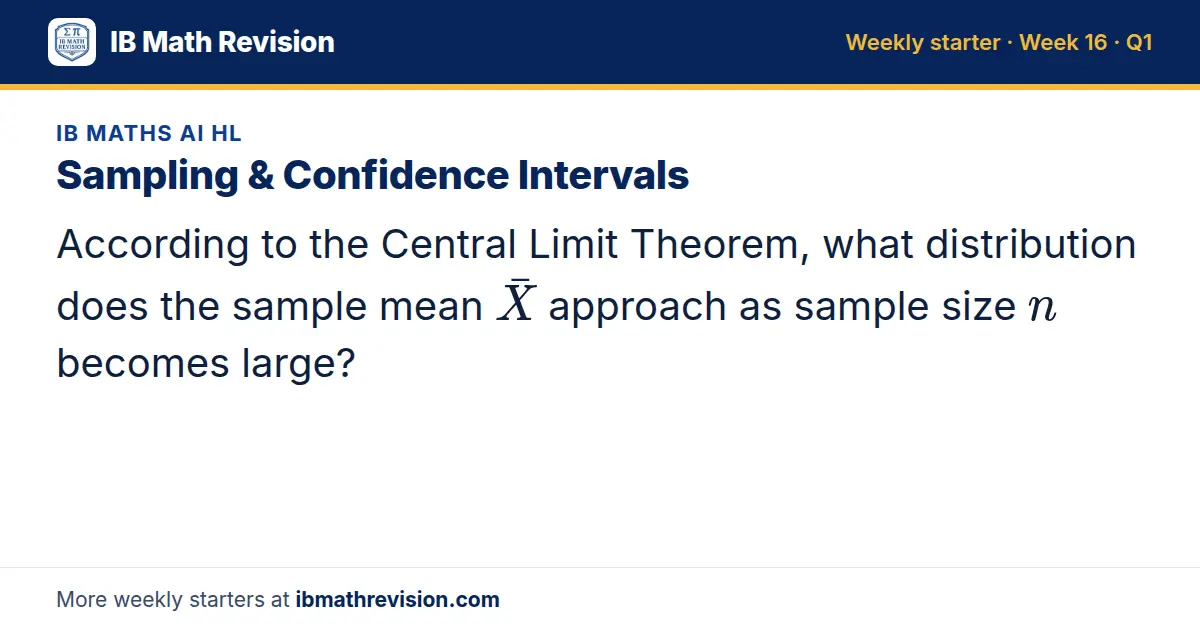
Question 1: Sampling & Confidence Intervals
According to the Central Limit Theorem, what distribution does the sample mean X approach as sample size n becomes large?
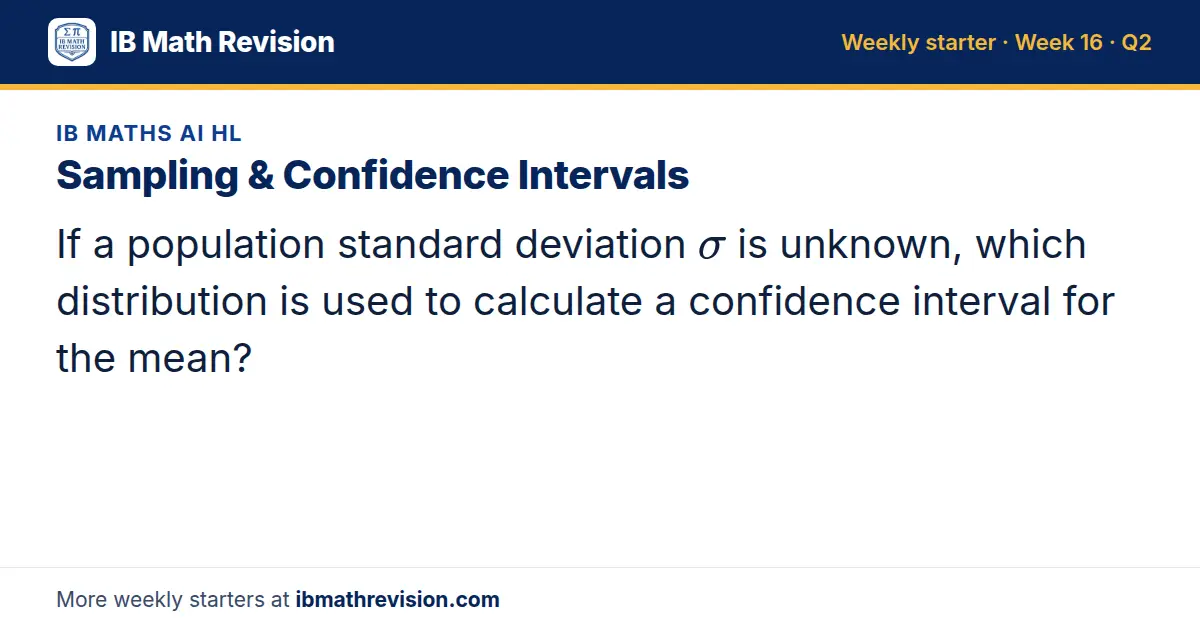
Question 2: Sampling & Confidence Intervals
If a population standard deviation σ is unknown, which distribution is used to calculate a confidence interval for the mean?
Question 3: Sampling & Confidence Intervals
If you increase a confidence level from 90% to 95%, will the confidence interval become wider or narrower?
Week 17
Question 1: Markov Chains
In a transition matrix T representing a Markov chain, what must the sum of probabilities in each column be?
Question 2: Markov Chains
Given a transition matrix T and an initial state matrix s_0, write the expression for the state matrix s_2 after two transitions.

Question 3: Markov Chains
For a regular Markov chain, a steady-state matrix s satisfies what matrix equation involving T?
Week 18
Question 1: Differentiation Rules
Find the derivative of y = sin(3x) with respect to x.
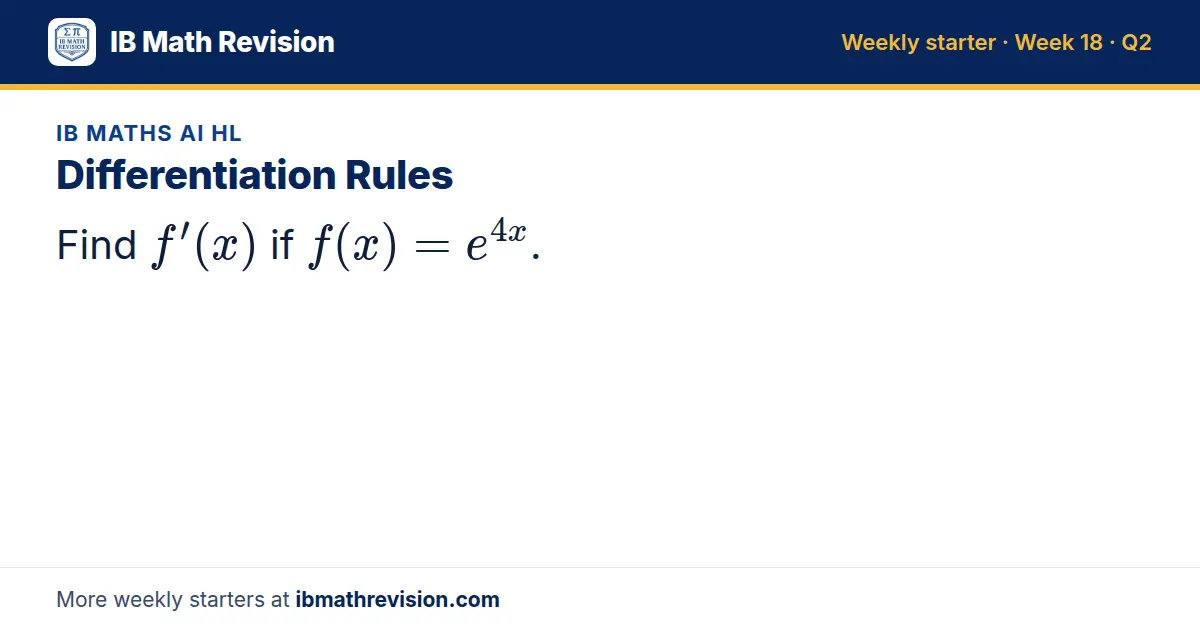
Question 2: Differentiation Rules
Find f'(x) if f(x) = e^(4x).
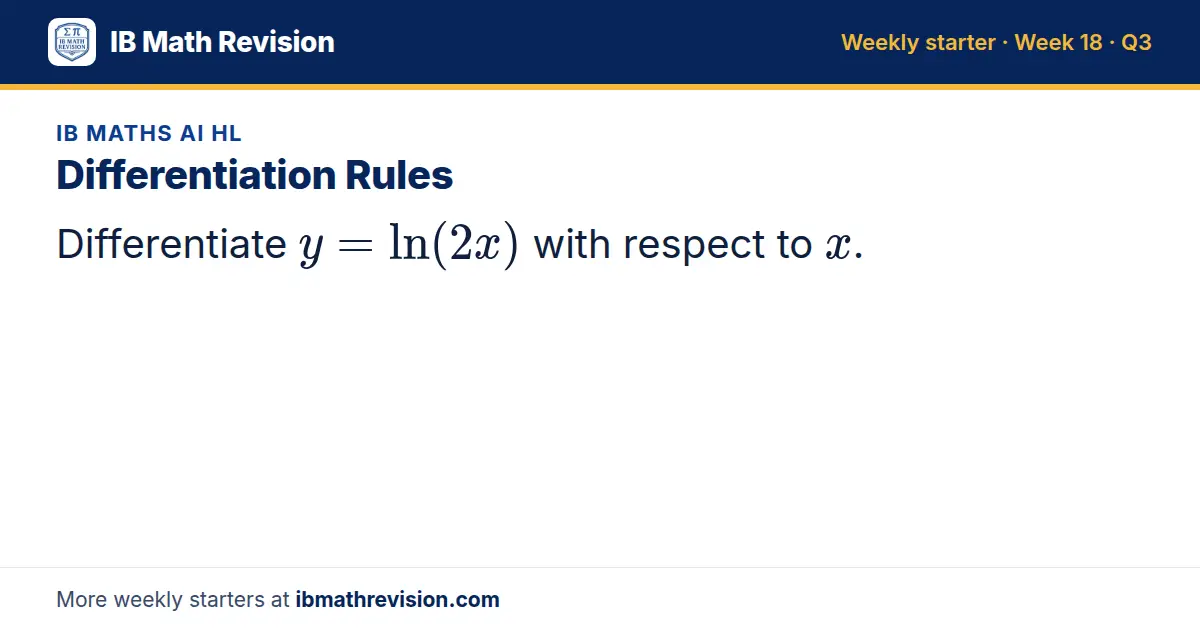
Question 3: Differentiation Rules
Differentiate y = ln(2x) with respect to x.
Week 19
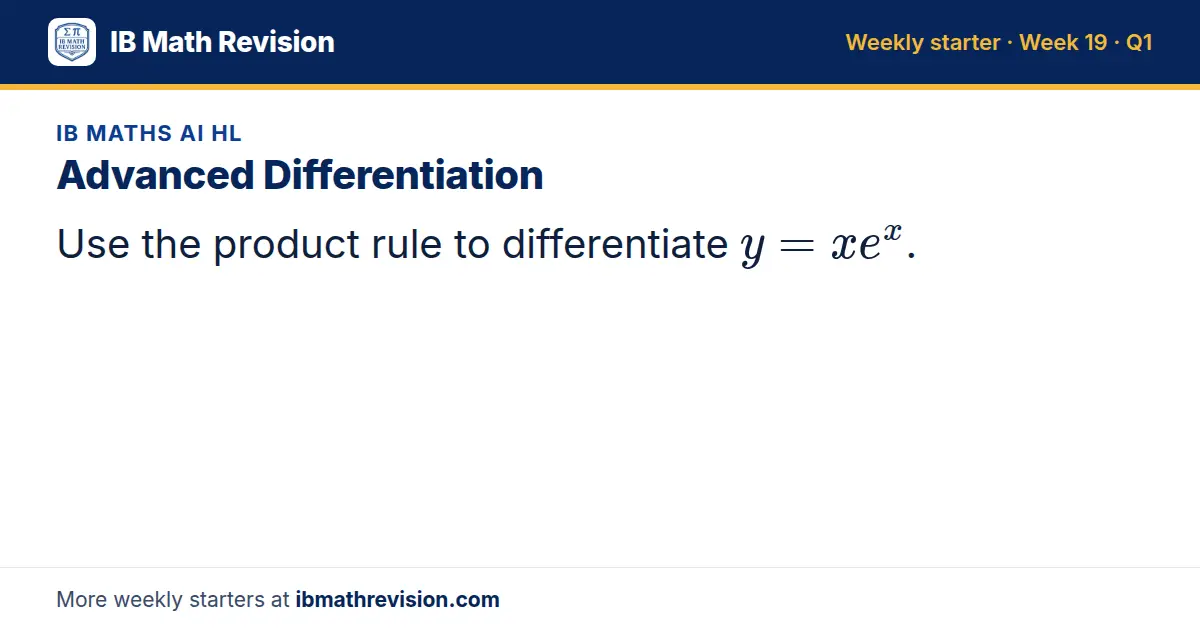
Question 1: Advanced Differentiation
Use the product rule to differentiate y = x e^x.
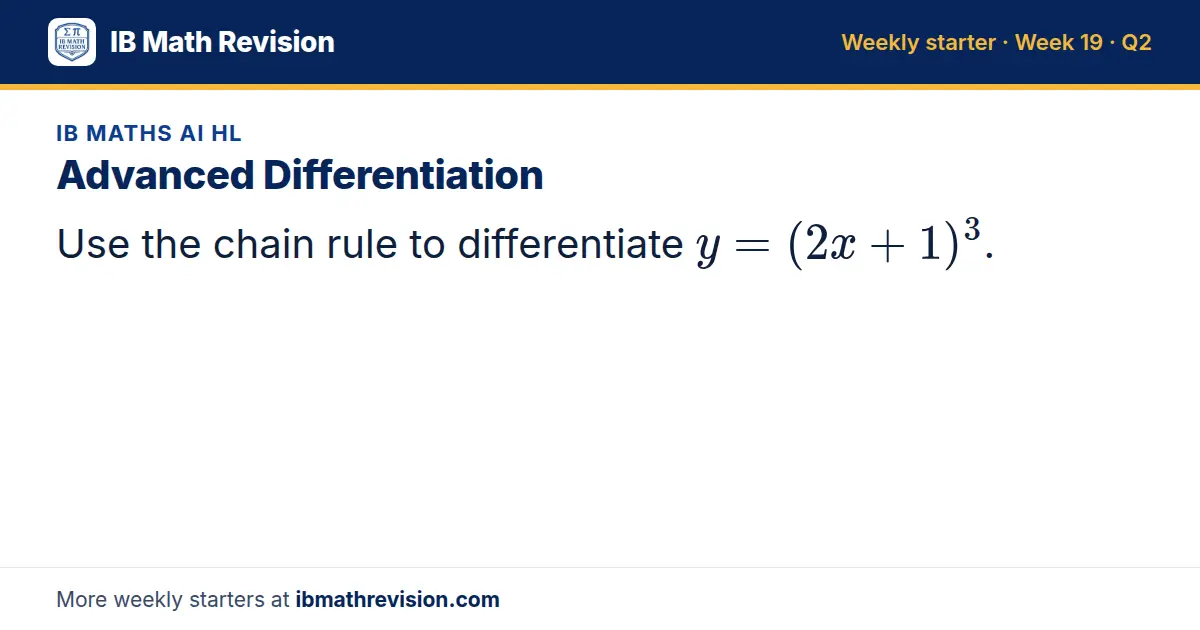
Question 2: Advanced Differentiation
Use the chain rule to differentiate y = (2x+1)^3.
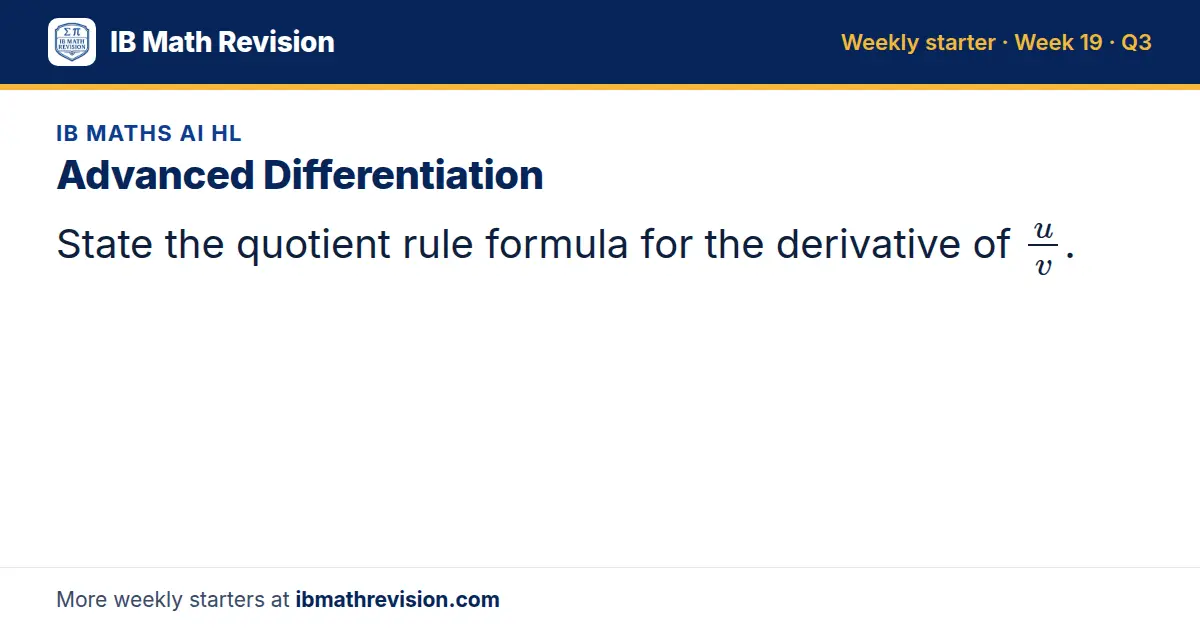
Question 3: Advanced Differentiation
State the quotient rule formula for the derivative of u/v.
Week 20
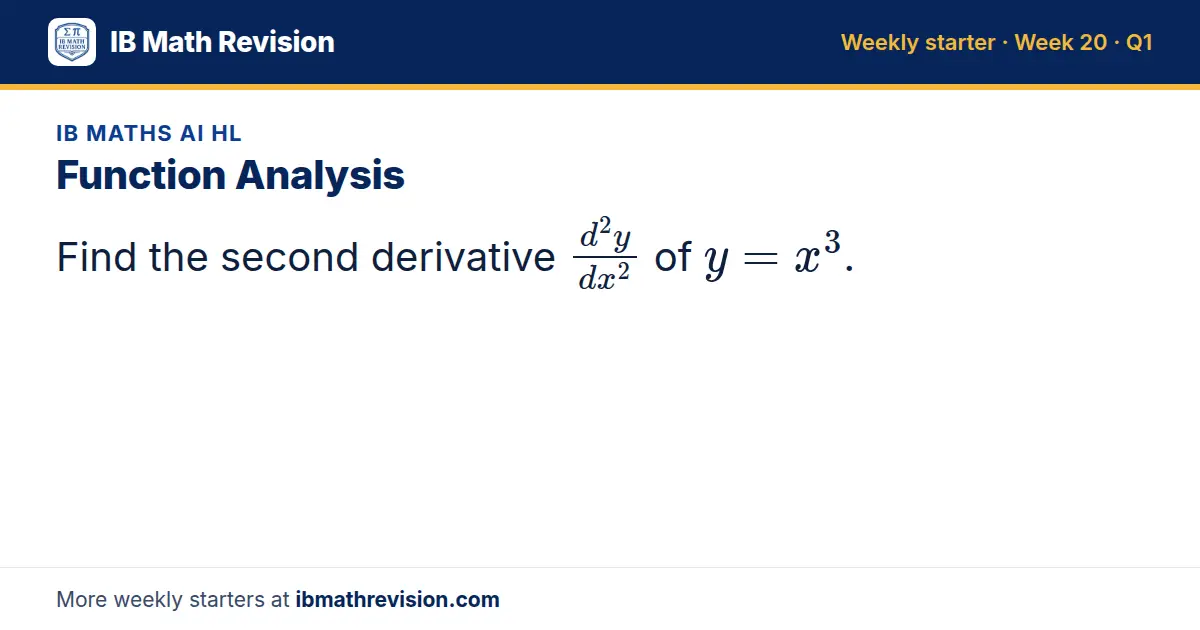
Question 1: Function Analysis
Find the second derivative (d²y)/(dx²) of y = x^3.
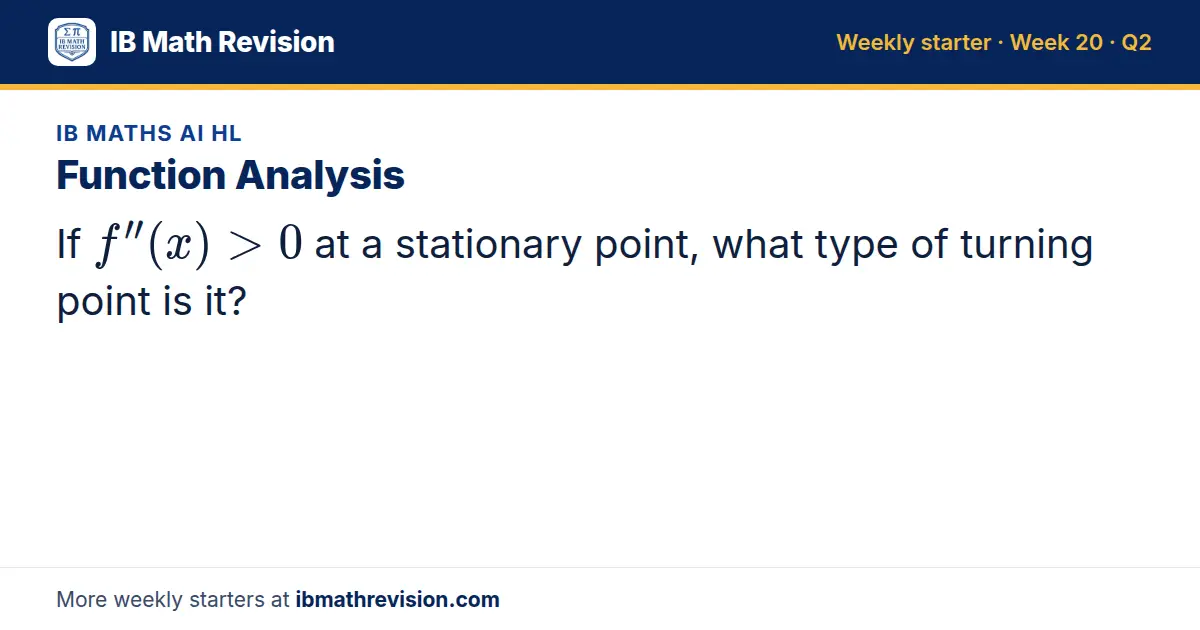
Question 2: Function Analysis
If f''(x) > 0 at a stationary point, what type of turning point is it?
Question 3: Function Analysis
What algebraic condition must typically be met to locate a possible point of inflexion?
Week 21
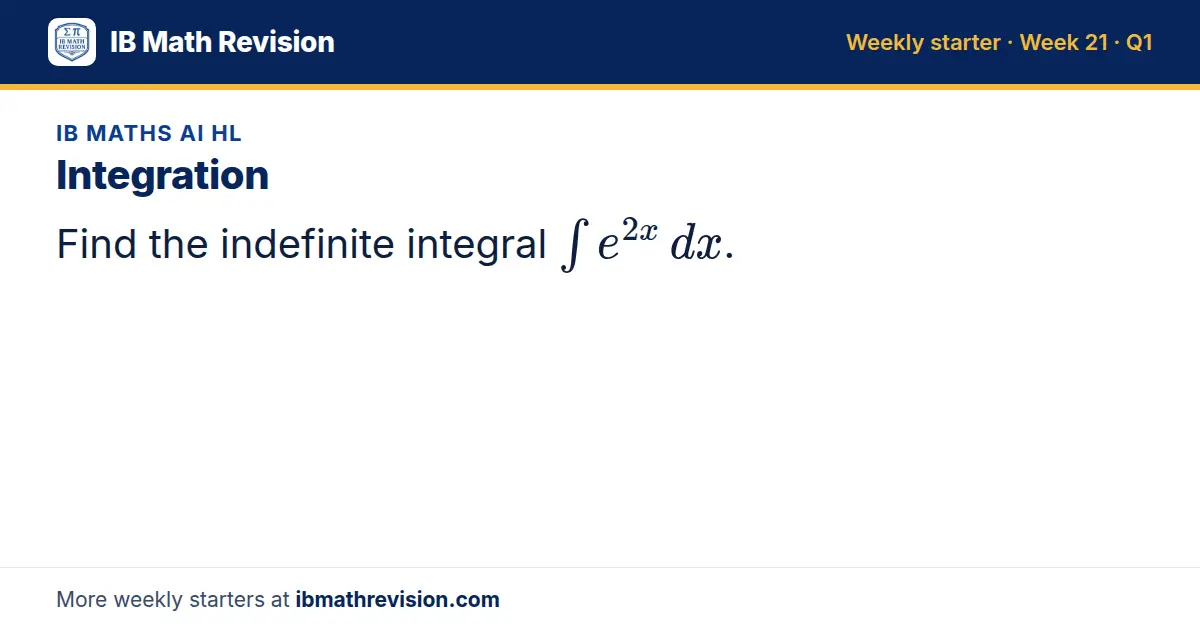
Question 1: Integration
Find the indefinite integral ∫ e^(2x) dx.
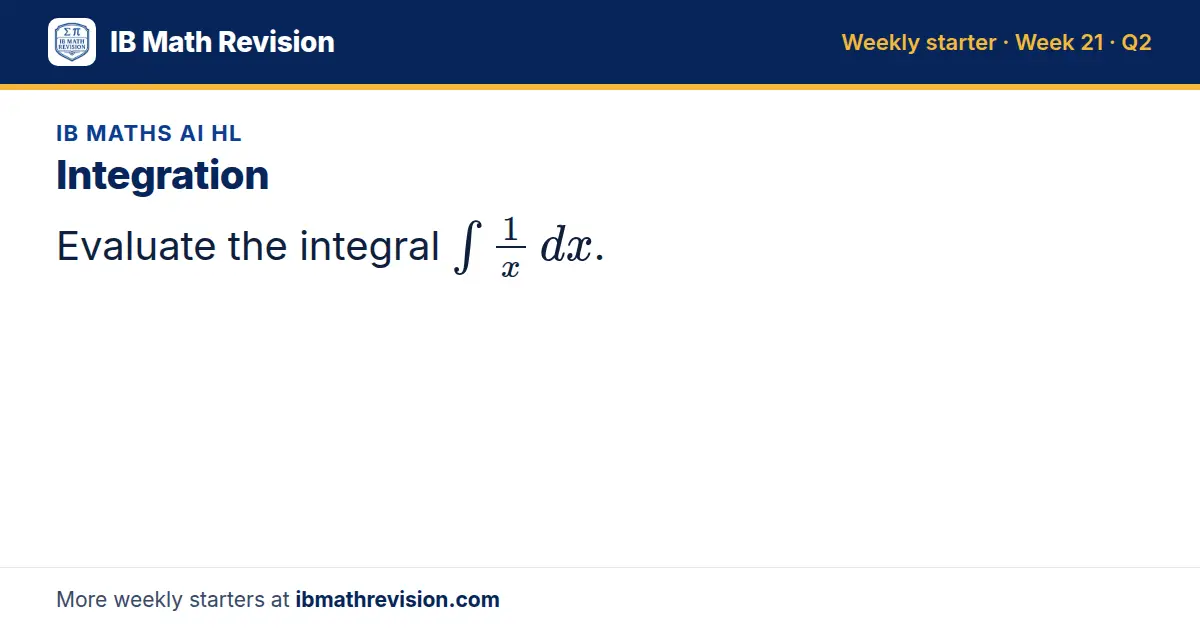
Question 2: Integration
Evaluate the integral ∫ 1/x dx.
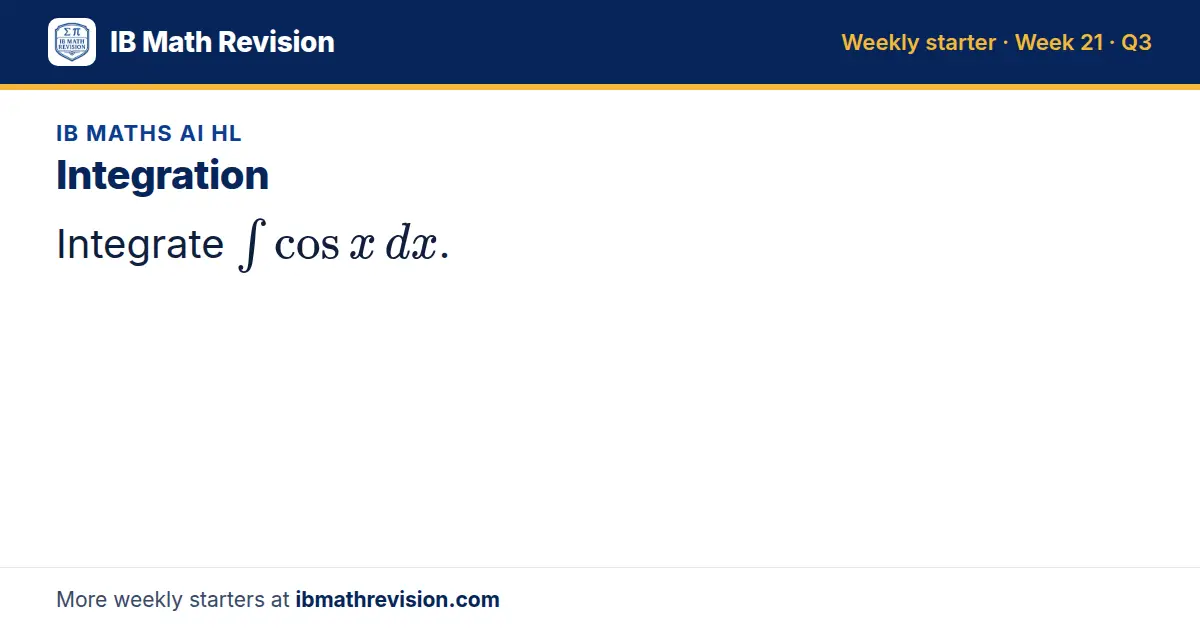
Question 3: Integration
Integrate ∫ cos x dx.
Week 22
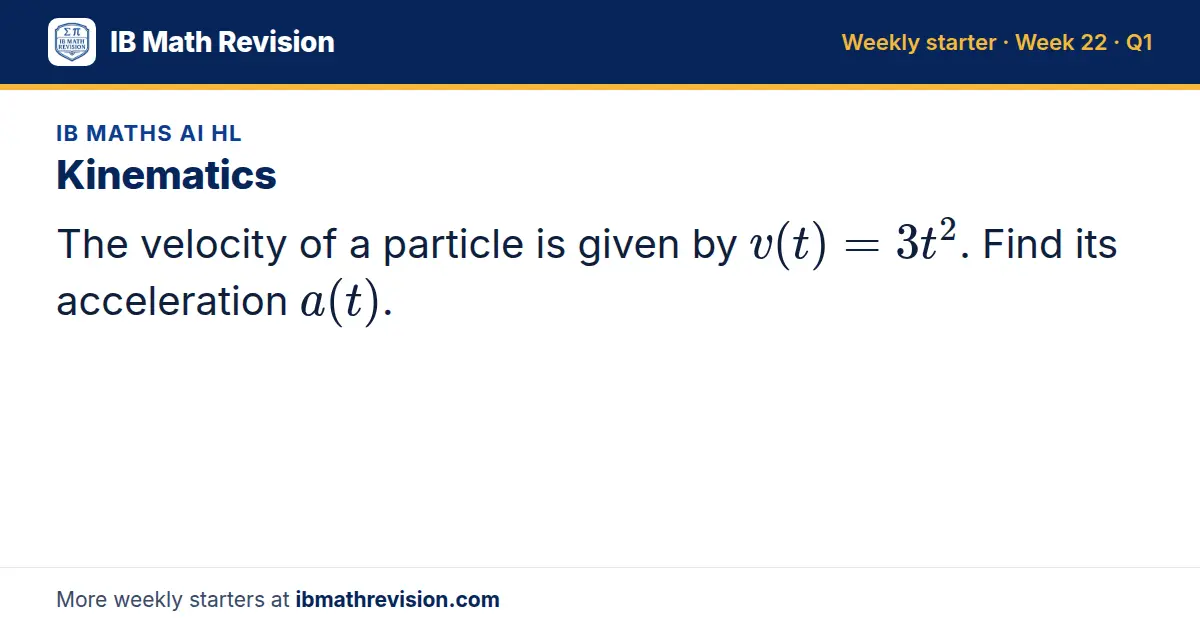
Question 1: Kinematics
The velocity of a particle is given by v(t) = 3t^2. Find its acceleration a(t).
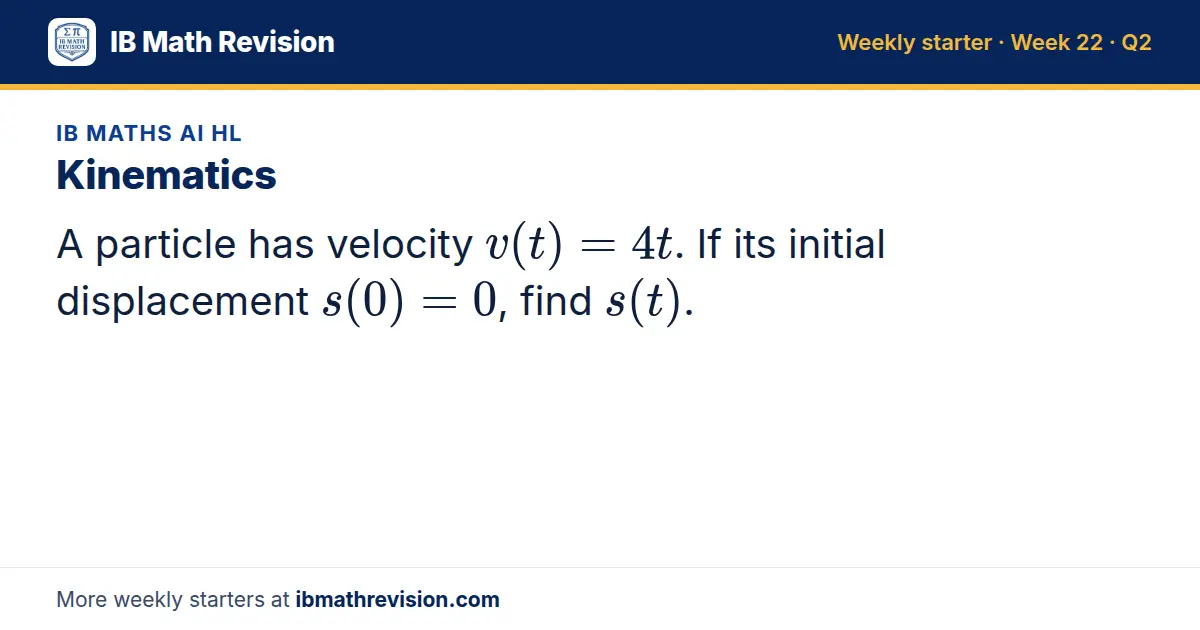
Question 2: Kinematics
A particle has velocity v(t) = 4t. If its initial displacement s(0) = 0, find s(t).
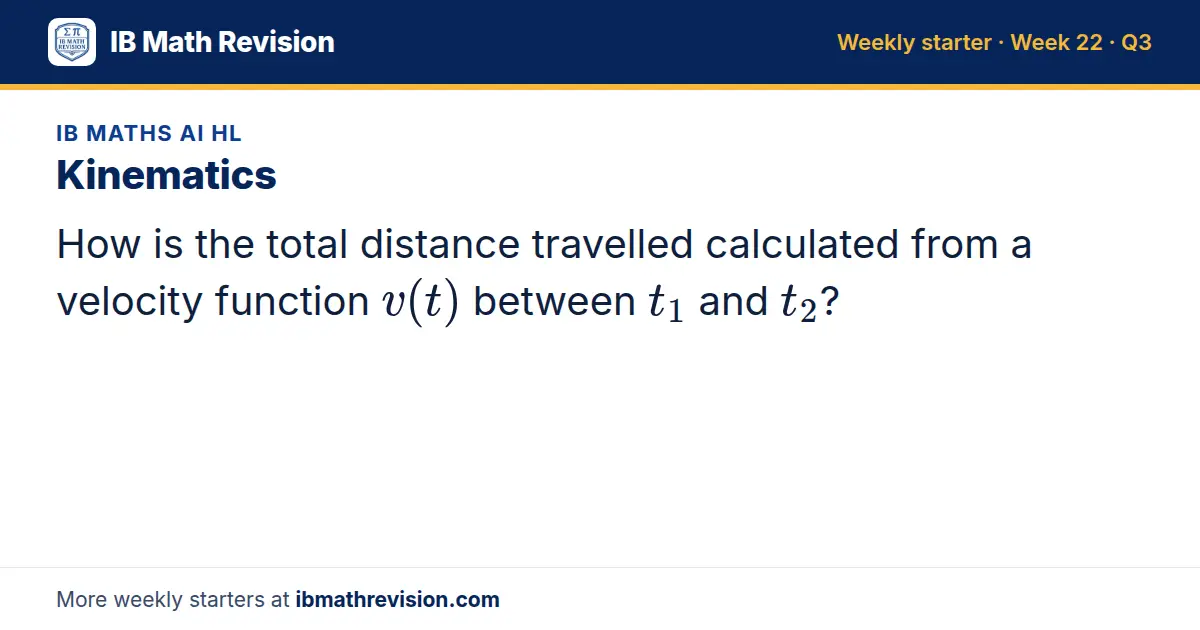
Question 3: Kinematics
How is the total distance travelled calculated from a velocity function v(t) between t_1 and t_2?
Week 23
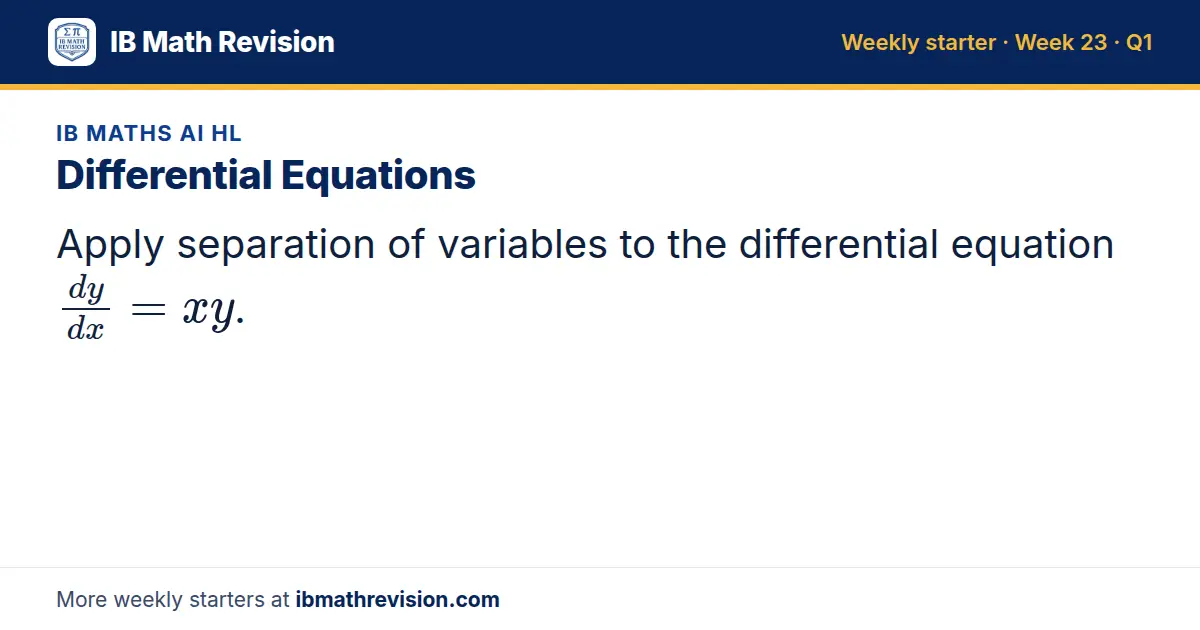
Question 1: Differential Equations
Apply separation of variables to the differential equation dy/dx = xy.
Question 2: Differential Equations
What is the primary purpose of Euler's Method?
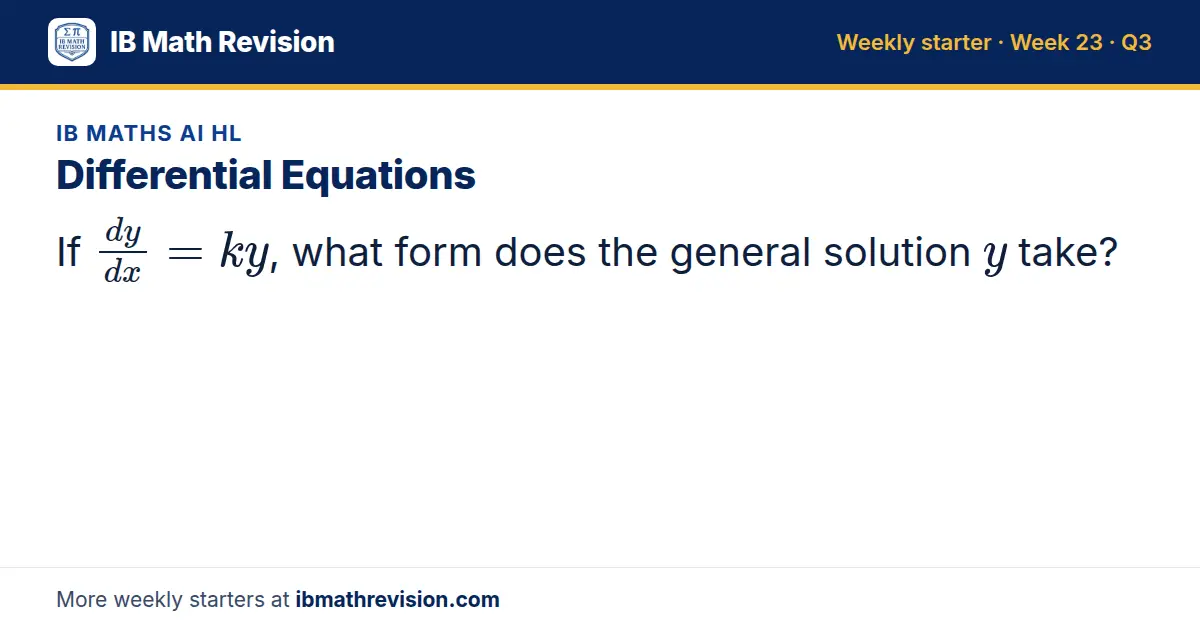
Question 3: Differential Equations
If dy/dx = ky, what form does the general solution y take?
Week 24
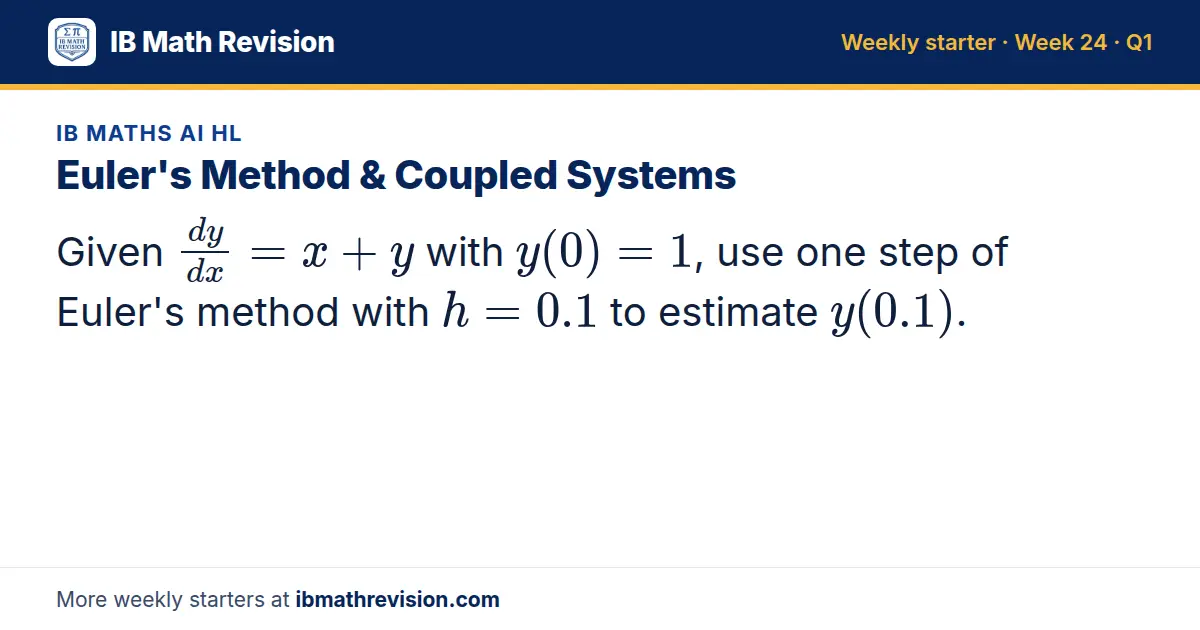
Question 1: Euler's Method & Coupled Systems
Given dy/dx = x + y with y(0) = 1, use one step of Euler's method with h = 0.1 to estimate y(0.1).
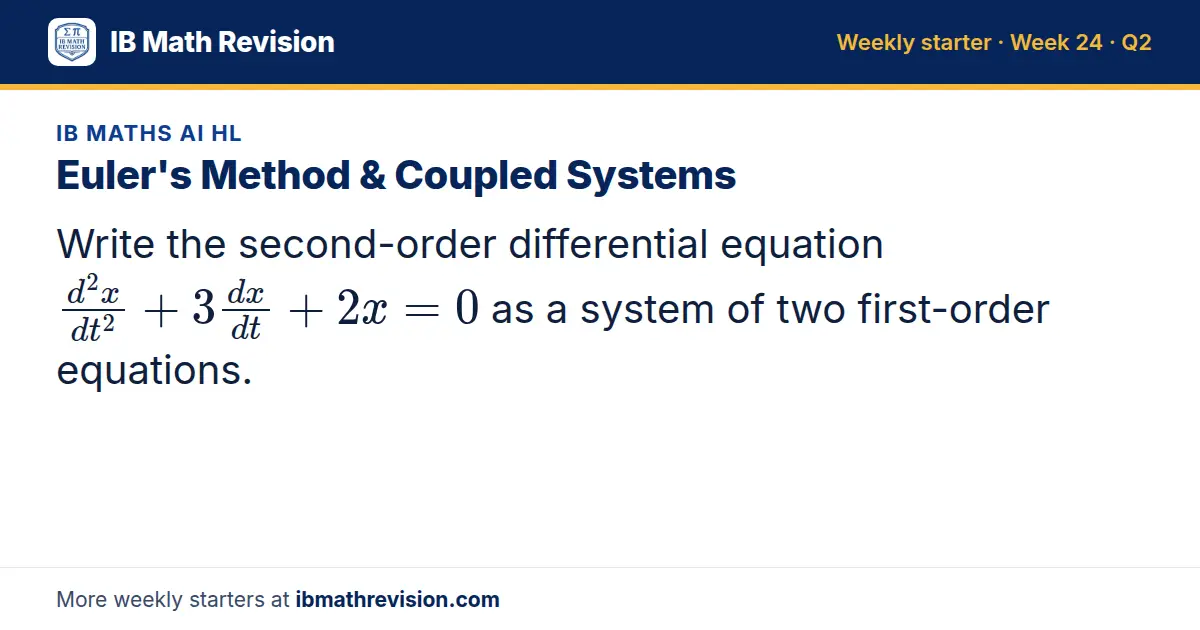
Question 2: Euler's Method & Coupled Systems
Write the second-order differential equation (d²x)/(dt²) + 3dx/dt + 2x = 0 as a system of two first-order equations.
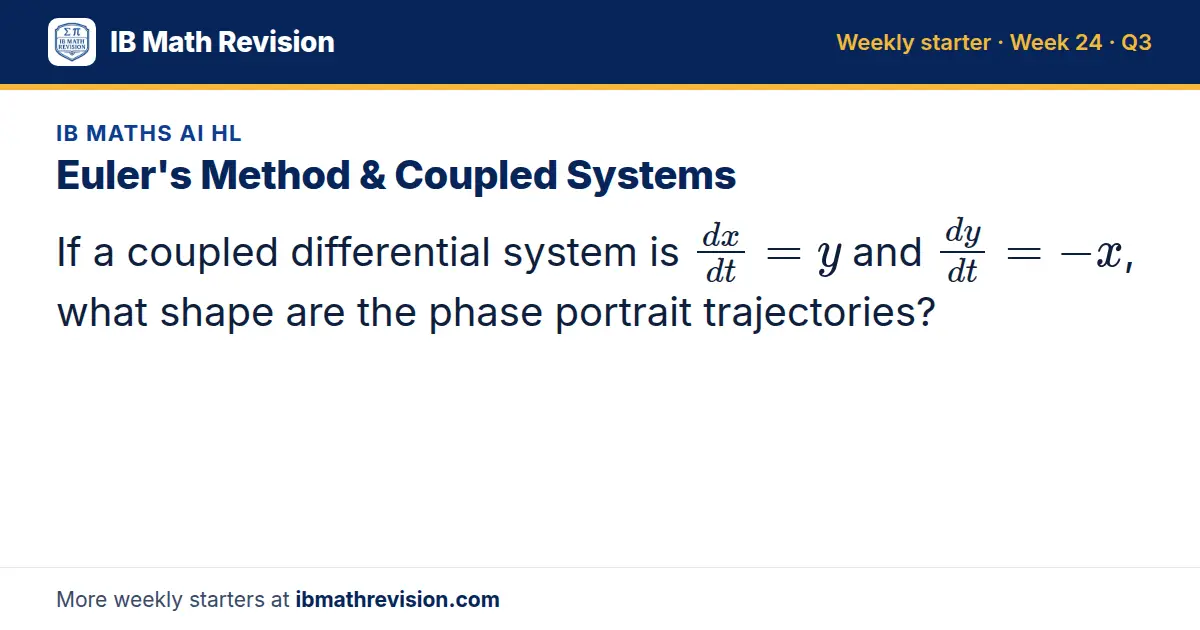
Question 3: Euler's Method & Coupled Systems
If a coupled differential system is dx/dt = y and dy/dt = -x, what shape are the phase portrait trajectories?
Week 25
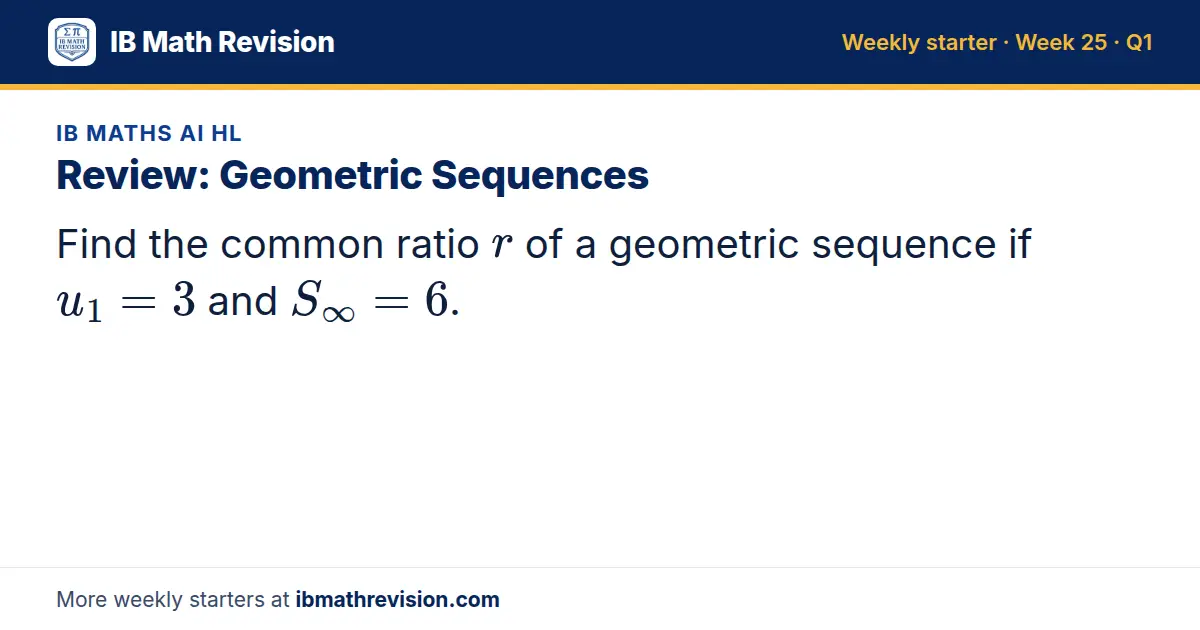
Question 1: Review: Geometric Sequences
Find the common ratio r of a geometric sequence if u_1=3 and S_∞ = 6.
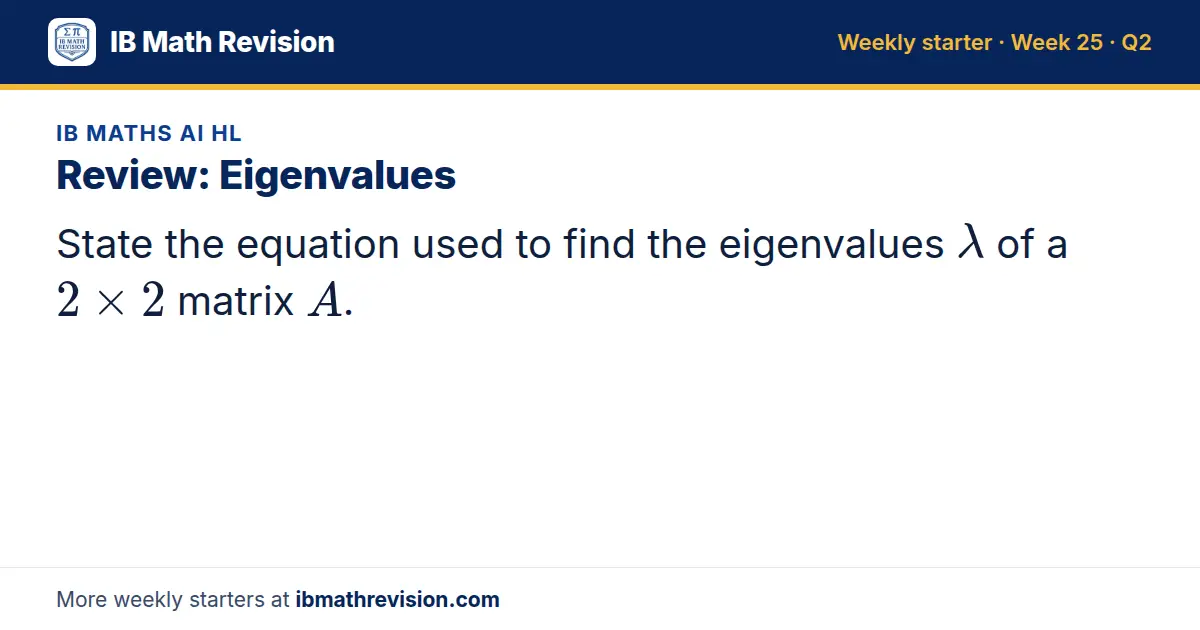
Question 2: Review: Eigenvalues
State the equation used to find the eigenvalues λ of a 2 × 2 matrix A.
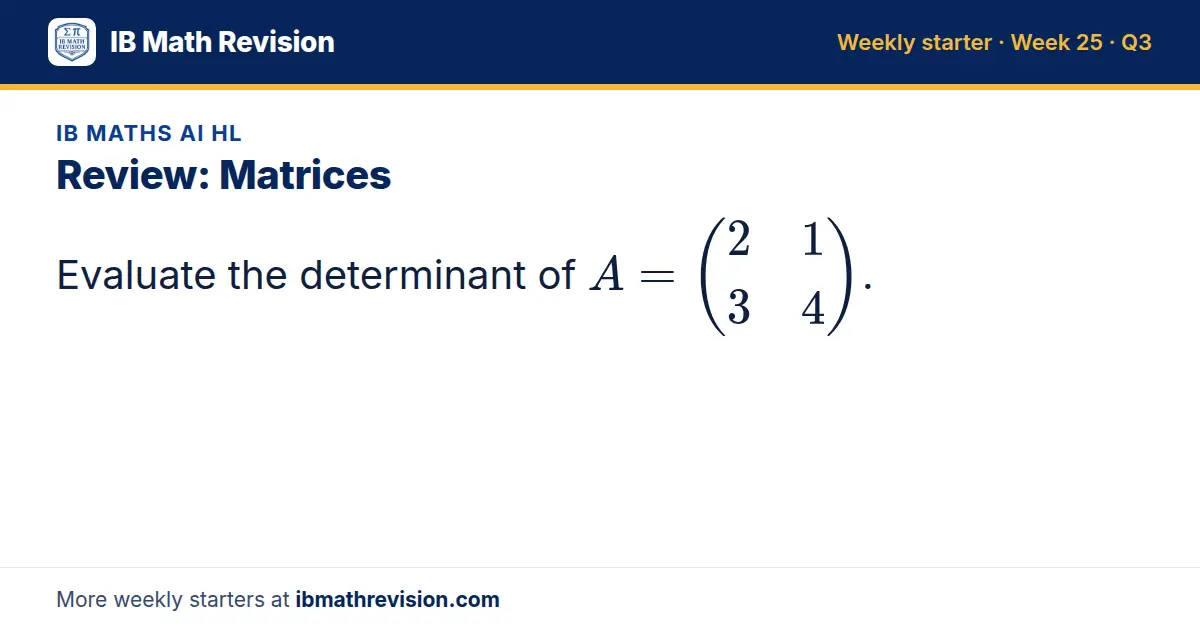
Question 3: Review: Matrices
Evaluate the determinant of A = 2 1; 3 4.
Week 26
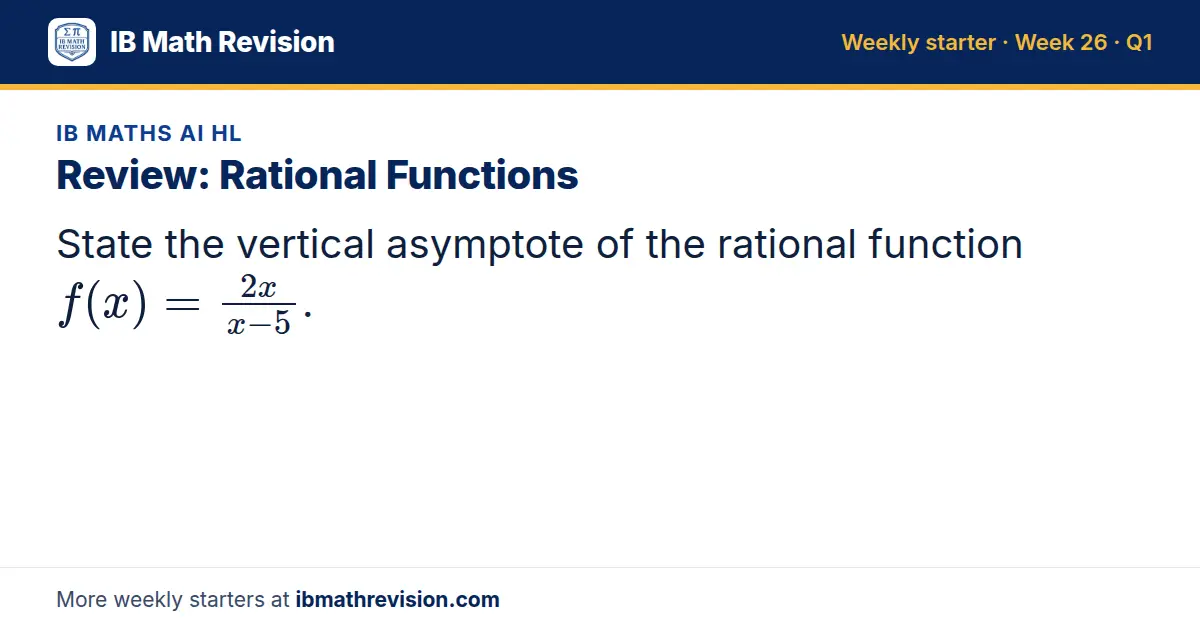
Question 1: Review: Rational Functions
State the vertical asymptote of the rational function f(x) = 2x/(x-5).
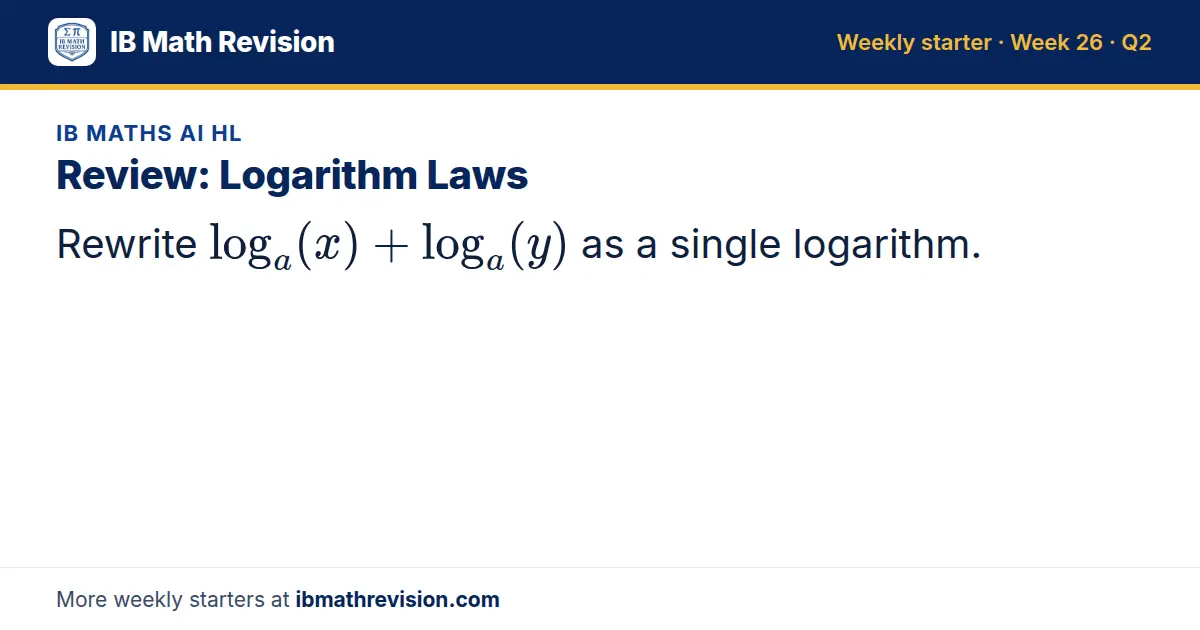
Question 2: Review: Logarithm Laws
Rewrite log_a(x) + log_a(y) as a single logarithm.
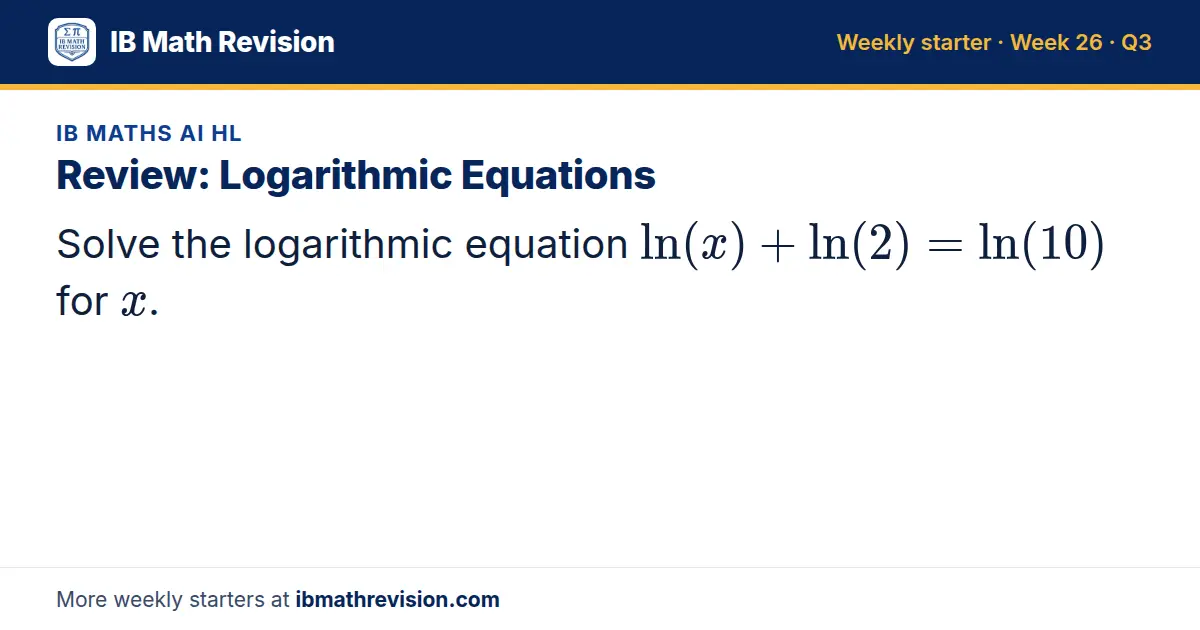
Question 3: Review: Logarithmic Equations
Solve the logarithmic equation ln(x) + ln(2) = ln(10) for x.
More starter questions
Other weeks: Weeks 1–13 · Weeks 14–26 · Weeks 27–40. Answers and mark schemes are in the starter tasks for teachers.