TI-84 Plus CE lesson 9: Sequences, series and the TVM Solver
Series questions and finance questions come up often on AI papers, and series on AA Paper 2 too. The TI-84 Plus CE does both quickly, as long as you know where the templates are and how the TVM Solver wants its signs.
Objective
Add up the terms of a sequence with Σ( or sum(seq(, and use the TVM Solver to find a future value, a repayment, a number of periods or an interest rate.
By the end, students can:
- find a finite sum with math 0: summation Σ( and with sum(seq(
- find the first n for which a sum passes a target, by changing the upper limit
- open the TVM Solver (apps 1: Finance… 1: TVM Solver…) and fill in N, I%, PV, PMT, FV, P/Y and C/Y
- solve for any one unknown with alpha enter, and use the right signs for money paid in and out
Which courses this lesson suits
- IB Maths AI (SL and HL): every paper
- IB Maths AA (SL and HL): Papers 2 and 3
- A Level Maths (UK and IAL): calculator allowed in every paper
The TVM Solver is for IB AI. AA and A Level students need steps 1 to 3 (Σ and sum(seq() and can leave out the finance part.
Before you start
On the mode screen choose FLOAT (the status bar then shows FLOAT), not a fixed number of decimal places, so money answers are not rounded twice.
The key presses, step by step
Every key is shown as it is printed on the calculator, like 2nd or enter. A second function (printed above a key) is 2nd then that key; a menu item is chosen by its number, or by moving to it and pressing enter.
The Σ template. Press math: the MATH tab opens. Scroll down to 0: summation Σ( and press enter (or press alpha window for the F2 shortcut menu and choose Σ().
The Σ template needs four things: the variable, the start value, the end value and the term.
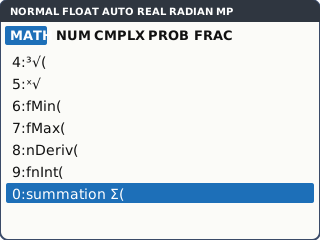
The MATH menu scrolled to 0: summation Σ( (our drawing of the TI-84 Plus CE screen, not a photo). Fill it in: X under the Σ, then 1, then 25 on top, then the term 4X − 1 (X is X,T,θ,n). Move between the boxes with the arrow keys. enter gives 1275.
The letter under the Σ must be the same letter as in the term.
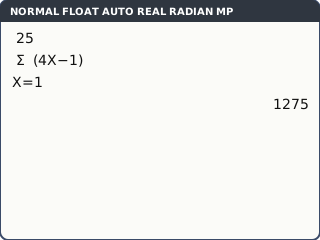
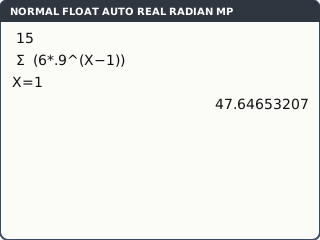
The Σ template, drawn flat (the real screen shows the small numbers above and below the Σ) (our drawing of the TI-84 Plus CE screen, not a photo). A geometric series works the same way: Σ from X = 1 to 15 of 6 × 0.9^(X − 1). The ^ key is ^. enter gives 47.64653207.
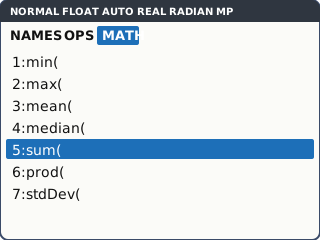
What the screen shows after this step (our drawing of the TI-84 Plus CE screen, not a photo). sum(seq( does the same in one line. 2nd stat (LIST), move right to the MATH tab, 5: sum(. Then 2nd stat again, OPS tab, 5: seq(. With STAT WIZARDS ON (the default) seq( opens a small form: Expr X², Variable X, start 1, end 10, step 1, then Paste. (With STAT WIZARDS OFF you type seq(X², X, 1, 10) yourself.) Close the bracket so the line reads sum(seq(X², X, 1, 10)) and press enter: 385.
sum(seq( is handy when you want to change one limit quickly: press 2nd enter (ENTRY), edit the number, enter.
What the screen shows after this step (our drawing of the TI-84 Plus CE screen, not a photo). The TVM Solver. Press apps, choose 1: Finance…, then 1: TVM Solver…. Fill in a savings question: 2500 invested at 3.8% a year, compounded quarterly, for 8 years. N = 32 (quarters), I% = 3.8, PV = −2500 (paid in, so negative), PMT = 0, FV = 0 for now, P/Y = 4, C/Y = 4, PMT: END.
N counts payment periods, not years. P/Y is the number of payments a year and C/Y the number of times interest is added a year.
What the screen shows after this step (our drawing of the TI-84 Plus CE screen, not a photo). Move the cursor to FV and press alpha enter (SOLVE). A small square appears next to FV, and FV = 3383.314372.
PV and FV have opposite signs: money you hand over is negative, money you get back is positive.
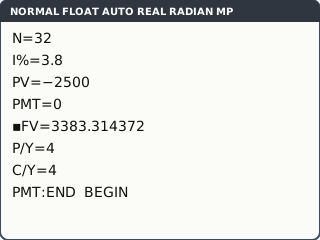
FV solved: the small square marks the value the calculator worked out (our drawing of the TI-84 Plus CE screen, not a photo).
Your turn: check your understanding
Try these straight after the key presses, on your own calculator, before looking at the answers.
- Use the Σ template to find the sum of 2X + 3 from X = 1 to 30.
- Find sum(seq(X³, X, 1, 8)).
- In the TVM Solver from step 6, change N to 40 and solve for FV again. Did the answer go up or down, and why?
Show the answers
- 1020
- 1296
- FV = 3649.160287: it went up, because the money is invested for 10 years (40 quarters) instead of 8.
Exam efficiency
- Write the sum in sigma notation or with the formula first, then the calculator's answer: the method mark is for what you write.
- For "the smallest n such that Sₙ > target", change the upper limit with 2nd enter (ENTRY) and write down the two sums either side of the target.
- TVM: decide the signs before you start. Paid in or borrowed and spent? One of PV and FV (or PMT) must be negative.
- Read the question for the compounding: monthly means C/Y = 12, quarterly C/Y = 4. Leaving C/Y at 1 is a common slip.
- Write down the values you put in (N = 60, I% = 6.2, PV = 18000 …): this earns the method mark even if a key press goes wrong.
Worked exam-style example
Question. Sam borrows $18 000 to buy a car. The loan is repaid with equal monthly payments over 5 years, at 6.2% a year compounded monthly. (a) Find the monthly payment. (b) Find the total interest paid. (c) Sam pays $450 a month instead. How many months does it take to repay the loan?
(a) apps 1: Finance… 1: TVM Solver…. N = 60, I% = 6.2, PV = 18000 (Sam receives it), PMT = 0, FV = 0 (the loan is paid off), P/Y = 12, C/Y = 12, PMT: END. Cursor on PMT, alpha enter: PMT = −349.6668395.
PMT is negative because Sam pays it out.
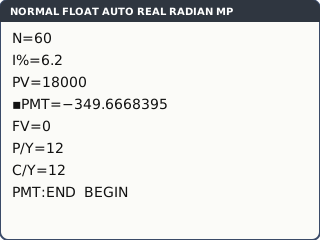
What the screen shows after this step (our drawing of the TI-84 Plus CE screen, not a photo). (b) Back on the home screen (2nd mode), the solver's values are stored. apps 1: Finance…, VARS tab, 4: PMT pastes PMT. Type −60 × PMT − 18000 enter: 2980.01037.
Using the stored PMT keeps every digit, so the interest is not thrown off by a rounded payment.
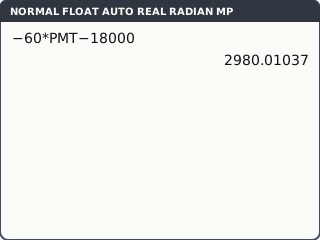
What the screen shows after this step (our drawing of the TI-84 Plus CE screen, not a photo). (c) Back in the TVM Solver, PMT = −450, then cursor on N and alpha enter: N = 44.92439215. So 45 payments: the last one is smaller.
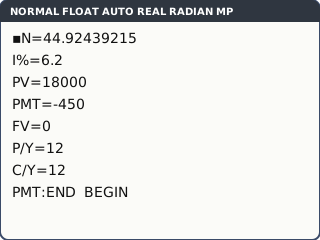
What the screen shows after this step (our drawing of the TI-84 Plus CE screen, not a photo).
What to write down
(a) N = 60, I% = 6.2, PV = 18000, FV = 0, P/Y = C/Y = 12, so the payment is $349.67 a month.
(b) Total paid − amount borrowed = 60 × 349.67… − 18 000 = $2980.01 (using the stored, unrounded payment).
(c) With PMT = −450, N = 44.9, so it takes 45 months.
Practice
Do these on your own calculator. Write the answers to 3 significant figures unless the task says otherwise.
- Find the sum of 7 − 0.5X from X = 1 to 40.
- Find the sum of the first 12 terms of the geometric sequence 3, 4.5, 6.75, …
- The sequence 5, 8, 11, … is arithmetic. Find the smallest n for which the sum of the first n terms is more than 1000.
- $4000 is invested at 5% a year, compounded monthly. How many months until it is worth $6000? (P/Y = C/Y = 12, PV = −4000, FV = 6000, solve for N.)
- $3000 grows to $4200 in 6 years with interest compounded once a year. Find the annual interest rate.
- A $250 000 mortgage is repaid monthly over 25 years at 4.5% a year compounded monthly. Find the monthly payment.
Show the practice answers
- −130
- 772 (3 s.f.): Σ from X = 1 to 12 of 3 × 1.5^(X − 1).
- n = 25: the sum of 24 terms is 948 and of 25 terms 1025.
- N = 97.5, so 98 months.
- I% = 5.77% (3 s.f.): N = 6, PV = −3000, FV = 4200, P/Y = C/Y = 1.
- $1389.58 (PMT = −1389.58)
Common mistakes
- N in years instead of periods: 5 years of monthly payments is N = 60.
- PV and FV with the same sign: the solver gives an error or a nonsense answer.
- Leaving P/Y or C/Y at 1 from the last question.
- Typing a rounded payment back in for the total interest: use the stored PMT from the Finance VARS tab.
- A different letter under the Σ from the one in the term: the sum is then the term times the number of terms.
- Writing "TVM" or the key presses as working instead of the values N, I%, PV, PMT, FV, P/Y, C/Y.
1-minute quick check
Answer these without looking back. Most need no calculation: they check that the key presses have stuck.
- Where is the TVM Solver?
- Which keys solve for the value under the cursor?
- Is money you invest entered as positive or negative?
- Interest compounded quarterly, payments quarterly: P/Y and C/Y?
- Where is the Σ( template?
Show the quick-check answers
- apps 1: Finance… then 1: TVM Solver…
- alpha enter (SOLVE)
- Negative (it leaves you).
- Both 4.
- math 0: summation Σ( (or alpha window).
Teaching this lesson (about 55 minutes)
| 0–5 min | Starter: by hand, how many terms in 5, 8, 11, …, 77? Then: how would you add them on the calculator? |
| 5–15 min | Steps 1–4: the Σ template and sum(seq(. Students try the first "your turn" task. |
| 15–25 min | Steps 5–6: the TVM Solver on a savings question. Stress N in periods and the signs. |
| 25–35 min | Worked example: the car loan, (a)–(c). Students say which value is the unknown before each solve. |
| 35–50 min | "Your turn" tasks, then practice 1–6 (AA and A Level: 1–3 only, then the Σ work in more depth). |
| 50–55 min | 1-minute quick check, no calculators. |
Students need their own TI-84 Plus CE. With a projector, the calculator-skills guides below have a Show on the board view and an animated walkthrough of the key presses.
Matching calculator guides
- How to find terms and sums of sequences on the Casio fx-CG50, TI-84 Plus CE and TI-Nspire CX II
- How to use the finance (TVM) solver on the Casio fx-CG50, TI-84 Plus CE and TI-Nspire CX II