Free IB Maths AI SL lesson: Exponential decay models
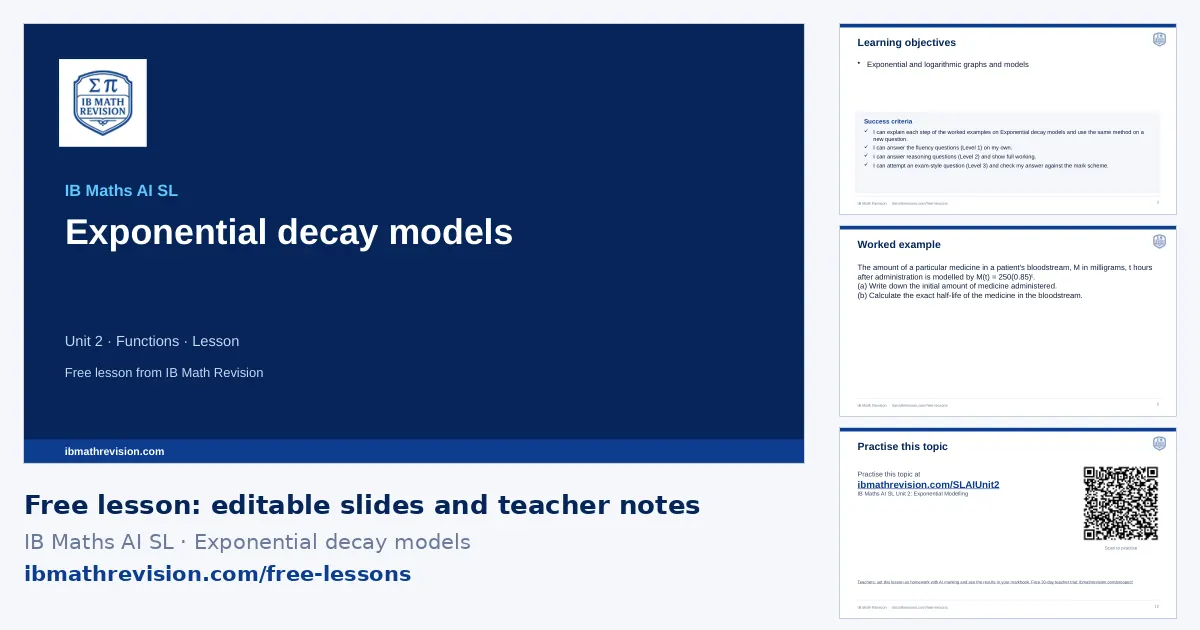
A ready-to-teach IB Maths AI SL lesson on Exponential decay models (Unit 2 · Functions): editable slides and teacher notes, free; a printable worksheet in 3 levels with answers for school plans. About 55 minutes.
Exponential decay models describe quantities that fall by the same percentage in each time period: medicine in the bloodstream, a car's value, or how far hot coffee is above room temperature. This lesson reads the parameters of N = N₀aᵗ and N = N₀eᵏᵗ + c, finds when the quantity reaches a given value, and interprets the horizontal asymptote.
Free with a teacher account. Sign in with Google, Microsoft or email and download the slides and teacher notes.
What's inside
- Slides (PowerPoint, editable) · freeabout 12 slides: do now, objectives, key ideas, a worked example step by step, “your turn”, practice QR code, exit ticket
- Teacher notes (PDF) · freelesson plan with timings, common mistakes, homework links
- Worksheet (PDF) · school plans6 questions, 40 marks: Fluency, Reasoning, Exam-style. Included with school plans and the teacher trial.
- Answers (PDF) · school plansthe answer to every worksheet question, from its mark scheme. Included with school plans and the teacher trial.
Learning objectives
- Exponential and logarithmic graphs and models
Worked example: Exponential decay models
A cup of coffee cools according to T = 20 + 70e^(−0.08t), where T is the temperature in °C and t is the time in minutes. (a) Find the initial temperature. (b) Find the temperature after 10 minutes. (c) Find when the coffee reaches 50 °C. (d) Describe what happens to T in the long run.
- (a) t = 0: T = 20 + 70 = 90 °C.
- (b) T = 20 + 70e^(−0.8) ≈ 20 + 31.45 ≈ 51.5 °C.
- (c) 70e^(−0.08t) = 30, so e^(−0.08t) = 3/7 and t = ln(7/3) ÷ 0.08 ≈ 10.6 minutes.
- (d) e^(−0.08t) → 0, so T gets closer and closer to 20 °C, the room temperature, without reaching it.
Answer: (a) 90 °C (b) about 51.5 °C (c) after about 10.6 minutes (d) T approaches 20 °C
Common mistakes in exponential decay models
- Saying the coffee reaches 20 °C: the asymptote T = 20 is approached, never reached.
- Reading −0.08 as 'falls by 8% a minute': with base e the factor per minute is e^(−0.08) ≈ 0.923, a fall of about 7.7%.
- Missing brackets on the calculator: type e^(−0.08 × 10), not e^(−0.08) × 10.
Where this lesson fits
Exponential decay models is in Unit 2 · Functions of the IB Maths AI SL scheme of work.
- The lesson before: Exponential growth models (scheme-of-work lessons: Exponential Growth & Decay; Exponential Growth & Decay in Context: Reading the Parameters; The Number e & Continuous Growth)
- The next lesson: Combined transformations (extension) (scheme-of-work lessons: Transformations of graphs)
Lesson plan
| 0–5 min | Do now: students write down what they remember about Exponential growth models and Interpreting quadratic vertex + roots in context |
| 5–8 min | Share the learning objective and success criteria |
| 8–20 min | Teach: the worked example, step by step; students copy the method |
| 20–25 min | Your turn: 1 mini-whiteboard question; check every board before moving on |
| 25–42 min | Practise: the worksheet (6 questions in 3 levels, with school plans and the teacher trial) or the topic's practice questions online; move up a level after two right in a row |
| 42–47 min | Plenary: 1-question exit ticket; collect it to plan the next lesson |
For students: practise this topic
The worksheet's QR code opens the IB Maths AI SL Unit 2: Exponential Modelling practice questions.
With a school plan
Set Exponential decay models as homework marked by AI, print this lesson's levelled worksheet with answers, and rebuild the lesson for your class with Create lesson. Free for 30 days as a teacher, no card.
Is it free, can I edit the slides, what do students use for homework? See questions teachers ask.