Free IB Maths AI SL lesson: Exponential growth models
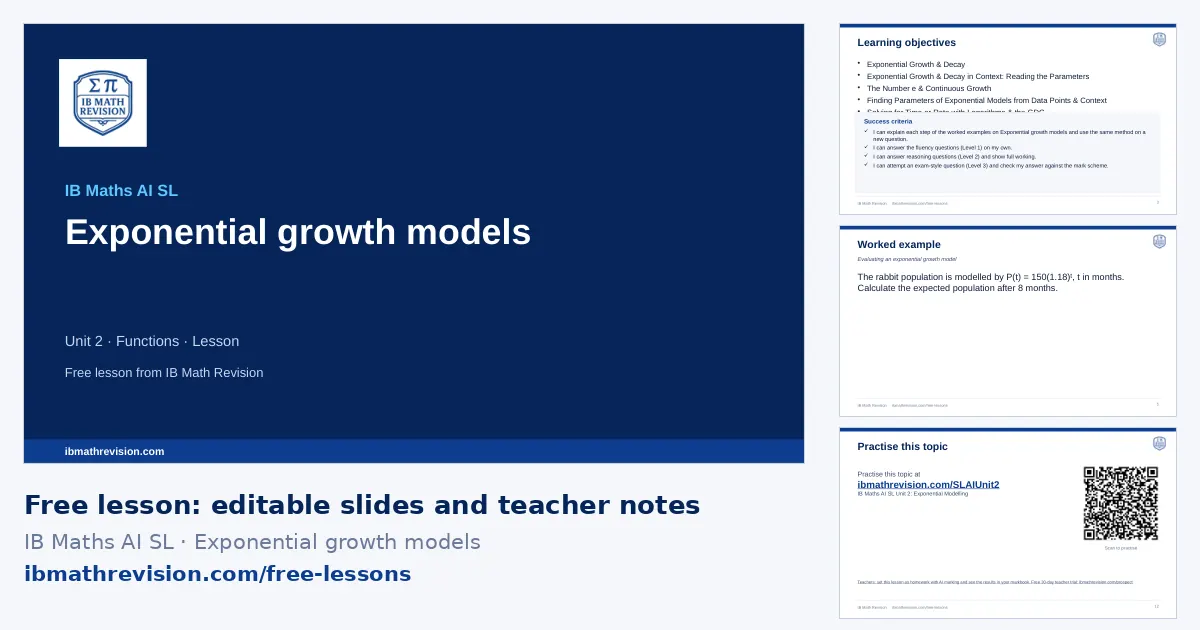
A ready-to-teach IB Maths AI SL lesson on Exponential growth models (Unit 2 · Functions): editable slides and teacher notes, free; a printable worksheet in 3 levels with answers for school plans. About 55 minutes.
Free with a teacher account. Sign in with Google, Microsoft or email and download the slides and teacher notes.
What's inside
- Slides (PowerPoint, editable) · freeabout 12 slides: do now, objectives, key ideas, a worked example step by step, “your turn”, practice QR code, exit ticket
- Teacher notes (PDF) · freelesson plan with timings, common mistakes, homework links
- Worksheet (PDF) · school plans6 questions, 36 marks: Fluency, Reasoning, Exam-style. Included with school plans and the teacher trial.
- Answers (PDF) · school plansthe answer to every worksheet question, from its mark scheme. Included with school plans and the teacher trial.
Learning objectives
- Exponential Growth & Decay
- Exponential Growth & Decay in Context: Reading the Parameters
- The Number e & Continuous Growth
- Finding Parameters of Exponential Models from Data Points & Context
- Solving for Time or Rate with Logarithms & the GDC
- Exponential Models Revisited: Fitting with Technology & Interpreting Parameters
- Exponential Models in Context: Half-Life & Doubling Time
Key ideas on the slides
- y = aˣ (a > 1) increases; y = a⁻ˣ decreases; both pass through (0, 1) with asymptote y = 0.
- y = logₐ x passes through (1, 0) with vertical asymptote x = 0; domain x > 0.
- Model N = N₀ aᵗ or N = N₀ eᵏᵗ: N₀ is the initial value; a > 1 (or k > 0) is growth, 0 < a < 1 (or k < 0) is decay.
- For y = Aeᵏˣ + c the horizontal asymptote is y = c: the long-term value of the model.
By the end of the lesson, students should be able to answer a question like: Find the population after 5 years if P(t) = 1000(1.05)t.
Key vocabulary
- exponential model: A model where the quantity is multiplied by a constant factor in each equal time step.
- horizontal asymptote: A horizontal line the graph approaches as x → ∞ (or −∞).
- parameter: A constant in a model (such as A or k) found from data.
- common ratio: r: the number each term is multiplied by to get the next.
- geometric sequence: A sequence where each term is the previous one times the common ratio.
Common mistakes this lesson tackles
- Exponential and log models: e⁰ = 1, the equation vs the inequality, reading the model. At t = 0 any bᵗ or e^(kt) equals 1. For "after how many complete years…", solve the inequality and round in the direction the context needs. Use the model's equation in any comment on it.
- Sequences: uₙ vs Sₙ vs n, and rounding n up. Decide first: one term (uₙ), a total (Sₙ) or which term (solve for n). Write the equation (uₙ = 42 means solve for n), then round n in the direction the context needs.
- Thinking y = e⁻ˣ crosses the x-axis.
- Reading the long-term value as 0 when the model has +c.
The worked example
The rabbit population is modelled by P(t) = 150(1.18)ᵗ, t in months. Calculate the expected population after 8 months.
- Substitute t = 8: P(8) = 150(1.18)⁸.
- Evaluate the power: 1.18⁸ = 3.7588…
- Multiply: 150 × 3.7588… = 563.83…
- Recognise populations must be whole numbers.
- State: 564 rabbits.
Tip: Populations of living things (animals, bacteria, people) must be rounded to the nearest integer. Fractional organisms don't exist.
Calculator tips
- Plot the model and use intersect for "when" questions; use exponential regression on data.
- The table mode or seq/sum commands check a term or sum; the solver finds n from Sₙ.
Where this lesson fits
Exponential growth models is in Unit 2 · Functions of the IB Maths AI SL scheme of work.
- The lesson before: Interpreting quadratic vertex + roots in context (scheme-of-work lessons: Factorised & Vertex Form; Solving Quadratics — Zeros, Axis of Symmetry & Vertex (GDC and Formula))
- The next lesson: Exponential decay models (scheme-of-work lessons: Exponential and logarithmic graphs and models)
Lesson plan
| 0–5 min | Do now: students write down what they remember about Interpreting quadratic vertex + roots in context and Quadratic models (fitting to data) |
| 5–8 min | Share the learning objective and success criteria |
| 8–20 min | Teach: the worked example, step by step; students copy the method |
| 20–25 min | Your turn: 1 mini-whiteboard question; check every board before moving on |
| 25–42 min | Practise: the worksheet (6 questions in 3 levels, with school plans and the teacher trial) or the topic's practice questions online; move up a level after two right in a row |
| 42–47 min | Plenary: 1-question exit ticket; collect it to plan the next lesson |
For students: practise this topic
The worksheet's QR code opens the IB Maths AI SL Unit 2: Exponential Modelling practice questions.
With a school plan
Set Exponential growth models as homework marked by AI, print this lesson's levelled worksheet with answers, and rebuild the lesson for your class with Create lesson. Free for 30 days as a teacher, no card.
Is it free, can I edit the slides, what do students use for homework? See questions teachers ask.