Free IB Maths AI HL lesson: Graph theory — adjacency & weighted matrices
A ready-to-teach IB Maths AI HL lesson on Graph theory — adjacency & weighted matrices (Unit 3 · Geometry & Trigonometry): editable slides and teacher notes, free; a printable worksheet in 3 levels with answers for school plans. About 55 minutes.
Free with a teacher account. Sign in with Google, Microsoft or email and download the slides and teacher notes.
What's inside
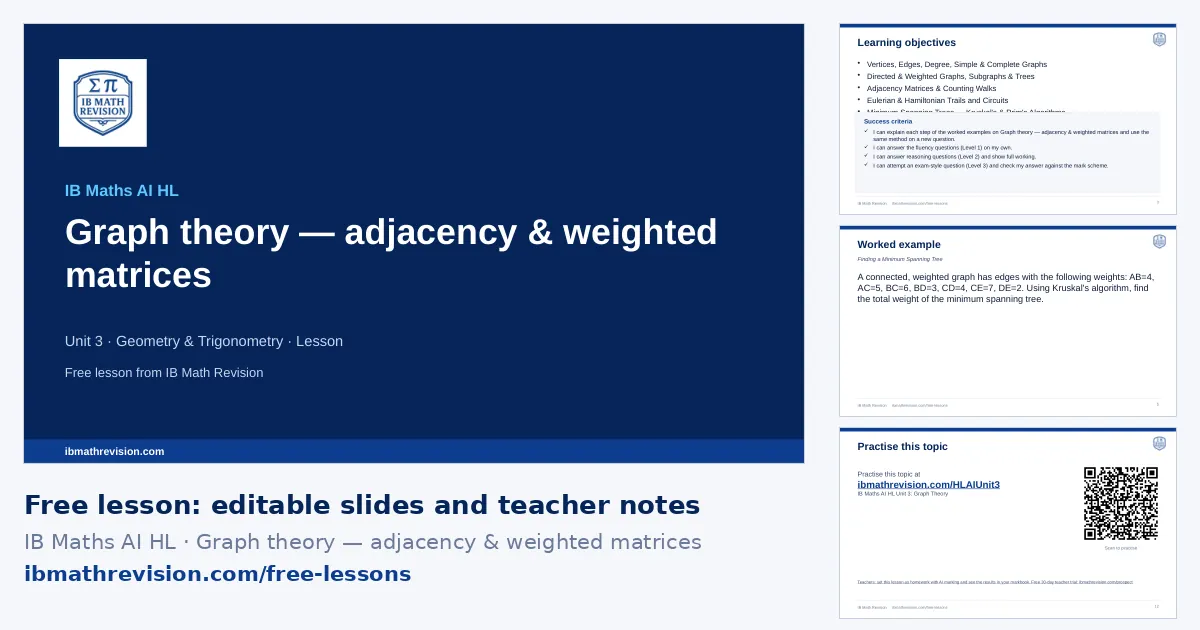
- Slides (PowerPoint, editable) · freeabout 12 slides: do now, objectives, key ideas, a worked example step by step, “your turn”, practice QR code, exit ticket
- Teacher notes (PDF) · freelesson plan with timings, common mistakes, homework links
- Worksheet (PDF) · school plans6 questions, 26 marks: Fluency, Reasoning, Exam-style. Included with school plans and the teacher trial.
- Answers (PDF) · school plansthe answer to every worksheet question, from its mark scheme. Included with school plans and the teacher trial.
Learning objectives
- Vertices, Edges, Degree, Simple & Complete Graphs
- Directed & Weighted Graphs, Subgraphs & Trees
- Adjacency Matrices & Counting Walks
- Eulerian & Hamiltonian Trails and Circuits
- Walks of Length k with Adjacency Matrix Powers
Key ideas on the slides
- A graph has vertices (nodes) joined by edges; the degree of a vertex is the number of edge ends at it, and the sum of degrees is twice the number of edges.
- Simple graphs have no loops or multiple edges; a complete graph Kₙ joins every pair of vertices and has (n(n−1))/2 edges.
- A tree is a connected graph with no cycles; a tree with n vertices has n − 1 edges.
- In an adjacency matrix A, entry (i, j) is the number of edges from i to j; (Aᵏ)ᵢⱼ is the number of walks of length k from i to j.
By the end of the lesson, students should be able to answer a question like: Write the weighted adjacency matrix for the given graph of four towns.
Skills in this topic
Graph theory — adjacency & weighted matrices breaks down into 2 skills. In the worksheet builder, teachers can set practice on just one of them.
- Graph properties, walks & trails
- Adjacency matrices & counting walks
Key vocabulary
- vertex: A point (node) of a graph.
- edge: A connection between two vertices.
- degree: The number of edges meeting at a vertex (a loop counts twice).
- walk: A sequence of edges, where vertices and edges may repeat.
- order: The size of a matrix: rows × columns.
Common mistakes this lesson tackles
- Graph algorithms: Prim vs nearest neighbour, no method shown, bounds mixed up. Show the algorithm: list edges in the order chosen, with weights, and say when it stops. Upper bound (nearest neighbour): best = smallest found. Lower bound (deleted vertex): MST of the rest + two shortest edges to the deleted vertex; best = largest found.
- Complex numbers and transformation matrices. Expand complex products fully (i² = −1), then collect real and imaginary parts. Work in radians. Learn the rotation and reflection matrices in the formula booklet and what their products represent.
- Counting a loop as degree 1.
- Confusing walks, trails, paths and cycles.
Calculator tips
- Enter the adjacency matrix and raise it to the power on the GDC.
- Enter matrices in the matrix editor; use A⁻¹ and det(A), but write the matrices you used.
Where this lesson fits
Graph theory — adjacency & weighted matrices is in Unit 3 · Geometry & Trigonometry of the IB Maths AI HL scheme of work.
- The lesson before: Direct & inverse variation (power models) (scheme-of-work lessons: Polynomials & Power Models: Cubic Graphs, Direct/Inverse Variation (axⁿ); Direct & Inverse Variation from Data)
- The next lesson: Minimum spanning trees (Kruskal's & Prim's algorithms) (scheme-of-work lessons: Minimum spanning trees: Kruskal's and Prim's algorithms)
Lesson plan
| 0–5 min | Do now: students write down what they remember about Vector kinematics (constant & variable velocity) and Cross product & shortest distances |
| 5–8 min | Share the learning objective and success criteria |
| 8–20 min | Teach: the worked example, step by step; students copy the method |
| 20–25 min | Your turn: 1 mini-whiteboard question; check every board before moving on |
| 25–42 min | Practise: the worksheet (6 questions in 3 levels, with school plans and the teacher trial) or the topic's practice questions online; move up a level after two right in a row |
| 42–47 min | Plenary: 1-question exit ticket; collect it to plan the next lesson |
For students: practise this topic
The worksheet's QR code opens the IB Maths AI HL Unit 3: Graph Theory practice questions.
With a school plan
Set Graph theory — adjacency & weighted matrices as homework marked by AI, print this lesson's levelled worksheet with answers, and rebuild the lesson for your class with Create lesson. Free for 30 days as a teacher, no card.
Is it free, can I edit the slides, what do students use for homework? See questions teachers ask.