Free IB Maths AI HL lesson: Direct & inverse variation (power models)
A ready-to-teach IB Maths AI HL lesson on Direct & inverse variation (power models) (Unit 2 · Functions): editable slides and teacher notes, free; a printable worksheet in 3 levels with answers for school plans. About 55 minutes.
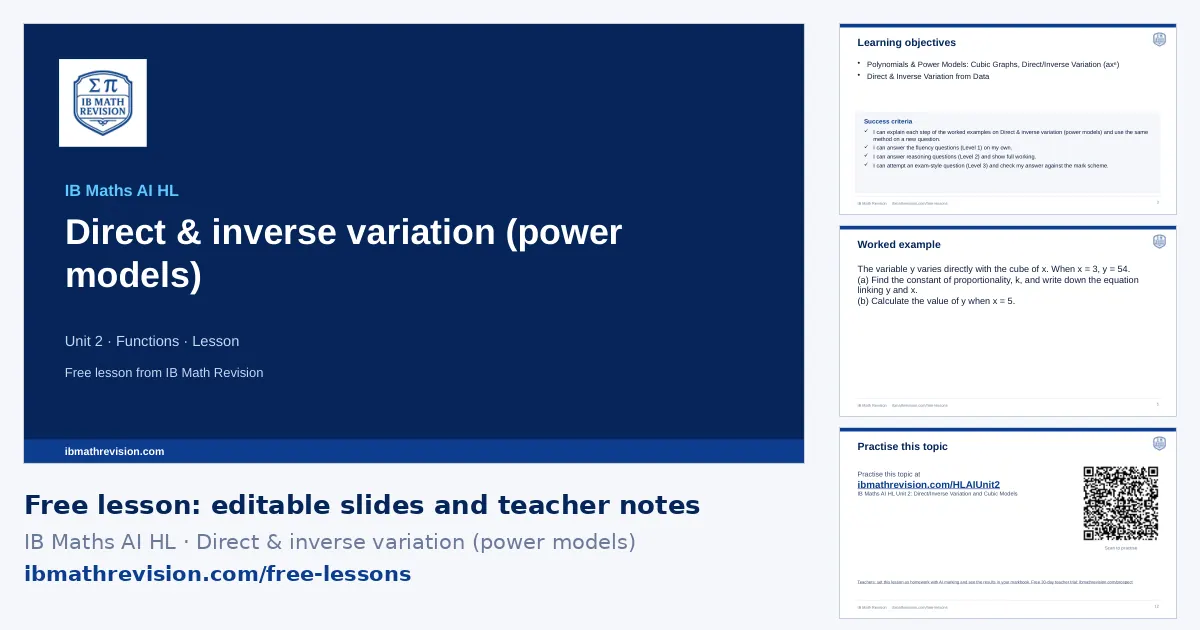
Free with a teacher account. Sign in with Google, Microsoft or email and download the slides and teacher notes.
What's inside
- Slides (PowerPoint, editable) · freeabout 12 slides: do now, objectives, key ideas, a worked example step by step, “your turn”, practice QR code, exit ticket
- Teacher notes (PDF) · freelesson plan with timings, common mistakes, homework links
- Worksheet (PDF) · school plans5 questions, 18 marks: Fluency, Reasoning, Exam-style. Included with school plans and the teacher trial.
- Answers (PDF) · school plansthe answer to every worksheet question, from its mark scheme. Included with school plans and the teacher trial.
Learning objectives
- Polynomials & Power Models: Cubic Graphs, Direct/Inverse Variation (axⁿ)
- Direct & Inverse Variation from Data
Key ideas on the slides
- Choose a model from the shape of the data and the context: linear (constant rate), quadratic (one turning point), exponential (constant percentage change), power y = axⁿ (variation), sinusoidal (periodic), logistic (growth with a limit).
- Fit the model with the matching regression on the GDC; write the equation with the parameters to 3 s.f.
- Judge the fit: R² (or r for a linear model) close to 1 means a good fit; the sum of squared residuals SSᵣₑₛ is smaller for a better fit.
- Check the model makes sense beyond the data (e.g. exponential growth cannot continue forever) and state a limitation.
By the end of the lesson, students should be able to answer a question like: The table shows a population over 6 years. Fit an exponential model and use it to predict the population in year 8. Comment on the reliability.
Key vocabulary
- model: A function used to describe a real situation.
- residual: The observed value minus the value predicted by the model.
- coefficient of determination: R²: the proportion of the variation in y explained by the model.
- directly proportional: y = kx: when one quantity is multiplied by a number, so is the other.
- constant of proportionality: The fixed number k in the formula.
Common mistakes this lesson tackles
- Modelling: regression on the GDC, r² for non-linear models, context of the variable. Use the GDC's regression for the model named. Compare non-linear fits with R² and quote both values. Define the variable ("t = years after 2010") before substituting, and answer the comparison the question actually asks.
- Choosing a model only from R² without looking at the context or the graph.
- Using r to judge a non-linear model.
- Extrapolating far beyond the data.
Calculator tips
- STAT → regression: LinReg, QuadReg, CubicReg, ExpReg, PwrReg, SinReg or Logistic; turn on diagnostics to see r and R².
- Store k in memory so later values are exact.
Lesson plan
| 0–5 min | Do now: students write down what they remember about Sinusoidal models and Domain, range, composite & inverse functions |
| 5–8 min | Share the learning objective and success criteria |
| 8–20 min | Teach: the worked example, step by step; students copy the method |
| 20–25 min | Your turn: 1 mini-whiteboard question; check every board before moving on |
| 25–42 min | Practise: the worksheet (5 questions in 3 levels, with school plans and the teacher trial) or the topic's practice questions online; move up a level after two right in a row |
| 42–47 min | Plenary: 1-question exit ticket; collect it to plan the next lesson |
For students: practise this topic
The worksheet's QR code opens the IB Maths AI HL Unit 2: Direct/Inverse Variation and Cubic Models practice questions.
What schools get
- Set this lesson as homework, marked by AI against the mark scheme, with every result in your markbook (with a School plan).
- This lesson's worksheet in three levels, with its answers, ready to print.
- Support, Core and Stretch versions and A/B copies of the worksheet from the full question bank, in the worksheet builder.
- Create lesson: this lesson rebuilt for your class's next scheme-of-work lesson, from the full bank.
School licences from €490 a year. Try everything free for 30 days as a teacher: no card.
Questions teachers ask
Is this lesson free?
The slides and the teacher notes are free to download with a free IB Math Revision teacher account (sign in with Google, Microsoft or email); no card. The printable worksheet in three levels and its answers are included with school plans and the free 30-day teacher trial.
Can I edit the slides?
Yes. The slides are an ordinary PowerPoint file: change, add or delete anything. They also open in Google Slides and Keynote. The logo and web address sit on the slide master, so your edits do not move them.
What do students use for homework?
The practice slide's QR code and web address take students to the IB Maths AI HL Unit 2: Direct/Inverse Variation and Cubic Models practice questions on ibmathrevision.com, where the free questions are open and the full bank comes with a plan.