Free IB Maths AI HL lesson: Domain, range, composite & inverse functions
A ready-to-teach IB Maths AI HL lesson on Domain, range, composite & inverse functions (Unit 2 · Functions): editable slides and teacher notes, free; a printable worksheet in 3 levels with answers for school plans. About 55 minutes.
Free with a teacher account. Sign in with Google, Microsoft or email and download the slides and teacher notes.
What's inside
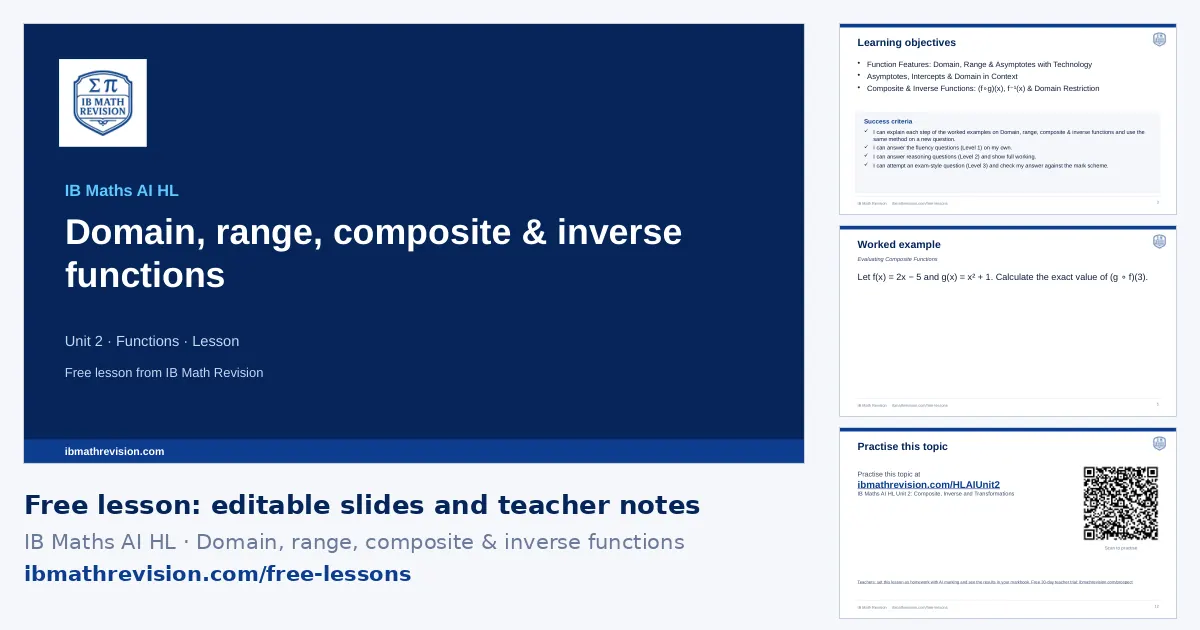
- Slides (PowerPoint, editable) · freeabout 12 slides: do now, objectives, key ideas, a worked example step by step, “your turn”, practice QR code, exit ticket
- Teacher notes (PDF) · freelesson plan with timings, common mistakes, homework links
- Worksheet (PDF) · school plans6 questions, 26 marks: Fluency, Reasoning, Exam-style. Included with school plans and the teacher trial.
- Answers (PDF) · school plansthe answer to every worksheet question, from its mark scheme. Included with school plans and the teacher trial.
Learning objectives
- Function Features: Domain, Range & Asymptotes with Technology
- Asymptotes, Intercepts & Domain in Context
- Composite & Inverse Functions: (f∘g)(x), f⁻¹(x) & Domain Restriction
Key ideas on the slides
- A function assigns exactly one output to each input; a vertical line meets its graph at most once.
- The domain is the set of allowed inputs; exclude values giving division by zero, the square root of a negative, or the log of a non-positive number.
- The range is the set of outputs: sketch the graph over the domain and read the y-values.
- Write domains and ranges with inequalities or intervals: x ≥ 2, 0 < y ≤ 5, {x: x ≠ 3}.
By the end of the lesson, students should be able to answer a question like: Find (f ∘ g)(x) and its inverse for f(x) = 2x + 1 and g(x) = x − 3.
Skills in this topic
Domain, range, composite & inverse functions breaks down into 3 skills. In the worksheet builder, teachers can set practice on just one of them.
- Domain & range
- Composite functions
- Inverse functions
Key vocabulary
- domain: The set of input values.
- range: The set of output values.
- one-to-one: Each output comes from exactly one input.
- many-to-one: Some outputs come from more than one input.
- composite function: A function applied to the output of another function.
Common mistakes this lesson tackles
- Giving the range in terms of x.
- Leaving out an end point or using < instead of ≤.
- Forgetting a restriction such as x > 0 for ln x.
- Applying f first in f ∘ g.
The worked example
Let f(x) = 2x − 5 and g(x) = x² + 1. Calculate the exact value of (g ∘ f)(3).
- Identify the correct order of operations: (g ∘ f)(3) is equivalent to g(f(3)).
- Evaluate the inner function first by substituting x = 3 into f(x): f(3) = 2(3) − 5.
- Calculate the result for f(3): 6 − 5 = 1.
- Substitute this result into the outer function g(x): g(1) = (1)² + 1.
- Calculate the final value to get 2.
Tip: A very common mistake is confusing (g ∘ f)(x) with the product g(x) × f(x). Always work from the inside bracket outwards.
Calculator tips
- Graph the function over its domain and use trace/min/max to see the range.
- Define f and g on the calculator and evaluate f(g(1)) to check.
Where this lesson fits
Domain, range, composite & inverse functions is in Unit 2 · Functions of the IB Maths AI HL scheme of work.
- The lesson before: Non-linear regression & residual analysis (scheme-of-work lessons: Piecewise Models: Linear Pieces & Continuity in Context; Non-Linear Regression: Least-Squares Models, SSres & R²)
- The next lesson: Direct & inverse variation (power models) (scheme-of-work lessons: Polynomials & Power Models: Cubic Graphs, Direct/Inverse Variation (axⁿ); Direct & Inverse Variation from Data)
Lesson plan
| 0–5 min | Do now: students write down what they remember about Key features of graphs & intersections with technology and Non-linear regression & residual analysis |
| 5–8 min | Share the learning objective and success criteria |
| 8–20 min | Teach: the worked example, step by step; students copy the method |
| 20–25 min | Your turn: 1 mini-whiteboard question; check every board before moving on |
| 25–42 min | Practise: the worksheet (6 questions in 3 levels, with school plans and the teacher trial) or the topic's practice questions online; move up a level after two right in a row |
| 42–47 min | Plenary: 1-question exit ticket; collect it to plan the next lesson |
For students: practise this topic
The worksheet's QR code opens the IB Maths AI HL Unit 2: Composite, Inverse and Transformations practice questions.
With a school plan
Set Domain, range, composite & inverse functions as homework marked by AI, print this lesson's levelled worksheet with answers, and rebuild the lesson for your class with Create lesson. Free for 30 days as a teacher, no card.
Is it free, can I edit the slides, what do students use for homework? See questions teachers ask.