Casio fx-CG50 lesson 9: Sequences, series and finance (TVM)
Sequences and finance questions reward speed: a sum is one Σ( line, a "how many years" question is one key in the Financial app. The marks are lost on signs and settings: a positive PV, a P/Y of 1 when payments are monthly, or a number of months given as years.
Objective
Add up a sequence in one line, find the first n that passes a value, and solve compound interest and loan questions in the Financial app with the right signs.
By the end, students can:
- use Σ( from OPTN F4 (CALC) F6 (▷) F3 for arithmetic and geometric sums
- use RECURSION with Σ Display to find the smallest n with Sₙ above a value
- fill in n, I%, PV, PMT, FV, P/Y and C/Y in the Financial app's compound interest screen
- use the sign rule: money you pay out is negative, money you receive is positive
- solve for FV, n, I% or PMT by pressing that F-key
Which courses this lesson suits
- IB Maths AI (SL and HL): every paper
- IB Maths AA (SL and HL): Papers 2 and 3
- A Level Maths (UK and IAL): calculator allowed in every paper
The Financial app (steps 4–6) is mainly for IB AI, where the TVM Solver is expected. Σ( and RECURSION (steps 1–3) suit every course with a calculator paper.
Before you start
Lessons 1, 2 and 7 first. For the Financial app check SET UP → Payment is End (the usual setting in exam questions).
The key presses, step by step
Every key is shown as it is printed on the calculator, like SHIFT or F1. The F-keys do whatever the bottom row of the screen says, so the picture next to each step shows that row.
MENU 1 (RUN-MATRIX). OPTN F4 (CALC) F6 (▷) F3 (Σ( ). Fill the template: the term 7 + 3(X − 1), the variable X, from 1 to 30. EXE: 1515.
That is the sum of the first 30 terms of 7, 10, 13, …
In linear input mode type Σ(7+3(X−1), X, 1, 30). The letter in the term and the counter must be the same.
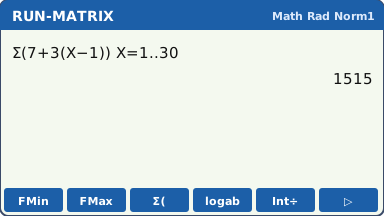
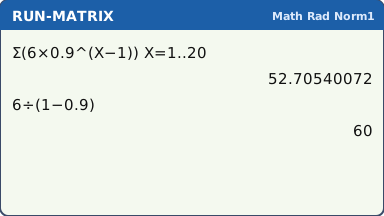
Σ( in Math input mode (the template shows the limits above and below the Σ) (our drawing of the fx-CG50 screen, not a photo). Geometric: Σ(6 × 0.9^(X − 1)) from X = 1 to 20 gives 52.70540072. Compare it with the sum to infinity, 6 ÷ (1 − 0.9) = 60.
Press ▲ and change the 20 to 50, then 100: the sums get closer and closer to 60. A quick check on any S∞ answer.
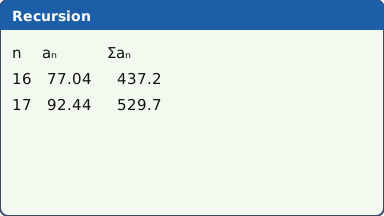
What the screen shows after this step (our drawing of the fx-CG50 screen, not a photo). Smallest n with RECURSION: MENU 8, F3 (TYPE) F1 (aₙ = An + B), type aₙ = 5 × 1.2^(n − 1) (n is on the F-key row in the aₙ editor: read the label there). Σ Display On in SET UP, F5 (SET) for n from 1 to 25, F6 (TABLE).
The Σaₙ column passes 500 between n = 16 (437.2106472) and n = 17 (529.6527767), so n = 17.
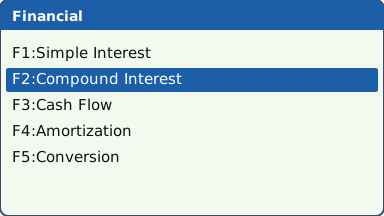
Cells shortened here; highlight one to read it in full (our drawing of the fx-CG50 screen, not a photo). Finance: MENU, highlight Financial and press EXE. Press F2 for compound interest.
Compound interest here covers savings with or without regular payments and loans: the same seven fields.
The Financial app's first screen (drawn as a list; read the labels on your own screen) (our drawing of the fx-CG50 screen, not a photo). £6000 invested at 3.8% a year, compounded monthly, for 5 years. Type n = 60 (months, not years), I% = 3.8, PV = −6000 (paid in, so negative), PMT = 0, FV = 0 for now, P/Y = 12, C/Y = 12, EXE after each.
Press F5 (FV): FV = 7253.319814.
PV and FV have opposite signs: money leaves you at the start and comes back at the end.
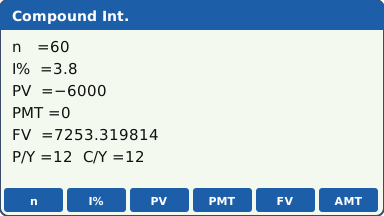
After F5 (FV): the answer fills the FV line (drawn here in place) (our drawing of the fx-CG50 screen, not a photo). How long until it reaches £10 000? EXIT back to the inputs, set FV = 10000, and press F1 (n): n = 161.5686331 months. So it passes £10 000 during month 162, in year 14.
A loan works the same way with the signs swapped: borrow £15 000 (PV = 15000) at 6.5% over 4 years (n = 48), FV = 0, then F4 (PMT): −355.7242939, negative because you pay it.
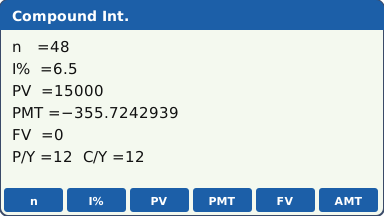
What the screen shows after this step (our drawing of the fx-CG50 screen, not a photo).
Your turn: check your understanding
Try these straight after the key presses, on your own calculator, before looking at the answers.
- Use Σ( to work out the sum of 2r + 5 for r = 1 to 12.
- In the Financial app (compound interest), $1200 is invested at 5% a year, compounded once a year, for 10 years. Find the final value. Which inputs are negative?
- £2000 is invested at 6% a year, compounded monthly. Use F1 (n) to find how many months it takes to double.
Show the answers
- 216
- $1954.67. PV = −1200 is negative (money paid in); FV comes out positive.
- n = 138.98 (138.975…), so it doubles during month 139.
Exam efficiency
- Before typing a single number, decide the period: monthly means n in months and P/Y = C/Y = 12.
- Sign rule: money out of your pocket is negative. Savings: PV negative, FV positive. Loans: PV positive, PMT negative.
- Answer "how many years" with a whole number of periods, rounded up, and say why: n = 161.6 months means the target is passed during month 162.
- Write the inputs you used in your working: "n = 60, I% = 3.8, PV = −6000, PMT = 0, P/Y = C/Y = 12 ⇒ FV = 7253.32". It earns the method mark even if a key slips.
- Money to 2 decimal places (or the currency's smallest unit); other answers to 3 s.f.
Worked exam-style example
Question. Ana invests $5000 at a nominal annual rate of 4.2%, compounded monthly. (a) Find the value of her investment after 6 years. (b) Find the number of complete years until the value first exceeds $8000. (c) Instead she takes a loan of $12 000 at 5.4% a year, compounded monthly, repaid with equal monthly payments over 3 years. Find the monthly payment and the total interest paid.
(a) Financial, F2: n = 72, I% = 4.2, PV = −5000, PMT = 0, P/Y = 12, C/Y = 12. F5 (FV): 6430.150467.
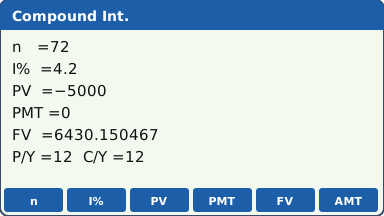
What the screen shows after this step (our drawing of the fx-CG50 screen, not a photo). (b) FV = 8000, then F1 (n): 134.5216162 months = 11.21013468 years. After 11 complete years it is not there yet, so the answer is 12 years.
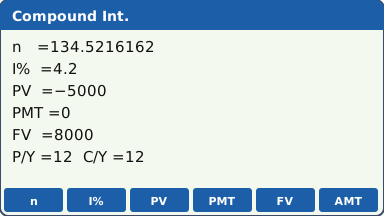
What the screen shows after this step (our drawing of the fx-CG50 screen, not a photo). (c) n = 36, I% = 5.4, PV = 12000, FV = 0, P/Y = C/Y = 12. F4 (PMT): −361.8098202, so she pays $361.81 a month. Total paid, using the rounded payment she actually pays: 36 × 361.81 = 13025.16, so the interest is 1025.16.
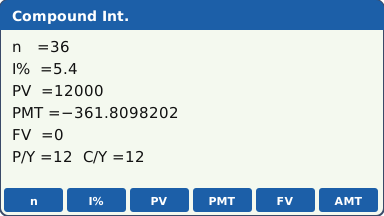
What the screen shows after this step (our drawing of the fx-CG50 screen, not a photo).
What to write down
(a) n = 72, I% = 4.2, PV = −5000, PMT = 0, P/Y = C/Y = 12 ⇒ FV = $6430.15.
(b) FV = 8000 ⇒ n = 134.5 months = 11.2 years, so 12 complete years.
(c) PMT = $361.81 a month; interest = 36 × 361.81 − 12 000 = $1025.16 (using the rounded payment).
Practice
Do these on your own calculator. Write the answers to 3 significant figures unless the task says otherwise.
- Find the sum of the first 15 terms of 3, 7, 11, 15, …
- Find Σ 3 × 2r−1 for r = 1 to 10.
- For the sequence 3, 7, 11, …, find the smallest n for which Sₙ > 1000.
- $2500 is invested at 3.5% a year, compounded quarterly, for 8 years. Find its final value.
- $4000 grows to $5000 in 6 years with interest compounded monthly. Find the nominal annual interest rate.
- A loan of $9000 at 7.2% a year, compounded monthly, is repaid monthly over 5 years. Find the monthly payment and the total amount repaid.
Show the practice answers
- Σ(4X − 1) from 1 to 15 = 465
- 3069
- n = 23 (S₂₂ = 990, S₂₃ = 1081)
- n = 32, P/Y = C/Y = 4: FV = $3303.80
- I% = 3.72%
- PMT = $179.06; total = 60 × 179.06 = $10743.60 (using the rounded payment)
Common mistakes
- n in years when the payments are monthly: n = 5 instead of 60.
- P/Y and C/Y left at 1 from an earlier question: always check the last line before solving.
- PV and FV with the same sign: the calculator gives an error or a nonsense answer.
- Rounding n down: 161.6 months means the target is reached during month 162, not the month before.
- In Σ(, a different letter in the term and the counter (Σ(3N + 2, X, 1, 20) treats N as a constant).
- Using the sum to infinity when |r| ≥ 1: the sums grow without limit.
1-minute quick check
Answer these without looking back. Most need no calculation: they check that the key presses have stuck.
- Which keys reach Σ( in RUN-MATRIX?
- Savings: is PV positive or negative?
- Monthly payments for 4 years: what are n and P/Y?
- Which F-key solves for the number of periods?
- In RECURSION, how do you see the running total?
Show the quick-check answers
- OPTN F4 (CALC) F6 (▷) F3
- Negative (money paid in).
- n = 48, P/Y = 12
- F1 (n)
- Turn on Σ Display in SET UP.
Teaching this lesson (about 55 minutes)
| 0–5 min | Starter: how many months in 5 years? If you save, does money leave or arrive? Agree the sign rule. |
| 5–15 min | Steps 1–3: Σ( for arithmetic and geometric sums, checking S∞, and RECURSION for smallest n. |
| 15–28 min | Steps 4–6: the Financial app. Savings (find FV), time (find n, round up), loans (find PMT). |
| 28–38 min | Worked example (a)–(c), writing the inputs as working. |
| 38–52 min | Practice tasks 1–6. |
| 52–55 min | 1-minute quick check. |
Students need their own fx-CG50. With a projector, the calculator-skills guides below have a Show on the board view and an animated walkthrough of the key presses.
Matching calculator guides
- How to find terms and sums of sequences on the Casio fx-CG50, TI-84 Plus CE and TI-Nspire CX II
- How to use the finance (TVM) solver on the Casio fx-CG50, TI-84 Plus CE and TI-Nspire CX II
- How to make a table of values on the Casio fx-CG50, TI-84 Plus CE and TI-Nspire CX II