Casio fx-CG50 lesson 11: Distributions: normal, binomial, Poisson, tests and intervals
Every probability distribution question uses the same menu, STAT → DIST, and the same few traps: σ typed before μ, a missing 1E99 for an open tail, and P(X ≥ k) for a binomial. This lesson drills them, then adds the AI HL tests and intervals.
Objective
Find any normal, binomial or Poisson probability, and any inverse normal value, in under a minute, with the parameters in the right order; then run a χ² goodness of fit test and a t-interval.
By the end, students can:
- find P(a < X < b) for a normal distribution with Ncd, typing σ before μ
- use ±1E99 for an open tail and Tail Left or Right in InvN
- use Bpd for P(X = x) and Bcd with Lower and Upper for any range of a binomial
- find Poisson probabilities with Ppd and Pcd
- run a χ² goodness of fit test and a t-interval, and read a p-value shown in E notation
Which courses this lesson suits
- IB Maths AA (SL and HL): Papers 2 and 3
- IB Maths AI (SL and HL): every paper
- IB Maths AI HL
- A Level Maths (UK and IAL): calculator allowed in every paper
Normal and binomial: every course listed. Poisson, the χ² goodness of fit test and the t-interval (steps 6 and 7, practice task 6): IB AI HL. A Level uses the normal and binomial steps (and the normal for hypothesis tests).
Before you start
Check the SET UP of STATISTICS is the same as RUN-MATRIX. No angle mode is needed here, but a student who does not know where F5 (DIST) is will lose time: open it once before the lesson starts.
The key presses, step by step
Every key is shown as it is printed on the calculator, like SHIFT or F1. The F-keys do whatever the bottom row of the screen says, so the picture next to each step shows that row.
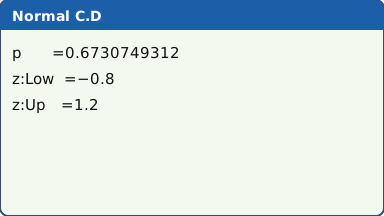
MENU 2 (STATISTICS), then F5 (DIST) F1 (NORM) F2 (Ncd). For X ~ N(64, 5²) and P(60 < X < 70): Data Variable, Lower 60, Upper 70, σ 5, μ 64, with EXE after each. Move down to Execute and press EXE.
The calculator asks for σ before μ. Typing 64 then 5 finds a different distribution and gives no warning.
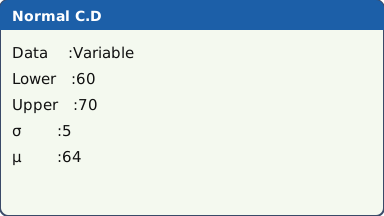
Normal C.D: σ comes before μ (our drawing of the fx-CG50 screen, not a photo). The result: p = 0.6730749312. The screen also shows the z-values of the bounds, −0.8 and 1.2.
For an open tail use a huge bound: P(X > 72) is Lower 72, Upper 1E99 (type 1 ×10ˣ 99), giving 0.0547992917. P(X < 72) is Lower −1E99, Upper 72.
What the screen shows after this step (our drawing of the fx-CG50 screen, not a photo). Inverse normal: F5 (DIST) F1 (NORM) F3 (InvN). For P(X < k) = 0.9: Tail Left, Area 0.9, σ 5, μ 64, Execute: k = 70.40775783.
For P(X > k) = 0.1 choose Tail Right and Area 0.1: the same k, 70.40775783, with no 1 − 0.1 step.
Tail can be Left, Right or Central. Match it to the inequality in the question.
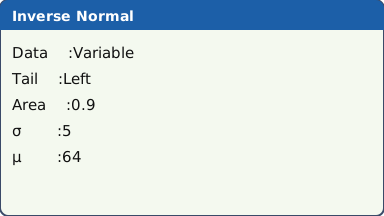
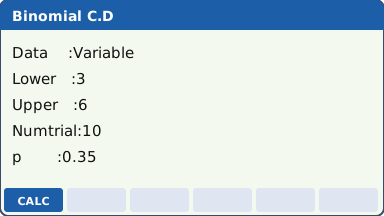
InvN: the result is xInv = 70.40775783 (our drawing of the fx-CG50 screen, not a photo). Binomial: F5 (DIST) F5 (BINOMIAL). For X ~ B(10, 0.35): F1 (Bpd) with x 4, Numtrial 10, p 0.35 gives P(X = 4) = 0.2376684928.
F2 (Bcd) takes a Lower and an Upper value: Lower 3, Upper 6 gives P(3 ≤ X ≤ 6) = 0.7123683281. For P(X ≥ 3) use Lower 3, Upper 10.
With Lower and Upper you rarely need 1 − P(…). Write the inequality first, then read Lower and Upper off it.
What the screen shows after this step (our drawing of the fx-CG50 screen, not a photo). Poisson: F5 (DIST) F6 (▷) F1 (POISSON). For X ~ Po(3.2): F1 (Ppd) with x 2 and μ 3.2 gives P(X = 2) = 0.2087024844; F2 (Pcd) with Lower 0, Upper 4 gives P(X ≤ 4) = 0.7806125111.
The calculator calls the Poisson mean μ; the IB writes m or λ.
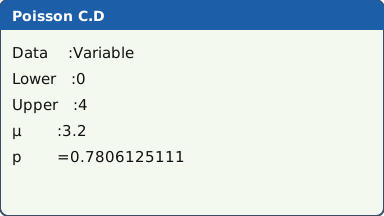
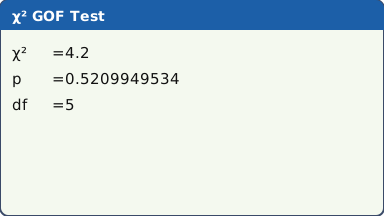
Poisson C.D: the input lines and, after Execute, p (our drawing of the fx-CG50 screen, not a photo). AI HL, χ² goodness of fit. A die is rolled 60 times: observed 8, 12, 9, 11, 6, 14. Put the observed values in List 1 and the expected values (10 each) in List 2.
F3 (TEST) F3 (CHI) F1 (GOF). Observed List1, Expected List2, df 5 (6 classes − 1), then Execute: χ² = 4.2, p = 0.5209949534.
p > 0.05, so there is not enough evidence at the 5% level that the die is biased. A small p-value often shows in E notation: 4.2056E−03 means 0.0042056.
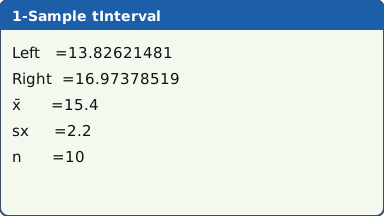
What the screen shows after this step (our drawing of the fx-CG50 screen, not a photo). AI HL, t-interval from summary statistics: F4 (INTR) F2 (t) F1 (1-SAMPLE). Data Variable, C-Level 0.95, x̄ 15.4, sx 2.2, n 10, Execute: the interval is 13.82621481 to 16.97378519.
C-Level is a decimal (0.95, not 95). With the data in a list, choose Data: List instead.
What the screen shows after this step (our drawing of the fx-CG50 screen, not a photo).
Your turn: check your understanding
Try these straight after the key presses, on your own calculator, before looking at the answers.
- X ~ N(50, 4²). Find P(X > 55) with Ncd. Which number goes in first, σ or μ?
- X ~ B(8, 0.5). Find P(X ≤ 3) with Bcd.
- X ~ N(50, 4²). Find k such that P(X < k) = 0.05 with InvN.
Show the answers
- 0.106. σ goes in before μ: σ 4, μ 50.
- 0.363
- k = 43.4
Exam efficiency
- Write the probability statement first (P(X > 160)), then fill Lower and Upper from it.
- Store a probability you need again. In RUN-MATRIX the same functions are under OPTN F5 (STAT) F3 (DIST): NormCD(160, 1E99, 9, 152) → A keeps every digit.
- Read E notation carefully: a p-value of 3.2E−04 is 0.00032, far below 0.05.
- Sense-check: a probability is between 0 and 1, and an inverse normal value for an area above 0.5 is above the mean.
Worked exam-style example
Question. The masses X g of apples follow X ~ N(152, 9²). (a) Find P(X > 160). (b) Find k such that P(X < k) = 0.05. (c) Twelve apples are chosen at random. Find the probability that at most 2 of them weigh more than 160 g.
(a) F5 (DIST) F1 (NORM) F2 (Ncd): Lower 160, Upper 1E99, σ 9, μ 152, Execute: 0.1870313987.
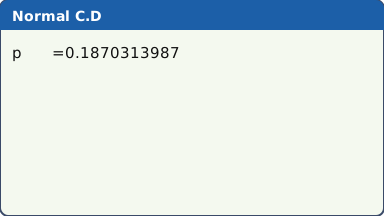
What the screen shows after this step (our drawing of the fx-CG50 screen, not a photo). (b) F3 (InvN): Tail Left, Area 0.05, σ 9, μ 152, Execute: k = 137.1963174.
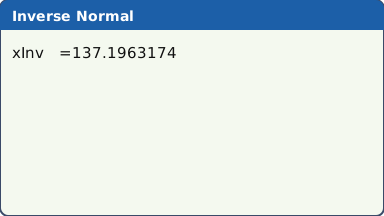
What the screen shows after this step (our drawing of the fx-CG50 screen, not a photo). (c) Y ~ B(12, p) with p from (a). Store it first: in RUN-MATRIX, NormCD(160, 1E99, 9, 152) → ALPHA X,θ,T (A) EXE. Then STAT → F5 (DIST) F5 (BINOMIAL) F2 (Bcd): Lower 0, Upper 2, Numtrial 12, p = A (type ALPHA X,θ,T in the p field). Execute: 0.6045870584.
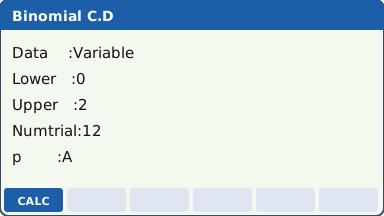
What the screen shows after this step (our drawing of the fx-CG50 screen, not a photo).
What to write down
(a) P(X > 160) = 0.187.
(b) P(X < k) = 0.05, so k = 137 g.
(c) Y ~ B(12, 0.187…), P(Y ≤ 2) = 0.605. Write the distribution and the inequality, not "Bcd".
Practice
Do these on your own calculator. Write the answers to 3 significant figures unless the task says otherwise.
- X ~ N(20, 3²). Find P(18 < X < 25).
- X ~ N(20, 3²). Find k such that P(X < k) = 0.75.
- X ~ N(100, 15²). Find k such that P(X > k) = 0.1 (use Tail Right).
- X ~ B(15, 0.4). Find P(X = 6) and P(X ≥ 8).
- X ~ Po(2.6). Find P(X ≤ 3).
- (AI HL) A sample of 12 has x̄ = 48.2 and sx = 3.1. Find a 95% confidence interval for the mean.
Show the practice answers
- 0.700
- 22.0
- 119
- P(X = 6) = 0.207, P(X ≥ 8) = 0.213 (Bcd with Lower 8, Upper 15)
- 0.736
- 46.2 to 50.2
Common mistakes
- μ typed before σ: the Casio order is σ, then μ.
- Leaving out 1E99 (or −1E99) for an open tail, or typing 99 instead of 1E99.
- P(X ≥ 8) done as Lower 0, Upper 8: that is P(X ≤ 8). Use Lower 8, Upper n.
- Using a rounded p from an earlier part in a binomial: store it instead.
- Reading 4.2E−03 as 4.2: look for the E at the end of the number.
- C-Level typed as 95 instead of 0.95.
1-minute quick check
Answer these without looking back. Most need no calculation: they check that the key presses have stuck.
- Which comes first in Ncd: σ or μ?
- What Upper value gives P(X > a)?
- Which binomial function has Lower and Upper?
- Where is POISSON in DIST?
- What does p = 3.2E−04 mean?
Show the quick-check answers
- σ
- 1E99 (1 ×10ˣ 99)
- Bcd (F2)
- F6 (▷) F1 (POISSON)
- 0.00032
Teaching this lesson (about 55 minutes)
| 0–5 min | Starter: X ~ N(64, 5²). Two students type σ and μ in different orders. Compare the answers. |
| 5–20 min | Steps 1–3: Ncd, open tails with 1E99, InvN with Tail Left and Right. |
| 20–30 min | Steps 4–5: binomial and Poisson. Students say the Lower and Upper for P(X ≥ 3), P(X < 3), P(2 < X ≤ 5). |
| 30–38 min | Worked example: normal into binomial, storing p. |
| 38–50 min | Practice tasks 1–5 (AI HL: 6, then steps 6–7 as an extension). |
| 50–55 min | 1-minute quick check. |
Students need their own fx-CG50. With a projector, the calculator-skills guides below have a Show on the board view and an animated walkthrough of the key presses.
Matching calculator guides
- How to do a normal distribution (normal cdf and inverse normal) on the Casio fx-CG50, TI-84 Plus CE and TI-Nspire CX II
- How to do binomial and Poisson probabilities (pdf and cdf) on the Casio fx-CG50, TI-84 Plus CE and TI-Nspire CX II
- How to do a t-test and a χ² test on the Casio fx-CG50, TI-84 Plus CE and TI-Nspire CX II
- How to find a confidence interval for a mean on the Casio fx-CG50, TI-84 Plus CE and TI-Nspire CX II