How to draw trig graphs and read off max, min and solutions on the Casio fx-CG50, TI-84 Plus CE and TI-Nspire CX II
On the fx-CG50: MENU → 5 (GRAPH) … SHIFT F5 (G-SOLVE).On the TI-84 Plus CE: 2nd trace (CALC).On the TI-Nspire CX II: menu → Analyze Graph → Maximum.
Graph y = a sin(bx) + d in the right angle mode, read off the maximum, minimum and period, and solve trig equations in an interval. Exact keystrokes for the fx-CG50 first, then the other calculators, a worked example you can check your answers against, the mistakes that cost marks, and the same thing in Desmos.
When you need it
Circular functions in AA (amplitude, period, solving in an interval) and sinusoidal models in AI (tide heights, temperatures, a Ferris wheel). Most of these are in radians; the calculator's angle mode is the first thing to check.
Practise it: SL AA trigonometric functions · SL AI sinusoidal modelling.
Which IB course and paper
| Course | GDC papers | What you use it for |
|---|---|---|
| AA SL | Paper 2 (Paper 1 is calculator-free) | Graphs of sin, cos and tan, amplitude and period, and solving trig equations in an interval on Paper 2. |
| AA HL | Papers 2 and 3 (Paper 1 is calculator-free) | As SL, with harder transformed graphs and equations. |
| AI SL | Papers 1 and 2 | Sinusoidal models y = a sin(b(x − c)) + d: amplitude, period, maximum and minimum. |
| AI HL | Papers 1, 2 and 3 | As SL, fitted to seasonal and periodic data. |
A GDC is allowed on every AI paper and on AA Papers 2 and 3; AA Paper 1 is calculator-free, so learn the method by hand as well.
Topic notes: Solving trigonometric equations in a given interval (AA SL) · Sinusoidal models for periodic data (AI SL) · Sinusoidal modelling with seasonal data (AI HL).
Keystrokes on your calculator
Pick your calculator: the page remembers it next time.
Trig graphs and angle mode on the Casio fx-CG50
Written for OS 3.80 (menus unchanged from OS 3.60 onwards as far as we can tell). Casio fx-CG50: graphic (GDC).
- Angle mode: SHIFT MENU (SET UP), move down to Angle, choose Rad (Deg for a question in degrees), EXIT.
- MENU 5 (GRAPH). Y1 = 3 sin(2X) + 1 EXE, Y2 = 2 EXE.
- SHIFT F3 (V-WINDOW): F2 (TRIG) gives a trig window for the angle mode, or type Xmin 0, Xmax π, Ymin −3, Ymax 5. EXIT, then F6 (DRAW).
- SHIFT F5 (G-SOLVE): F2 (MAX) and F3 (MIN) for the turning points; F5 (INTSECT) for where Y1 meets Y2, and ► for the next one.
- The angle unit shows in the status bar (Rad or Deg). A flat or squashed curve usually means the wrong mode.
Trig graphs and angle mode on the TI-84 Plus CE
Written for OS 5.8.x. TI-84 Plus CE: graphic (GDC); also the TI-84 Plus CE Python / CE-T Python Edition.

- mode: choose RADIAN (DEGREE for a question in degrees), enter.
- y=: Y1 = 3sin(2X) + 1, Y2 = 2.
- zoom 7: ZTrig, or window: Xmin 0, Xmax π, Ymin −3, Ymax 5, then graph.
- 2nd trace (CALC): 4: maximum, 3: minimum, 5: intersect. Answer Left Bound?, Right Bound? and Guess? (for intersect: first curve, second curve, Guess?).
- The status bar shows RADIAN or DEGREE: check it before the first trig question.
Trig graphs and angle mode on the TI-Nspire CX II
Written for OS 6.x. TI-Nspire CX II: graphic (GDC), non-CAS; the CX II CAS is not allowed in IB, A Level or IGCSE exams.

- Angle mode: home/on → Settings → Document Settings → Angle: Radian (or Degree).
- Add a Graphs page: f1(x) = 3·sin(2x) + 1, f2(x) = 2.
- menu → Window/Zoom (menu 4) → Window Settings: x from 0 to π, y from −3 to 5.
- menu → Analyze Graph → Maximum, Minimum or Intersection, then click a lower and an upper bound either side of the point.
For teachers: Show on the board Print a keystroke card Teaching GDC skills
Worked example
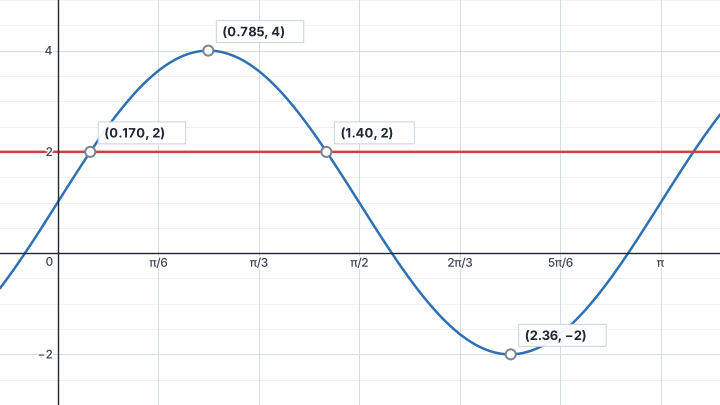
y = 3 sin(2x) + 1 for 0 ≤ x ≤ π (x in radians). Find (a) the maximum and minimum points, (b) the solutions of 3 sin(2x) + 1 = 2.
Answers (checked with Python)
(a) Maximum (0.785, 4) at x = π⁄4; minimum (2.36, −2) at x = 3π⁄4. The amplitude is 3 and the period is π. (b) x = 0.170 and x = 1.40.
Common calculator mistakes
- Degree mode for a radian question (or the other way round): the graph looks like a flat line or a dense zigzag, and every value is wrong.
- Not using the interval: the calculator shows every solution on screen, the question wants only those in 0 ≤ x ≤ π (or 0° ≤ x ≤ 360°).
- Period of sin(bx): it is 2π ÷ b (360° ÷ b), not 2π × b.
- Missing brackets: sin 2x + 1 typed as sin(2x + 1) moves the graph instead of the line.
- Giving decimals when the question says exact: π⁄4 and 3π⁄4, not 0.785 and 2.36.
- Angle mode: calculus with trig functions (and most AA trig) needs radians; bearings and triangle questions use degrees. Check the mode before the first trig question of the paper.
- Accuracy: unless the question says otherwise, IB markschemes want answers exact or to 3 significant figures. Keep the full calculator value for later parts and round only the answer you write down (x = 2.094551… is written 2.09, not 2.1 or 2.0946).
If you get an error
fx-CG50: Ma ERROR
Ma ERROR Casio's Math ERROR: the result is outside the allowable calculation range, or you are trying to do an illegal mathematical operation, such as dividing by zero. Check: Look for a zero denominator, sin⁻¹ or cos⁻¹ of a number bigger than 1 (often a wrong side or angle in the sine or cosine rule), the log of 0 or of a negative number, and a value stored in a variable earlier that you forgot about. Fix: Casio's advice: check your input values and change them so the result is within the allowable range.
TI-84 Plus CE: ERR:DOMAIN, ERR:INVALID DIM, ERR:SYNTAX
ERR:DOMAIN A value given to a function or instruction is outside the values it accepts. In a regression, TI says it means the data do not suit the model you chose. Check: Is every input allowed? σ must be positive, p between 0 and 1, and sin⁻¹ or cos⁻¹ needs a number from −1 to 1. Exponential and power models need positive data. Fix: Change the value that is out of range, or choose a model that suits the data.
ERR:INVALID DIM TI's knowledge base: one or more stat plots are turned on, but the lists they use are empty. Check: A stat plot left on from a statistics question, so the error appears when you graph a function. Fix: Turn off the stat plots you are not using, or put the data back in the lists.
ERR:SYNTAX The command contains a syntax error: a misplaced function, argument, bracket or comma. Check: TI points out that subtract − and negative (−) are different keys, and using the wrong one causes this error. Then check the brackets and commas. Fix: Find the misplaced function, argument, bracket or comma and correct it.
TI-Nspire CX II: Domain error, Syntax error
Domain error An argument must be in a specified domain, and this one is not (TI's example: rand(0)). Check: Is every input allowed? σ must be positive, p between 0 and 1, and sin⁻¹ or cos⁻¹ needs a number from −1 to 1. Fix: Change the value that is out of range.
Syntax error The syntax checker found a problem. Check: A missing bracket or comma. Fix: Correct the expression and try again.
Do it in Desmos
Not in the exam. Desmos is not an approved calculator for IB exams, so never rely on it for Paper 2. It is excellent for learning, checking a GDC answer and building graphs for your Internal Assessment (IA).
- Desmos works in radians unless you switch to degrees with the wrench (Graph Settings).
- Type y = 3sin(2x) + 1 and y = 2, and restrict the curve with {0 ≤ x ≤ π}.
- Click the curve for the maximum and minimum, and the crossings for the solutions.
Open desmos.com/calculator (free, in any browser) and type:
y=3sin(2x)+1{0≤ x≤pi}y=2
Questions
Can I use a calculator for trig graphs and angle mode in the exam?
In IB Maths you can use one approved GDC on every AI paper and on AA Papers 2 and 3, in exam mode. AA Paper 1 is calculator-free, so learn the method by hand as well.
What are the fx-CG50 keystrokes for trig graphs and angle mode?
Angle mode: SHIFT MENU (SET UP), move down to Angle, choose Rad (Deg for a question in degrees), EXIT. Then MENU 5 (GRAPH). Y1 = 3 sin(2X) + 1 EXE, Y2 = 2 EXE. Then SHIFT F3 (V-WINDOW): F2 (TRIG) gives a trig window for the angle mode, or type Xmin 0, Xmax π, Ymin −3, Ymax 5. EXIT, then F6 (DRAW). The full steps and the other calculators are in the keystrokes section above.
Does this work on other calculators?
Yes. This page has keystrokes for the Casio fx-CG50, TI-84 Plus CE and TI-Nspire CX II. The worked example has the same answers on every model, so use it to check.
What should I write as working?
Write the maths, not the key presses: say what you are finding in normal notation (the equation, the probability statement or the integral), then the calculator's answer exact or to 3 significant figures unless the question says otherwise. Keep full accuracy in later parts.
More calculator skills
What else is free here
- Every syllabus topicA page for each AA and AI sub-topic, with exam-style questions and mark schemes.
- GDC keystrokes by topicTI-Nspire and Casio fx-CG50 guides for the calculator papers.
- Casio fx-CG50 guideEvery menu you need for IB Maths and the exam traps, on one page.
- Free formula sheets (PDF)One page per course, marking which formulas are not in the IB booklet.
Save your scores and practise the questions that use thisA free account remembers the questions you have done and brings you back to this page.
Join freeAlready have an account? Sign in
Sources
- Casio fx-CG50 Software User's Guide, OS 3.70 (PDF) : Casio fx-CG50, OS 3.80 (menus unchanged from OS 3.60 onwards as far as we can tell).
- TI-84 Plus CE guidebook (Texas Instruments) : TI-84 Plus CE, OS 5.8.x.
- TI-Nspire CX II guidebooks (Texas Instruments) : TI-Nspire CX II, OS 6.x.
- Desmos Help Center for the Desmos functions.
Menu names are taken from each manufacturer's manual for the models shown. Menus can move slightly between OS updates: if a screen looks different on yours, the manual for your version is the reference, and please tell us so we can update this page. A calculator with no tab here has no checked steps for this skill yet. Worked-example answers were recomputed independently in Python.