Home › IB Maths AA SL › Exam practice › Trigonometric Functions

IB Maths AA SL · Unit 3

Trigonometric Functions: AA SL exam practice with markscheme

Covers modelling with sinusoidal functions; trig graphs: amplitude, period, phase shift. Work through the 10 questions on paper as if it were the exam, then open each solution and mark your work against the markscheme.

10 questions · 50 marks · about 56 minutes · 5 Paper 1 style, 5 Paper 2 style

Download the PDF 7 pages, worked solutions after the questions

Question 1

4 marks · Paper 1 style · no calculator

The graph of y=asin⁡(bx)+c, where a,b>0, has a maximum value of 7, a minimum value of −1 and period 4π.

Find the values of a, b and c. [4]

Show solution

a=7−(−1)2=4 A1

c=7+(−1)2=3 A1

2πb=4π (M1)

b=12 A1

Answer: a=4, b=12, c=3

Question 2

4 marks · Paper 1 style · no calculator

Let f(x)=3cos⁡(2x)+1.

(a) Write down the amplitude of f. [1]

(b) Find the period of f. [1]

(c) Write down the range of f. [2]

Show solution

(a)

3 A1

(b)

2π2=π A1

(c)

−2≤f(x)≤4 A1A1

Answer: (a) 3; (b) π; (c) −2≤f(x)≤4

Question 3

5 marks · Paper 2 style · calculator

The height, h in metres, of a passenger on a Ferris wheel above the ground is modelled by the function: h(t)=20sin⁡(π30t−π2)+25 where t is the time in seconds after the ride begins.

  1. Find the maximum height and the minimum height of the passenger above the ground.

  2. Calculate the time it takes for the Ferris wheel to complete exactly one full revolution.

[5]

Show solution
  1. The principal axis is 25 m and the amplitude is 20 m. (M1)
    Max height =d+a=25+20=45 m. A1
    Min height =d−a=25−20=5 m. A1

  2. The time for one revolution is the period of the function. (M1)
    Period =2πb=2ππ/30=2π×30π=60.
    Time =60 seconds (or 1 minute). A1

Answer: (Maximum) 45 m; (Minimum) 5 m; (b) 60seconds

Question 4

4 marks · Paper 1 style · no calculator

Let g(x)=2sin⁡(x−π4), for 0≤x≤2π.

(a) Find the x-intercepts of the graph of g. [2]

(b) Write down the coordinates of the maximum point. [2]

Show solution

(a)

x−π4=0, π (M1)

x=π4, 5π4 A1

(b)

(3π4, 2) A1A1

Answer: (a) x=π4, 5π4; (b) (3π4, 2)

Question 5

5 marks · Paper 1 style · no calculator

The graph of y=tan⁡(x2) is shown below for 0≤x≤4π.

  1. State the period of the function.

  2. Write down the exact equations of the two vertical asymptotes shown in the domain 0≤x≤4π.
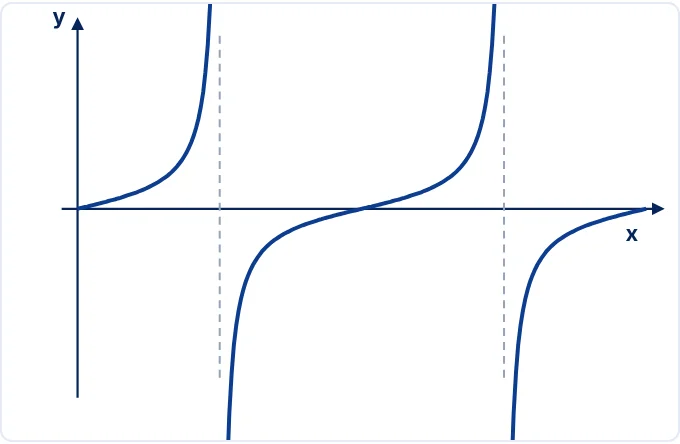
Diagram for Question 5

[5]

Show solution
  1. For y=tan⁡(bx) the period is πb, here with b=12: (M1)
    Period =π1/2=2π. A1

  2. Vertical asymptotes occur where x2=π2+kπ, i.e. x=π+2kπ. (M1)
    In 0≤x≤4π: x=π A1
    and x=3π. A1

Answer: (a) 2π; (b) x=π,x=3π

Question 6

5 marks · Paper 2 style · calculator

The depth of water in a harbour, d metres, t hours after midnight is modelled by d(t)=1.8cos⁡(πt6)+4.2, for 0≤t≤12.

(a) Write down the maximum depth. [1]

(b) Find the times when the depth is 5 m. [3]

(c) Find the length of time for which the depth is less than 5 m. [1]

Show solution

(a)

6 m A1

(b)

1.8cos⁡(πt6)+4.2=5 (M1)

t=2.12 A1

t=9.88 A1

(c)

9.879…−2.120…=7.76 hours A1

Answer: (a) 6 m; (b) t=2.12 and t=9.88 hours; (c) 7.76 hours

Question 7

5 marks · Paper 1 style · no calculator

Let f(x)=2sin⁡(3x), for 0≤x≤π.

(a) Write down the period of f. [1]

(b) Solve f(x)=1. [4]

Show solution

(a)

2π3 A1

(b)

sin⁡3x=12, with 0≤3x≤3π M1

3x=π6, 5π6, 13π6, 17π6 A1

x=π18, 5π18, 13π18, 17π18 A2

Answer: (a) 2π3; (b) x=π18, 5π18, 13π18, 17π18

Question 8

6 marks · Paper 2 style · calculator

A Ferris wheel with a diameter of 80 m rotates at a constant speed. The bottom of the wheel is 4 m above the ground. The wheel completes one full revolution in 20 minutes. After t minutes, the height of a seat above the ground is given by h(t)=44−acos⁡(π10t).

  1. Find the value of a.
  2. Find the first time t when the seat is exactly 60 m above the ground.

[6]

Show solution
  1. a is the amplitude, which equals the radius: a=802 (M1)
    a=40 A1

  2. Set up the equation: 44−40cos⁡(π10t)=60 M1
    cos⁡(π10t)=44−6040=−0.4 A1
    Inverse cosine (or GDC) for the first positive solution: π10t=1.9823… (M1)
    t=6.31 minutes (3 s.f.) A1

Answer: (a) a=40; (b) t=6.31

Question 9

6 marks · Paper 2 style · calculator

The number of hours of daylight, S, in a northern city throughout the year is modelled by S(t)=3.5sin⁡(2π365(t−80))+12, where t is the number of days after January 1st (1≤t≤365).

  1. Find the maximum number of hours of daylight, and the day of the year t on which it occurs.

  2. A certain crop can only be successfully grown during the part of the year when there are strictly more than 14 hours of continuous daylight. Use your GDC to find the total number of consecutive days this crop can be grown.

[6]

Show solution
  1. Maximum daylight =d+a=12+3.5=15.5 hours. A1
    This occurs when the sine function equals 1: (M1)
    2π365(t−80)=π2⟹t−80=3654=91.25 (M1)
    t=171.25, so it occurs on day t=171. A1

  2. Solve 3.5sin⁡(2π365(t−80))+12=14 with the GDC (G-Solv -> ISCT). (M1)
    t1=115.33…, t2=227.16…, so S>14 for 115.33<t<227.17.
    Whole days in this interval: t=116,117,…,227, giving 227−116+1=112 days. A1
    (Accept an interval length of 111.8 days.)

Answer: (Maximum) 15.5hours; (Day) t=171; (b) 112days

Question 10

6 marks · Paper 2 style · calculator

The temperature in a town, T∘C, t hours after midnight is modelled by T(t)=Acos⁡(B(t−C))+D, where A,B>0 and 0≤C<24. The highest temperature is 28∘C at 14:00 and the lowest is 12∘C at 02:00. The pattern repeats every 24 hours.

(a) Find the values of A, B, C and D. [4]

(b) Find the temperature at 09:00. [2]

Show solution

(a)

A=8 A1

D=20 A1

B=2π24=π12 A1

C=14 A1

(b)

8cos⁡(π12(9−14))+20 (M1)

22.1∘C A1

Answer: (a) A=8, B=π12, C=14, D=20; (b) 22.1∘C

How the marks work: M marks are for a correct method, A marks for an accurate answer that follows it, R marks for a reason, and AG means the answer is given in the question. A mark in brackets, like (M1), can be implied by later correct work.

Notes, worked examples and more questions on this topic: AA SL Trigonometric Functions. Previous topic: The unit circle and exact values of trigonometric ratios. Next topic: Trigonometric Identities. Every AA SL topic.

Revise first with the AA SL revision notes, then finish on real papers: IB Maths AA SL past papers.