Scalar Products and Voronoi: AI HL exam practice with markscheme
Covers geometric transformations with matrices; dot product & angle between vectors. Work through the 10 questions on paper as if it were the exam, then open each solution and mark your work against the markscheme.
10 questions · 39 marks · about 47 minutes · 10 Paper 1 style, 0 Paper 2 style
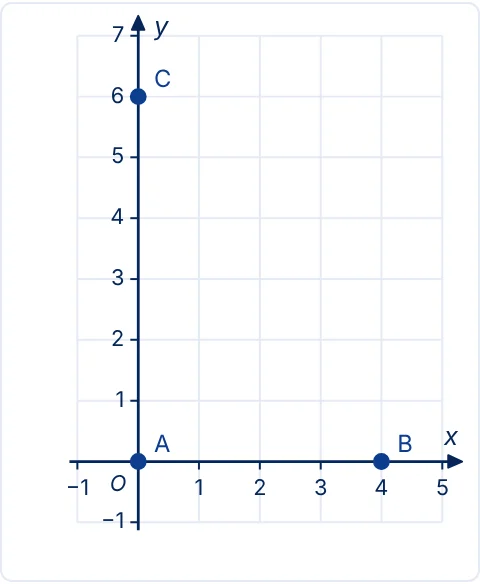
Three sites ,, and are used to form a Voronoi diagram on a 2D plane. Find the exact coordinates of the Voronoi vertex formed between these three sites.
[3]
Show solution
The Voronoi vertex is equidistant from all three sites, so it lies on the perpendicular bisectors of and M1 Bisector of (midpoint ): ; bisector of (midpoint ): A1 Intersection: A1
Answer:
Question 2
4 marks · Paper 1 style · calculator allowed
Calculate the exact scalar (dot) product of the vectors and .
[4]
Show solution
Scalar product: .M1
Substitute: A1 A1 A1
Answer:
Question 3
4 marks · Paper 1 style · calculator allowed
The vectors and are orthogonal (perpendicular). Find the exact value of the constant .
[4]
Show solution
If vectors are orthogonal, their scalar (dot) product is exactly 0. [M1] .[M1] .[A1] .[A1]
Answer:
Question 4
4 marks · Paper 1 style · calculator allowed
A triangle has an area of . It is transformed by the matrix .
Calculate the area of the transformed image triangle.
[4]
Show solution
Area Scale Factor .[M1] .[M1][A1]
New Area .[A1]
Answer:
Question 5
2 marks · Paper 1 style · calculator allowed
Three schools are at , and . Students go to the nearest school.
A student lives at . State which school she goes to. [2]
Show solution
distances: :,:,:M1
school A1
(6, 4) is in the cell of C
Answer: school
Question 6
3 marks · Paper 1 style · calculator allowed
Find the angle between and .
Find the angle. [3]
Show solution
A1
M1
A1
Answer:
Question 7
3 marks · Paper 1 style · calculator allowed
The matrix is applied to the triangle with vertices , and .
Find the image vertices and describe the transformation. [3]
Show solution
,,A2
rotation anticlockwise about the origin A1
Answer: a proof: the worked solution above is the full answer
Question 8
5 marks · Paper 1 style · calculator allowed
Find the angle between the 3D vectors and .
Give your answer in degrees correct to 1 decimal place.
[5]
Show solution
.[M1] .[A1] ..[A1] .[M1] .[A1]
Answer:
Question 9
7 marks · Paper 1 style · calculator allowed
A transformation matrix is given by .
In matrix transformations, invariant lines (lines passing through the origin that map onto themselves) correspond to the eigenvectors of the matrix.
By solving the characteristic equation , find the two eigenvalues of matrix .
[7]
Show solution
Set .[M1] .[M1] .[M1] .[A1][A1]
Factorise: .[M1]
Eigenvalues are and .[A1]
Answer:
Question 10
4 marks · Paper 1 style · calculator allowed
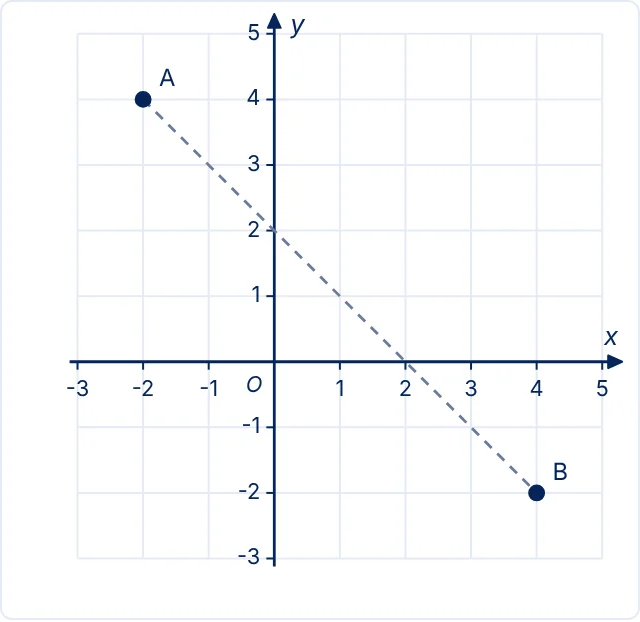
Two sites on a Voronoi diagram are located at and .
Find the coordinates of the midpoint of and calculate the gradient of the perpendicular bisector separating the two sites.
[4]
Show solution
Midpoint .[M1][A1]
Gradient of AB .[M1]
Perpendicular gradient .[A1]
Answer: (Midpoint) ; (Gradient of the bisector)
How the marks work: M marks are for a correct method, A marks for an accurate answer that follows it, R marks for a reason, and AG means the answer is given in the question. A mark in brackets, like (M1), can be implied by later correct work.