IB Maths AI HL · Unit 5
Advanced Integration and Kinematics: AI HL exam practice with markscheme
Covers kinematics: displacement, velocity & acceleration. Work through the 10 questions on paper as if it were the exam, then open each solution and mark your work against the markscheme.
10 questions · 41 marks · about 49 minutes · 6 Paper 1 style, 4 Paper 2 style
Question 1
4 marks · Paper 1 style · calculator allowed
Find the indefinite integral:
[4]
Show solution
Use the power rule for integration: . M1
. M1 A1
. A1
(Note: do not forget the constant of integration .)
Answer:
Question 2
4 marks · Paper 1 style · calculator allowed
Find the exact indefinite integral:
[4]
Show solution
Separate the integral into two standard forms. M1
The antiderivative of is . M1
The antiderivative of is . M1
. A1
Answer:
Question 3
5 marks · Paper 1 style · calculator allowed
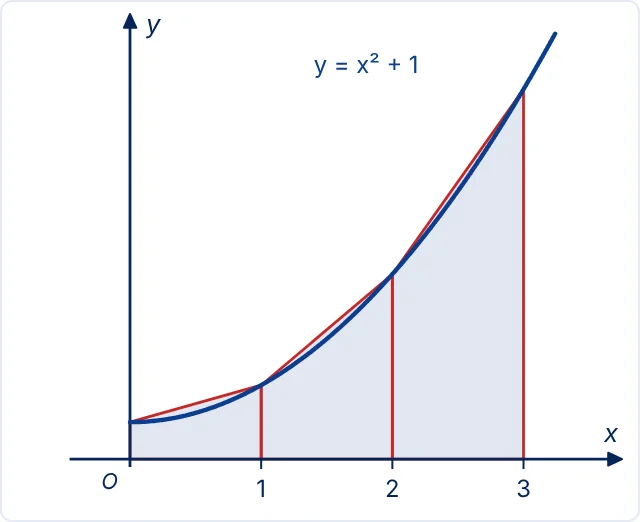
Use the trapezoidal rule with exactly intervals to approximate the area under the curve from to .
[5]
Show solution
Calculate the width of each interval: . M1
Find the -values at :
.
.
.
. A1 A1
Trapezoidal Rule formula: . M1
.
. A1
Answer:
Question 4
3 marks · Paper 2 style · calculator allowed
The region under the curve , between and , is rotated through about the -axis. Find the volume of the solid formed.
[3]
Show solution
M1A1
A1
Answer:
Question 5
3 marks · Paper 2 style · calculator allowed
The region under for is rotated about the -axis.
Find the volume. [3]
Show solution
Answer:
Question 6
3 marks · Paper 1 style · calculator allowed
Find using a substitution.
Find the integral. [3]
Show solution
M1
A1
A1
Answer:
Question 7
4 marks · Paper 2 style · calculator allowed
A particle has velocity m/s.
Find the total distance travelled in the first seconds. [4]
Show solution
at A1
M1
A1
m A1
Answer: m
Question 8
5 marks · Paper 1 style · calculator allowed
Find the exact area of the region totally bounded by the curve and the -axis.
[5]
Show solution
First, find where the curve crosses the -axis by setting : M1
and . A1
Set up the definite integral for area: . M1
Antiderivative: . A1
Substitute bounds: .
Area . A1
Answer:
Question 9
6 marks · Paper 1 style · calculator allowed
A particle moves in a straight line with velocity for .
Calculate the exact total distance travelled by the particle in the first seconds of motion.
[6]
Show solution
Total distance requires finding when the particle changes direction (). M1
and . A1
Distance . M1
We must split the integral: . M1
.
, , , . A1
Distance .
.
(or m). A1
Answer:
Question 10
4 marks · Paper 2 style · calculator allowed
A particle has acceleration m/s, m/s and .
Find and the displacement at . [4]
Show solution
A1
A1A1
m A1
Answer: ; m