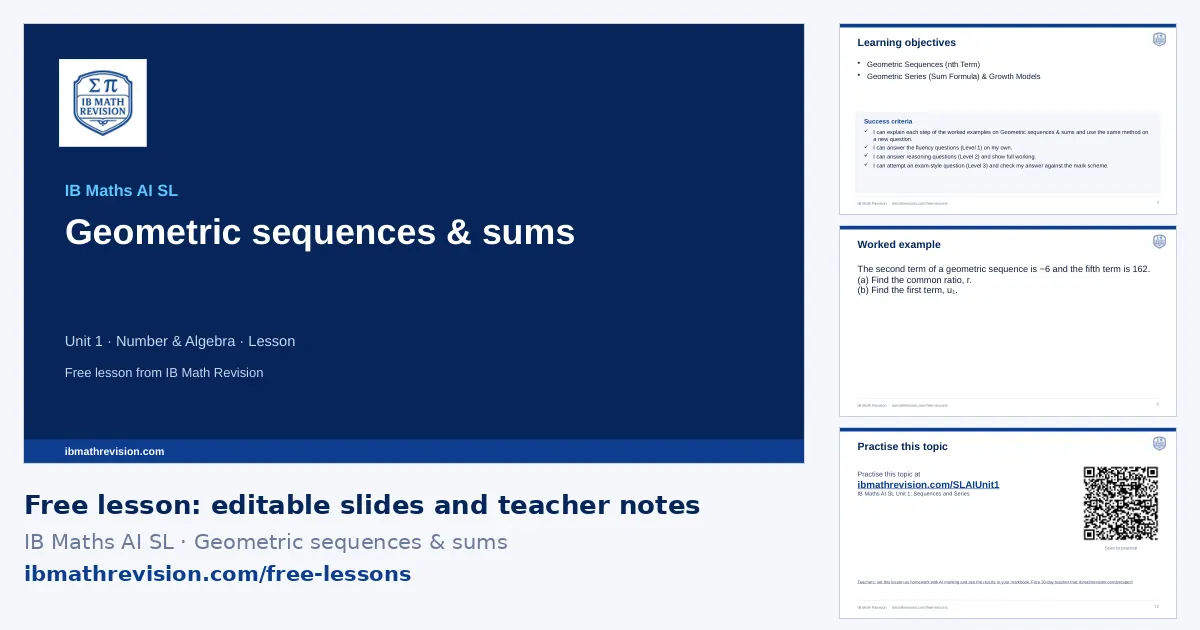
Free IB Maths AI SL lesson: Geometric sequences & sums
A ready-to-teach IB Maths AI SL lesson on Geometric sequences & sums (Unit 1 · Number & Algebra): editable slides and teacher notes, free; a printable worksheet in 3 levels with answers for school plans. About 55 minutes.
Geometric sequences model anything that changes by the same percentage each step: savings, populations, a car's value or the height of a bouncing ball. In AI SL the formulas are in the booklet, so this lesson concentrates on spotting the common ratio in a context, choosing between uₙ and Sₙ, and using the GDC to find n.
Free with a teacher account. Sign in with Google, Microsoft or email and download the slides and teacher notes.
What's inside
- Slides (PowerPoint, editable) · freeabout 12 slides: do now, objectives, key ideas, a worked example step by step, “your turn”, practice QR code, exit ticket
- Teacher notes (PDF) · freelesson plan with timings, common mistakes, homework links
- Worksheet (PDF) · school plans6 questions, 32 marks: Fluency, Reasoning, Exam-style. Included with school plans and the teacher trial.
- Answers (PDF) · school plansthe answer to every worksheet question, from its mark scheme. Included with school plans and the teacher trial.
Learning objectives
- Geometric Sequences (nth Term)
- Geometric Series (Sum Formula) & Growth Models
Worked example: Geometric sequences & sums
A ball is dropped from 2 m. After each bounce it rises to 75% of its previous height. (a) Find the height it reaches after the 5th bounce. (b) After which bounce is its height first below 20 cm?
- Height after n bounces: hₙ = 2 × 0.75ⁿ metres (the common ratio is 0.75).
- h₅ = 2 × 0.75⁵ ≈ 0.475 m.
- Solve 2 × 0.75ⁿ < 0.2 with the GDC's table: 2 × 0.75⁸ ≈ 0.2002 m, still just above 0.2 m; 2 × 0.75⁹ ≈ 0.150 m.
Answer: (a) about 0.475 m (b) the 9th bounce
Common mistakes in geometric sequences & sums
- Using r = 75 or r = 0.25 instead of r = 0.75.
- Off-by-one errors: decide whether the first term is the drop or the first bounce, and write the formula to match.
- Rounding 0.2002 to 0.20 and stopping at the 8th bounce: compare unrounded values.
Where this lesson fits
Geometric sequences & sums is in Unit 1 · Number & Algebra of the IB Maths AI SL scheme of work.
- The lesson before: Arithmetic sequences on the GDC (scheme-of-work lessons: Arithmetic Sequences (nth Term); Arithmetic Series (Sum Formula & Sigma Notation); Sequences in Context: Arithmetic vs Geometric Models)
- The next lesson: Simple & compound interest (scheme-of-work lessons: Compound interest, depreciation and financial maths)
Lesson plan
| 0–5 min | Do now: students write down what they remember about Arithmetic sequences on the GDC and Upper & lower bounds of measurements |
| 5–8 min | Share the learning objective and success criteria |
| 8–20 min | Teach: the worked example, step by step; students copy the method |
| 20–25 min | Your turn: 1 mini-whiteboard question; check every board before moving on |
| 25–42 min | Practise: the worksheet (6 questions in 3 levels, with school plans and the teacher trial) or the topic's practice questions online; move up a level after two right in a row |
| 42–47 min | Plenary: 1-question exit ticket; collect it to plan the next lesson |
For students: practise this topic
The worksheet's QR code opens the IB Maths AI SL Unit 1: Sequences and Series practice questions.
With a school plan
Set Geometric sequences & sums as homework marked by AI, print this lesson's levelled worksheet with answers, and rebuild the lesson for your class with Create lesson. Free for 30 days as a teacher, no card.
Is it free, can I edit the slides, what do students use for homework? See questions teachers ask.