Free IB Maths AI SL lesson: Discrete distributions & E(X)
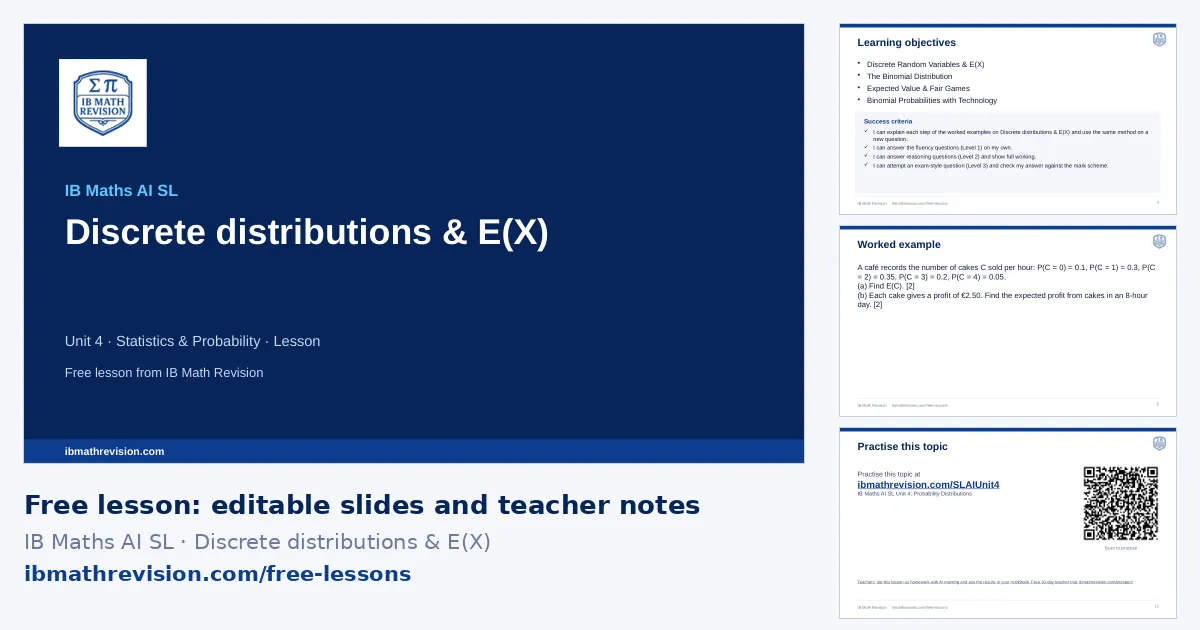
A ready-to-teach IB Maths AI SL lesson on Discrete distributions & E(X) (Unit 4 · Statistics & Probability): editable slides and teacher notes, free; a printable worksheet in 3 levels with answers for school plans. About 55 minutes.
A discrete random variable turns a probability problem into a table of values and their probabilities. AI SL questions ask students to complete the table using the fact that the probabilities add to 1, find the expected value, and decide whether a game is fair; this lesson builds each step with games of chance.
Free with a teacher account. Sign in with Google, Microsoft or email and download the slides and teacher notes.
What's inside
- Slides (PowerPoint, editable) · freeabout 12 slides: do now, objectives, key ideas, a worked example step by step, “your turn”, practice QR code, exit ticket
- Teacher notes (PDF) · freelesson plan with timings, common mistakes, homework links
- Worksheet (PDF) · school plans6 questions, 27 marks: Fluency, Reasoning, Exam-style. Included with school plans and the teacher trial.
- Answers (PDF) · school plansthe answer to every worksheet question, from its mark scheme. Included with school plans and the teacher trial.
Learning objectives
- Discrete Random Variables & E(X)
- Expected Value & Fair Games
- Expected Value in Games & Decisions
Worked example: Discrete distributions & E(X)
A spinner pays €0, €2 or €10. P(€0) = 0.6, P(€2) = 0.3 and P(€10) = k. (a) Find k. (b) Find the expected payout. (c) A player pays €2 for each spin. Is the game fair?
- The probabilities add to 1: 0.6 + 0.3 + k = 1, so k = 0.1.
- E(X) = 0 × 0.6 + 2 × 0.3 + 10 × 0.1 = 0 + 0.6 + 1 = €1.60.
- Expected gain per spin = 1.60 − 2 = −€0.40. A fair game has an expected gain of 0, so this game is not fair: on average a player loses 40 cents a spin.
Answer: (a) k = 0.1 (b) €1.60 (c) not fair; the expected gain is −€0.40 a spin
Common mistakes in discrete distributions & E(X)
- Treating E(X) as a payout that can happen: €1.60 is never actually paid.
- Forgetting to subtract the cost of playing when finding the expected gain.
- Calling a game fair when the expected gain is positive: fair means exactly 0.
Where this lesson fits
Discrete distributions & E(X) is in Unit 4 · Statistics & Probability of the IB Maths AI SL scheme of work.
- The lesson before: Conditional probability (scheme-of-work lessons: Conditional Probability & Independence; Two-Way Tables & Conditional Probability)
- The next lesson: Binomial distribution (scheme-of-work lessons: The Binomial Distribution; Binomial Probabilities with Technology; Binomial & Normal in Context: Multi-Step Problems)
Lesson plan
| 0–5 min | Do now: students write down what they remember about Conditional probability and Combined events & sample-space diagrams |
| 5–8 min | Share the learning objective and success criteria |
| 8–20 min | Teach: the worked example, step by step; students copy the method |
| 20–25 min | Your turn: 1 mini-whiteboard question; check every board before moving on |
| 25–42 min | Practise: the worksheet (6 questions in 3 levels, with school plans and the teacher trial) or the topic's practice questions online; move up a level after two right in a row |
| 42–47 min | Plenary: 1-question exit ticket; collect it to plan the next lesson |
For students: practise this topic
The worksheet's QR code opens the IB Maths AI SL Unit 4: Probability practice questions.
With a school plan
Set Discrete distributions & E(X) as homework marked by AI, print this lesson's levelled worksheet with answers, and rebuild the lesson for your class with Create lesson. Free for 30 days as a teacher, no card.
Is it free, can I edit the slides, what do students use for homework? See questions teachers ask.