Free IB Maths AA SL and AI SL lesson: Binomial distribution
A ready-to-teach IB Maths AA SL and AI SL lesson on Binomial distribution: editable slides and teacher notes, free; a printable worksheet in 3 levels with answers for school plans. About 55 minutes.
Free with a teacher account. Sign in with Google, Microsoft or email and download the slides and teacher notes.
One lesson for AA SL and AI SL
Binomial distribution is taught in IB Maths AA SL and IB Maths AI SL, with the same key ideas. Choose your course above the download button: each version's slides use that course's own worked example, questions and practice link.
- AA SL (Unit 4 · Statistics & Probability): Comparing Distributions; Cumulative Probabilities in Context
- AI SL (Unit 4 · Statistics & Probability): The Binomial Distribution; Binomial Probabilities with Technology; Binomial & Normal in Context: Multi-Step Problems
What's inside
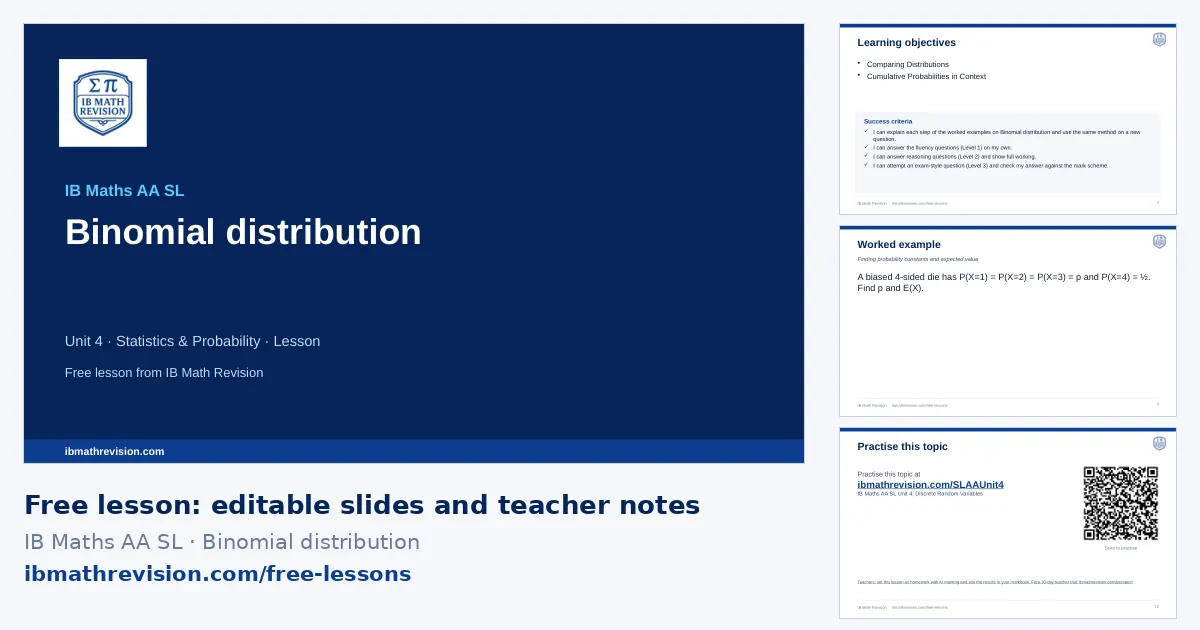
- Slides (PowerPoint, editable) · freeabout 12 slides: do now, objectives, key ideas, a worked example step by step, “your turn”, practice QR code, exit ticket
- Teacher notes (PDF) · freelesson plan with timings, common mistakes, homework links
- Worksheet (PDF) · school plans6 questions, 28 marks: Fluency, Reasoning, Exam-style. Included with school plans and the teacher trial.
- Answers (PDF) · school plansthe answer to every worksheet question, from its mark scheme. Included with school plans and the teacher trial.
Learning objectives (AA SL)
- Comparing Distributions
- Cumulative Probabilities in Context
Key ideas on the slides
- X ~ B(n, p) when there are n independent trials, each with the same probability p of success, and X counts the successes.
- P(X = r) = (ⁿCᵣ)pʳ(1 − p)ⁿ⁻ʳ; E(X) = np, Var(X) = np(1 − p).
- "At least 3" is P(X ≥ 3) = 1 − P(X ≤ 2); "more than 3" is P(X ≥ 4); "fewer than 3" is P(X ≤ 2).
- State the conditions in context when asked to justify the model (fixed n, independent trials, constant p, two outcomes).
By the end of the lesson, students should be able to answer a question like: X ~ B(20, 0.3). Find P(X ≥ 5).
Skills in this topic
Binomial distribution breaks down into 2 skills. In the worksheet builder, teachers can set practice on just one of them.
- Binomial probabilities: Recognise a binomial situation and find P(X = r), P(X ≤ r) or P(X ≥ r) on a GDC.
- Binomial mean, variance & unknown n or p: Use E(X) = np and Var(X) = np(1 − p), or work back to n or p.
Key vocabulary
- trial: One repetition of the experiment.
- success: The outcome being counted.
- binomial distribution: The distribution of the number of successes in n independent trials with constant p.
Common mistakes this lesson tackles
- Binomial and normal: "at least", inequalities, rounding bounds and which distribution. Write the distribution and the probability statement first (X ~ B(n, p), P(X ≥ 1) = 1 − P(X = 0)). Dividing by ln of a number below 1 reverses the inequality. For a measurement to the nearest 0.1, use the interval from −0.05 to +0.05. Solve for μ and σ on the GDC.
- Using P(X ≤ 3) for "fewer than 3".
- P(X ≥ 3) = 1 − P(X ≤ 3) (off by one).
- Using the binomial when the trials are not independent (without replacement from a small group).
The worked example
A biased 4-sided die has P(X=1) = P(X=2) = P(X=3) = p and P(X=4) = ½. Find p and E(X).
- Sum of probabilities = 1: 3p + ½ = 1.
- Solve: p = ⅙.
- Expected value: E(X) = 1(⅙) + 2(⅙) + 3(⅙) + 4(3/6) = (1+2+3+12)/6 = 3.
Tip: Multiply each outcome by its probability BEFORE adding. Averaging the outcomes alone is a common mistake.
Calculator tips
- binompdf(n, p, r) for P(X = r); binomcdf(n, p, r) for P(X ≤ r).
Lesson plan
| 0–5 min | Do now: students write down what they remember about Discrete random variables & E(X) and Independent & mutually exclusive events |
| 5–8 min | Share the learning objective and success criteria |
| 8–20 min | Teach: the worked example, step by step; students copy the method |
| 20–25 min | Your turn: 1 mini-whiteboard question; check every board before moving on |
| 25–42 min | Practise: the worksheet (6 questions in 3 levels, with school plans and the teacher trial) or the topic's practice questions online; move up a level after two right in a row |
| 42–47 min | Plenary: 1-question exit ticket; collect it to plan the next lesson |
For students: practise this topic
The worksheet's QR code opens your course's practice questions:
- IB Maths AA SL Unit 4: Discrete Random Variables practice questions
- IB Maths AI SL Unit 4: Probability Distributions practice questions
What schools get
- Set this lesson as homework, marked by AI against the mark scheme, with every result in your markbook (with a School plan).
- This lesson's worksheet in three levels, with its answers, ready to print.
- Support, Core and Stretch versions and A/B copies of the worksheet from the full question bank, in the worksheet builder.
- Create lesson: this lesson rebuilt for your class's next scheme-of-work lesson, from the full bank.
School licences from €490 a year. Try everything free for 30 days as a teacher: no card.
Questions teachers ask
Is this lesson free?
The slides and the teacher notes are free to download with a free IB Math Revision teacher account (sign in with Google, Microsoft or email); no card. The printable worksheet in three levels and its answers are included with school plans and the free 30-day teacher trial.
Can I edit the slides?
Yes. The slides are an ordinary PowerPoint file: change, add or delete anything. They also open in Google Slides and Keynote. The logo and web address sit on the slide master, so your edits do not move them.
What do students use for homework?
The practice slide's QR code and web address take students to the IB Maths AA SL Unit 4: Discrete Random Variables practice questions on ibmathrevision.com, where the free questions are open and the full bank comes with a plan.