Free IB Maths AI HL lesson: Poisson distribution
A ready-to-teach IB Maths AI HL lesson on Poisson distribution (Unit 4 · Statistics & Probability): editable slides and teacher notes, free; a printable worksheet in 3 levels with answers for school plans. About 55 minutes.
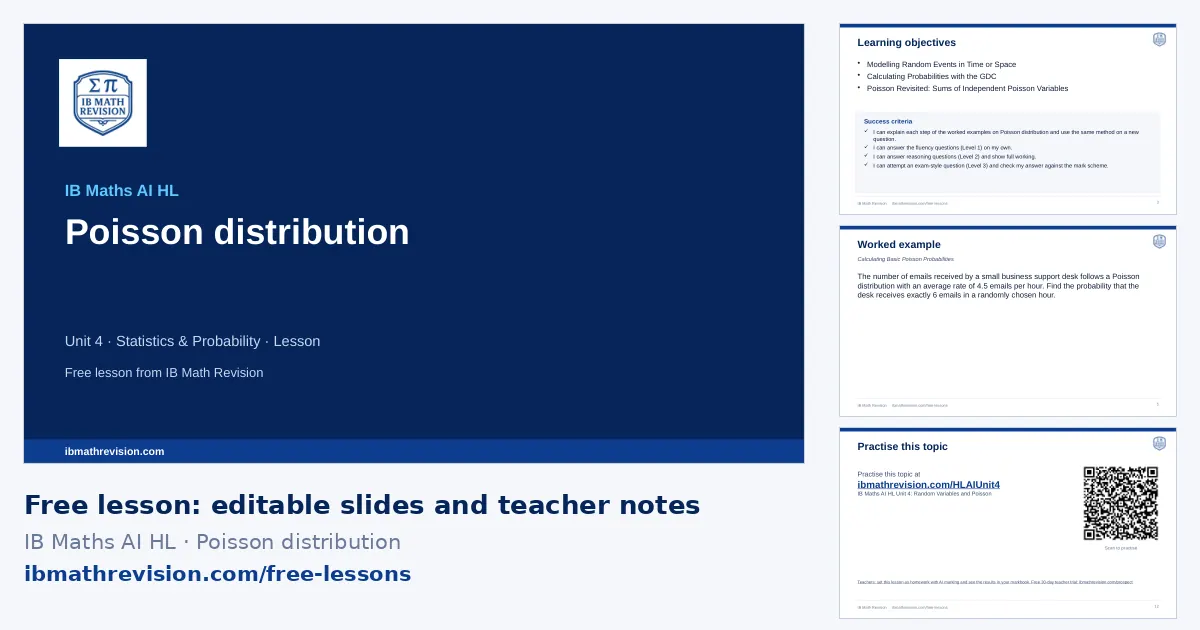
Free with a teacher account. Sign in with Google, Microsoft or email and download the slides and teacher notes.
What's inside
- Slides (PowerPoint, editable) · freeabout 12 slides: do now, objectives, key ideas, a worked example step by step, “your turn”, practice QR code, exit ticket
- Teacher notes (PDF) · freelesson plan with timings, common mistakes, homework links
- Worksheet (PDF) · school plans6 questions, 28 marks: Fluency, Reasoning, Exam-style. Included with school plans and the teacher trial.
- Answers (PDF) · school plansthe answer to every worksheet question, from its mark scheme. Included with school plans and the teacher trial.
Learning objectives
- Modelling Random Events in Time or Space
- Calculating Probabilities with the GDC
- Poisson Revisited: Sums of Independent Poisson Variables
Key ideas on the slides
- X ~ Po(m) models the number of random, independent events in a fixed interval at a constant average rate m.
- P(X = x) = (e⁻ᵐmˣ)/(x!); E(X) = Var(X) = m.
- Scale the rate to the interval: 3 per hour means Po(6) for 2 hours.
- The sum of independent Poisson variables is Poisson: X + Y ~ Po(m₁ + m₂).
By the end of the lesson, students should be able to answer a question like: If X~Po(4.2), find the probability of observing exactly 3 events, P(X=3).
Key vocabulary
- Poisson distribution: A model for counts of random events in an interval.
- rate: The mean number of events per interval.
- independent events: Events that occur without affecting each other.
Common mistakes this lesson tackles
- Distributions: variances add, the normal is continuous, the binomial coefficient. For independent X and Y: Var(X ± Y) = Var(X) + Var(Y); Var(aX) = a²Var(X). State the final distribution, e.g. X − Y ~ N(20, 25), before finding probabilities.
- Not scaling the mean to the interval asked.
- Using the Poisson when the mean and variance of the data differ a lot.
- Off-by-one errors with "at least" and "more than".
The worked example
The number of emails received by a small business support desk follows a Poisson distribution with an average rate of 4.5 emails per hour. Find the probability that the desk receives exactly 6 emails in a randomly chosen hour.
- Define the random variable X as the number of emails per hour. X ~ Po(4.5).
- Set up the probability statement: P(X = 6).
- Use the Poisson Probability Density (Ppd) function on your GDC with λ = 4.5 and x = 6.
- Alternatively, substitute into the formula: P(X = 6) = (e^(−4.5) × 4.5⁶)/(6!).
- Evaluate the probability: 0.12812…
- The probability is 0.128 (to 3 s.f.).
Tip: Use `Poisson Ppd` (Point) for exact values like P(X=6), and use `Poisson Pcd` (Cumulative) for range values like P(X ≤ 6).
Calculator tips
- poissonpdf(m, x) and poissoncdf(m, x) on the GDC.
Where this lesson fits
Poisson distribution is in Unit 4 · Statistics & Probability of the IB Maths AI HL scheme of work.
- The lesson before: Bayes' theorem (extension) (scheme-of-work lessons: Bayes' theorem)
- The next lesson: Normal distribution (scheme-of-work lessons: The Standard Normal Curve & Standardisation; Finding Probabilities & Inverse Normal)
Lesson plan
| 0–5 min | Do now: students write down what they remember about Binomial distribution and Conditional probability |
| 5–8 min | Share the learning objective and success criteria |
| 8–20 min | Teach: the worked example, step by step; students copy the method |
| 20–25 min | Your turn: 1 mini-whiteboard question; check every board before moving on |
| 25–42 min | Practise: the worksheet (6 questions in 3 levels, with school plans and the teacher trial) or the topic's practice questions online; move up a level after two right in a row |
| 42–47 min | Plenary: 1-question exit ticket; collect it to plan the next lesson |
For students: practise this topic
The worksheet's QR code opens the IB Maths AI HL Unit 4: Random Variables and Poisson practice questions.
With a school plan
Set Poisson distribution as homework marked by AI, print this lesson's levelled worksheet with answers, and rebuild the lesson for your class with Create lesson. Free for 30 days as a teacher, no card.
Is it free, can I edit the slides, what do students use for homework? See questions teachers ask.