Free IB Maths AI HL lesson: Euler's method for numerical solutions to DEs
A ready-to-teach IB Maths AI HL lesson on Euler's method for numerical solutions to DEs (Unit 5 · Calculus): editable slides and teacher notes, free; a printable worksheet in 3 levels with answers for school plans. About 55 minutes.
Free with a teacher account. Sign in with Google, Microsoft or email and download the slides and teacher notes.
What's inside
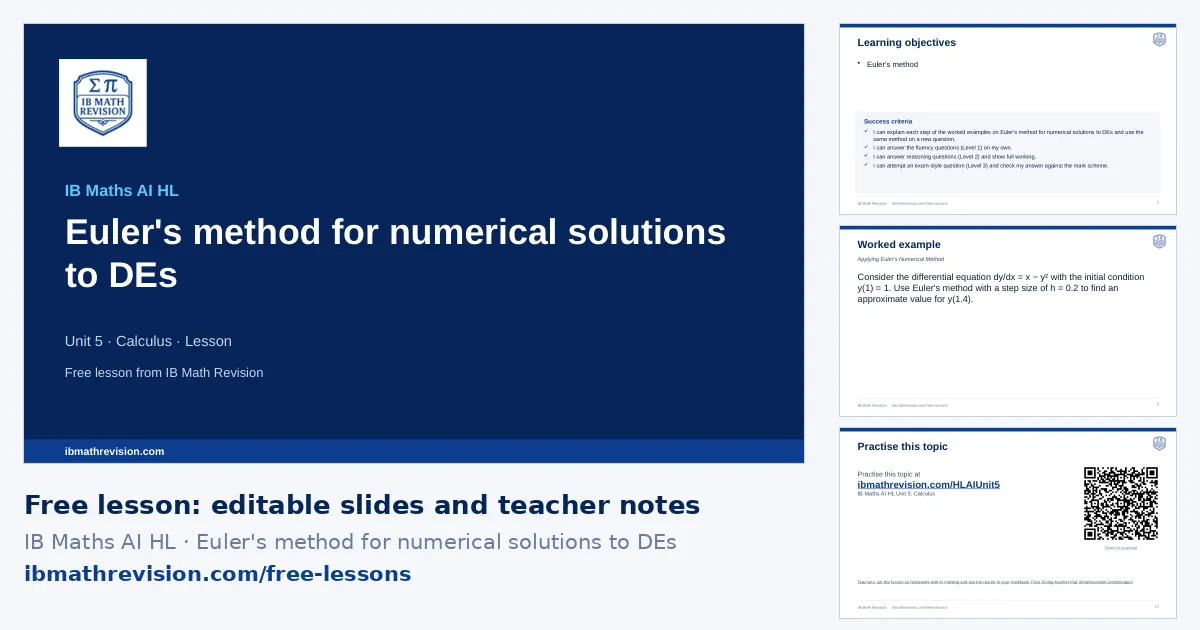
- Slides (PowerPoint, editable) · freeabout 12 slides: do now, objectives, key ideas, a worked example step by step, “your turn”, practice QR code, exit ticket
- Teacher notes (PDF) · freelesson plan with timings, common mistakes, homework links
- Worksheet (PDF) · school plans6 questions, 26 marks: Fluency, Reasoning, Exam-style. Included with school plans and the teacher trial.
- Answers (PDF) · school plansthe answer to every worksheet question, from its mark scheme. Included with school plans and the teacher trial.
Learning objectives
- Euler's method
Key ideas on the slides
- For dy/dx = f(x, y) with step h: xₙ₊₁ = xₙ + h, yₙ₊₁ = yₙ + hf(xₙ, yₙ).
- Each step follows the tangent from the current point, so errors build up; a smaller h usually gives a better approximation.
- For coupled systems, update each variable with its own rate using the old values: xₙ₊₁ = xₙ + h(dx/dt), yₙ₊₁ = yₙ + h(dy/dt).
- Set out a table (or use the GDC's sequence/spreadsheet) and give the answer to the accuracy asked.
By the end of the lesson, students should be able to answer a question like: Given dy/dx = x + y, y(0) = 1, use Euler's method with h = 0.1 to estimate y(0.5).
Key vocabulary
- Euler's method: A step-by-step numerical method for approximating the solution of a DE.
- step length: h, the increase in x (or t) at each step.
- approximation: An estimate of the true value.
Common mistakes this lesson tackles
- Euler's method: formula copied, not applied, and GDC variables. Write the recurrence in the question's variables (xₙ₊₁ = xₙ + h, yₙ₊₁ = yₙ + h × f(xₙ, yₙ)), show the first step with numbers, then give the final value from the GDC table.
- Using the new y in f(xₙ, yₙ) before it has been calculated.
- Taking the wrong number of steps for the interval.
- Copying the formula without applying it.
The worked example
Consider the differential equation dy/dx = x − y² with the initial condition y(1) = 1. Use Euler's method with a step size of h = 0.2 to find an approximate value for y(1.4).
- Identify the initial values for Step 1: x₀ = 1, y₀ = 1. Calculate the initial gradient: (dy/dx)₀ = 1 − 1² = 0.
- Apply Euler's formula yₙ₊₁ = yₙ + h (dy/dx)ₙ to find y₁: y₁ = 1 + 0.2(0) = 1.
- Identify the values for Step 2: x₁ = 1 + 0.2 = 1.2, y₁ = 1. Calculate the new gradient: (dy/dx)₁ = 1.2 − 1² = 0.2.
- Apply Euler's formula to find y₂ (which corresponds to x=1.4): y₂ = 1 + 0.2(0.2).
- Calculate the final approximation: y₂ = 1 + 0.04 = 1.04.
Tip: Setting up a table with columns for n, xₙ, yₙ, and (dy/dx)ₙ is highly recommended to prevent substituting the wrong values into the iterative formula during exam pressure.
Calculator tips
- Use the recursive sequence mode or a spreadsheet: u(n+1) = u(n) + 0.1(n·0.1 + u(n)).
Where this lesson fits
Euler's method for numerical solutions to DEs is in Unit 5 · Calculus of the IB Maths AI HL scheme of work.
- The lesson before: Coupled differential equations & phase portraits (scheme-of-work lessons: Setting Up & Interpreting Coupled Linear Systems; Euler's Method for Coupled Systems; Solving Coupled Systems with Eigenvalues & Eigenvectors)
- The next lesson: Volumes of revolution (scheme-of-work lessons: Volumes of revolution)
Lesson plan
| 0–5 min | Do now: students write down what they remember about Second-order differential equations and Coupled differential equations & phase portraits |
| 5–8 min | Share the learning objective and success criteria |
| 8–20 min | Teach: the worked example, step by step; students copy the method |
| 20–25 min | Your turn: 1 mini-whiteboard question; check every board before moving on |
| 25–42 min | Practise: the worksheet (6 questions in 3 levels, with school plans and the teacher trial) or the topic's practice questions online; move up a level after two right in a row |
| 42–47 min | Plenary: 1-question exit ticket; collect it to plan the next lesson |
For students: practise this topic
The worksheet's QR code opens the IB Maths AI HL Unit 5: Calculus practice questions.
With a school plan
Set Euler's method for numerical solutions to DEs as homework marked by AI, print this lesson's levelled worksheet with answers, and rebuild the lesson for your class with Create lesson. Free for 30 days as a teacher, no card.
Is it free, can I edit the slides, what do students use for homework? See questions teachers ask.