Free IB Maths AA SL lesson: Sampling techniques & bias
A ready-to-teach IB Maths AA SL lesson on Sampling techniques & bias (Unit 4 · Statistics & Probability): editable slides and teacher notes, free; a printable worksheet in 3 levels with answers for school plans. About 55 minutes.
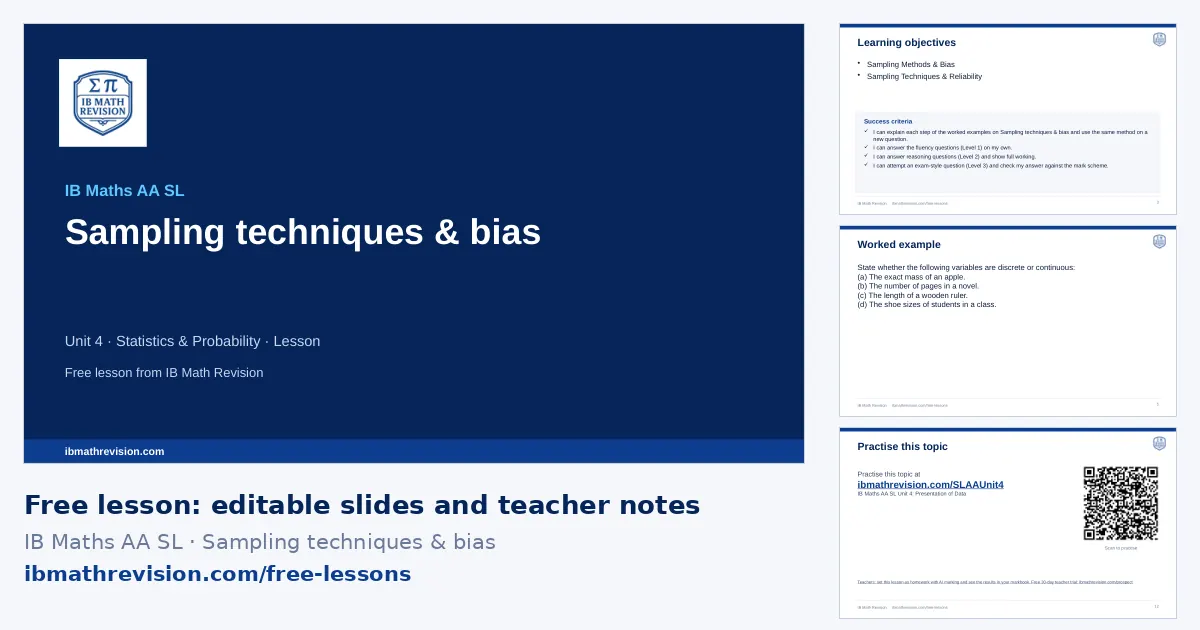
Free with a teacher account. Sign in with Google, Microsoft or email and download the slides and teacher notes.
What's inside
- Slides (PowerPoint, editable) · freeabout 12 slides: do now, objectives, key ideas, a worked example step by step, “your turn”, practice QR code, exit ticket
- Teacher notes (PDF) · freelesson plan with timings, common mistakes, homework links
- Worksheet (PDF) · school plans5 questions, 13 marks: Fluency, Reasoning, Exam-style. Included with school plans and the teacher trial.
- Answers (PDF) · school plansthe answer to every worksheet question, from its mark scheme. Included with school plans and the teacher trial.
Learning objectives
- Sampling Methods & Bias
- Sampling Techniques & Reliability
Key ideas on the slides
- A census uses the whole population; a sample uses part of it (cheaper and quicker, but may not represent the population).
- Simple random: every sample of size n is equally likely (random numbers). Systematic: every kth item from a random start.
- Stratified: sample each group in proportion to its size: (group size)/population × sample size. Quota: fill set numbers from each group (not random). Convenience/opportunity: whoever is available.
- Bias is a systematic error that makes a sample unrepresentative; describe it in the context of the question.
By the end of the lesson, students should be able to answer a question like: Identify the bias in asking 50 gym members about their exercise habits.
Key vocabulary
- population: The whole group being studied.
- sample: The part of the population that is studied.
- sampling frame: The list of the population from which a sample is chosen.
- bias: A systematic tendency for results to differ from the true value.
Common mistakes this lesson tackles
- Calling a quota sample random.
- Giving advantages or disadvantages that are not about the context.
- Rounding stratum sizes so they no longer add up to the sample size.
Calculator tips
- Use the random-integer function (RandInt) to choose items for a simple random sample.
Where this lesson fits
Sampling techniques & bias is in Unit 4 · Statistics & Probability of the IB Maths AA SL scheme of work.
- The lesson before: Modelling with sinusoidal functions (scheme-of-work lessons: Sine, Cosine & Tangent Functions; Trig Models: Sinusoidal Functions in Context; Fitting a Sinusoidal Model to Data)
- The next lesson: Central tendency (mean/median/mode) (scheme-of-work lessons: Mean, Median & Mode from Frequency Tables; Grouped Data & the Effect of Constant Changes)
Lesson plan
| 0–5 min | Do now: students write down what they remember about Modelling with sinusoidal functions and Volume & surface area of 3D solids |
| 5–8 min | Share the learning objective and success criteria |
| 8–20 min | Teach: the worked example, step by step; students copy the method |
| 20–25 min | Your turn: 1 mini-whiteboard question; check every board before moving on |
| 25–42 min | Practise: the worksheet (5 questions in 3 levels, with school plans and the teacher trial) or the topic's practice questions online; move up a level after two right in a row |
| 42–47 min | Plenary: 1-question exit ticket; collect it to plan the next lesson |
For students: practise this topic
The worksheet's QR code opens the IB Maths AA SL Unit 4: Presentation of Data practice questions.
With a school plan
Set Sampling techniques & bias as homework marked by AI, print this lesson's levelled worksheet with answers, and rebuild the lesson for your class with Create lesson. Free for 30 days as a teacher, no card.
Is it free, can I edit the slides, what do students use for homework? See questions teachers ask.