Free IB Maths AA SL lesson: Measures of spread (SD, IQR)
A ready-to-teach IB Maths AA SL lesson on Measures of spread (SD, IQR) (Unit 4 · Statistics & Probability): editable slides and teacher notes, free; a printable worksheet in 2 levels with answers for school plans. About 55 minutes.
Free with a teacher account. Sign in with Google, Microsoft or email and download the slides and teacher notes.
What's inside
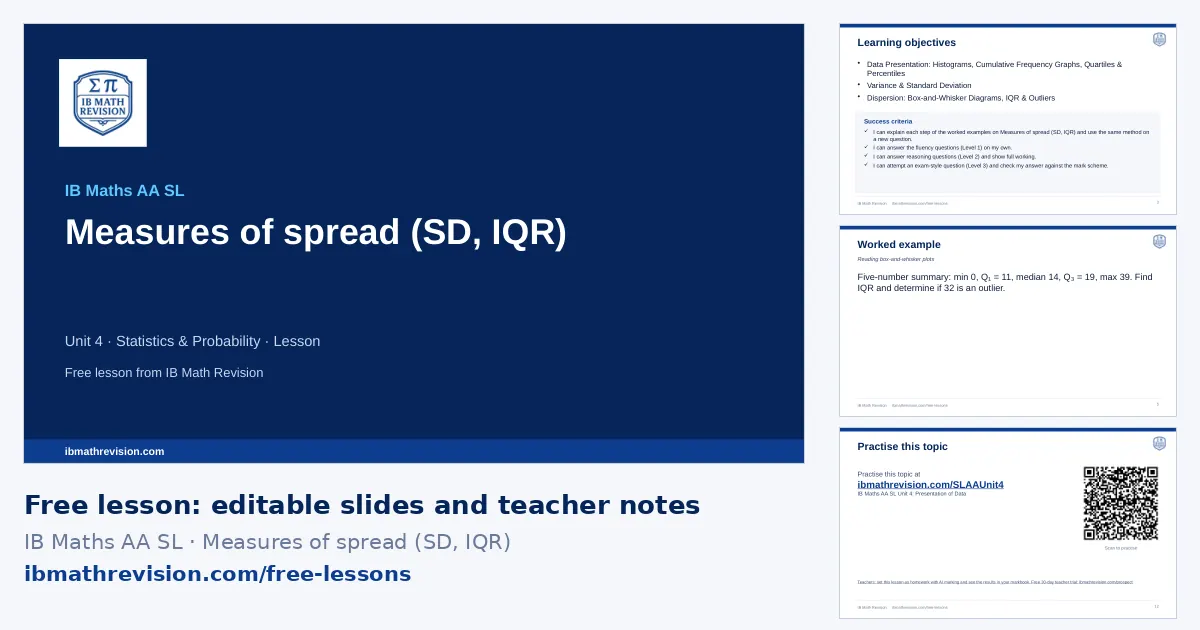
- Slides (PowerPoint, editable) · freeabout 12 slides: do now, objectives, key ideas, a worked example step by step, “your turn”, practice QR code, exit ticket
- Teacher notes (PDF) · freelesson plan with timings, common mistakes, homework links
- Worksheet (PDF) · school plans3 questions, 17 marks: Fluency, Exam-style. Included with school plans and the teacher trial.
- Answers (PDF) · school plansthe answer to every worksheet question, from its mark scheme. Included with school plans and the teacher trial.
Learning objectives
- Variance & Standard Deviation
- Dispersion: Box-and-Whisker Diagrams, IQR & Outliers
Key ideas on the slides
- Variance σ² = (Σ (x − x̄)²)/n = (Σ x²)/n − x̄²; standard deviation σ = √variance.
- From a frequency table: σ² = (Σ fx²)/(Σ f) − x̄².
- The standard deviation measures the typical distance of values from the mean, in the same units as the data.
- IB uses the population standard deviation (σₓ on the GDC); A Level uses (Sₓₓ)/n with Sₓₓ = Σ x² − ((Σ x)²)/n (or n − 1 where stated).
By the end of the lesson, students should be able to answer a question like: Find the standard deviation of the data sample: 3, 5, 8, 12.
Key vocabulary
- variance: The mean of the squared deviations from the mean.
- standard deviation: The square root of the variance.
- deviation: x − x̄, how far a value is from the mean.
Common mistakes this lesson tackles
- Subtracting x̄ instead of x̄² in (Σ x²)/n − x̄².
- Forgetting to square-root the variance.
- Using s (n − 1) when the course asks for σ (or the reverse).
The worked example
Group A: 20 students, mean 15, SD 3. Group B: 30 students, mean 20, SD 4. Find the combined group's SD.
- Sums: S_A = 300, S_B = 600; combined mean = 900/50 = 18.
- Sum of squares formula: Σ x² = n(σ² + μ²).
- Group A: Σ x_A² = 20(9 + 225) = 4680.
- Group B: Σ x_B² = 30(16 + 400) = 12480.
- Combined variance: (4680 + 12480)/50 − 18² = 343.2 − 324 = 19.2.
- Combined SD: √19.2 ≈ 4.38.
Tip: You cannot average standard deviations directly. Rebuild the total sum-of-squares first, then re-apply the variance formula.
Calculator tips
- 1-Var Stats: read σₓ (population) or sₓ as your course requires.
Where this lesson fits
Measures of spread (SD, IQR) is in Unit 4 · Statistics & Probability of the IB Maths AA SL scheme of work.
- The lesson before: Central tendency (mean/median/mode) (scheme-of-work lessons: Mean, Median & Mode from Frequency Tables; Grouped Data & the Effect of Constant Changes)
- The next lesson: Presenting data: histograms, cumulative frequency & box plots (scheme-of-work lessons: Data Presentation: Histograms, Cumulative Frequency Graphs, Quartiles & Percentiles; Comparing Distributions)
Lesson plan
| 0–5 min | Do now: students write down what they remember about Central tendency (mean/median/mode) and Sampling techniques & bias |
| 5–8 min | Share the learning objective and success criteria |
| 8–20 min | Teach: the worked example, step by step; students copy the method |
| 20–25 min | Your turn: 1 mini-whiteboard question; check every board before moving on |
| 25–42 min | Practise: the worksheet (3 questions in 2 levels, with school plans and the teacher trial) or the topic's practice questions online; move up a level after two right in a row |
| 42–47 min | Plenary: 1-question exit ticket; collect it to plan the next lesson |
For students: practise this topic
The worksheet's QR code opens the IB Maths AA SL Unit 4: Measures of Central Tendency practice questions.
With a school plan
Set Measures of spread (SD, IQR) as homework marked by AI, print this lesson's levelled worksheet with answers, and rebuild the lesson for your class with Create lesson. Free for 30 days as a teacher, no card.
Is it free, can I edit the slides, what do students use for homework? See questions teachers ask.