Free IB Maths AA SL and AI SL lesson: Distance & midpoint in 3D
A ready-to-teach IB Maths AA SL and AI SL lesson on Distance & midpoint in 3D: editable slides and teacher notes, free; a printable worksheet in 3 levels with answers for school plans. About 55 minutes.
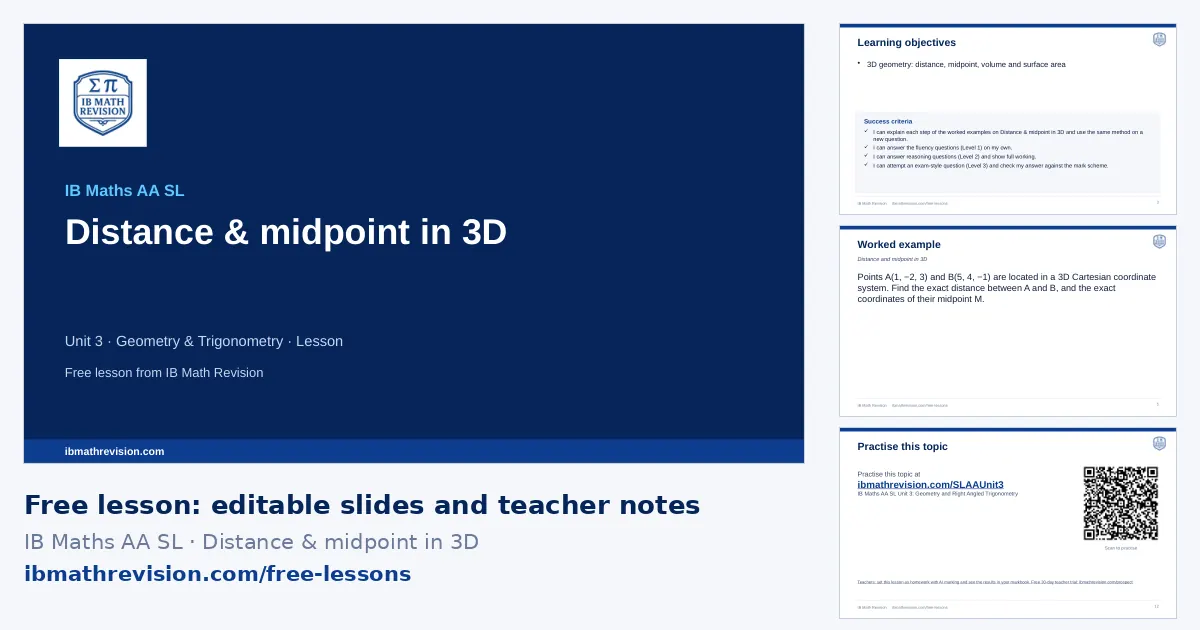
Free with a teacher account. Sign in with Google, Microsoft or email and download the slides and teacher notes.
One lesson for AA SL and AI SL
Distance & midpoint in 3D is taught in IB Maths AA SL and IB Maths AI SL, with the same key ideas. Choose your course above the download button: each version's slides use that course's own worked example, questions and practice link.
- AA SL (Unit 3 · Geometry & Trigonometry)
- AI SL (Unit 3 · Geometry & Trigonometry)
What's inside
- Slides (PowerPoint, editable) · freeabout 12 slides: do now, objectives, key ideas, a worked example step by step, “your turn”, practice QR code, exit ticket
- Teacher notes (PDF) · freelesson plan with timings, common mistakes, homework links
- Worksheet (PDF) · school plans5 questions, 18 marks: Fluency, Reasoning, Exam-style. Included with school plans and the teacher trial.
- Answers (PDF) · school plansthe answer to every worksheet question, from its mark scheme. Included with school plans and the teacher trial.
Learning objectives
- 3D geometry: distance, midpoint, volume and surface area
Key ideas on the slides
- Distance between (x₁, y₁, z₁) and (x₂, y₂, z₂): d = √((x₂ − x₁)² + (y₂ − y₁)² + (z₂ − z₁)²); midpoint ((x₁ + x₂)/2, (y₁ + y₂)/2, (z₁ + z₂)/2).
- Volumes (formula booklet): cuboid lwh, prism (cross-section area × length), cylinder π r² h, pyramid ⅓Ah, cone ⅓π r² h, sphere (4/3)π r³.
- Surface areas: cylinder 2π r² + 2π rh, cone curved surface π rl, sphere 4π r², where l is the slant height.
- For angles in 3D, find a right-angled triangle, draw it flat, and use Pythagoras and trigonometry; the angle between a line and a plane uses the line's projection onto the plane.
By the end of the lesson, students should be able to answer a question like: Find the midpoint of A(1, 2, 3) and B(5, -2, 1).
Key vocabulary
- slant height: The distance from the apex of a cone to the edge of its base.
- projection: The "shadow" of a line on a plane, used to measure the angle between them.
- composite solid: A solid made from two or more simpler solids.
Common mistakes this lesson tackles
- Accuracy: 2 s.f. answers, early rounding and ignored accuracy instructions. Keep full calculator values (store them) until the very last line. Give final answers exactly or to 3 s.f. unless the question says otherwise, and when a given answer has more figures, show your value to more figures than that before rounding.
- Using the vertical height where the slant height is needed (or the reverse).
- Adding the base of a hemisphere or cone when the question asks for the curved surface only.
- Rounding a length early and reusing it in the next step.
The worked example
Points A(1, −2, 3) and B(5, 4, −1) are located in a 3D Cartesian coordinate system. Find the exact distance between A and B, and the exact coordinates of their midpoint M.
- Identify the 3D distance formula: AB = √((x₂−x₁)² + (y₂−y₁)² + (z₂−z₁)²).
- Substitute: AB = √((5−1)² + (4−(−2))² + (−1−3)²).
- Simplify: AB = √(16+36+16) = √68 = 2√17.
- Midpoint formula: M = ((x₁+x₂)/2, (y₁+y₂)/2, (z₁+z₂)/2).
- Substitute and evaluate: M(3, 1, 1).
Tip: When calculating distance, always use brackets around negative numbers before squaring in your GDC; typing −4² instead of (−4)² gives −16 instead of +16.
Calculator tips
- Store intermediate lengths in memory; keep the GDC in degrees for angles.
Lesson plan
| 0–5 min | Do now: students write down what they remember about Inverse functions & their graphs and Composite functions (f∘g) |
| 5–8 min | Share the learning objective and success criteria |
| 8–20 min | Teach: the worked example, step by step; students copy the method |
| 20–25 min | Your turn: 1 mini-whiteboard question; check every board before moving on |
| 25–42 min | Practise: the worksheet (5 questions in 3 levels, with school plans and the teacher trial) or the topic's practice questions online; move up a level after two right in a row |
| 42–47 min | Plenary: 1-question exit ticket; collect it to plan the next lesson |
For students: practise this topic
The worksheet's QR code opens your course's practice questions:
- IB Maths AA SL Unit 3: Geometry and Right Angled Trigonometry practice questions
- IB Maths AI SL Unit 3: 3D Coordinate Geometry practice questions
What schools get
- Set this lesson as homework, marked by AI against the mark scheme, with every result in your markbook (with a School plan).
- This lesson's worksheet in three levels, with its answers, ready to print.
- Support, Core and Stretch versions and A/B copies of the worksheet from the full question bank, in the worksheet builder.
- Create lesson: this lesson rebuilt for your class's next scheme-of-work lesson, from the full bank.
School licences from €490 a year. Try everything free for 30 days as a teacher: no card.
Questions teachers ask
Is this lesson free?
The slides and the teacher notes are free to download with a free IB Math Revision teacher account (sign in with Google, Microsoft or email); no card. The printable worksheet in three levels and its answers are included with school plans and the free 30-day teacher trial.
Can I edit the slides?
Yes. The slides are an ordinary PowerPoint file: change, add or delete anything. They also open in Google Slides and Keynote. The logo and web address sit on the slide master, so your edits do not move them.
What do students use for homework?
The practice slide's QR code and web address take students to the IB Maths AA SL Unit 3: Geometry and Right Angled Trigonometry practice questions on ibmathrevision.com, where the free questions are open and the full bank comes with a plan.