Free IB Maths AA HL and AI HL lesson: Modulus, argument & polar form
A ready-to-teach IB Maths AA HL and AI HL lesson on Modulus, argument & polar form: editable slides and teacher notes, free; a printable worksheet in 3 levels with answers for school plans. About 55 minutes.
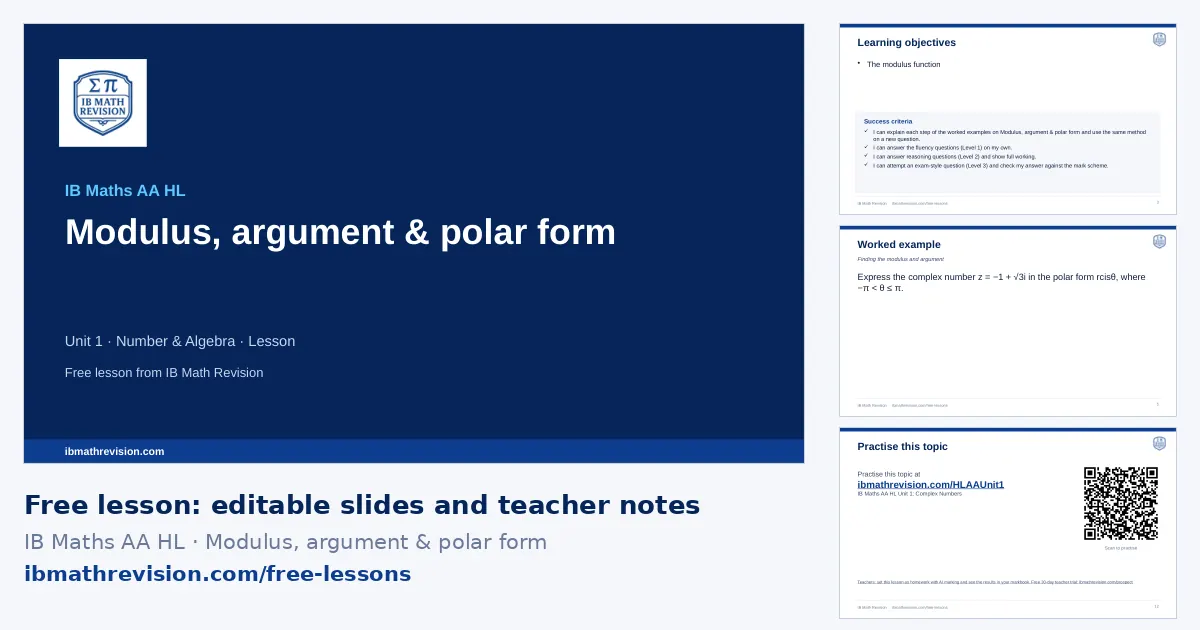
Free with a teacher account. Sign in with Google, Microsoft or email and download the slides and teacher notes.
One lesson for AA HL and AI HL
Modulus, argument & polar form is taught in IB Maths AA HL and IB Maths AI HL, with the same key ideas. Choose your course above the download button: each version's slides use that course's own worked example, questions and practice link.
- AA HL (Unit 1 · Number & Algebra): The modulus function
- AI HL (Unit 1 · Number & Algebra): The Argand Diagram, Modulus & Argument (Introducing Radian Measure); Polar & Euler Form — Conversions, Products, Quotients & Powers
What's inside
- Slides (PowerPoint, editable) · freeabout 12 slides: do now, objectives, key ideas, a worked example step by step, “your turn”, practice QR code, exit ticket
- Teacher notes (PDF) · freelesson plan with timings, common mistakes, homework links
- Worksheet (PDF) · school plans6 questions, 32 marks: Fluency, Reasoning, Exam-style. Included with school plans and the teacher trial.
- Answers (PDF) · school plansthe answer to every worksheet question, from its mark scheme. Included with school plans and the teacher trial.
Learning objectives (AA HL)
- The modulus function
Key ideas on the slides
- |x| = x if x ≥ 0 and −x if x < 0: the distance from zero.
- y = |f(x)|: reflect the parts of y = f(x) below the x-axis in the x-axis.
- y = f(|x|): keep the part for x ≥ 0 and reflect it in the y-axis.
- Solve |f(x)| = g(x) by solving f(x) = g(x) and f(x) = −g(x), then check each answer (some may not satisfy the original); a sketch shows how many solutions there are.
By the end of the lesson, students should be able to answer a question like: Express -1 + i × √3 in polar form.
Key vocabulary
- modulus: The absolute value: the size of a number without its sign.
- reflect: Map each point to its mirror image in a line.
- extraneous solution: A solution of the working that does not satisfy the original equation.
- argument: The angle arg z from the positive real axis.
Common mistakes this lesson tackles
- Graphs and transformations: describing a rational function, and graphs of [f(x)]². Write the rational function in the form a + b/(x − c) first; each of a, b, c is one transformation. For [f(x)]², values between −1 and 1 get smaller and zeros become touching points.
- Complex numbers and polynomials: conjugate roots, all the roots, general solutions. A real polynomial with root a + bi also has a − bi. Build the quadratic factor (z − (a + bi))(z − (a − bi)) = z² − 2az + a² + b² and divide, or use sum/product with every root.
- Reflecting the whole graph instead of only the negative part for |f(x)|.
- Keeping solutions that do not satisfy the original modulus equation.
The worked example
Express the complex number z = −1 + √3i in the polar form rcisθ, where −π < θ ≤ π.
- Calculate the modulus r = |z| = √((−1)² + (√3)²).
- Evaluate the sum to get r = √(1 + 3) = 2.
- Determine the reference angle α = arctan ((√3)/1) = π/3.
- Identify the quadrant on the Argand diagram; since the real part is negative and imaginary part is positive, it lies in Quadrant 2.
- Compute the principal argument θ = π − π/3 = 2π/3.
- State the final polar form: z = 2cis(2π/3).
Tip: A common mistake is simply plugging arctan(−√3/1) into the calculator and blindly accepting the negative fourth-quadrant angle without checking the coordinates on an Argand diagram sketch.
Calculator tips
- Graph both sides and use intersect to see how many solutions there are.
- Complex mode converts between a + bi and r∠θ; check the argument is in the right quadrant.
Where this lesson fits
Modulus, argument & polar form is in Unit 1 · Number & Algebra of the IB Maths AA HL scheme of work.
- The lesson before: Complex numbers — Cartesian form (scheme-of-work lessons: Complex numbers: Cartesian form)
- The next lesson: De Moivre & Euler form (roots of unity) (scheme-of-work lessons: Euler's Form & De Moivre's Theorem; nth Roots of Complex Numbers & Geometric Applications; De Moivre's Theorem — Exact Powers)
Lesson plan
| 0–5 min | Do now: students write down what they remember about Complex numbers — Cartesian form and Counter-example proofs |
| 5–8 min | Share the learning objective and success criteria |
| 8–20 min | Teach: the worked example, step by step; students copy the method |
| 20–25 min | Your turn: 1 mini-whiteboard question; check every board before moving on |
| 25–42 min | Practise: the worksheet (6 questions in 3 levels, with school plans and the teacher trial) or the topic's practice questions online; move up a level after two right in a row |
| 42–47 min | Plenary: 1-question exit ticket; collect it to plan the next lesson |
For students: practise this topic
The worksheet's QR code opens your course's practice questions:
- IB Maths AA HL Unit 1: Complex Numbers practice questions
- IB Maths AI HL Unit 1: Complex Numbers and Argand Diagrams practice questions
With a school plan
Set Modulus, argument & polar form as homework marked by AI, print this lesson's levelled worksheet with answers, and rebuild the lesson for your class with Create lesson. Free for 30 days as a teacher, no card.
Is it free, can I edit the slides, what do students use for homework? See questions teachers ask.