Free IB Maths AA HL lesson: De Moivre & Euler form (roots of unity)
A ready-to-teach IB Maths AA HL lesson on De Moivre & Euler form (roots of unity) (Unit 1 · Number & Algebra): editable slides and teacher notes, free; a printable worksheet in 3 levels with answers for school plans. About 55 minutes.
Free with a teacher account. Sign in with Google, Microsoft or email and download the slides and teacher notes.
What's inside
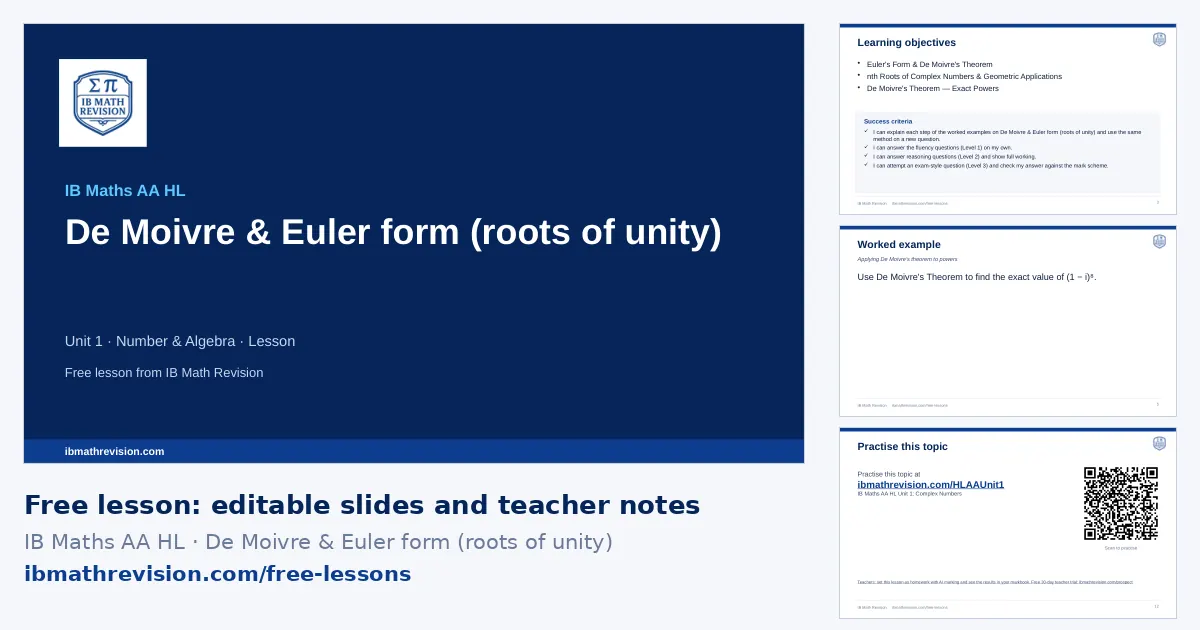
- Slides (PowerPoint, editable) · freeabout 12 slides: do now, objectives, key ideas, a worked example step by step, “your turn”, practice QR code, exit ticket
- Teacher notes (PDF) · freelesson plan with timings, common mistakes, homework links
- Worksheet (PDF) · school plans6 questions, 25 marks: Fluency, Reasoning, Exam-style. Included with school plans and the teacher trial.
- Answers (PDF) · school plansthe answer to every worksheet question, from its mark scheme. Included with school plans and the teacher trial.
Learning objectives
- Euler's Form & De Moivre's Theorem
- nth Roots of Complex Numbers & Geometric Applications
- De Moivre's Theorem — Exact Powers
Key ideas on the slides
- De Moivre: [r(cos θ + isin θ)]ⁿ = rⁿ(cos nθ + isin nθ), i.e. (re^(iθ))ⁿ = rⁿe^(inθ).
- The nth roots of z = re^(iθ) are r^(1/n)e^(i((θ + 2kπ)/n)) for k = 0, 1, …, n − 1.
- The n roots lie equally spaced on a circle of radius r^(1/n), 2π/n apart; the nth roots of unity add to 0.
- Use de Moivre with the binomial theorem to write cos 3θ or sin 3θ in powers of cos θ and sin θ.
By the end of the lesson, students should be able to answer a question like: Find the three cube roots of 8i in Euler form.
Skills in this topic
De Moivre & Euler form (roots of unity) breaks down into 2 skills. In the worksheet builder, teachers can set practice on just one of them.
- Powers with De Moivre's theorem
- Roots of complex numbers
Key vocabulary
- roots of unity: The solutions of zⁿ = 1.
- de Moivre's theorem: The rule for raising a complex number in polar form to a power.
- Euler's form: z = re^(iθ).
- modulus: The distance of z from the origin, |z|.
- argument: The angle arg z from the positive real axis.
Common mistakes this lesson tackles
- Complex numbers and polynomials: conjugate roots, all the roots, general solutions. A real polynomial with root a + bi also has a − bi. Build the quadratic factor (z − (a + bi))(z − (a − bi)) = z² − 2az + a² + b² and divide, or use sum/product with every root.
- Complex numbers and polynomials: conjugate roots, all the roots, general solutions. A real polynomial with root a + bi also has a − bi. Build the quadratic factor (z − (a + bi))(z − (a − bi)) = z² − 2az + a² + b² and divide, or use sum/product with every root.
- Finding only one root instead of n.
- Forgetting to add 2kπ before dividing by n.
The worked example
Use De Moivre's Theorem to find the exact value of (1 − i)⁸.
- Convert the base 1 − i into polar form. The modulus is r = √(1² + (−1)²) = √2.
- Find the argument. The point (1, −1) is in the fourth quadrant, so θ = −π/4.
- Apply De Moivre's Theorem: (rcisθ)ⁿ = rⁿ cis(nθ).
- Substitute the values into the theorem: (√2)⁸ cis(8 × −π/4).
- Simplify the modulus and argument: 16cis(−2π).
- Evaluate the exact Cartesian value by expanding: 16(cos(−2π) + isin(−2π)) = 16(1 + 0i) = 16.
Tip: Students often try to expand high powers of complex binomials using Pascal's triangle, which is incredibly time-consuming and error-prone compared to immediately converting to polar form and utilizing De Moivre's theorem.
Calculator tips
- Check a root by raising it to the power n in complex mode.
- Complex mode converts between a + bi and r∠θ; check the argument is in the right quadrant.
Where this lesson fits
De Moivre & Euler form (roots of unity) is in Unit 1 · Number & Algebra of the IB Maths AA HL scheme of work.
- The lesson before: Modulus, argument & polar form (scheme-of-work lessons: The modulus function)
- The next lesson: 3×3 linear systems (GDC + elimination) (scheme-of-work lessons: Systems of linear equations)
Lesson plan
| 0–5 min | Do now: students write down what they remember about Modulus, argument & polar form and Complex numbers — Cartesian form |
| 5–8 min | Share the learning objective and success criteria |
| 8–20 min | Teach: the worked example, step by step; students copy the method |
| 20–25 min | Your turn: 1 mini-whiteboard question; check every board before moving on |
| 25–42 min | Practise: the worksheet (6 questions in 3 levels, with school plans and the teacher trial) or the topic's practice questions online; move up a level after two right in a row |
| 42–47 min | Plenary: 1-question exit ticket; collect it to plan the next lesson |
For students: practise this topic
The worksheet's QR code opens the IB Maths AA HL Unit 1: Complex Numbers practice questions.
With a school plan
Set De Moivre & Euler form (roots of unity) as homework marked by AI, print this lesson's levelled worksheet with answers, and rebuild the lesson for your class with Create lesson. Free for 30 days as a teacher, no card.
Is it free, can I edit the slides, what do students use for homework? See questions teachers ask.