Home › IB Maths AA SL › Exam practice › Graphing Functions

IB Maths AA SL · Unit 2

Graphing Functions: AA SL exam practice with markscheme

Covers key features of graphs & intersections with technology. Work through the 10 questions on paper as if it were the exam, then open each solution and mark your work against the markscheme.

10 questions · 43 marks · about 48 minutes · 1 Paper 1 style, 9 Paper 2 style

Download the PDF 6 pages, worked solutions after the questions

Question 1

2 marks · Paper 2 style · calculator

Use technology to find the coordinates of the point where the graphs of y=ex and y=4−x intersect.

[2]

Show solution

x=1.07 (1.0737…) A1
(1.07,2.93) A1

Answer: (1.07,2.93)

Question 2

3 marks · Paper 2 style · calculator

Use your calculator to solve the equation 2x=x+3. [3]

Show solution

sketch or table of y=2x and y=x+3 (M1)

x=−2.86 A1

x=2.44 A1

Answer: x=−2.86 or x=2.44

Question 3

4 marks · Paper 2 style · calculator

Consider the quadratic function f(x)=2x2−5x−12.

  1. Use your graphic display calculator to find the coordinates of the x-intercepts.

  2. Find the coordinates of the vertex of the graph of f.

[4]

Show solution
  1. CG50: Go to MENU 5 (Graph). Enter Y1 = 2x^2 - 5x - 12. Press DRAW (F6).
    Press G-Solv (F5) -> ROOT (F1).
    Coordinates are (−1.5,0) and (4,0). A1A1

  2. CG50: Press G-Solv (F5) -> MIN (F3). (M1)
    Vertex is (1.25,−15.125) (=(1.25,−15.1)). A1

Answer: (a) (−1.5,0),(4,0); (b) (1.25,−15.125)

Question 4

4 marks · Paper 2 style · calculator

Let the function g(x) be defined by g(x)=3x+1x−2 for x≠2.

  1. Write down the equation of the vertical asymptote.

  2. Find the equation of the horizontal asymptote.

  3. Find the coordinates of the y-intercept.

[4]

Show solution
  1. Vertical asymptote occurs where denominator is zero: x−2=0⟹x=2. A1

  2. Horizontal asymptote for ax+bcx+d is y=ac. (M1)
    y=31=3. A1

  3. CG50: Graph Y1 = (3x+1)/(x-2). Press G-Solv -> Y-ICEPT (F4).
    Or manually: g(0)=1−2=−0.5. Coordinate is (0,−0.5). A1

Answer: (a) x=2; (b) y=3; (c) (0,−0.5)

Question 5

5 marks · Paper 2 style · calculator

Let f(x)=4−2ex.

  1. Find the exact coordinates of the y-intercept of the graph of f.

  2. Use your GDC to find the x-intercept, giving your answer to three significant figures.

  3. Write down the equation of the horizontal asymptote.

[5]

Show solution
  1. y-intercept occurs at x=0. f(0)=4−2e0=4−2=2. (M1)
    Exact coordinates are (0,2). A1

  2. CG50: Graph Y1 = 4 - 2 * e^x. Press G-Solv -> ROOT. (M1)
    x=0.69314...⟹x=0.693 (3sf). A1

  3. As x→−∞, ex→0. Therefore, f(x)→4−0=4.
    Horizontal asymptote is y=4. A1

Answer: (a) (0,2); (b) x=0.693; (c) y=4

Question 6

5 marks · Paper 1 style · no calculator

Let f(x)=(x−1)(x+3).

(a) Write down the x-intercepts of the graph of f. [1]

(b) Find the y-intercept. [1]

(c) Find the coordinates of the vertex. [3]

Show solution

(a)

x=1 and x=−3 A1

(b)

(0,−3) A1

(c)

axis x=1+(−3)2=−1 (M1)(A1)

(−1,−4) A1

Answer: (a) x=1, x=−3; (b) (0,−3); (c) (−1,−4)

Question 7

5 marks · Paper 2 style · calculator

The following diagram shows part of the graph of y=xx2+2 for x≥0.

  1. Use your GDC to find the coordinates of the local maximum point, giving your values to three significant figures.

  2. Determine the equation of the horizontal asymptote as x→∞.
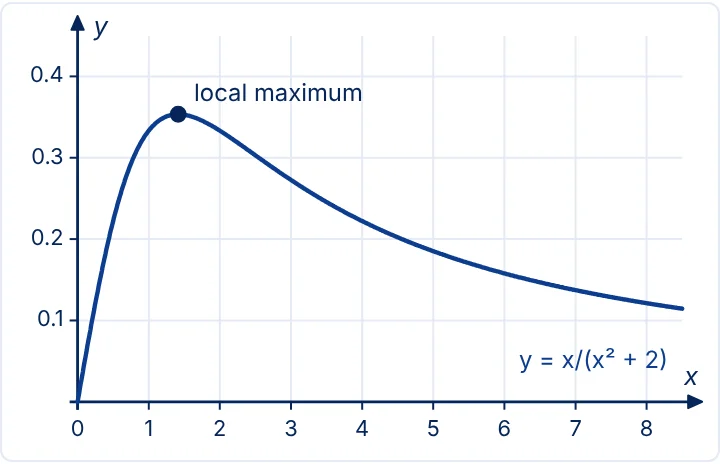
Graph of y = x / (x^2 + 2) for x >= 0 with its local maximum marked

[5]

Show solution
  1. CG50: MENU 5. Y1 = x / (x^2 + 2). DRAW. (M1)
    Press G-Solv (F5) -> MAX (F2).
    x=1.4142... and y=0.35355...
    Coordinates are (1.41,0.354) to 3sf. A1A1

  2. As x→∞, the x2 term in the denominator dominates the x term in the numerator.
    f(x)→xx2=1x→0. (M1)
    Horizontal asymptote is y=0. A1

Answer: (a) (1.41,0.354); (b) y=0

Question 8

5 marks · Paper 2 style · calculator

Let f(x)=x3−3x+1.

(a) Use your calculator to find the x-intercepts of the graph of f. [3]

(b) Write down the coordinates of the local maximum and the local minimum points. [2]

Show solution

(a)

x=−1.88, 0.347, 1.53 A1A1A1

(b)

maximum (−1,3) A1

minimum (1,−1) A1

Answer: (a) x=−1.88, 0.347, 1.53; (b) max (−1,3), min (1,−1)

Question 9

5 marks · Paper 2 style · calculator

Let h(x)=xe−x, for x≥0.

(a) Use your calculator to find the coordinates of the maximum point of the graph of h. [2]

(b) Write down the equation of the horizontal asymptote. [1]

(c) Solve h(x)=0.2. [2]

Show solution

(a)

(1, 0.368) A1A1

(b)

y=0 A1

(c)

x=0.259 A1

x=2.54 A1

Answer: (a) (1, 0.368); (b) y=0; (c) x=0.259 or x=2.54

Question 10

5 marks · Paper 2 style · calculator

The graphs of y=ln⁡x and y=x−2 meet at two points.

(a) Find the x-coordinates of the two points. [2]

(b) For x between these two values, the vertical distance between the graphs is d(x)=ln⁡x−x+2. Find the maximum value of d. [3]

Show solution

(a)

x=0.159 A1

x=3.15 A1

(b)

d′(x)=1x−1=0 or use of a graph of d (M1)

x=1 (A1)

maximum distance 1 A1

Answer: (a) x=0.159 and x=3.15; (b) 1

How the marks work: M marks are for a correct method, A marks for an accurate answer that follows it, R marks for a reason, and AG means the answer is given in the question. A mark in brackets, like (M1), can be implied by later correct work.

Notes, worked examples and more questions on this topic: AA SL Graphing Functions. Previous topic: Function fundamentals. Next topic: Quadratic Functions. Every AA SL topic.

Revise first with the AA SL revision notes, then finish on real papers: IB Maths AA SL past papers.