Free IB Maths AI SL lesson: Writing numbers in standard form
A ready-to-teach IB Maths AI SL lesson on Writing numbers in standard form (Unit 1 · Number & Algebra): editable slides and teacher notes, free; a printable worksheet in 3 levels with answers for school plans. About 55 minutes.
Standard form opens AI SL Unit 1 and turns up on every paper, usually as an answer format: 'give your answer in the form a × 10ᵏ, where 1 ≤ a < 10 and k ∈ ℤ'. This lesson is about writing very large and very small numbers in that form, and reading the form a GDC displays, such as 4.2E−5.
Free with a teacher account. Sign in with Google, Microsoft or email and download the slides and teacher notes.
What's inside
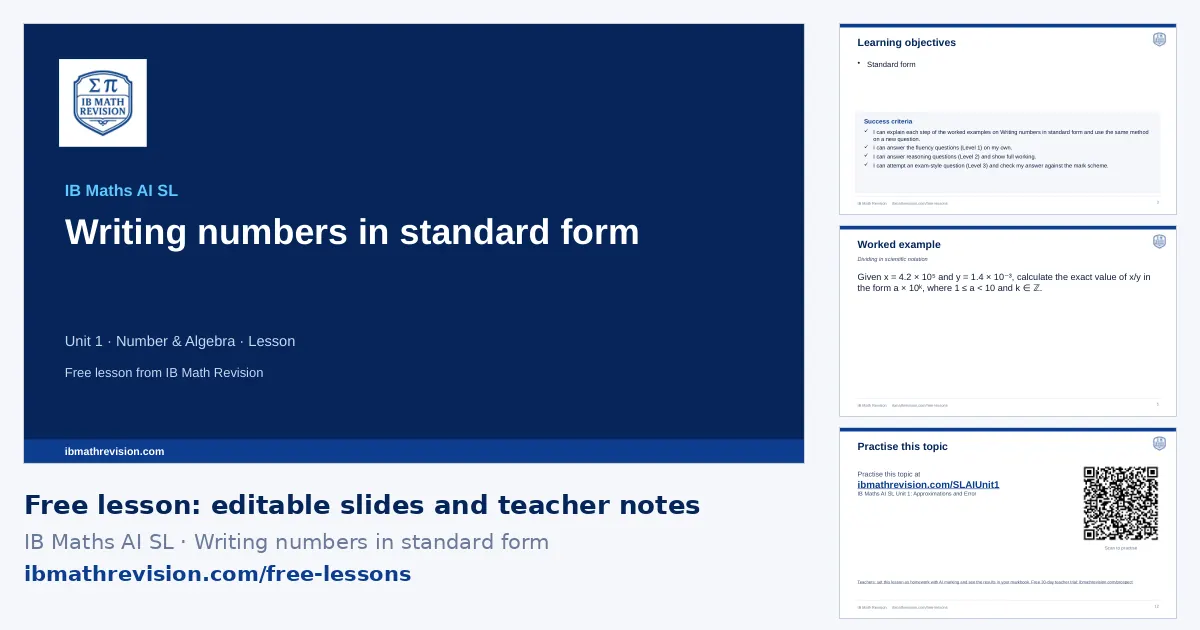
- Slides (PowerPoint, editable) · freeabout 12 slides: do now, objectives, key ideas, a worked example step by step, “your turn”, practice QR code, exit ticket
- Teacher notes (PDF) · freelesson plan with timings, common mistakes, homework links
- Worksheet (PDF) · school plans6 questions, 28 marks: Fluency, Reasoning, Exam-style. Included with school plans and the teacher trial.
- Answers (PDF) · school plansthe answer to every worksheet question, from its mark scheme. Included with school plans and the teacher trial.
Learning objectives
- Standard form
Worked example: Writing numbers in standard form
(a) Write 0.0000607 in standard form. (b) Write 3 040 000 000 in standard form. (c) A GDC shows 2.75E8. Write this as an ordinary number.
- (a) Move the decimal point 5 places to the right to get 6.07, so the power is −5.
- (b) Move the decimal point 9 places to the left to get 3.04, so the power is 9.
- (c) E8 means × 10⁸: 2.75 × 10⁸ = 275 000 000.
Answer: (a) 6.07 × 10⁻⁵ (b) 3.04 × 10⁹ (c) 275 000 000
Common mistakes in writing numbers in standard form
- Writing 60.7 × 10⁻⁶: the first number must be at least 1 and less than 10.
- Getting the sign of the power wrong: numbers between 0 and 1 have a negative power.
- Copying 2.75E8 from the screen as the answer: write 2.75 × 10⁸.
The worked example
Given x = 4.2 × 10⁵ and y = 1.4 × 10⁻³, calculate the exact value of x/y in the form a × 10ᵏ, where 1 ≤ a < 10 and k ∈ ℤ.
- Set up: (4.2 × 10⁵)/(1.4 × 10⁻³).
- Divide the coefficients: 4.2/1.4 = 3.
- Subtract the exponents: 10⁵⁻⁽⁻³⁾ = 10⁸.
- Combine: 3 × 10⁸.
- State: 3 × 10⁸.
Tip: Type the calculation into your GDC to confirm, but always translate calculator output like `3E8` into proper mathematical notation (3 × 10⁸) on your exam paper.
Where this lesson fits
Writing numbers in standard form is in Unit 1 · Number & Algebra of the IB Maths AI SL scheme of work.
- The lesson before: Basic probability (scheme-of-work lessons: Probability rules and Venn diagrams)
- The next lesson: Operations with standard form (scheme-of-work lessons: Standard form)
Lesson plan
| 0–5 min | Do now: students write down what they remember about Basic probability and Averages & basic data handling |
| 5–8 min | Share the learning objective and success criteria |
| 8–20 min | Teach: the worked example, step by step; students copy the method |
| 20–25 min | Your turn: 1 mini-whiteboard question; check every board before moving on |
| 25–42 min | Practise: the worksheet (6 questions in 3 levels, with school plans and the teacher trial) or the topic's practice questions online; move up a level after two right in a row |
| 42–47 min | Plenary: 1-question exit ticket; collect it to plan the next lesson |
For students: practise this topic
The worksheet's QR code opens the IB Maths AI SL Unit 1: Approximations and Error practice questions.
With a school plan
Set Writing numbers in standard form as homework marked by AI, print this lesson's levelled worksheet with answers, and rebuild the lesson for your class with Create lesson. Free for 30 days as a teacher, no card.
Is it free, can I edit the slides, what do students use for homework? See questions teachers ask.