Free IB Maths AI SL lesson: Two-sample t-test
A ready-to-teach IB Maths AI SL lesson on Two-sample t-test (Unit 4 · Statistics & Probability): editable slides and teacher notes, free; a printable worksheet in 2 levels with answers for school plans. About 55 minutes.
Free with a teacher account. Sign in with Google, Microsoft or email and download the slides and teacher notes.
What's inside
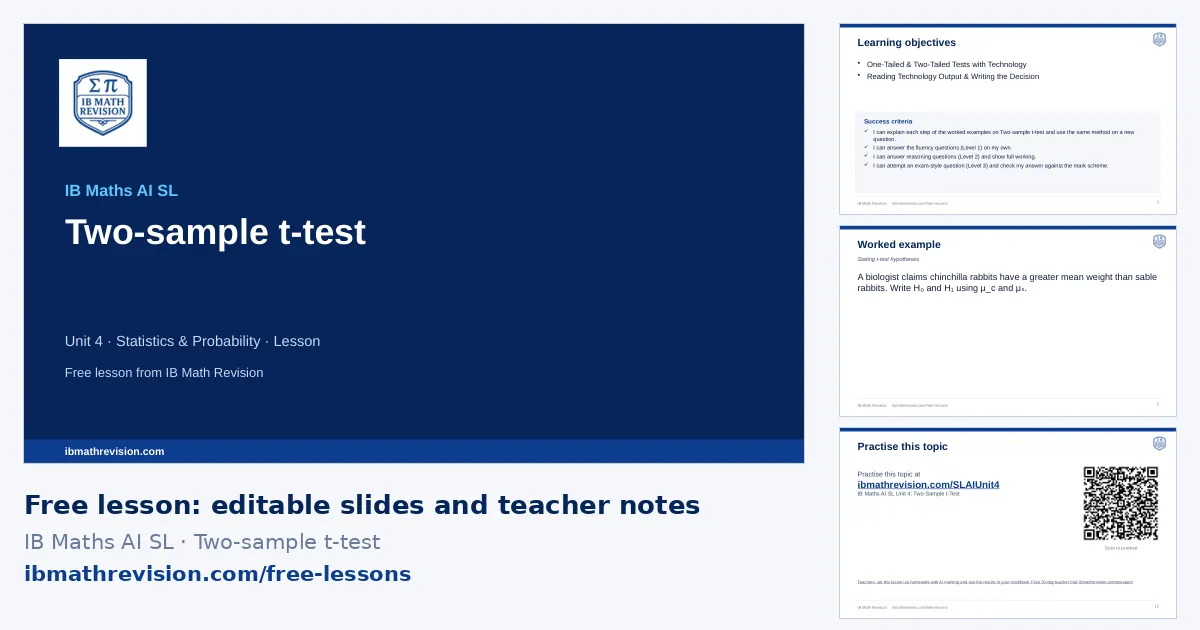
- Slides (PowerPoint, editable) · freeabout 12 slides: do now, objectives, key ideas, a worked example step by step, “your turn”, practice QR code, exit ticket
- Teacher notes (PDF) · freelesson plan with timings, common mistakes, homework links
- Worksheet (PDF) · school plans4 questions, 18 marks: Fluency, Exam-style. Included with school plans and the teacher trial.
- Answers (PDF) · school plansthe answer to every worksheet question, from its mark scheme. Included with school plans and the teacher trial.
Learning objectives
- Hypothesis Testing Language: p-Values, Critical Values & Conclusions
- One-Tailed & Two-Tailed Tests with Technology
- Reading Technology Output & Writing the Decision
Key ideas on the slides
- A t-test compares means when the population standard deviation is unknown (sample data, approximately normal).
- Two-sample t-test: H₀: μ₁ = μ₂; H₁: μ₁ ≠ μ₂ (two-tailed) or μ₁ > μ₂ / μ₁ < μ₂ (one-tailed).
- In IB exams the two samples are unpaired and the population variances are assumed equal, so use the pooled test (Pooled: Yes on the GDC).
- Reject H₀ if the p-value < the significance level; write the conclusion in context.
By the end of the lesson, students should be able to answer a question like: Test at the 5% level whether two groups have different mean reaction times.
Key vocabulary
- t-test: A hypothesis test for means using the t-distribution.
- one-tailed test: H₁ specifies a direction.
- p-value: The probability of a result at least as extreme as observed if H₀ is true.
Common mistakes this lesson tackles
- χ² and t-tests: hypotheses, the comparison and the conclusion in context. Use a fixed layout: H₀ and H₁ in symbols with the population parameter (μ₁ = μ₂; μ₁ > μ₂) or in words naming both variables for χ²; the p-value; "p < 0.05, so reject H₀" (or not); then one sentence in context.
- Choosing a one-tailed test when the question says "different".
- Using the t-test on paired or categorical data.
- Comparing the t-statistic with the significance level.
The worked example
A biologist claims chinchilla rabbits have a greater mean weight than sable rabbits. Write H₀ and H₁ using μ_c and μₛ.
- Recall: H₀ always assumes equality.
- H₀: μ_c = μₛ — the population mean weight of chinchilla equals that of sable rabbits.
- Extract claim: "strictly greater".
- H₁: μ_c > μₛ — the population mean weight of chinchilla rabbits is greater than that of sable rabbits.
Tip: Always use the phrase "population mean" when defining t-test hypotheses in words — "sample mean" loses marks.
Calculator tips
- 2-SampTTest on the GDC with Pooled: Yes (the IB two-sample test is pooled).
Where this lesson fits
Two-sample t-test is in Unit 4 · Statistics & Probability of the IB Maths AI SL scheme of work.
- The lesson before: Continuous distributions (normal on GDC) (scheme-of-work lessons: The Normal Distribution; Normal Probabilities & Inverse Normal with the GDC; Normal Probabilities in Context)
- The next lesson: Sampling techniques & data collection (scheme-of-work lessons: Populations, Samples, Sampling Techniques & Bias; Data Collection Revisited: Sampling Techniques, Bias & Reliability of Data; Choosing a Sampling Technique)
Lesson plan
| 0–5 min | Do now: students write down what they remember about Continuous distributions (normal on GDC) and Binomial distribution |
| 5–8 min | Share the learning objective and success criteria |
| 8–20 min | Teach: the worked example, step by step; students copy the method |
| 20–25 min | Your turn: 1 mini-whiteboard question; check every board before moving on |
| 25–42 min | Practise: the worksheet (4 questions in 2 levels, with school plans and the teacher trial) or the topic's practice questions online; move up a level after two right in a row |
| 42–47 min | Plenary: 1-question exit ticket; collect it to plan the next lesson |
For students: practise this topic
The worksheet's QR code opens the IB Maths AI SL Unit 4: Two-Sample t-Test practice questions.
With a school plan
Set Two-sample t-test as homework marked by AI, print this lesson's levelled worksheet with answers, and rebuild the lesson for your class with Create lesson. Free for 30 days as a teacher, no card.
Is it free, can I edit the slides, what do students use for homework? See questions teachers ask.